

Why don't instructions for industrial furnaces prevent errors?
An industrial furnace is a complex unit that the continuity of the entire production process depends on. A mistake during assembly or maintenance results in more than just defective products — it means costly downtime, unscheduled repairs, and risk to personnel safety.
And the human factor remains the main cause of failures: an employee misunderstood the sequence, missed a critical component, or relied on memory.
Paper instructions for assembling industrial furnaces are a formal document that most often gathers dust in a cabinet.
Even if the procedure is well-written, it's difficult to use on the job: dozens of pages of fine print, diagrams that need to be matched against real equipment, and terminology that only engineers understand.
A newcomer spends weeks adapting, while an experienced employee ignores the instructions because they "already know everything." As a result, everyone assembles the furnace their own way.
The price of such freedom is unscheduled stoppages, excess fuel consumption, and equipment wear. When a furnace fails in the middle of a shift, losses come not only from repairs but also from unfulfilled orders.
Staff training is formal at best: lectures and tests don't build practical skills, and mentors pass down experience inconsistently.
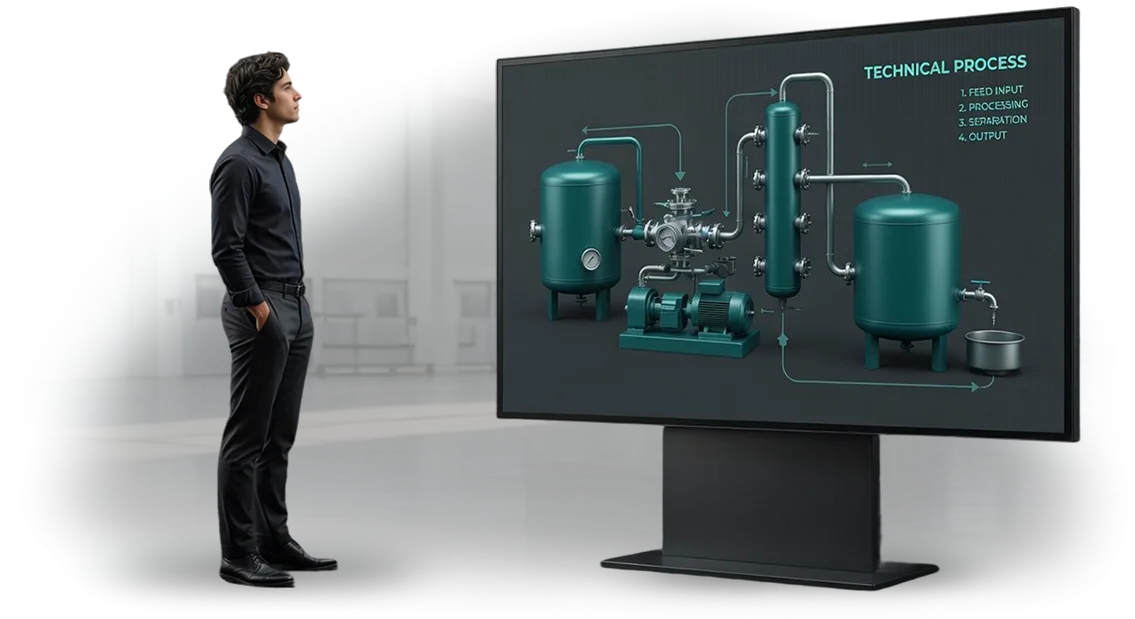
We solve this problem with 3D video instructions for industrial furnaces. The employee sees every step of assembly and maintenance in full detail — with the correct sequence, emphasis on critical components, and typical mistakes.
Such training reduces the number of violations and shortens the time it takes for a newcomer to start working independently.
What a video instruction delivers: benefits for production and training
Training people to work with industrial furnaces always carries the risk of errors, injuries, and costly defects. Text instructions and "pass on knowledge by word of mouth" don't create a unified standard, and newcomers start working independently too slowly.
A 3D video instruction clearly shows every step — from installing a component to burner maintenance — so training becomes fast, predictable, and safe.
Benefit: quick ramp-up to the job
Instead of spending a week reading documents and asking endless questions to a mentor, an employee watches a short video with precise actions.
Assembly, setup, and maintenance of furnaces are shown in the correct sequence — a newcomer masters the process after a few viewings and moves on to hands-on practice under supervision.
Benefit: fewer errors and defects
The video demonstrates correct techniques while also showing common mistakes: improper clearance, misaligned parts, incorrect startup mode. By repeating what they've seen, workers make fewer wrong decisions, which means less defective output and fewer unscheduled stoppages.
Benefit: a single standard for the entire shift
All employees are trained using the same visual procedure. Knowledge quality no longer depends on the mood or memory of a particular specialist, and when technology changes, all that's needed is to update the video — and the whole team immediately gets the current version.
Benefit: safety without risk
Hazardous operations can be shown on a 3D model of the furnace without running real equipment. A trainee sees the consequences of wrong actions in a safe environment and memorizes occupational safety requirements faster, which reduces the risk of injuries on the production floor.
Benefit: less burden on mentors
Experienced employees stop spending hours on repeated explanations — the video does it for them. The mentor only steps in at the control stage and can devote more time to complex tasks instead of basic operations.
At our team we develop 3D video instructions for the assembly and maintenance of industrial furnaces tailored to your equipment and procedures. As a result, you get a ready-made training system that shortens onboarding time, reduces errors, and makes the process standardized.
Video instruction formats: choosing what fits your task
A training video is never "one size fits all." For mass onboarding and for understanding a complex furnace component, you need different formats: they differ in duration, level of detail, and how the material is presented.
When the format matches the task, employees absorb information faster and make fewer mistakes on the job.
We develop 3D video instructions for industrial furnaces — from overview courses to frame-by-frame breakdowns of specific operations. The table below shows the main formats and their application scenarios.
| Video format | Who it's for | What it gives the client |
|---|---|---|
| Full 3D furnace assembly instruction | New employees, installation crews | Shortens the onboarding period, eliminates skipping important stages |
| Detailed breakdown of a complex component | Maintenance and service personnel | Fewer errors in maintenance, faster troubleshooting |
| Safety video | All workshop staff | Reduces the risk of injuries, clearly replaces lengthy regulations |
| Short refresher video before a shift | Furnace operators | Quick review of key operations, confidence in actions |
| Modular course for certification | HR department, production managers | A unified training standard and transparent knowledge assessment |
Each format can be used on its own or combined into a single training program. We'll help you choose the structure that fits your specifics and goals — from a single video to a full course.
The key is that after watching the video instruction, your employee can immediately perform the operation on a real furnace.
How we create a video instruction: the step-by-step process
Developing a video instruction for industrial furnaces is a process we've designed so you get results without unnecessary approvals and downtime. You see intermediate versions at every stage and make edits while the project is still in progress, not after delivery. This saves your time and ensures the final video truly solves your employees' tasks.
-
Brief and audit. We gather information about your furnace, procedures, and typical assembly and maintenance errors. Together with your team, we define the target operations, video format, and audience. We hold a meeting with technologists and engineers — this usually takes one to two days.
-
Script development. We prepare a step-by-step script in the language your employees use, without bureaucratic jargon. We agree on the sequence of actions, emphasis points, and safety warnings with you. The text is approved before production begins so we don't have to redo finished graphics.
-
Creating the 3D model and animation. We model the furnace and its components, and animate disassembly, assembly, and maintenance. You receive intermediate renders and can request changes without waiting for the final edit. At this stage, every detail is visible — from bolts to hydraulics.
-
Voiceover and editing. A professional narrator records the script, and we edit the video with subtitles, diagrams, and visual highlights.
We add checkpoints for the viewer, such as "switch off the furnace before this step." The video is clear even to new employees with no experience.
-
Final approval. You watch the finished video with your team, suggest edits — and we make them quickly. Time for this is built into the process, so there's no need to worry that edits will break the schedule. We approve the final version within a few days.
-
Delivery and support. We provide files in the formats you need and upload them to a learning management system or corporate portal. If the procedure changes, we'll promptly update the video instruction. This way you always have up-to-date training material.
This staged production process lets you control the development of the video instruction at every step. You know in advance what you'll get and can influence the outcome without wasting time or budget.
The workflow is transparent, and the final video becomes a working tool — not just a file on a disk.
What's included in the delivery: a complete training and induction kit
The delivery package includes everything needed to launch training and employee induction — from video materials to a knowledge assessment system. You get a ready-made toolkit that covers both in-person sessions and remote staff training.
- Video instructions for assembling and maintaining industrial furnaces — in formats for computer, tablet, and smartphone, so employees can learn both on the workshop floor and remotely.
- An interactive 3D model of the equipment — allows studying the structure of components and the sequence of operations without stopping production or risking personnel.
- Text guides and quick-reference cards — compact action algorithms for workstations and pre-shift induction.
- Access to cloud storage — all materials are stored in one place, the latest version is always at hand, and updates appear automatically.
- Methodological recommendations for instructors — ready-made lesson scenarios, review questions, and skill practice procedures.
- Knowledge assessment tests — electronic and paper versions to evaluate material comprehension and record results.
- Training for your administrators — system setup, material upload, tracking employee progress, and generating reports.
The entire package is delivered as a single integrated system. When procedures or equipment change, the video instructions and 3D models are updated — you always work with the current version, and technical support accompanies the implementation at every stage.
Implementation example: how we reduced downtime and errors
For a machine-building plant, any mistake in furnace assembly or maintenance results in defects and sometimes a full production stoppage.
Text procedures and drawings are overloaded with details — newcomers take weeks to get up to speed, and experienced employees still make inaccuracies. Rework disrupts the schedule, and eventually, complaints hit the company's reputation.
We proposed replacing classic instructions with a clear 3D format. For one plant, the specialists at our team developed a detailed video model of an industrial furnace and broke the entire assembly and maintenance process into understandable stages.
Each operation is shown in action, from the right angle and in the correct sequence — the employee doesn't need to mentally "assemble" components from a drawing.
The results of the implementation were noticeable almost immediately. Assembly errors dropped by 35%, and downtime caused by poor-quality repairs fell by 40%.
New employee onboarding time was cut from two weeks to three days: all it takes is watching the video and repeating the actions on screen. Site supervisors confirmed that staff began making decisions faster and depending less on mentors.
The video instruction proved convenient not only for training but also for day-to-day work. A tablet on the floor is all that's needed: an operator can pause the video at the required step, review it, or slow it down to verify their actions.
This removes uncertainty, speeds up work, and eliminates situations where someone "knows better" than the approved procedure.
Following the project, the plant noted consistent assembly quality and a reduction in customer complaints. This instruction is now used both for training newcomers and for confirming the qualifications of current employees.
The client is already discussing expanding it to other furnace types to get a unified work standard without extra spending on repeated procedures.
How to choose the right training format for industrial furnaces?
Choosing a training format for employees working with industrial furnaces can't be reduced to a one-size-fits-all solution.
The right answer depends on three things: what goal the training must achieve, the current skill level of the personnel, and how complex the equipment is to master.
For industrial furnaces, video instructions are most often the optimal choice — they combine clarity, repeatability, and safety in a way that text or lectures alone can't match.
First, define the goal. If you need to get a newcomer up to speed quickly, a detailed step-by-step video with emphasis on the sequence of actions and safety procedures works best.
If you're looking to upskill experienced operators, shorter videos breaking down abnormal situations and fine-tuning settings are more effective.
Video training is easy to scale: a single piece of material can be reused for retraining, certification, and knowledge refreshes without bringing in expensive instructors.
The employees' skill level is the second key factor. Newcomers need more context: how the furnace is designed, why temperature regimes matter, and which mistakes are most common.
Experienced workers only absorb what relates to their area of responsibility, so modular videos of 3–5 minutes are better for them to avoid wasting time. A video instruction lets each employee learn at their own pace and return to difficult moments as many times as needed.
The complexity of the industrial furnaces themselves dictates the third criterion.
Modern equipment has numerous procedures, hazard zones, and precise parameters that can't be explained "on your fingers." This is exactly where video training helps: it shows real equipment in operation, records the operator's correct actions, and demonstrates the consequences of violations.
This reduces the risk of errors, accelerates reaching full productivity, and protects people from injuries.
The takeaway: choose a format not "because it's trendy," but for your specific situation. We help analyze your goals, your team's level, and your furnaces' specifics, and then develop video instructions that solve your actual problem.
Come for a consultation — we'll select a format that works, not one that sits as dead weight in your training system.
Frequently asked questions and concerns: honest answers
Having doubts before starting is normal. We work with industrial enterprises and know that if an instruction will become the foundation of training, there's no room for error.
So we answer the key questions — about timelines, updates, quality, and documentation — directly, without fine print.
How long does it take to develop video instructions?
It depends on the complexity of the furnace and the number of operations. After the brief, we give you an exact timeline and put it in the contract. Typically, it's two to four weeks for standard equipment.
For non-standard lines, we calculate the timeline separately, but we always stick to the schedule — delays are bad for both you and us.
How do we update the instructions if the furnace design changes?
Training videos outlive any piece of equipment. That's why, after delivery, we hand over the source materials and train your employee to make quick edits. If the changes are complex, you order an update — it's cheaper than a full redevelopment. No "made it and forgot it": the instruction always matches the current model.
Will the quality match an industrial standard?
Yes. We build 3D models from your drawings, verify every detail with technologists, and produce the video on professional equipment. We test the finished video on real employees: if something isn't clear, we reshoot before your approval. You get a clear sequence of actions that a worker will understand from the first viewing.
Do you provide documentation for internal audits?
A complete set: a script with time codes, a description of every component, usage rights for the video, and source files. You'll be able to show auditors that training was conducted.
For our part, we guarantee confidentiality — the furnaces' technical data is never shared with third parties.
Didn't find the answer to your question? Contact us directly — we'll explain how we structure our work around your specific task and what guarantees we put in writing.Ready to discuss your task? Get a cost calculation
Every day of downtime or an error when working with an industrial furnace is a risk to safety, quality, and budget. A 3D video instruction transfers the experience of the best mentor into a clear format that an employee can follow step by step.
To find the optimal format for your tasks and production processes, we'll start with a short discussion.
When you reach out, you'll get not just a commercial proposal, but a preliminary plan for solving your problem.
We'll study your equipment's specifics, the number of employees, and your current training materials — and suggest the option that will get you to the desired result fastest.
After the consultation, you'll understand which video instruction format suits you: from working with industrial furnaces to complex maintenance operations.
What's included in our proposal after your request:
- An individual consultation with an expert in developing 3D training materials.
- A cost calculation and timeline for your specific task — no hidden conditions.
- A preliminary script: which operations and stages will be shown in the video instruction.
- Format selection: full 3D reconstruction or a combined option with live footage.
- Examples of our work for your industry, so you can assess quality and presentation style.
- Recommendations for implementing video instructions into your employee training system.
Take a 20-minute pause and discuss your current situation with us. We'll help make training clear and safe without pulling employees away from production.
Leave a request on this page — we'll call you back within one business day, answer your questions, and prepare a cost calculation. We start with a conversation, not a contract.