

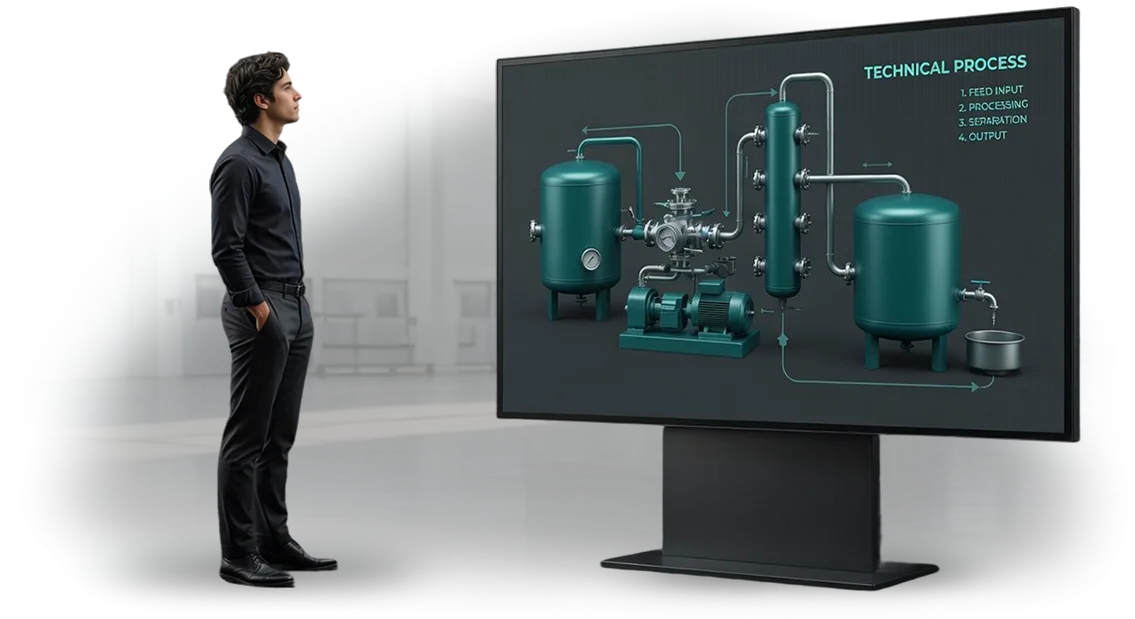
Why do employees make mistakes on production lines?
Mistakes on production lines most often occur not because of low employee qualifications, but because of ambiguous instructions.
When a regulation is dense pages of text, diagrams, and terms, it's hard for a newcomer to find their bearings quickly, and for an experienced worker to keep all the nuances in mind. The result is defects, rework, and forced equipment downtime that directly hit planned targets.
The problem is especially acute amid staff turnover. Every new employee requires a mentor's attention, and personnel training stretches over weeks.
Meanwhile, the supervisor is distracted from their own tasks, and the quality of knowledge depends on their experience and even their mood. Mistakes in production repeat until a person goes through a long path of trial and error.
Many companies try to close the issue with additional briefings and tests, but this only increases costs and doesn't produce a stable result. Video instructions work differently: they show each step in action rather than describing it abstractly.
An employee sees the correct sequence of operations, can pause and return to the needed fragment — knowledge is absorbed faster and retained longer.
That's why an enterprise needs clear video instructions for production lines, not another text regulation. They reduce onboarding time, lower the defect rate, and cut downtime caused by incorrect personnel actions. Personnel training stops depending on the human factor and becomes a predictable process.
We develop such video instructions tailored to the specifics of your production. The next section shows how the work is organized and what results clients get.
What results does business get from video instructions
Newcomers in production usually learn "by hand": a mentor shows, an employee repeats, and then everything depends on memory and attentiveness.
This approach is expensive — every error in assembling or maintaining a line turns into downtime, defects, or an emergency stop. Video instructions close this problem systematically.
Onboarding stops depending on the human factor. A new employee watches a short video where each step is shown on real equipment, and starts work with a full understanding of the sequence of actions.
Training takes several times less time — no need to wait for a mentor to become free or ask the same questions ten times over.
The key benefit for business is a unified operations standard. All employees perform work to a single template, regardless of experience and tenure.
The director or area supervisor knows: a specific operation was done as prescribed by the technology, not "however is convenient for the worker." This directly reduces the defect rate and the number of unscheduled line stops.
Mentors stop wasting time repeating the same information. Instead of explaining one operation multiple times, they focus on quality control and complex cases.
The video instruction handles the routine, while experienced employees pass on only real knowledge that cannot be captured in a video.
When a person has a clear instruction in front of them, the fear of making a mistake and holding back questions disappears. Employees settle in faster, work with equipment more confidently, and don't distract colleagues over trifles. This reduces turnover during the probation period and increases engagement in the process.
In total, business gets predictable line operation, fast personnel training, and fewer losses from defects. Video instructions pay off on the very first error that was avoided. It's enough to convert key operations into video format — and production starts running more smoothly.
Video instruction formats for production lines
Employees with different experience work on a production line: newcomers need to understand the structure of a unit, experienced workers need to quickly refresh the sequence of actions before repairs.
A universal video lecture doesn't solve both tasks, which leads to errors and downtime. We match the format to a specific operation and skill level — this reduces time-to-competency and lowers the number of breakdowns caused by the human factor.
Main formats
| Format | For whom | What it gives the client |
|---|---|---|
| Interactive 3D instructions | New employees, operators of complex line areas | Safe hands-on practice without stopping production. The mechanism can be taken apart from the inside, hidden parts can be seen, and steps can be repeated as many times as needed. |
| Video with real equipment | Experienced workers, repair and service teams | Quick knowledge refresh: real parts, effort levels, and unit specifics are visible. Minimum distraction, maximum concreteness for daily work. |
| Combined format (3D + video footage) | Mixed groups, turnkey training of new teams | Full immersion in the process: the overall line layout, then real operations with equipment. Used for mass training and retraining. |
3D animation helps where a unit is hidden behind a housing or is dangerous to touch directly. Real camera video is indispensable for transferring experience — you can see exactly how to press, which wrench to use, and with what force.
The combined option covers both scenarios and gives employees a clear sequence: first "how it works," then "how to do it."
We'll help you choose the optimal set of formats for your tasks — without unnecessary costs for reshoots.
How turnkey video instruction development works
Development follows a transparent process that we have refined across dozens of projects for manufacturing companies. You always understand what stage the video is at, who is responsible for what, and when you will get the result. Below are the key stages of turnkey work.
-
Brief and audit — we record which line and which operation needs an instruction, who will watch it, and what result matters. You get a clear technical specification that removes disagreements within the team before work even starts.
-
Instruction script — we break the process into elementary steps, highlight critical points and safety rules. The script is approved by your technologists, so you see the logic of the future video in advance and don't pay for rework after animation.
-
3D modeling and animation — we create a digital copy of the line's units and show every movement of the mechanism and the employee's hands. A clear picture eliminates misinterpretation: a new worker sees the ideal sequence of actions from the first time.
-
Voiceover and editing — we add narration, subtitles, and visual accents on the most critical operations. The video becomes self-contained: it can be used without a mentor and works equally well for in-person and remote training.
-
Approval — you receive intermediate versions and submit edits, which we process promptly. The project closes only after you sign the final protocol, so the result is guaranteed to match expectations.
-
Launch — we hand over the finished files in the required formats and help embed the instruction into your learning management system or corporate portal. Employees get access in the same environment where they undergo certification — without additional load on IT.
-
Support and updates — if regulations change, equipment is modified, or new requirements appear, we promptly update the video and return the current version. You are never left alone with an outdated instruction — training always matches real work.
What is included in the video instruction kit for employees
To make sure the video instructions actually work rather than sit as dead weight, you get more than just a link to the videos. The kit includes everything needed to launch training, track completion, and update materials independently — without contacting the contractor again.
Here is the full kit contents:
- Ready video instructions for assembling and maintaining production lines — from basic operations to complex procedures. Videos are shot from the right angles, every operation is clearly visible, so an employee understands the sequence of actions from the first viewing.
- Video sources and project files — if the line changes a unit or simplifies an operation, your team can make edits on its own. No additional approvals or waiting on the contractor.
- Text scripts and narration texts — in case you need to approve wording, adapt the video for another shift, or re-voice it in Russian and other languages.
- Integration into your LMS — we upload the courses into the system, set up access for employee groups and progress tracking. You see who has completed the training and who hasn't.
- Unlimited usage rights — the videos can be used inside the company, on the corporate network, on tablets, and in the training center. No license fees and no "can I forward this to a colleague."
- Video update instructions — a simple procedure: how to make an edit, replace a fragment, and re-upload the video so all employees work with the current version.
This kit covers the main concerns: training launches quickly, you keep responsibility for the outcome, and the materials live and evolve together with your production.
Case study: how we reduced downtime in production
At one food industry plant, a line stop meant significant losses every hour. New employees spent weeks learning to work with complex equipment, and experienced mentors were distracted from their own tasks. Management was looking for a way to speed up training without losing quality.
We proposed replacing part of the text regulations with 3D video instructions for assembling and maintaining lines. Instead of abstract diagrams, the employee sees every unit, every action, and typical mistakes.
our team created 15 such instructions in two months, covering key operations across three production areas.
The result was noticeable within the first month. Training time for new operators dropped by 40% — instead of two weeks, they reached the line in six working shifts.
Equipment downtime related to personnel errors fell by 25%, and the number of repeated requests to mentors decreased by more than three times.
For the client, this isn't just numbers but direct money: less time spent on training, faster production startup, and calm operation without emergency stops. Today, these instructions are used as the base onboarding system, and we are preparing to expand to an adjacent workshop.
If your employees take too long to train or lines sit idle because of the human factor — tell us about your challenge, and we'll prepare a cost estimate for your site.
How to choose the video instruction format for your task?
Choosing a training video format for a production line is never purely a technical decision. It comes down to three simple questions: how many employees need training, how complex the operations are, and what budget you are ready to allocate.
For a small team and standard actions, a short video with live footage or 2D animation is enough. This format is quick to create, easy to update, and covers the basic task: the employee sees the sequence of operations and remembers it.
But if the line requires complex assembly, setup, or diagnostics, a flat image won't show internal units and process mechanics.
3D video instructions win here. They show a cross-section of the line, part movement, mounting points, and disassembly sequence — the employee doesn't just repeat actions but understands the logic.
This is critical for mass training: one video can be rolled out to any stream of newcomers without losing quality, and updating a single scene takes days, not months.
On budget, the rule is simple: the more complex the operation and the larger the workforce, the more worthwhile the investment in 3D. With a small team and simple actions, excessive detail is overpaying. We help find the balance and offer a format that solves your task — without hidden costs.
The mistake is choosing a format "like everyone else's." You need to calculate the cost of an error, the frequency of instruction updates, and the skill level of employees.
If you're unsure, we'll review your production lines, suggest a specific option, and lock in the estimate before work starts.
Frequently asked questions about video instruction development
When it comes to developing video instructions for production lines, managers ask the same questions. We've gathered the five most common concerns and answered them — no technical details, only what matters for business.
How much does video instruction development cost?
Cost is calculated individually after a short brief — it depends on the number of operations, scene complexity, and format. You get a transparent estimate before we start, and the price is fixed in the contract. Work is staged, so you pay for the finished result, not "for the process."
What are the production timelines?
A typical project takes three to six weeks, depending on the volume of material. We create a schedule with clear approval checkpoints so you can see the progress. If deadlines are tight, an accelerated format is available without losing quality.
Is it difficult to integrate video into existing training?
No. We deliver finished files in standard formats — any learning management system, corporate portal, or video player can open them. Employees simply press play and follow the instruction. No special platforms or IT modifications are required.
How often will the instructions need updating?
Only when equipment or technology changes. We make videos modular: each operation is a separate block. When one unit changes, you order a replacement of that specific scene rather than reshooting the entire course. It's fast and doesn't require the full budget.
What quality will we get and how do you guarantee it?
We work with professional equipment and refined tools — this delivers consistent results in every video. We approve the script together with you, and finished videos are checked against the technical process. You receive material that genuinely reduces employee errors and speeds up their adaptation.
Order video instructions for your production
Employees master work on new production lines faster when training is built on visual video instructions. Instead of dry texts and diagrams — short videos with 3D models that help understand the assembly and maintenance sequence without unnecessary questions.
This reduces the number of errors and downtime, and new employees can be trained faster and without leaving the production floor.
We handle the entire process: from analyzing your operations to finished videos. At a consultation, we'll show examples, discuss your tasks, and prepare a cost estimate for your scale. Submit a request — and we'll contact you at a convenient time.
After ordering, you will receive:
- An analysis of your production and a list of operations to be shown in the video.
- An approved script and storyboards — you see the content of each video in advance.
- Professional 3D graphics that accurately replicate your equipment and workflows.
- Video instructions for computers, tablets, and phones — employees can learn anywhere.
- Training for your team so they can use the materials independently.
- Support and video corrections after changes in regulations or equipment.
Submit a request for a consultation and cost estimate. We'll help reduce onboarding time, lower accident rates, and improve personnel efficiency.