

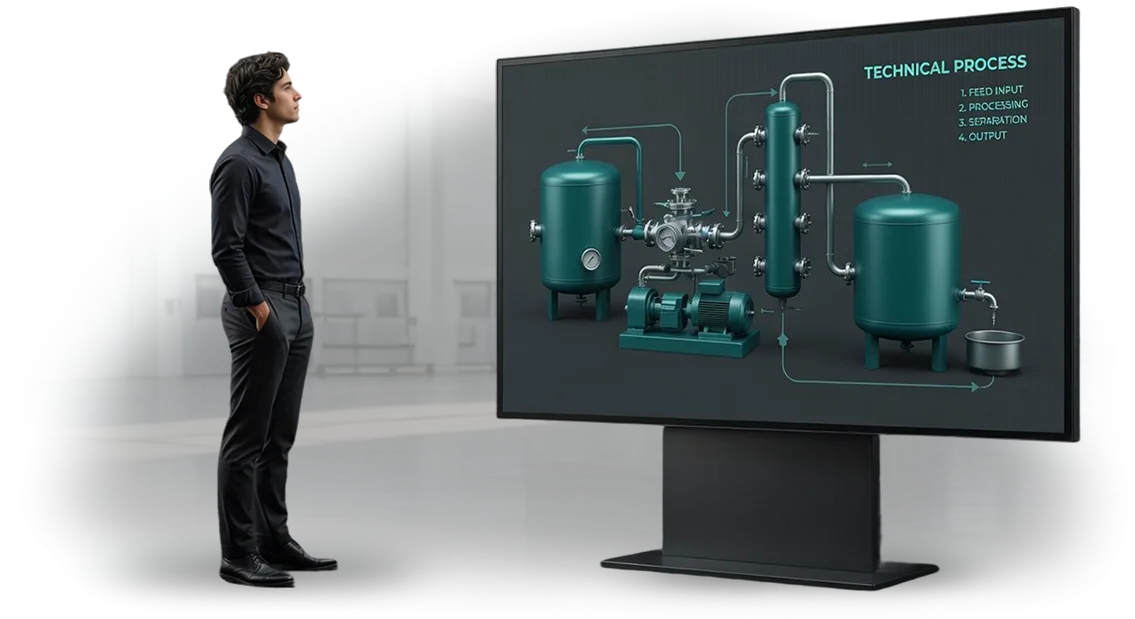
Medical sterilizers: how to reduce staff errors
Errors when working with medical sterilizers are not just a glitch in the procedure. They are a direct risk to patients: an improperly sterilized instrument can lead to healthcare-associated infection, complications, and serious health consequences.
The cost of such an error is measured not only in the clinic's reputation, but also in people's health, patient trust, and the requirements of regulatory authorities, which become stricter every year.
Staff training often comes down to reading instructions on paper or a short briefing “from a colleague's words.” In real work, this does not work: employees remember about 20% of what they read, and under a heavy workload they act out of habit rather than according to protocol.
This leads to typical sterilization errors—incorrect chamber loading, improper holding time, ignoring indicators, wrong mode selection.
Video instructions solve this problem differently. Instead of dry text, the employee sees a visual action algorithm—from instrument preparation to final control. This format reduces sterilization errors dramatically, because a person remembers the sequence, not individual points.
In addition, the training is built on the real work processes of your clinic or laboratory, not on abstract theory.
We create training video instructions that close the gap between protocol and practice. Staff ramp up faster, ask senior colleagues for clarification less often, and the manager gets a tool for controlling the quality of personnel training. The result: fewer errors, stable sterilization outcomes, and peace of mind about patient safety.
What video training delivers: 5 key results for the clinic
Video training for assembling and maintaining medical sterilizers turns scattered knowledge into a precise, repeatable process. For the clinic, these are five measurable results that directly affect the quality of work and patient safety.
First result: fewer errors. The 3D instruction shows every component and the sequence of actions from the angle visible during real work.
The employee remembers the correct operation and does not have to “figure out” difficult spots—the risk of damaging the sterilizer or disrupting the processing cycle is significantly reduced.
Second result: process standardization. All staff follow one reference scenario that has already been recognized as correct. A nurse with many years of experience and a new employee act the same way, which is critical for meeting sanitary requirements. The manager gets a single standard to rely on during quality checks.
Third result: quick onboarding of newcomers. Instead of weeks of mentor support—a few days of independent work with video material. A new employee integrates faster, feels more confident, and distracts senior colleagues less often. This saves the whole team's energy and reduces turnover during the probation period.
Fourth result: experienced staff save time. Video does not require a mentor's presence: it can be watched on any shift, at any moment. The manager does not need to run the same session for every group—just record the instruction once and show it when needed. Employees spend the freed-up time on their direct tasks.
Fifth result: improved safety. Fewer errors and adherence to a single algorithm reduce the risk of breakdowns, sterility violations, and emergency situations. This protects patient health, the clinic's reputation, and keeps the workload manageable for staff.
In short: video training addresses several pain points at once—from the human factor to time spent on training. Employees get a clear reference, and management gets a quality-control tool and a predictable result that pays off from the very first prevented failure.
Video instruction formats for medical sterilizers
Medical sterilizers are equipment on which patient safety and the clinic's reputation depend. Every new employee must quickly master the procedures for preparation, loading, startup, and control, while text instructions are often overloaded with details.
As a result, mentors spend hours repeating the same things, and mistakes still happen. A properly chosen video instruction format solves this problem: training becomes visual, fast, and verifiable.
Let's compare the three main formats we use in clinic projects: 3D animation, interactive instruction, and video recording. Each has its own strengths, so the choice depends on the staff's skill level and the training goals.
| Format | For whom | What it gives the client |
|---|---|---|
| 3D animation | New employees, technical staff | Shows the internal structure and operating principle of the sterilizer without opening the housing. Understandable even without specialized knowledge; reduces initial training time. |
| Interactive instruction | Employees who need to practice actions | Allows step-by-step training of operation sequences with error checking. Reduces the risk of protocol breaches in real work. |
| Video recording | All staff, including non-medical | Demonstrates real equipment, external components, and operator actions. Suitable for quick knowledge refreshers and standard procedures. |
For medical sterilizers, it is optimal to combine formats: 3D animation explains “how it works,” interactive instruction covers “how to do it correctly,” and recording captures the reference sequence of actions.
As a result, the clinic gets a training package that saves mentors' time, speeds up onboarding, and reduces the number of errors. Training videos are also easy to update when protocols change or new equipment models appear.
How video instruction development works: 6 steps
You order a video instruction so employees master the work faster and make fewer mistakes. But without a clear development process, it is easy to get lost in revisions and miss deadlines.
We have structured the work so that you control every stage of video creation and understand what is happening at any moment.
- Briefing and collection of source data. We study the technical documentation for sterilizers, drawings, and maintenance protocols. We clarify who will watch the video: nurses, technicians, or engineers. We lock in deadlines and the format of the result.
- Script and storyboard. We describe every step—from unpacking to preventive maintenance. We align the logic and terminology with your technologist and make edits before animation begins.
- 3D model creation and animation. We build the sterilizer components and show parts in section, disassembly, and replacement of parts. You receive intermediate versions and see how the video is progressing.
- Voice-over and subtitles. We record the narrator's script, add explanations, and emphasize safety points. We finalize the text so it is understandable to employees without specialized training.
- Testing with real users. We show a draft version to your technicians and operators. We collect feedback and verify that each step is truly clear and feasible.
- Implementation and material handover. We deliver final files in formats suitable for your training system. We help upload videos to an LMS or internal portal and provide usage recommendations.
This development process removes surprises: you see the result at every decision point and can intervene before a mistake becomes costly. The result is a video instruction that employees actually understand—not just a “pretty picture” with unclear actions.
What is included in the video instruction delivery package
We deliver not just videos, but a ready-made training system for employees. The full package—from script to updates—allows you to implement the instructions immediately, without preparing a separate procedure.
The delivery package includes:
- Training script—a text-and-graphic storyboard for each instruction. You approve the content before editing and receive videos exactly according to the agreed logic.
- Final video files in convenient formats—for distance learning systems, messengers, and in-person sessions. The materials are clearly labeled and easy to upload to the right service.
- Employee guides—short reference sheets: sterilizer preparation, assembly, common malfunctions. They transfer knowledge from the screen to the workplace.
- Instructor materials—recommendations for integrating video into onboarding, tests for knowledge checks, and a lesson plan.
- Access to the current version of the package—when the sterilizer model or maintenance protocol changes, you receive updated videos and scripts.
- Instructions for using the package—how to organize training for new employees and track completion of the material.
We deliver all materials within the agreed deadlines and support you during implementation. If necessary, we adapt the package to your corporate brand—this does not affect deadlines.
Case study: cut equipment maintenance errors by 40%
For the medical center Gorizont Med, which operates sterilizers in three branches, we created a series of 3D video instructions for assembly and maintenance.
The problem was typical: paper protocols were interpreted differently by employees, so errors occurred during equipment maintenance—from incorrect cassette installation to loss of seal integrity. Briefing took weeks, and some knowledge was still lost.
We developed short videos for each operation. Operators received videos on the standard cycle and daily checks; engineers received a breakdown of components, common faults, and the procedure for replacing consumables.
Visibility was a key requirement: looking at a 3D model lets you immediately see how a component fits into a slot, instead of having to imagine it from a diagram.
Within three months, the number of errors in sterilizer maintenance at the center dropped by 40%. The time to onboard a new employee fell by almost half, and service call-outs became a third less frequent.
Technical staff stopped asking about the sequence of actions because the instruction is always at hand—on a tablet or in a vehicle.
The head of the center's technical department gave this assessment: “Previously, a new specialist spent a week studying diagrams and still got confused about operations. With 3D videos, he assembles the sterilizer without a single error after two days.
I didn't expect such an effect.” This quote shows the key point: what matters to the client is predictable equipment operation, not just “nice graphics.”
After the first stage, the client returned to us for a course on disinfection and care for junior staff. Now the video instructions are used across all branches, and management plans to convert maintenance of the remaining equipment to this format.
We believe these are exactly the projects people call systematic error prevention—they save staff time and the budget for urgent repairs.
How to choose the right video instruction format for your task?
There is no universal format—what is ideal for training on assembly of one sterilizer model may be useless for another.
So the right answer to the question “how to choose” starts not with the format but with the task: what operations the instruction covers, how many employees need training, how often new staff arrives, and what budget is set aside for creating the material. These parameters determine what the video will be—and how much benefit it will bring to the clinic.
For complex equipment with many components and hidden mechanisms, full 3D animation works best.
It lets you show the internal structure of the sterilizer, break down every assembly stage without the risk of damaging the actual unit, and clearly demonstrate what happens in the event of an error.
This format reduces training time severalfold and lowers the number of maintenance errors—especially when expensive equipment and sterility requirements are involved.
For standard procedures—such as daily processing or routine maintenance—high-quality filming of the real process with an experienced technologist is sufficient.
Live footage is easier to understand, faster to shoot, and costs less, while fully covering the need for basic training. The optimal approach is to combine both: 3D models for complex components, and recording for general protocols. Then the clinic gets an accurate, clear, and cost-effective set of instructions.
No less important are the clinic's own requirements: internal standards, safety protocols, and the need to document that staff training has taken place.
The video instruction must meet these requirements, update easily when protocols change, and integrate into the existing staff training system.
We always start with a task audit, propose a format for the specific equipment type and budget, and stay in touch for refinements after handover. This helps avoid overpaying and ensures the video will actually work in your clinic.
Common concerns: what if the video becomes outdated or needs changes?
Training videos for sterilizers remain relevant for years, so the question “what will happen when the protocol changes?” is one of the first asked by the person responsible for training.
That is normal: instrument processing instructions do get revised, new standards appear, and equipment models change. It is better to build the answer into the project before filming starts, rather than after the training system is launched.
We design video instructions from the outset with future edits in mind. We break the material into logical blocks: general operating principles, sterilization cycle, chamber care, common faults. If one block changes, we update it without reshooting the entire video. This saves budget and time, and employees always see the current version, not an “old film.”
How often should video instructions be updated?
Usually it is enough to update the video when the protocol changes, a new sterilizer model is released, or after analyzing staff errors. On average, that is once every six months to a year.
We record this in the support procedure and remind you when it is time to check the current version.
Will the new instruction differ in style from the old one?
No. Even if the edit comes a year later, we use the project's original materials: narrator voice, graphics, and presentation structure.
The new version looks like a continuation of the original, not like a “patch”—employees are not distracted by format changes and perceive the update as the familiar video.
What if an urgent edit is needed before an audit?
We provide rapid communication channels and priority slots for revisions. If the matter concerns safety or a protocol change, we move that task to the front of the queue and complete it within a short time. It is important that you have a direct contact, not an impersonal ticket.
In essence, we close the main risk: the video instruction does not become a “monument” that becomes outdated on the day it is published. You get a working tool with an update procedure and technical support. In the next block, we will look at how the change process works and what timelines to plan for.
Submit a request: get a cost estimate and a demo video
Training staff to assemble and maintain sterilizers is a process where the cost of an error is high: protocol violations lead to disruption in clinic operations and risks to patients.
3D video instructions remove these risks: staff see every component and every action—and reach stable performance faster. One request is enough to assess the benefit for your team.
Submit a request—and within one business day you will receive:
- A cost estimate for your scope and complexity: how long development will take, what formats are needed, and how this will affect training speed.
- A demo video with a fragment of a 3D instruction for assembling or maintaining a medical sterilizer—see what the result will look like.
- A consultation with a script specialist: which operations are most important to show and how to break the material into short modules so employees are not overloaded.
- Examples of completed projects for medical equipment manufacturers—with implementation metrics and client feedback.
- A commercial proposal with clear timelines and stages: when the script will be ready, when the draft video, and when the final version.
- Recommendations on format and content volume for your task: from a single short instruction to a full library for all equipment types.
No obligations and no hidden terms. You get the full picture on cost, timeline, and result, and then make a decision. Just write or call—we will take care of the rest.