

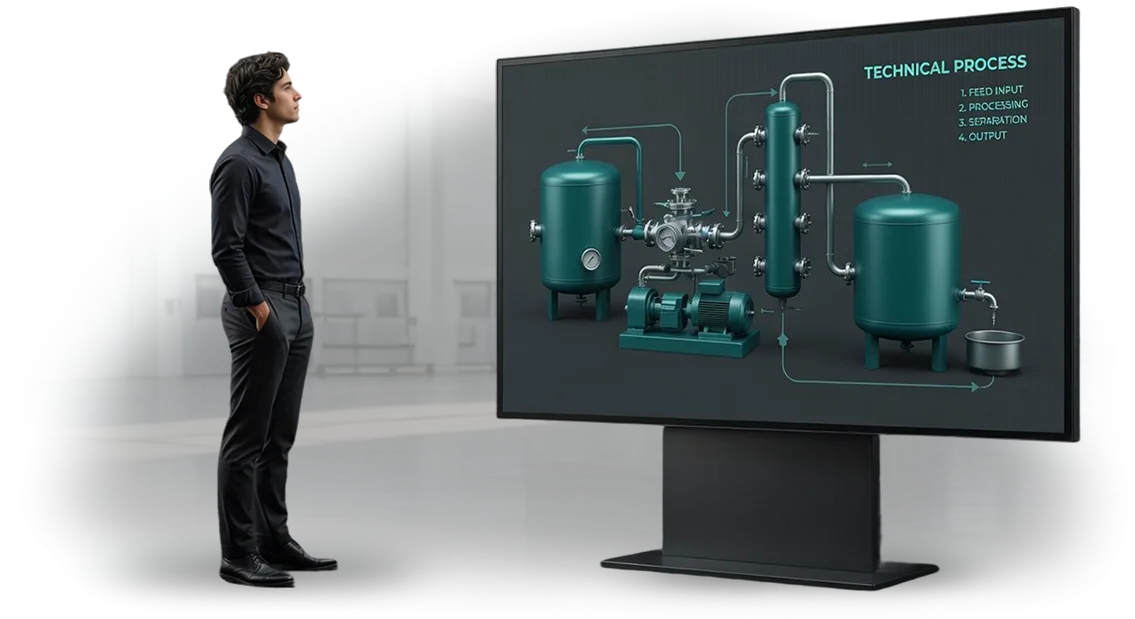
Why Assembly Instructions for Packaging Equipment Waste Time
Imagine a new employee encountering packaging equipment assembly for the first time. Nearby is a multi-page paper manual where each component is described in abstract terms, and the diagrams don't match the actual line layout.
The operator ends up spending half an hour searching for the right section, assembles the component with an error, and the line comes to a halt.
Each such staff mistake is not just a 10–15 minute delay. It means missed shipping schedules, material overruns, forced changeovers, and a frazzled shift.
Meanwhile, experienced specialists are constantly pulled away from their own tasks to explain to newcomers how to properly perform line maintenance. Production loses speed, and training costs keep rising.
The cause is almost always the same — the employee can't see the entire process. They don't understand the sequence of operations, don't know where to apply force, where the tolerance is, and where a critically important moment lies.
Text descriptions and static images don't provide visual clarity, so errors repeat even when a person is trying their best.
We solve this problem with video training instructions. Instead of abstract diagrams — real packaging equipment assembly on screen: every step, every component, every checkpoint. The employee sees the movement, the angle, the force — and repeats the operation without guesswork. This cuts onboarding time and reduces staff errors dramatically.
Video instructions also work for routine line maintenance: a clear visual algorithm for replacing parts, lubrication, and adjustments — without needing to call a mentor.
Production doesn't stop, competencies are reinforced across the whole shift, and the supervisor stops being a "walking encyclopedia." We've already helped dozens of companies accelerate equipment startup and reduce downtime — now it's your line's turn.
What a Video Instruction for Assembly and Maintenance Provides
When a new employee first approaches a packaging line, they get lost among dozens of operations. Every person reads ordinary text instructions in their own way — resulting in assembly errors, wasted time, and excess material consumption.
A 3D video instruction removes this uncertainty: any worker sees the exact sequence of actions and repeats it without guesswork.
Our team creates such videos for your specific equipment model — from packaging machines to complete lines. The employee doesn't study blueprints; instead, they watch exactly how the operation is performed, at the right speed and with emphasis on checkpoints. This works both for beginners and for experienced specialists during retraining.
What you get after implementation:
- Fast employee training. Onboarding time is reduced many times over: instead of a week of reading documentation — three or four shifts with a video instruction.
- Fewer assembly errors. All actions are shown down to the smallest detail, so incorrect component installation, missed fasteners, and misalignments become a thing of the past. Less scrap — lower rework costs.
- A unified instruction standard. All employees work according to the same model regardless of seniority and experience. This simplifies quality control and makes personnel replacement easier.
- Process visibility. 3D visualization shows the equipment from the inside and from any angle: the employee understands the mechanism's design rather than just memorizing movements.
Such a video instruction doesn't become obsolete along with the documentation: when regulations change, you only need to record an updated video rather than rewrite hundreds of pages.
You get a manageable training process, measurable results, and fewer downtime incidents on a new or upgraded line.
Formats of 3D Video Instructions for Packaging Equipment
A 3D video instruction is not a single format but an entire toolkit: from a short clip to a full-fledged training system. For packaging equipment, it's critical that the employee understands the operation down to the smallest detail — otherwise downtime is unavoidable. We distinguish four main formats, each addressing a specific task.
To choose the right option, you only need to answer two questions: who will be trained and what result is needed. For line personnel, a short clip is enough; for complex repairs — detailed animation; for systematic training — an interactive module.
| Format | Who it's for | What it gives the client |
|---|---|---|
| Short clip (30–60 sec) | New employees on the line | Fast onboarding without reading instructions |
| Step-by-step 3D animation | Setup technicians and repair staff | Breakdown of complex components, fewer maintenance errors |
| Interactive instruction | Personnel with varying experience | Training with action verification, skill gaps visible immediately |
| Modular video instruction | Multiple workshops and lines | Unified training standard, only the needed blocks are updated |
If the task is to train a newcomer in a few hours, choose the interactive instruction. If you need to standardize knowledge across all lines — the modular format.
We select the format for your training process and equipment specifics — from a short clip for a quick start to a full package for the entire team.
How Work on a Video Instruction Proceeds: From Brief to Launch
We start with a brief in which we capture the task: what equipment, what operations, and for what employee category the video instruction is being created.
At this stage, you receive the structure of the future recording and an understanding of which processes can be shown more clearly with 3D visualization.
From there, we move through agreed stages so you can see the result at every step and make edits before final delivery.
- Video instruction brief. We gather source data: regulations, technical documentation, and footage of real assembly if available. The output is a description of the format, runtime, and a list of key operations to be included in the instruction.
- Script approval. We turn dry regulations into a clear sequence of actions: step-by-step text with emphasis on critical components and typical employee errors. You approve the script before production begins — this eliminates unnecessary rework.
- Preparation of 3D models and draft visualization. We model the equipment and work areas and show preliminary frames. At this stage, you can see what the final instruction will look like and adjust angles and level of detail.
- Creation of the video instruction. We assemble the final scenes: animation of moving components, neat labels, and voiceover. We show complex operations from multiple angles so the employee has no questions when working with the real equipment.
- Final video approval. You receive a viewing link and make edits to the narrative logic or emphasis points. We continue making changes until the instruction becomes convenient specifically for your employees.
- Production launch. We deliver the final files in the required formats: for training stations, tablets, work computers, or a corporate portal. Plus, we provide recommendations on how to integrate the video instruction into your onboarding and certification process.
- Post-launch support. If you later need to supplement the instruction with new operations or adapt it for other equipment — we're available and will refine the video without repeating all the stages.
In the end, you get not just a video but a working training tool: employees master operations faster, make fewer mistakes, and don't distract mentors with the same questions.
What's Included in the Delivery of a Video Instruction for Production
Training employees to work with packaging equipment is not just an orientation session — it's protection against downtime and errors that cost more than any development effort.
That's why the delivery includes not "a video file" but a ready-made training tool that immediately integrates into your personnel training system.
- Video instruction script. We develop the training logic: from basic operating principles to maintenance regulations and typical faults. Each step is described in the language of your specialists and accounts for real situations on the production line — the employee understands what they're doing and why.
- Voiceover and subtitles. Professional narrator recording and synchronized subtitles make the video clear to everyone: newcomers, experienced workers, and those for whom Russian is not their native language. This improves material retention and reduces the burden on mentors.
- 3D assembly of packaging equipment components. Instead of flat diagrams and long texts, the employee sees the mechanism in volume: how to install parts, where the lubrication points are, which elements can be disassembled, and which are off-limits. This is exactly how complex processes are remembered quickly and without errors.
- Final video in ready formats. The video is delivered in formats and resolutions for a work computer, tablet, or training classroom screen. You don't need to transcode anything — just place the file where it's convenient for training people.
- Integration into the training system. We select the format and settings for your learning management system: view tracking, a short test after the video, and a completion record for the HR department. You always see which employees have completed the training and which haven't.
Additionally, along with the video, you receive the source 3D models of the components and the rights to use the video without restrictions within the company.
This means that when equipment is modernized, you can update the instruction quickly and without developing from scratch — saving time and the cost of retraining, with the cost calculated after audit.
Case Study: How a Video Instruction Accelerated Assembly and Reduced Errors
When a client — a packaging equipment manufacturer — approached us, their engineers were assembling a new line using paper blueprints and individual photos. The process took up to four days, and due to errors in the sequence of operations, some components had to be reassembled.
We proposed replacing the scattered materials with a unified series of 3D video instructions. The employee sees each step from the right angle: how to orient a part, with what force to tighten a fastener, what to check before the next operation. We created 12 short videos for one line — from frame installation to sensor calibration.
Results on the production floor
We measured the effect one month after launch. The time for a new engineer to reach normal production pace dropped by a third: previously six weeks, now four. The number of assembly errors more than halved, and the number of reworks on the line decreased almost threefold. Line assembly began to be completed on average one day faster.
For the production owner, this is not just time savings. Fewer reworks mean less downtime and scrap, which means more stable shipping schedules for finished lines to customers.
What made the project successful
The secret lies in the detailed development of scripts together with the client's technologists. We analyzed the real errors that newcomers kept repeating and built the right emphasis points into each video.
The instructions are available on tablets and work computers — no need to stop the process to open a blueprint.
After the first results, the client expanded the project to three more equipment lines. We continue supporting the client: adding new videos when component designs change and updating existing ones.
This case study shows how a video instruction gathers the team's scattered experience into a ready-made training tool. Faster onboarding and operational accuracy are an achievable result that we're ready to replicate on your production floor.
Answers to Questions Before Ordering: Timelines, Cost, Guarantees
Before placing an order, questions about timelines, cost, and guarantees naturally arise. We've gathered answers to the most common ones so you understand how the work is structured and what you can expect.
Every project is adapted to your equipment, regulations, and staff skill levels. That's why the answers contain not generalities but specifics you'll encounter at the brief stage.
How long does development take?
The timeline is from two weeks if blueprints or 3D models are available. Usually we fit into 3–6 weeks: first we approve the script, then create a draft version, and after revisions — the final video. The exact timeline is fixed in the contract.
How do you adapt the instruction to our equipment?
At the start, we send you a checklist of what's needed: blueprints, photos, component videos, or access to a sample unit. If documentation isn't available, we visit the production site and take measurements ourselves.
In the end, you receive a video that mirrors the actions on your machine, with your component designations.
What about guarantees? What if we find an error?
We provide a guarantee that the video matches the script and covers all operations. If you find an inaccuracy within one month of delivery, we'll fix it free of charge. Payment is split into stages, so you don't pay for a result you can't see.
Errors related to design or regulation changes are considered a new stage, but standard revision terms apply to them.
What does the cost depend on?
The price is based on equipment complexity, the number of operations, and the depth of detail — for example, whether cutaways, animations, or narrator voiceover are needed.
We provide a preliminary estimate after the brief, and the final cost is fixed in the contract — it doesn't change during the process.
Can you update the instruction if regulations change?
Yes. We store the project source files, so there's no need to re-shoot everything from scratch for an update. You just describe the changes — we'll make the edits while preserving the style, narrator, and overall structure. This is faster and more cost-effective than creating a new instruction.
Get a Video Instruction Plan for Your Task Within One Day
Submit a request for a cost calculation — and by the next day you'll receive a ready-made video instruction plan for your task. We'll analyze exactly what equipment needs to be shown, how many employees will be trained, and which operations cause the most errors.
Based on this, we'll propose a format that delivers quick results without overpaying for unnecessary options.
The plan includes everything needed for a solution: from initial drafts to full implementation.
- Cost calculation request via the form on the website — you specify the equipment type and the task.
- Consultation on the video instruction format: 3D model, live-action filming, or a combined option.
- Cost estimate and timeline — within one business day after receiving the source data.
- Work plan broken down by stages: preparation, filming, editing, approval.
- Pilot project — a short fragment of the future instruction so you can assess the style and level of detail.
- Integration of video instructions into the training system: placement in the LMS, internal portal, or application.
- Post-launch support and refinement — we update the videos when regulations or equipment change.
This approach lets you start the project without lengthy approvals: you immediately understand the budget, timeline, and exactly what you'll receive. The pilot segment also reduces risk — you see the result before major resources are spent.
Spend 10 minutes on the request — and in a day you'll have a clear action plan.
All that's left is to approve the cost estimate and launch production of the video instructions that will shorten training time for new employees and reduce the number of errors during assembly and maintenance of packaging equipment.
How to Choose the Right Video Instruction Format for Your Task?
There is no single "best" video instruction format — there is a format that solves your specific task at optimal cost. The choice depends on how complex the operations on your line are, how often the equipment changes, and what skill level new employees have. These criteria, not trendy technologies, determine which format will bring the most value.
If the task is to train personnel in basic operation or safety procedures, short videos of 2–3 minutes per operation are sufficient. They're quick to produce, easy to update, and don't require a large budget.
For complex assembly, calibration, or maintenance of packaging equipment components, a detailed 3D instruction is necessary: it shows the internal structure of mechanisms and the sequence of actions without being tied to the workshop, and the employee can access it at any time.
The key selection criterion is the cost of error. If incorrect assembly or adjustment leads to line downtime and lost revenue, saving on the format will end up costing more.
3D instructions pay for themselves by reducing newcomer onboarding time and decreasing the number of emergency stops. For standard procedures where an error is non-critical, screen capture or animated diagrams are suitable — they're faster and more cost-effective.
The second criterion is the speed of change. Packaging lines often undergo changes in tooling or recipes, and instructions need to be updated quickly. Ask the contractor how long it takes to make revisions in each format and how much it costs.
A good option is a modular structure where a single block can be replaced without re-shooting the entire instruction.
We recommend starting with an audit: identify the five most frequent operations that cause difficulties for employees and calculate the losses from each error.
Then, together with us, choose the format that addresses exactly those pain points — whether it's a detailed 3D assembly, a quick video diagram, or a combined option with knowledge-check tests.