

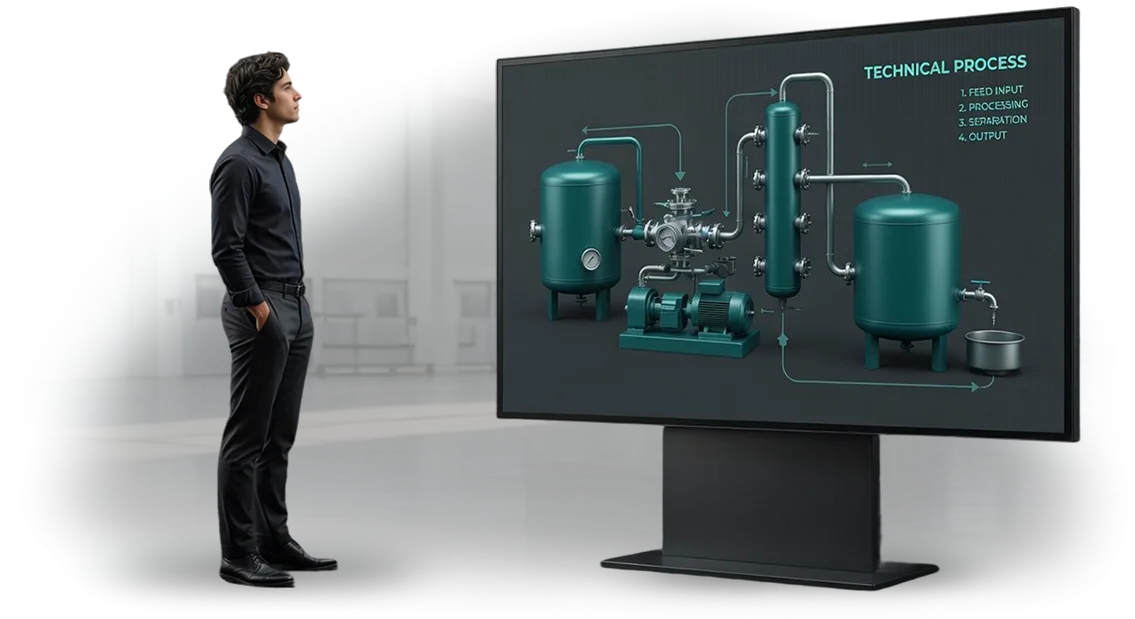
Why Gas Safety Is Critical for Business
Working with gas is one of the riskiest processes in production. The cost of a mistake here is measured not in fines, but in employee health and company reputation.
Ignoring gas safety requirements sooner or later leads to an accident, a workshop shutdown, and inspections by regulatory authorities. Managers often remember occupational safety only after an incident — even though it could have been prevented.
Text instructions and memos solve the problem only partially. Employees skim through documents, don't remember the sequence of actions, and don't see the real consequences of a mistake.
Risks on the production floor remain high, especially for new employees who have to figure things out on the go.
Video instructions change the approach to training. Instead of abstract bullet points — a visual scenario: how to open a valve, check for a leak, and act in an emergency. This format shows every action on screen and reinforces correct habits. Occupational safety becomes understandable practice, not a formality.
For a business, this means stability: fewer accidents, lower chances of fines and downtime. Employees absorb the material faster, and the manager gets a tool that works equally well for onboarding new hires and for scheduled knowledge checks.
Video instructions are easy to update — just reshoot one block instead of reprinting a pile of documents.
We create training video instructions tailored to your production needs: with real workstations, typical mistakes, and the requirements of your occupational safety department in mind. You receive ready-made training material that reduces production risks and protects your employees.
What Safety Training in Video Format Delivers
Gas safety video instructions are not a replacement for paper memos, but a new format that employees actually remember.
We have been creating such videos for over 10 years — from short animations to full-scale training films — and we see how they improve safety metrics at facilities.
Here is what a business gains from implementing video briefings:
- Fewer injuries. The employee sees dangerous situations and the correct sequence of actions, not abstract instruction points. Mistakes are practiced on screen before stepping onto the site — and are repeated less often in reality.
- Higher engagement. A short, dynamic video holds attention to the end, unlike a multi-page text. Training is faster and leaves a stronger memory trace.
- Savings on briefings. One video replaces hours of repeated lectures. New employees can be trained in a streamlined way without pulling experienced specialists away from their work.
- A unified knowledge standard. Every worker learns the same algorithms, regardless of who conducts the briefing.
- Transparent completion tracking. The system records who completed the training and when. This simplifies paperwork and checks.
Any one of these benefits justifies the investment in producing video instructions. Together, they deliver a lasting effect: fewer incidents, higher productivity, and peace of mind for the manager.
Based on our clients' experience, the material is absorbed many times better than with classic briefings.
Corporate Video Instruction Formats for Different Tasks
Choosing a video instruction format means deciding in advance how employees will perceive the material and how quickly they will master safe actions.
For topics where the cost of a mistake is high, what matters is not just a nice video, but an accurate representation of processes: how a valve opens, what a leak looks like, how a normal situation differs from an emergency.
One client needs simple diagrams; another needs a full simulation of a real facility with detailed equipment. We use three approaches — 2D animation, 3D modeling, and full CGI video. They cover different training tasks and budgets. Below is a comparison to help you choose the right format for your task.
| Format | Essence | What it gives the client |
|---|---|---|
| 2D animation | Flat diagrams, arrow accents, infographics | Quickly explains the logic of actions and the sequence of steps. Good for introductory briefings and general rules. |
| 3D modeling | Three-dimensional models of equipment and facilities | Shows the structure of objects and the interaction of parts. Suitable for studying the design of gas equipment. |
| CGI video (full) | Full-fledged simulation of real scenarios | Maximum immersion: the employee sees the process "as in real life." Ideal for practicing emergency situations and rare scenarios that are dangerous to demonstrate live. |
CGI video dominates in safety matters — it allows you to simulate a leak, ignition, or abnormal equipment behavior without any risk to people or property.
The employee remembers the visual signs of danger and the correct reaction, even if they have never encountered such a situation in reality.
2D and 3D remain in demand for regular training: they are more budget-friendly and are updated faster when regulations change. We often combine formats within a single program: 2D for theory, 3D for equipment structure, CGI for practical scenarios. This way, you get a training system, not just a single video.
We help you choose a format for your task and budget. Simply describe which employees need to be trained and in what — we will suggest the optimal combination of formats.
How We Develop Video Instructions: From Brief to Launch
Training employees to work with gas requires precise and clear instructions. Our team develops video instructions from the initial brief to finished videos integrated into your training system. You control the key decisions, and we handle the technical side.
The process is structured so that at every stage you see an intermediate result: the script, key frames, and a rough cut. This allows you to make corrections on time and eliminates unexpected rework.
The main stages:
- Brief and audit. We study your gas safety regulations, analyze typical employee mistakes, and define the scenarios.
- Script approval. We prepare a shot-by-shot description of the video — you verify the accuracy of the actions and content.
- Computer graphics development. We create visualizations of gas equipment operations and safety signs.
- Intermediate review. We show draft scenes, and you make adjustments before the final edit.
- Final version. We assemble the video, add voiceover and subtitles, and adapt it to the required formats.
- Launch. We deliver the finished video instructions and training materials for your learning system.
As a result, you get gas safety video instructions that employees understand — without lengthy approvals and rework — and the training process becomes faster and more controllable.
What Is Included in the Delivery and in What Timeframe
We deliver a complete package ready for use, not just video files. You won't have to figure out how to implement the training: everything is already packaged for launch.
- Scripts — step-by-step developments based on your internal regulations and gas safety requirements.
- Finished videos — final videos in formats that work in an LMS, on a phone, and in in-person sessions.
- Training materials — employee memos, test questions, and an instructor's guide.
- Access to the distance learning system — we upload the courses, configure groups and completion tracking so you can see results right away.
- Implementation recommendations — a launch plan, message templates, and criteria for assessing material comprehension.
The timelines are clear in advance: a typical project takes 4–6 weeks. The first 2–3 days go to the brief and script approval, then we produce the visualization and editing, followed by the training materials and course testing. At every stage, you receive an intermediate result, so the final video never comes as a surprise.
If the training needs to be launched sooner, we speed up the process by working on the script and graphics in parallel. In the end, you get not just files, but a working system for training employees in safe gas operations.
Case Study: How We Reduced the Number of Violations with Video Instructions
For an industrial enterprise with a large workforce, a text-based gas safety instruction often remains a formality: it is looked over once a year, and violations repeat over and over.
The managers saw that training was not changing people's behavior and were looking for a format that is truly memorable and works in practice.
We developed a series of short video instructions for the company SeverGaz. Instead of dry algorithms from regulations — realistic scenes with simulated emergency situations: a leak, the smell of gas, incorrect instrument readings.
Each video lasts 2–3 minutes and focuses on a single action so that the employee can easily reproduce it in their own work.
During preparation, we took metrological requirements into account: the sensor and indicator readings in the video correspond to real settings, so no false associations arise.
Three months after launch, the number of violations recorded by internal inspections dropped by 40%. Cases related to the human factor when working with gas equipment also decreased, and employee retest results improved by a quarter compared to the paper instructions.
The head of the occupational safety department at SeverGaz noted: "Video instructions have become a working tool, not a chore. People really remember the algorithms — this is evident both in inspections and in behavior at the facilities."
This case shows that a well-designed training video changes employee habits. We don't just draw pictures; we work through every detail with industry standards and real production conditions in mind — which is why the result is measurable and backed by numbers. It is exactly this approach that reduces risks and improves safety at the enterprise.
Answers to Frequently Asked Questions About Implementing Video Instructions
Implementing gas safety video instructions raises the same questions among clients: how long it will take, whether existing materials can be used, and how to integrate the videos into training afterwards.
We have gathered the typical requests and answered them briefly — so you immediately understand what you will receive and in what timeframe.
| Question | Short answer |
|---|---|
| How long does it take to create a video? | One 5–7 minute video takes 3–4 weeks. The timeframe depends on the number of scenes and the complexity of the graphics. |
| Can you adapt our existing materials? | Yes. We use your regulations, presentations, and training materials as a basis and convert them into video format. |
| How do we integrate the video into training? | In any convenient way: through the distance learning system, a corporate portal, or direct links in messengers. |
Some nuances are worth examining in more detail — expand the blocks below.
What do production timelines depend on?
The timelines are determined by the scope and complexity. One 5–7 minute video with realistic 3D graphics takes 3–4 weeks. If you need multiple videos or detailed scenes with equipment, the timeline increases — but the final dates are fixed in the contract.
What is needed to transfer content?
Current instructions, regulations, and presentations are sufficient. We will rework them into a script, get your approval, and only then start production. No special formats are required from you — regular documents are fine.
Who helps with integration?
We deliver the finished files in the required formats and advise on how to upload them to your training system. If necessary, we will connect with your technical specialists and help set up access for employees.
Order Video Instruction Development for Your Enterprise
Gas safety rules cannot be learned from simplified explanations — the cost of a mistake is too high. Text instructions and posters do not hold attention, and analyzing real accidents at a worksite is life-threatening.
This is why enterprises are switching to CGI video instructions: they show all the risks and the correct actions without the slightest threat to employees.
We develop training videos that integrate into your personnel training system. Using professional equipment and proven tools, we create 3D models of production facilities and emergency scenarios.
This way, the employee sees the consequences of a mistake in a safe environment and remembers the action algorithm at a reflex level.
What you get as part of the collaboration
- Format consultation — we will select the duration, style, and level of detail to match your specific gas work operations.
- Pilot project — a short demo video at your real site so you can evaluate the quality and approach before the full cycle.
- Regulation adaptation — the script is built on your instructions and occupational safety requirements.
- Training without stopping production — employees complete the material at a convenient time, from any device.
- Completion tracking — you see who has studied the video and can repeat the material if needed.
- Content updates — when regulations change, we quickly revise the video rather than reshooting everything.
Leave a request for a consultation — we will discuss your task, show examples of our work, and calculate the timelines. If you need to quickly test the effectiveness, order a pilot project for one of the safety scenarios.
We have produced over 150 training videos for industrial enterprises over 10 years, and most clients come back to us for their next videos.
Don't postpone employee safety: the sooner video instructions appear in your training system, the faster the risk from the human factor will drop. Fill in the form or call us — we will find a solution for your budget and regulations.
How to Choose the Right Video Instruction Format for Your Task
The right video instruction format is determined not by the length of the video, but by the nature of the task.
For standard procedures, a short animated video is enough; for working with dangerous gas equipment, you need detailed step-by-step scenarios with emphasis on every critical step.
If the specifics are ignored, employees will remember the general picture but miss important safety details.
Specific requirements often arise with non-standard equipment that has no typical solutions. In such cases, ready-made templates do not work: you need to show the real components, the sequence of actions in an emergency, and the consequences of a mistake.
A video instruction must precisely match your equipment and regulations, not be a generalized diagram.
We start by analyzing your task: who will watch the video — newcomers or experienced employees — what operations are performed, and what risks exist. Based on this, we choose the format: from visual animation to a highly detailed breakdown of every element. This approach allows us to address your specific needs rather than offer a standard solution.
For example, for gas safety, it is often more important to show prohibited actions and signs of a leak than the entire commissioning process. That is why we focus attention on critical points, using slow-motion details and close-ups. As a result, the employee does not just watch the video, but forms the correct behavior model.
If you are unsure which format suits you, send us a description of your task. We will suggest the optimal option, the script structure, and the implementation timelines, so you get an instruction that truly protects your personnel.