

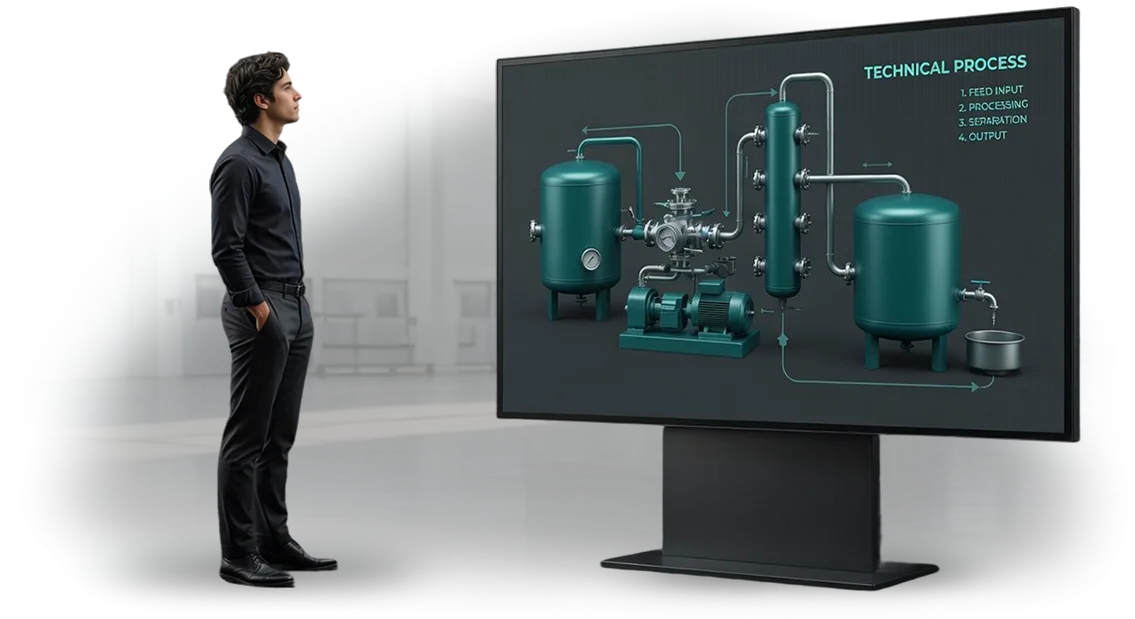
Accidents Caused by Ignoring Safety When Working with Equipment
Every day, an accident occurs in the workplace because an employee ignored a basic safety rule.
More often than not, this is not malicious intent but a lack of understanding: employee briefings were formal, the text in the safety memo was illegible, and no one bothered to visibly demonstrate the consequences.
The result is that safety violations become a habit, and even an experienced worker risks injury or damage to expensive equipment. For businesses, this means not only human pain but also halted processes, sick leave, fines, and reputational damage. Occupational safety turns into an expensive line item rather than a protective mechanism.
Moreover, the problem is not the absence of regulations — they exist. The problem is how the information is presented: dry texts, boring posters, and long lectures do not stay in memory. The employee does not see what their haste or carelessness will actually lead to.
Workplace injuries continue to rise where training does not inspire trust and does little to prevent incidents.
Modern video instructions solve this problem. Short, clear videos modeled down to the smallest detail show the correct sequence of actions and demonstrate the consequences of an error without any risk to the person.
This is understandable to everyone — from a novice to an experienced master — and occupational safety becomes a natural part of the work process.
These are exactly the video instructions we create for your employees — visual, safe, and tailored to your equipment and regulations. You get a tool that actually reduces the number of violations and protects people.
Five Key Benefits of Corporate Video Instructions
Corporate safety video instructions start working from the very first day of implementation. The employee sees a clear action scenario instead of dozens of pages of text and makes fewer mistakes from the very first shift.
This reduces the risk of injuries and breakdowns, which in turn eliminates unplanned downtime and extra expenses.
The speed of onboarding for new employees increases dramatically: instead of a week of mentoring, two or three viewings of the video are enough. A new person starts working independently faster, experienced employees are not distracted, and the manager fills the vacancy sooner.
Video is remembered better than text: visual and auditory memory work together, and emphasis on dangerous operations stays with the viewer for a long time. During refresher training or after a break, the employee only needs to revisit the video — and they act confidently again.
Cost reduction becomes noticeable within just a few months. One created video instruction works for all new employees, for regulation updates, and across branches.
There is no need to pay again for a trainer's visit, rental, or printing of manuals — repeated training costs almost nothing.
You get control over training: you can see who watched the video and when, whether they returned to difficult blocks, and whether they are ready to work independently. Access to equipment is granted based on facts, and the training program can be easily adjusted.
Formats of Educational Video Instructions for Staff
Employees perceive information differently: some need a short diagram, others need a full breakdown of actions with equipment. An educational video should not simply record the rules but convey them so that the person remembers and applies them in practice.
That is why our team develops video instructions in several formats — tailored to specific tasks and staff skill levels.
Using one format for all topics rarely works: a detailed 3D scene is excessive for a simple briefing, and superficial animation does not provide the necessary depth for complex equipment.
When the format matches the task, training takes less time, and equipment-related mistakes happen less frequently.
| Format | Who it's for | What it gives the client |
|---|---|---|
| 2D animation | For mass briefings, basic rules, and simple operations | Quick to create, easy to update, clearly explains algorithms and safety requirements |
| 3D instruction | For complex equipment where details, components, and sequence of actions matter | Visually shows the device and processes, including elements hidden from the camera |
| Interactive video | For practicing actions in emergency situations and testing understanding | The employee makes decisions themselves, sees the consequences, and reinforces the skill before real work |
The choice of format depends on which mistake you want to prevent first. Animation is optimal for mass training, 3D modeling for complex regulations, and interactive branching scenarios for knowledge assessment.
We will help you choose the right format for your task or combine several into a single training system. As a result, you get clear video instructions that reduce the risk of injuries, equipment breakdowns, and the cost of retraining employees.
Step-by-Step Turnkey Development Process for a Video Instruction
Turnkey video instruction development is a structured process with clear stages and control points. The development stages are designed so that you are kept informed at every step rather than waiting for the result in uncertainty.
We take on the brief, script, production, and launch so that your employees receive a visual safety instruction for working with equipment and you receive a finished product within the agreed timeline.
- Brief and task immersion. We study your equipment, regulations, and typical employee mistakes. We determine the main goal: what needs to be taught and which actions should become habitual.
- Technical specification and storyboard. We turn goals into a detailed script: a frame-by-frame description of actions, instructor commentary, and emphasis on risks. You approve the script before production begins — we make changes at no extra cost.
- Visual style approval. We select graphics, characters, and animation that match your corporate style. Employees recognize the familiar atmosphere and process the material more easily.
- Animation production. We model the equipment, work scenes, and dangerous zones. The video shows every step from the right angle to eliminate misinterpretation of the instruction.
- Interim project approval. We show draft versions of key scenes, collect feedback, and make edits. You see the result at an early stage and control whether it meets your expectations.
- Final editing and voice-over. We combine the scenes into a single video, add the narrator's text, subtitles, and safety callouts. The format is suitable for a distance learning system and an internal portal.
- Launch and support. We hand over the finished materials and source files, help set up deployment, and answer employee questions. If regulations change, we will promptly update the video.
What's Included in the Delivery: The Complete Video Instruction Package
You receive not "just a video" but a complete package for launching training. Every element of the delivery is designed for practice: the employee sees real risks, understands the sequence of actions, and remembers the safe equipment operation algorithm. Everything is ready to use from day one.
Here is what is included in the delivery:
- Video instruction script. We develop it based on your regulations and typical workplace situations. You approve the text in advance, so the final video does not contradict internal safety standards.
- Animation and graphics. Dangerous zones, movement of mechanisms, correct and incorrect sequences of actions — everything is shown visually. The employee does not need to read the instruction; they see how to work safely.
- Professional voice-over. A clear narrator's voice, calm pace, and proper emphasis. This material is easy to listen to even in the background, and key warnings are remembered automatically.
- Editing and final file. The finished video is assembled from all materials, with titles, subtitles, and callouts on critically important steps. You receive the video in the formats and resolutions needed for your screens and devices.
- Integration into your training system. The file is adapted for upload to an LMS or for display on a shared screen in the workshop. Simply attach the video to a course or send a link to employees — no additional setup required.
- Full usage rights. The materials remain your property without restrictions on time or number of views. Update the video, include it in briefing programs, and share it across departments.
- Instructor's guide. An accompanying document: how to incorporate the video into a lesson, which points to highlight, and how to assess material comprehension.
The entire package is delivered within the agreed timeframe, and after launch we make minor corrections for free. You get a ready-to-use tool for reducing injuries and downtime, one that immediately works for safety and discipline.
Case Study: How a Video Instruction Reduced Incidents on the Production Floor
On the production floor, the main risk is the human factor: even experienced employees eventually simplify procedures, and newcomers get lost in multi-page instructions.
This is exactly the problem a plant manager brought to us: incidents involving equipment occurred monthly, and analyzing each one meant downtime and additional costs.
We proposed replacing paper memos with a series of CGI video instructions: every step — from starting the machine to acting in an emergency — is shown visually, clearly, and without unnecessary words. Within a month of the launch, it became clear that this works.
Implementation Results
The number of production incidents dropped by 35% within the first three months. Equipment setup errors were cut in half — saving about 40 hours of working time per month. Less downtime, less scrap, and a safer shift — exactly what a manager expects from training.
Onboarding time for new employees was reduced from three hours to 25 minutes: instead of reading regulations, newcomers watch the video and immediately repeat the actions on a simulator.
Experienced workers also willingly return to the video before complex operations — the instruction is always at hand.
Client Testimonial
The technical director of Technotron noted that the video instructions became the primary tool for onboarding: "Workers themselves rewatch the videos before each shift — this reduced requests to the occupational safety department by three times." Within six months, the project paid for itself through reduced downtime and lower insurance costs.
This case study shows: a high-quality video instruction is not a "checkbox video" but a working tool that optimizes processes and protects people.
We handle the entire cycle — script, 3D modeling, voice-over, and editing — and adapt the material to the specifics of your equipment.
How to Choose the Video Instruction Format for Your Task?
The format of a video instruction is determined not by the desired visual style but by the task: what the employee needs to learn and what happens if they make a mistake.
Simple procedures — document processing, turning on a computer — are covered by a short screen-recording video. However, safety when working with equipment requires realistic 3D graphics: the cost of an error here is a person's health and expensive machinery.
The main selection criterion is the degree of danger of the operation and the complexity of the equipment itself. For simple actions, flat graphics save budget and time without losing usefulness.
For multi-step processes where you need to memorize a sequence of a dozen steps, a three-dimensional model of the equipment delivers a "see and remember" effect that cannot be achieved with text or photos.
The second criterion is the audience composition and staff turnover.
If operators change frequently, the instruction is watched by inexperienced newcomers — the video instruction should be designed so that a person can repeat the actions after a single viewing, without verbal explanations from a mentor. This is especially important in production environments where training is continuous.
In practice, we reduce the format selection to three questions: how critical is the mistake, how many steps are in the operation, and who will watch the video.
Simple operations — a concise format of a couple of minutes; complex procedures — step-by-step 3D animation with emphasis on risk zones and typical mistakes.
The right video instruction format is one that reduces the number of incidents and speeds up an employee's return to full working mode.
We record the selection criteria in the brief before production starts, so you get a video that solves the problem rather than one that simply looks impressive.
Frequently Asked Questions About Creating Video Instructions for Staff
Before starting a project, clients always have questions — that's normal. Developing video instructions for staff may seem complicated, so we've gathered answers to the main concerns: timelines, budget, guarantees, and the approval process.
Here is how the work is structured, so you understand the outcome even before you start.
How long does it take to create a video instruction?
A standard project takes 2 to 4 weeks. The timeline depends on the complexity of the script and the number of scenes. At the initial consultation, we set an exact deadline in the contract. If you need it urgently, we'll offer an optimized production format without sacrificing quality.
How is the cost calculated and what affects it?
The estimate is transparent and is fixed after the brief. The cost is affected by the runtime, the number of locations, the complexity of the graphics, and the need for professional equipment. You receive a stage-by-stage breakdown — no hidden payments or "surprises" at the end.
What guarantees are there that the video will be liked and will work?
We guarantee the result: if you find an actual error in the instruction after delivery, we make corrections for free. In addition, you receive a complete set of source materials — you can update the video with your own team or order revisions from us at any time.
How does the approval process work and can I make changes?
You approve three key milestones: the script, the storyboard, and the draft video. At each stage, changes are made without any limit on the number until you are satisfied with the result.
You don't need to understand the technical side — we support you at every step and explain everything in simple language.
If you still have doubts — ask us directly: we will respond within one business day and offer a solution for your task.Order Development of a Corporate Video Instruction
Leave a request to order a video instruction — and within one business day we will prepare a proposal with the exact scope of work and cost. We will set the timeline, format, and number of videos so that you immediately understand the budget and the result.
No "we'll figure it out along the way": every stage is transparent and agreed upon before the start.
Here is what you get after contacting us:
- A preliminary cost and timeline estimate for your task — no hidden surcharges.
- A script checklist: dangerous zones, equipment safety rules, typical employee mistakes.
- Format recommendations: duration, style, adaptation to different skill levels.
- Examples of our work in your industry — to evaluate the style and presentation.
- A project roadmap: from brief to final video delivery.
- A dedicated manager who is responsible for communication and deadlines.
After refining the details, we assemble a team: scriptwriter, director, 3D artists, and editors.
You approve the script and visual decisions at every stage, rather than receiving a finished result "at the finish line." This ensures that the video instruction truly reduces the risk of injuries and shortens the time of initial training.
Leave a request — we will calculate the cost of development for your equipment and team. To order a video instruction, simply write to us: we will respond within one business day, send a commercial proposal, and take care of all organizational matters.