

Fines and Injuries: How to Achieve Safety in Auto Repair Shops
Fines for violating workplace safety regulations are growing, and on-the-job injuries at auto service stations remain one of the biggest headaches for owners.
Every accident means not only missed deadlines and sick leave, but also inspections, investigations, and serious financial losses.
At the same time, formal training for workers in hazardous occupations is often done "for show": there's a signature in the logbook, but the mechanic or electrician has no real knowledge.
This is where the main risk lies. When the briefing is conducted verbally, the employee retains only a small part of the information, and a week later forgets even that.
As a result, the same violation repeats over and over: someone doesn't use safety gear, someone works with equipment without protection.
Sooner or later this leads to an injury, and then workplace safety in the auto repair shop becomes not a formality but a matter of business survival.
Video instructions close the gaps that regular training leaves behind. The employee sees the correct actions with their own eyes: how to work with a tool, how to lift a car, how to behave in an emergency.
Such training is easy to absorb and works equally well for everyone — from a newcomer to an experienced master. You get a single standard that cannot be "retold in your own words" or skipped.
The main benefit is protection for the auto service station owner. When training is confirmed by video materials, you have proof that the employee actually saw and absorbed the safety rules. This reduces both the risk of injuries and the risk of claims during inspections.
Video instructions pay for themselves at the very first prevented incident, and they also build a safety culture that improves discipline across the entire workshop.
We help auto service station owners close these risks — we film and develop corporate video instructions tailored to your real processes. We break down specific work situations, demonstrate safe techniques, and make training clear for every employee.
As a result, you reduce injuries, avoid fines, and sleep easy knowing your team is acting correctly.
Why CGI Instructions Are More Understandable Than Regular Videos for Mechanics
Regular video is simple to shoot, but a mechanic may miss the main thing: how exactly a component is built, where the force is directed, where the error lies. They have to rewatch, get distracted, and the result is mistakes on the job and safety risks.
Every rewatch is minutes of downtime, and every mistake is the cost of repairs and the employee's health.
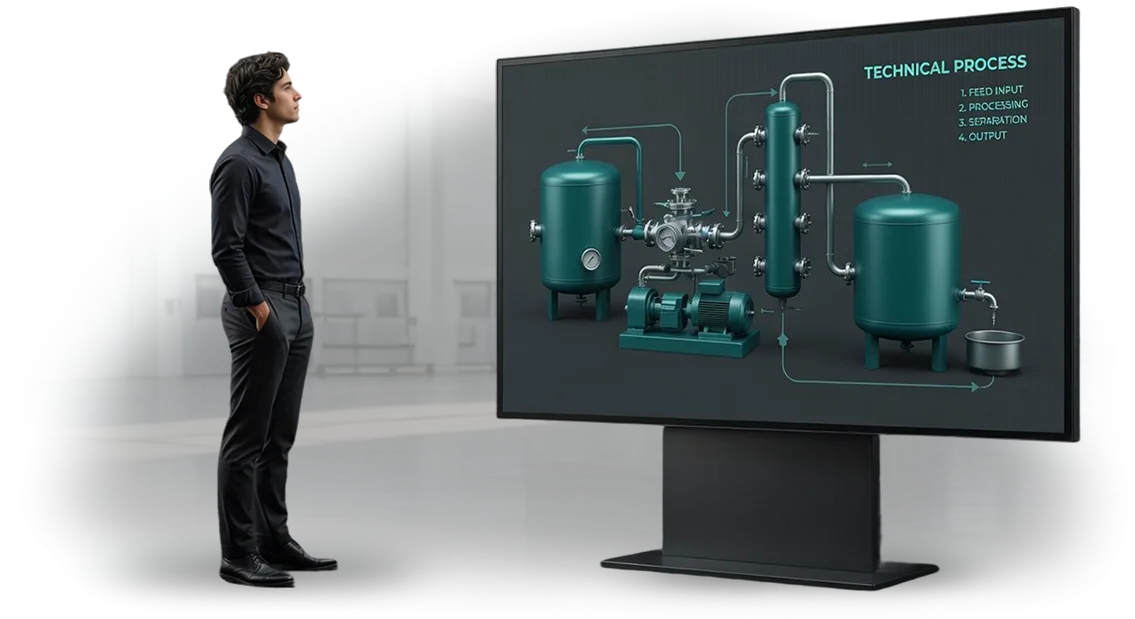
CGI video instructions don't have these limitations. We create 3D models of equipment and processes, show the internal structure, and add highlights and explanations.
This way, the auto service station employee sees not just "a picture" but understands the operating principle and remembers the correct sequence of actions.
Visual staff training reduces the time of initial onboarding and lowers the number of errors. In our projects, mechanic adaptation is 30% faster, and the number of safety violations drops by almost half. That's a measurable result that directly affects the service's bottom line and reputation.
We work with professional 3D graphics software, so every frame is detailed and realistic. Our team have been using the CGI approach for over 10 years — during that time we've refined production so that training videos for mechanics are accurate and easy to follow.
Such video clips for auto service station employees replace dozens of pages of instructions and are suitable for regular briefings, exams, and work in high-risk areas.
These are not just recordings of actions, but full-fledged learning materials that employees understand the first time and apply without mistakes.
Video Safety Instructions for Auto Repair Shops: Formats for Every Task
In an auto repair shop, safety is not a formality — it's protection for people, equipment, and reputation.
But employees absorb information differently: newcomers need a full course, experienced masters need a short reminder, and the manager needs a way to verify that the material has been understood. One format for every case doesn't work: attention scatters, and the risk of violations grows.
To cover different tasks, we develop video instructions in three formats. You can choose the one you need or combine them.
| Format | For whom | What it gives the client |
|---|---|---|
| Full training course | New employees, trainees | A unified knowledge system: in 20–30 minutes a person absorbs all the key rules |
| Express videos (2–3 minutes) | Experienced staff, meetings, briefings | A quick reminder of risks without taking time away from work |
| Interactive video instructions | Training with knowledge checks | The employee answers questions as the video plays — you see who actually grasped the material |
We produce the content ourselves: we use live footage and animation, depending on what needs to be shown. In auto repair shops this delivers the best result — real footage for detailed operations, and clear animation for general rules that simplifies comprehension. In the end, you get video instructions that employees watch to the end and apply on the job.
How a Video Instruction Project Works: From Brief to Launch
Each stage of video course development is designed so that you control the outcome without getting into production details.
We've broken the path from brief to launch into clear steps — at each one, you make decisions that affect the value for employees and the safety of your operations.
- Brief and immersion in the task. We gather information about your regulations, typical employee mistakes, and training requirements. We define the goals of the video course and the target audience — so that every instruction answers the real questions of mechanics and managers.
- Training script development. Based on the brief, we create a script: storyline, sequence of actions, and key safety rules. Already at this stage you can see how the training will be structured and adjust the emphasis before production begins.
- Visual mockup approval. We prepare a storyboard and visual style: how the frames, characters, or equipment will look. You understand in advance how the video course will fit your corporate style and whether it will be clear to employees.
- Content production. We create animation, 3D models, or live footage depending on the chosen format. All scenes undergo internal review for accuracy of safety compliance.
- Editing and voiceover. We assemble the videos into a single course, add explanations, on-screen prompts, and emphasis on important details. The finished material is convenient to watch both on a computer and on a tablet in the workshop.
- Final approval. You receive the completed video course for sign-off. We make edits based on your feedback — until the result fully meets your expectations.
- Launch and support. We upload the material to your training system and help set up access for employees. If needed, we extend the course with new scenarios or update the rules — so training always stays current.
This approach removes the risk of a "long approval at the end": you're involved from the very first stage and get exactly the result you planned. The video course launches on schedule and immediately works for the safety of your workshop.
What's Included in the Video Instruction Package for Your Auto Service Station
When you order a safety video course, you receive not separate files but a delivery package that lets you start training immediately. All materials are coordinated with each other: from the script to the final course file.
| Package component | What it gives you |
|---|---|
| Script and storyboard | Text and frame plans are approved before filming — you see the logic and completeness of the instruction |
| Video clips for operations | Ready-made lessons with voiceover and on-screen text |
| Final course file | A compiled course in a single format for launch on any device |
| Video editing and graphic elements | Arrows, highlights, and pauses on dangerous actions — the employee won't miss anything important |
| Files for the auto service station | Instructions for launching the course and setting up knowledge checks |
In addition to the videos, the delivery package includes supporting materials:
- Script and storyboard of all scenes for approval and reuse;
- Final videos with captions — can be watched without sound;
- Check questions after each block;
- Employee memo "How to Work Safely";
- Briefing log template for the HR department;
- Methodical recommendations for the master or administrator;
- Files for uploading to a distance learning system or to a tablet.
Video editing is not just splicing frames together. We place emphasis on typical mistakes, slow down dangerous moments, and add prompts. As a result, the employee remembers the sequence of actions, and you don't have to explain the same thing in person.
The final package is proven in practice: it works both for initial onboarding and for regular knowledge checks. You get a ready-made tool that operates without constant involvement from management.
Case Study: How We Reduced Violations at an Auto Service Station by 40%
Every auto service station network has a hidden pain: even experienced mechanics violate safety rules. The consequences are injuries, fines, and reputational risks — one incident in the workshop hits social media, and clients start doubting the service's reliability.
Regular briefings and signatures in the logbook stopped working long ago: employees let information pass them by, and a formal approach doesn't reduce accident rates.
We proposed that the auto service network replace paper regulations with short video instructions. Each clip featured not abstract rules but real situations from the workshop: how to properly lift a car, work with tools, and organize a workstation.
Employees watch this format without pausing their day — on a phone or tablet — and for knowledge checks we added tests after each topic, so managers could see the real level of comprehension.
The result exceeded expectations: in the first quarter, the number of violations at the auto service station dropped by 40%.
Initial training time shrank from three days to two hours — branch managers stopped spending entire shifts reading instructions and focused on hands-on supervision in the workshop.
The tracking system shows which mechanics completed the course and which topics cause difficulty, so training stopped being "for show" and became a management tool.
After the pilot launch, the AvtoTech network scaled the solution to all 15 branches.
Today, more than 200 employees train with our video instructions, and branch managers have transparent reporting for each employee and the ability to quickly adjust the program to address team weak points.
Video courses pay off not only through fewer violations.
They save mentors' and managers' time, help bring newcomers up to speed quickly, and create a unified work standard across all branches of the network — that is the key outcome of corporate training, one that can be measured and replicated.
Frequently Asked Questions About Employee Training
Before ordering safety video instructions, workshop owners ask the same questions. We hear them every day and are ready to clear up any doubts — without technical details or generic phrases.
How long does it take to create a video?
A standard 2–3 minute instruction is ready in 10–14 working days. We fix the timeline in the contract and stick to it — you plan employee training without disruptions.
Do video instructions become outdated quickly?
Video becomes outdated when regulations or equipment change. We design videos with replaceable scenes from the start. After a year, it's enough to reshoot a short fragment rather than the whole film — this saves budget and time.
Who is responsible for ensuring employees actually absorb the material?
We are responsible for the result. First, we analyze typical mistakes in your workshop, then prepare a script and show intermediate versions. You approve each stage — and you get a clear instruction that employees watch and apply.
How much does development cost?
The cost depends on the complexity of the script and the number of scenes. After a short brief, we name the exact amount and fix it in the contract — it won't grow during the process. You see the estimate before work begins.
Leave a Request — We'll Prepare an Instruction Plan for Your Risks
Leaving a request doesn't obligate you to start work — it's a way to get specifics for your situation. We'll study your risks and work processes and come back with a proposal that shows the scope, timeline, and budget.
Tell us what operations your employees perform and where mistakes happen most often — based on that brief, we'll prepare a video course plan for safe work.
You'll receive a document listing the future instructions, broken down by profession and by filming or 3D graphics format, without unnecessary detail.
What you get after submitting a request for employee training:
- Risk analysis — we determine which processes should be covered first to reduce injuries and fines for regulatory violations.
- Instruction plan for your format — we outline which videos you need: for a stand at the entrance, for work tablets, or for certification.
- Cost calculation for instructions — we provide a cost estimate for the full package and for each video separately, so you can adjust your budget.
- Timeline agreement — we state the completion dates for each stage, from script to final editing.
- Examples of similar solutions — we show what our video instructions look like for other production facilities.
- Dedicated manager — one contact person for the entire project who answers questions and keeps you updated.
Safety briefing at an auto repair shop is a constant expense: the master's time spent explaining, hours lost on repeated onboarding, the risk of human error from carelessness.
Video instructions remove these costs: an employee opens the needed clip at any moment and refreshes their knowledge, and you don't have to pull staff away from work.
For a cost estimate, it's enough to write a couple of words about your company and the number of employees. We'll clarify the rest in correspondence or a short call so we don't take up your time. Leave a request — and by tomorrow you'll have an action plan and a clear estimate on your desk.
How to Choose the Video Instruction Format for Your Auto Service Station's Specifics
Let's start with the main point: there is no universal "best" format for an auto repair shop. The choice between animation and live footage depends on the number of employees, typical work scenarios, and the budget you're ready to invest in the training system.
There's a simple guideline: where it's important to show a sequence of actions in a real environment, live footage is the answer; where you need to look inside a mechanism or show the consequences of a mistake without risk to people, animation works better.
If your auto service station has a small crew and you need to quickly teach newcomers the safety rules, animated video instructions deliver what's hard to achieve with live footage: they show hidden processes — part movement, pressure, heat — and put emphasis on dangerous zones.
This format plays identically on any screen and doesn't depend on who conducts the briefing. That matters when you want a single standard for all employees and don't want to spend time repeating the same things manually.
Live footage with real masters is justified when you need to convey the specifics of your particular equipment and the atmosphere of a specific site.
It works well for demonstrating proper workstation organization, team interaction, and the typical situations that arise every day. But it has a limitation: any change in regulations requires reshooting, while an animated video can be updated faster and at lower cost.
So when choosing a format, don't base your decision on what's "trendy" but on the scale of the task. If you have one or two workshops and training happens in person, quality live footage is enough.
If you're growing a network or plan to update instructions regularly, animation pays off through scalability: a video created once can be adapted for different areas and workshops.
Budget matters too: to get started, you can choose a mixed approach — short live inserts from a real facility plus animated diagrams of dangerous zones.
We'll help you find your bearings and propose a format that solves your problem without overpaying for unnecessary features. First, we'll briefly review your situation, and then offer an option based on the number of employees and the specifics of your workshop.