

Why Doesn't Safety Training in the Energy Sector Prevent Accidents?
Every occupational safety briefing in the energy sector follows the same script: a lecture, a signature in the logbook, a formal test.
The employee mechanically memorizes the correct answers, but in a real emergency acts on autopilot — the way they are used to, not the way the regulations say. As a result, the number of violations does not decrease, and accidents repeat with the same scenario.
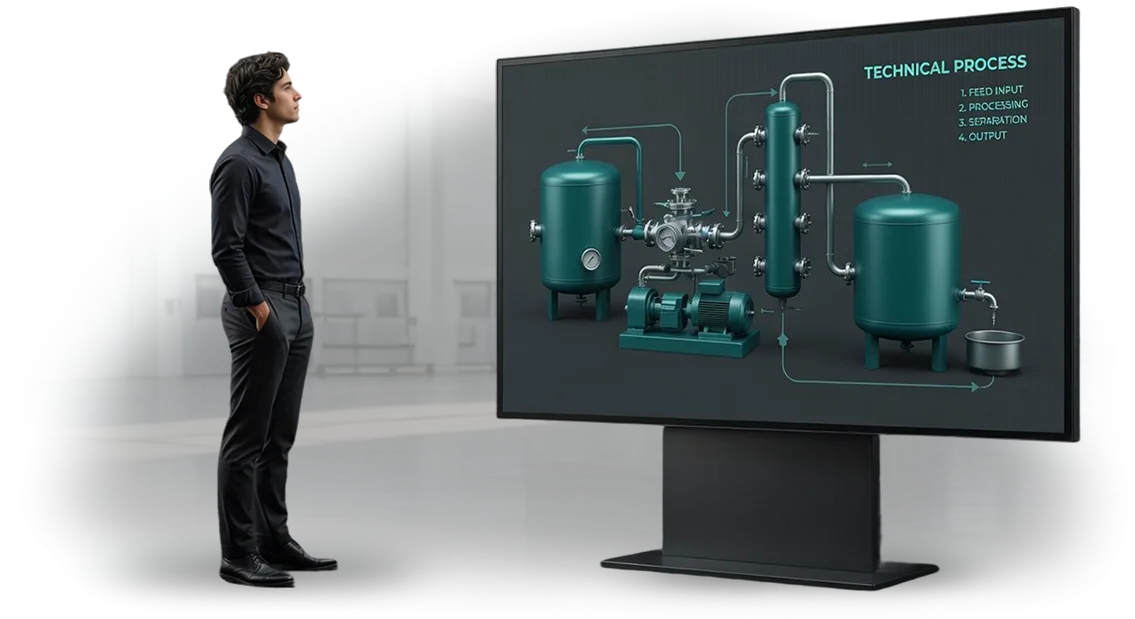
The problem is not inattentiveness or a weak regulatory framework. Classic staff training is built on transferring information, not on developing safe behavior skills. When an employee sees dry diagrams and tables, their brain does not connect them to real risk.
They do not experience the consequences of an error, do not see how an accident develops in seconds and what exactly needs to be done to prevent it.
Industrial safety requires a different approach — not memorizing items, but readiness to act under stress. People remember what evoked emotion, what they saw with their own eyes and played in their head as their own scenario.
That is why familiar presentations and posters do not work: they do not create an emotional trace and do not teach decision-making.
A modern solution is educational video instructions built on the principle of immersion in the situation. The employee sees the production facility, hazardous factors, and the development of events from the participant's point of view.
They observe what a violation leads to and remember the correct sequence of actions as the only possible way out. Such staff training reduces the number of violations because it changes the attitude toward risk from abstract to personal.
We develop CGI video instructions that turn occupational safety from a formal obligation into a clear and memorable process. Instead of lectures — realistic scenarios, instead of checkboxes in the logbook — real readiness of employees for emergency situations.
What Do Training Video Instructions Give a Company?
Employee video training in the energy sector solves a specific problem: reduce the number of errors and accidents without increasing the workload of instructors.
Instead of endless lectures and paper memos, a person sees real scenarios — from a typical switching operation to an emergency. Thus knowledge becomes part of habit rather than a temporary memory aid.
The first measurable result is fewer errors. An employee who has completed video instruction acts according to a single algorithm and less often misses critical steps. This directly affects accident rates and the cost of downtime.
The second is faster staff adaptation. A new specialist watches short videos at their own pace and immediately starts on work tasks without waiting for a mentor to become available. The average onboarding time noticeably decreases.
The third is a unified knowledge standard. Video lessons fix the correct sequence of actions and eliminate discrepancies in the interpretation of safety rules. No matter what happens on the site, each employee acts according to one logic.
The fourth is stress-free inspections. Knowledge assessment is built into the process: after each module, the employee answers questions, and the system shows who has mastered the topic and who needs review. Instead of total control — a transparent picture of competencies.
We develop such video instructions on professional equipment and in accordance with industry regulations. As a result, you get a ready-made package that works to reduce accident rates and is regularly updated without contacting a contractor.
Which Video Instruction Formats Suit Different Tasks?
The same video instruction does not cover all training tasks. For mass briefings, short videos that an employee can watch in 5–7 minutes and immediately answer control questions are needed.
For hazardous operations — an interactive scenario where the worker chooses actions himself and sees the consequences of a mistake.
The formats also differ in value for business: mass briefing saves instructor hours, interactive improves retention, and full 3D animation allows training for rare emergency situations without risk or production downtime. For remote sites, a distance learning system with access from anywhere is separately needed.
| Video instruction format | For what tasks | What it gives the client |
|---|---|---|
| Short videos for mass briefing | Daily training of all employees, repetition of basic rules | Fast coverage of the team, control of views and testing, saving mentors' time |
| Interactive scenario with action choice | Hazardous operations, work with equipment, emergency situations | Employee trains the correct reaction before real work, the risk of error is reduced |
| Full 3D animation | Rare scenarios: accidents, fires, evacuation, complex units | Visual demonstration of what cannot be filmed on video, safe practice of critical situations |
| Distance learning modules | Remote sites, shift crews, branches | Unified knowledge standard in all departments, automatic completion reports |
The choice of format depends on the goals: if you need to quickly train hundreds of people — short videos are suitable; if readiness for an emergency is important — interactive and animation.
At the briefing stage, we analyze your tasks and offer the format that will give a measurable result: reduction of briefing time, higher test pass rates, and fewer violations.
Stages of Developing a Corporate Video Instruction
Developing a corporate video instruction is not just "shoot and edit" but a structured process that leads to a concrete result: employees learn safety rules and act correctly in emergency situations.
We have completed dozens of projects in the energy sector and refined a transparent route from brief to launch. Below are the stages by which a video instruction is created.
How We Built the Process
- Brief and analytics. We immerse ourselves in your specifics: study regulations, analyze typical personnel errors, and identify which scenarios are most often dangerous.
- Training script. We turn dry instructions into a story with clear logic: what happens, where the risk is, how to act correctly. We coordinate the script with your experts.
- Video course approval. We show the storyboard and scene descriptions before production begins. You make edits here — this saves time and budget.
- Production. We create the video instruction on professional equipment and with refined tools. We take into account your brand, occupational safety standards, and features of energy facilities.
- Review and refinement. We test the material on a small group of employees, collect feedback, and make final edits.
- Implementation of the video instruction. We adapt the files to your distance learning system, set up access, and verify that the video opens on all devices.
- Support. When regulations change, we update scenes, help relaunch the course, and answer employee questions.
What Does the Video Instruction Delivery Package Include?
The full delivery package of a video course is not just files with videos, but a ready-made system for launching training.
You get everything you need for employees to start training as early as next week, while the person responsible for training does not spend time refining content.
We put together the package so that it covers all stages: from showing the video to monitoring completion and updating materials. Therefore, the package includes:
- Ready video instructions on safety in the energy sector — in formats for any devices and distance learning systems. The videos can be immediately uploaded to the LMS, shown on tablets, or displayed on screens in the work area.
- Source materials — all files from which the videos were assembled: video sequences, graphic elements, text base. If the regulation changes, you can quickly make edits with your own team or order an update from us without reshooting.
- Scripts and texts of all instructions — in a convenient form for coordination with occupational safety specialists and lawyers. This simplifies content approval and serves as a basis for knowledge testing.
- Instructions for using the package — a guide for the LMS administrator and trainer: how to upload courses, configure access, and track employee progress.
- Methodological recommendations — how to integrate video instructions into the existing training program, which scenarios to use for initial and repeated briefings.
- Content updates — after regulations or internal instructions change, we update the videos and provide a new version of the package. You are not left with outdated materials.
- Technical support after launch — we answer your employees' questions, help set up access, and resolve any difficulties with the videos.
Such a video course delivery package saves your team weeks of work and ensures that safety training starts without delay. You receive not "raw material" but a clear tool with clear instructions — all that remains is to assign the course and launch training.
Practice Example: Video Instructions Improved Safety in the Energy Sector
Traditional briefing in the energy sector often comes down to reading regulations — employees formally listen but do not remember action algorithms in an accident. For an industry where the cost of a mistake is health and life, this approach is too expensive.
Video instructions solve this problem: the scenario is demonstrated visually, and personnel see the consequences of violations without real risk.
For one of the energy holdings, we developed a series of CGI occupational safety video courses. Instead of dry instructions — simulated situations: from working at height to actions during a leak. All line crews and dispatchers completed the courses.
Six months later, the enterprise recorded a twofold reduction in violations, and the time of initial briefing decreased by a third — employees absorb the material faster and without interruption to production.
Implementation Results
| Indicator | Before video course | After video course |
|---|---|---|
| Safety violations | 10–12 per quarter | 4–5 per quarter |
| Initial briefing time | 40 minutes | 25–27 minutes |
| Passing final test on first attempt | 62% of employees | 91% of employees |
The secret of effectiveness is realistic scenarios and a unified picture for all departments. An employee sees the correct sequence of actions, remembers it, and transfers it to real work.
Management receives a transparent training process: it is possible to set up testing and see who has mastered the material and who needs re-study.
Using the same principle, we create briefings for other energy facilities — from thermal power plants to distribution networks. Tell us about your task, and we will show examples for your areas.
How to Choose a Format for Non-Standard Company Requirements?
Standard training video rarely covers the non-standard requirements of energy companies. Different sites have different equipment, their own regulations, and procedures. Rare operations that occur once a quarter or in an emergency cannot be safely and quickly filmed live. As a result, employees receive general information instead of clear instructions for their area.
Therefore, we choose the format not by template but for a specific scenario.
First, we analyze the operations that need to be covered: frequent actions require short videos for quick repetition, while rare and complex ones require detailed video instructions with computer graphics showing every step without risk to personnel. This approach allows dangerous processes to be clearly demonstrated without endangering employees.
When a company has several sites with different specifics, we create a base scenario and adapt it to each site: change equipment names, regulation numbers, and sequence of actions.
This is not duplicating the same instruction, but a modular system where the general logic is preserved and details correspond to the real work of employees. As a result, you get a set of video instructions that considers the features of each area.
Individual scenarios are not a cost increase but a way to improve training effectiveness. The more accurately the video repeats an employee's actions, the faster they remember the correct order and the fewer errors at work.
We help choose a format that solves your specific task: from one complex video to a series of short instructions for different departments.
Frequently Asked Questions About Developing Video Instructions
Most often, energy sector clients come with similar concerns: how much time will it take to create video instructions, how often they will need to be updated, how to confirm that employees have absorbed the material, and what guarantees can be expected.
These are valid questions — the safety of personnel and the continuity of operations directly depend on the quality of training.
Deadlines are manageable without losing quality. We produce a standard video instruction in three to four weeks, and if urgent, we speed up the process to two weeks.
Updates do not require full reshooting: it is enough to change individual scenes, title sequences, or voice-over text, so instructions remain relevant for years and revision costs remain predictable.
Learning assessment is an integral part of the project. We do not just deliver video but embed check questions and a final test into it. The system shows which employees have completed training, where errors are concentrated, and which topics require additional review. This turns video instructions from a carrier of information into a competency management tool.
Result guarantees are fixed in the contract: deadlines, number of revisions, format, and acceptance criteria. We work on professional equipment and with a proven team — the energy sector is not for experiments, so we take on the risks of production stages.
How quickly can an instruction be adapted to new regulations?
Usually edits are made within three to five working days. If only the voice-over text or individual visual fragments change, we update the video without replacing the entire recording. After new standards are issued, you have time to retrain personnel before inspections occur.
Start Your Video Instruction Project Right Now
The need for clear video instructions on safety in the energy sector grows with every new regulation. But managers often postpone the project because of uncertainty: how long development will take, who will do it, and what source materials are needed.
We simplified the start: after a short request, you receive a brief, work plan, timeline estimate, and team composition — without lengthy negotiations and approvals.
The development brief helps capture training goals, topics, and formats — so the video instruction solves your specific task, not just "looks nice." The work plan shows all stages from script to final edit, and deadlines are calculated for your schedule. You see the full picture and decide to start within one day.
Here is what you get immediately after your request:
- a brief for video instruction development: questions about the audience, safety scenarios, and format;
- a work plan with stages and milestones;
- a timeline estimate based on your calendar plan;
- team composition: director, scriptwriter, artists, animators, editors;
- acceptance procedure and number of revision rounds.
This approach helps energy sector companies launch training without schedule disruption: employees receive unified standards, and managers receive a clear process and predictable results. You can order a video instruction right now by submitting a request on the website.
Video course development will begin with a brief — you spend a few minutes, and we prepare everything else.
Start your project today to make it in time for the next training cycle. Send your request — and by tomorrow you will have the brief, plan, and timeline.