

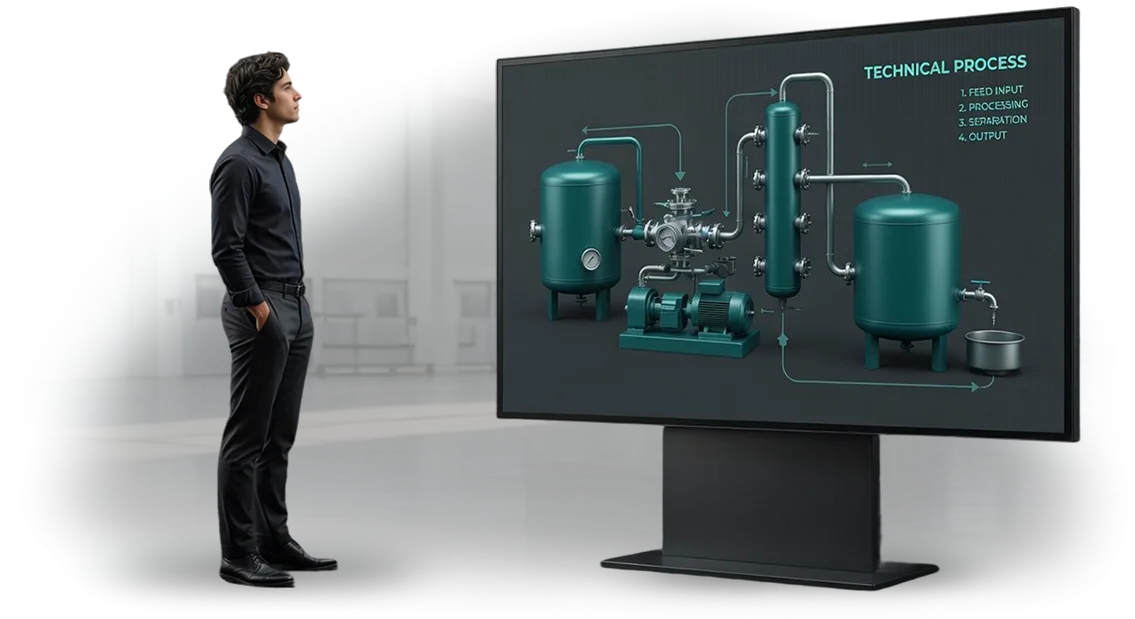
Video instructions for safety in the mining industry
Why do employees violate safety requirements even after briefings? It is not a matter of negligence — it is that the text of a memo or an oral explanation does not create a clear picture of the danger.
A person does not see the real consequences of a mistake, so they do not connect a specific action with a risk to life.
Occupational safety in production requires that every worker understand not only the rules but also the physics of the process: where the mechanism is moving, how many seconds remain for reaction, what happens if a cable breaks.
In the mining industry, the cost of a mistake is especially high — people's health and lives are at stake. Traditional training formats do not provide this clarity, and knowledge remains abstract.
Our team bridges this gap with CGI instructions. We recreate real production scenarios: emergency situations, equipment operation, evacuation routes. The employee sees the action and its consequences from the outside — this is how a stable image of correct behavior is formed. This works where an instructor's words are powerless.
Video safety instructions solve three key tasks. They standardize training — every employee receives an equally accurate picture, regardless of the mentor's experience. They accelerate learning: a visual scenario is remembered faster than text.
And they create a unified knowledge base that can be reviewed before a shift, after an incident, or when hiring a newcomer.
For an occupational safety specialist, this reduces the load: there is no need to repeat the same thing at every briefing. For a manager — predictability: fewer violations, less downtime, lower probability of an accident.
Personnel training becomes a manageable process, and not a formality that everyone tries to get through as quickly as possible.
CGI makes it possible to show even scenarios that cannot be reproduced in reality: a methane explosion, rock collapse, brake system failure.
The employee learns from others' mistakes without risk to themselves — and at the same time gets a strong enough impression to remember the lesson for a long time.
How video instructions reduce injuries and downtime
Any accident at a mining enterprise is not only a risk to people's health, but also a work stoppage, fines, and reputational losses. Video instructions solve this task systemically: the employee sees the correct algorithm of actions and brings it to automaticity.
We create realistic 3D videos that show the process through the worker's eyes. They can be used during introductory briefing, at shift handover, or in a distance learning system. This format is easier to perceive than any regulations and is remembered for a long time.
Reducing injuries
When an employee sees real scenarios — how to secure a safety line, how to act in a gassy atmosphere, how to stop a conveyor in an emergency — they memorize the sequence of actions with their body, not just their eyes.
This directly reduces the number of accidents and the associated equipment stoppages. The company spends less on downtime, insurance payouts, and proceedings with regulatory authorities, and most importantly, preserves employees' health.
Fast adaptation of new employees
A newcomer immerses themselves in work processes in days, not weeks. Instead of reading long instructions, they watch short visual videos where each stage is shown from the point of view of a person who already works at the site. The mentor spends less time explaining, and the employee reaches a full shift faster.
Knowledge control
Video instructions are conveniently combined with a knowledge testing system: after watching, the employee takes a test, and the manager sees real results. This eliminates a formal approach where a signature in a log is enough.
The manager notices gaps in time and prepares personnel for certification, rather than learning about problems after an incident.
Productivity growth
When an employee is confident in safe actions, they work faster and without unnecessary pauses. Automatic skills reduce the number of errors and downtime for rework.
As a result, the same crews produce a larger volume, and production indicators grow without additional equipment costs.
Video instruction formats: 3D videos and interactive simulators
Safety training in the mining industry does not allow for formalities. An employee may pass a test but become confused in a real situation and act from memory — with risk to themselves and colleagues.
To avoid this, formats are needed that translate requirements from an instruction into specific skills.
We offer two complementary formats: 3D videos for explanation and interactive simulators for practice. Below is a table showing which format addresses which task.
| Format | For whom | What it gives the customer |
|---|---|---|
| 3D animation for training | New employees, scheduled briefings, refresher knowledge checks | Clearly shows each step and typical mistakes without requiring production stoppage or filming at a hazardous site |
| Interactive simulators | Practicing actions during an accident or non-standard situation | The employee makes decisions independently in a safe environment, mistakes are analyzed without real consequences — the number of incidents is reduced |
| Multimedia instructions | Regular updating of requirements, distance learning | Hold employees' attention, are easily adapted to new regulations, and integrate into the company's training system |
The main thing the customer gets is a controlled learning process. 3D videos create a unified picture of correct actions, while simulators verify that the employee has not just watched but truly mastered the sequence of operations.
This approach reduces the time for introductory briefing and increases personnel confidence when working on site.
The formats are easy to combine: the same instruction can be shown as a video for a group and then reinforced individually on a simulator. This way you cover all stages — from familiarization with the process to monitoring employee readiness.
Stages of creating video instructions for your regulation
We build the process so that you understand what is happening at every step. A video instruction must follow your regulation exactly; otherwise, employees will learn by the wrong rules.
That is why we work together: you provide the standards, we turn them into a clear CGI instruction and return a ready training material.
- Brief and regulation review. We receive your occupational safety instructions, clarify hazard zones, common mistakes, and training requirements. We align on goals: what exactly employees should learn after watching.
- Script and storyboard. We describe each scene: employee actions, warnings, possible consequences. We show how the video will look, and you approve the logic before production starts.
- CGI visualization development. We create realistic 3D imagery of equipment, workwear, and movement routes. The employee sees a clear situation, not an abstract diagram.
- Verification against the regulation. Together with your occupational safety specialist, we check that every action in the video complies with current standards. We make edits so there are no discrepancies.
- Training kit. We assemble the videos into a single course, add tests and handouts for workers. Everything is ready for a distance learning system or in-person sessions.
- On-site implementation. We help launch training, answer questions, and when the regulation is updated, we update the video — keeping the material current.
This process eliminates duplicated work and missed deadlines: you see the result in advance at each stage and control compliance with your requirements.
What's Included in the Package: Script, Videos, and Briefing
We deliver not just files, but a ready-made corporate training system. All materials are packaged so that your occupational safety department can launch the briefing immediately after delivery — without rework or engaging contractors. Here is what is included in the kit.
- Instruction Script — a detailed text describing each scene, employee actions, and key safety rules. You approve it before filming, so the final video fully complies with your internal regulations.
- Video File Package — ready-made videos in several formats: for in-person classes, for a distance learning system, and for viewing on mobile devices. No self-conversion — just take and use.
- Instructional Materials — a guide for the instructor: how to structure a lesson, which points to emphasize, and how to check understanding of the topic. This saves your employees' time and makes the delivery consistent.
- Train-the-Trainer — we transfer to your specialists the methodology for conducting the briefing, so they can work independently and update materials when regulations change. You won't have to contact us every time.
- Test Assignments and Checklists — ready-made questions to check material retention and control sheets that confirm completion of training. This covers certification and discipline matters.
- Short Video for Review — a separate video with key safety rules that can be played before the start of a shift or included in regular mailings.
- Post-Launch Support — for a month after handover, we answer trainers' questions and, if necessary, make edits to the materials so that the system works without failures.
Case: 40% reduction in injuries after video instructions
For the mining industry, the cost of an error is not a fine or a defect, but people's health. A mining enterprise Altai-Ruda approached us: within six months, it needed to reduce safety violations in key areas.
Previous briefings did not work — employees reviewed the materials formally and a month later forgot the procedure.
What we did
We developed a series of video instructions for five hazardous operations: descent into the mine, work with explosives, conveyor lines, smoke/fire, evacuation.
Instead of dry text — a realistic 3D scene where all scenarios are played out: the correct sequence and consequences of an error. The employee sees the result visually and remembers the rules after two or three viewings.
We integrated the training into the enterprise's system, so 1,400 specialists completed the briefing in two weeks, without leaving their shifts. Previously, this took two months.
Implementation result
Six months later, injuries decreased by 40%, and identified safety violations — by almost half. The time for introductory briefing was reduced from a two-hour lecture to a 15-minute video and a short check.
The head of the occupational safety service noted: “Video instructions are the only format that employees actually watch to the end. We see changes in behavior at workplaces, not on paper.”
After such a result, the client transferred three more areas to video instructions: transport, emergency situations, and work with equipment. We are ready to analyze a similar case for your enterprise and show which processes should be digitized first.
What should be considered when implementing video instructions for safety?
First of all: a video instruction is not a video for the sake of a checkmark, but a working tool for reducing injuries. In the mining industry, risk does not tolerate generalizations: each enterprise has its own ventilation schemes, evacuation routes, equipment, and regulations.
Implementation begins with an analysis of your documentation — from occupational safety instructions to process maps — and only then is a script created for the actual conditions of your production.
The second common question is which format to choose. If you need to show hidden processes — rock movement, mechanisms in cross-section, the consequences of an error — CGI animation is the most illustrative: it makes the invisible visible.
For human behavior in a stressful situation, a training film with staged footage is suitable. We combine formats within a single series, and in practice this holds attention better than uniform videos.
The third point is implementation. Video instructions work when they are integrated into training: distribution after the introductory briefing, short check questions, repetition before a shift, recording of viewing in a log.
We make the series modular so that you can change the order and supplement materials without re-recording the entire set.
Finally, about methodology: we do not bring a ready-made template. First, we study the specifics of the enterprise, meet with occupational safety engineers, and take your existing regulations as a basis.
That is why the instructions do not remain dead weight, but are actually used by employees and withstand inspections by supervisory authorities.
Frequently asked questions about developing video instructions
We have collected answers to the questions most often asked before ordering: timelines, updates, materials, guarantees. Brief and to the point.
How long does it take to develop a video instruction?
On average, 2–4 weeks: from brief to final video. We approve the script and storyboard — you see the result before animation.
Exact timelines are fixed in the contract. If you need to speed things up, a priority mode is available: it preserves all control stages.
Can instructions be updated after launch? Yes, the videos are assembled on our side, so a new version of a regulation is not a reason to reshoot everything from scratch. We change only the necessary scenes.
You pay for targeted edits, not for a new project. This keeps the instruction series cohesive. What materials do you need from us? The minimum set is your safety instructions, regulations, and descriptions of situations. From them we create the script, storyboard, and voiceover text.
If you have diagrams, photos, or videos, that is a plus, but not required. Editors will help structure the material so a newcomer can understand it.
What guarantees do you provide? Deadlines, approval stages, and the number of revisions are fixed in the contract. If a technical error is found after delivery, we fix it at our own expense.
We formally secure confidentiality: we do not transfer regulations and videos to third parties. You receive exclusive rights to the instructions.
Order video instructions: get a cost estimate in 2 days
Leave a request — and in just 2 days you’ll receive a cost estimate for your script. We’ll contact you within one business day, clarify your requirements for the video instructions, and propose a format that fits your budget and timeline.
Expert consultation: we’ll determine which videos are needed first — for training new employees, for refresher briefings, or for analyzing specific hazardous situations. You’ll receive not just a cost estimate, but a well-thought-out solution for your tasks.
What you get after ordering
- Cost estimate in 2 days — no hidden payments or unexpected surcharges.
- A clear production plan: from script to final editing, with dates for each stage.
- Ready video instructions that employees watch to the end — a clear story instead of dry text.
- Adaptation to your regulations and safety standards, including industry specifics.
- Support at all stages — one manager is responsible for the project and keeps you informed.
- Rights to the finished materials: use the videos in training, on the internal portal, and during inspections.
We work under a development contract that fixes deadlines, the scope of video instructions, and the terms for revisions. You pay in stages and see the result at every step.
Ordering video instructions is easy — click the button below or call us. In 2 days you’ll know the exact cost, and in a few weeks you’ll receive videos that genuinely reduce the risk of injury and save instructors’ time. Shall we start with a short consultation?