

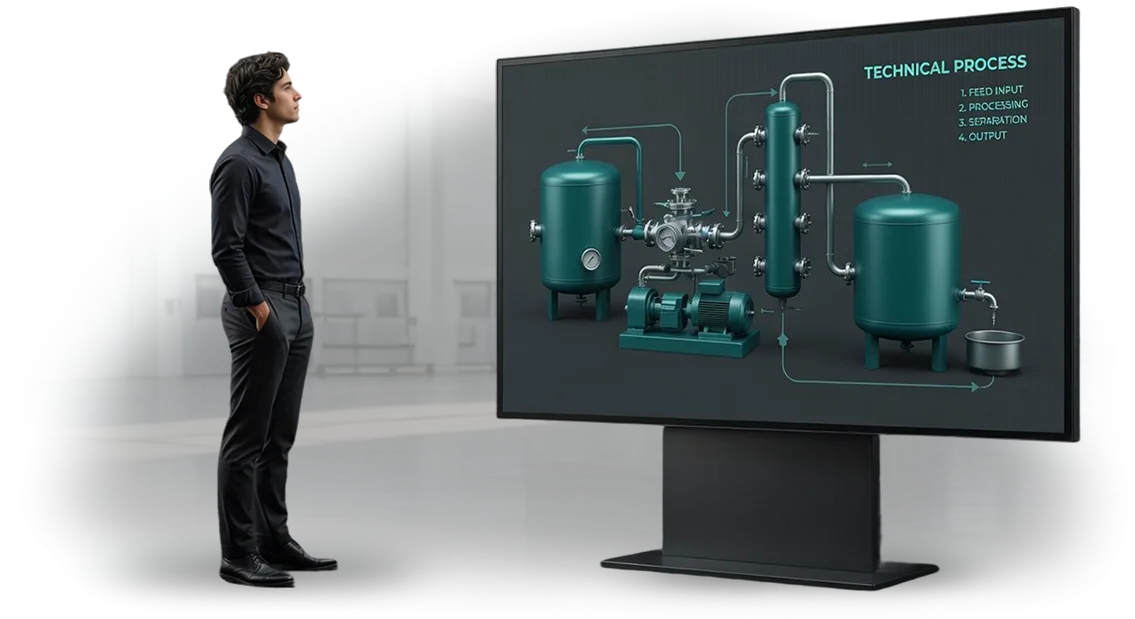
Why safety briefings in laboratories don't work
Standard safety briefings in laboratories most often turn into a mere formality. Employees nod, sign the logbook, and within a couple of days can no longer remember where the emergency exit is or how to act when a reagent spills. Staff training happens just to tick a box, while the responsibility remains high.
The consequences of this approach aren't visible immediately, but they hit the business hard. Violating laboratory safety means the risk of injuries, equipment damage, costly downtime, and proceedings with regulatory authorities.
Even a single incident can undermine the company's reputation and partners' trust, not to mention the moral side of the issue.
Why does this happen? It's not about employee laziness or bad instructions. A traditional briefing is text, a diagram, or a presentation that evokes no emotion and doesn't hold attention.
The brain quickly switches off from a stream of abstract rules, especially when it comes to situations the employee has never seen in person.
When staff training is built on real scenarios, it works differently. Video instructions that model dangerous situations and show the correct actions step by step engage visual memory and provide a ready-made behavior model.
The employee doesn't just memorize the instruction points — they understand the logic of safety and the consequences of a mistake.
That's why companies are replacing standard briefings with high-quality occupational safety video instructions. This format increases engagement, reduces the number of violations, and makes laboratory safety truly manageable.
What a quality video instruction gives for a laboratory
A quality safety video instruction is not just a video for reporting purposes but a working tool that reduces risks in the laboratory.
Employees remember the correct order of actions 60% faster than when reading instructions, and they are more willing to follow standards when they see real situations on screen.
In the end, there are fewer errors, fewer injuries, and initial briefing time is several times shorter.
When training is built on video, employee engagement grows — they watch the material in full rather than skimming text regulations.
This is especially important for laboratories where the price of a mistake is high: the understanding of the rules for working with reagents and equipment must be the same for everyone.
A video instruction sets a single safety standard, eliminating the discrepancies that most often cause incidents.
For management, this also means saving resources. A mentor no longer repeats the same thing ten times: new employees complete the course on their own, and knowledge checks happen at clear control points.
Training effectiveness becomes measurable, so you can track who has truly absorbed the material and is ready to work.
Investing in a quality video instruction is an investment in the company's reputation and corporate standards. When laboratory safety looks modern and clear, it increases client and partner trust, and employees feel cared for and work more calmly.
You get not just a training video but a system that every day protects the business's main asset — people and uninterrupted operations.
Formats of training video instructions for laboratories
For laboratory employees to truly absorb safety rules, one format is not enough. Someone needs a quick reminder before a shift, someone needs full immersion in the regulations, and someone needs a visual breakdown of an emergency situation. That's why we select video materials for a specific task, budget, and audience skill level.
Short videos solve specific issues — for example, reminding about protective equipment or the procedure for working with a reagent. Multi-episode formats build systematic training: from basic rules to complex scenarios.
Animation is ideal for showing dangerous processes that are risky to film in reality, while a demonstration with a real person brings the instruction as close to real work as possible.
| Video format | Suitable for what tasks | What it gives the client |
|---|---|---|
| Short videos (up to 2 minutes) | Quick reminders, pre-work briefings, review of common mistakes | Employees remember key rules faster, the number of violations drops |
| Multi-episode videos | Full training course, onboarding of newcomers, annual retraining | Systematic training without halting production, progress tracking for material completion |
| Animation / CGI | Dangerous scenarios, chemical reactions, equipment operation | Full visual clarity without risk to people or property, modeling of any situation |
| Demonstration with a real person | Practical skills, use of protective equipment, real work processes | Employees see the benchmark performance and replicate it, fewer mistakes in the first weeks |
This approach covers all the laboratory's needs: from an introductory video to a full safety course. And by combining formats, you get exactly the program that works to reduce risks — while staying within your budget.
We'll help you choose the optimal combination of formats and advise what will deliver the greatest effect at each stage of training.
How video instruction development works: 7 steps
A transparent process means confidence in the result. You always know what stage the project is at and what comes next, and we are responsible for timelines and quality at each step.
-
Brief and immersion in the task. We study your regulations, safety requirements, and laboratory specifics. We understand which scenarios need to be shown to employees for the video to truly work.
-
Script development. We turn dry instructions into a clear narrative with emphasis on key rules. You approve the text, wording, and logic — we make edits before production starts.
-
Storyboard and style. We show what the shots, characters, and graphics will look like. You see the future video in advance and adjust details without wasting extra time.
-
Video production. We shoot on professional equipment or create 3D graphics when we need to show processes that cannot be filmed in a real laboratory. Your employees get a clear visual instead of abstract text.
-
Editing and sound. We assemble the material, add voiceover, subtitles, and graphic prompts. Already at this stage you see a draft version and understand how the video will be perceived by the viewer.
-
Approval and adjustments. We make final edits based on your comments, polish details, and approve the finished version. No important detail goes unnoticed.
-
Launch and delivery. We provide files in the required formats and help place the video in the training system or on the internal portal. When regulations change, we update the video so instructions always remain relevant.
What's included in the delivery of ready-made video instructions
The delivery package is not a single file but a working set that you can immediately use in training. We put it together so that the safety department and HR have all the materials for launch and control.
The standard package includes:
- Ready-made laboratory safety videos — final files for the learning management system, video hosting, and offline screenings. With subtitles, voiceover, and emphasis on critical actions.
- Scripts and storyboards — from the original idea to the final text. You'll be able to update individual shots without a full reshoot.
- Methodological materials — knowledge check cards, test questions, handouts, and checklists for instructors. Everything for turning the video into a full-fledged session.
- Usage license — covers internal training and distribution across branches. You don't depend on us for every launch.
- A list of key hazards and common mistakes — an analysis of real situations that formed the basis of the videos. Helps adapt instructions to your regulations.
- Source scene files — if needed, you can make short versions for different audiences.
With this composition, video instructions are implemented within a few days. Employees get clear rules for safe work, and managers get a ready-made knowledge control tool.
Case study: how we reduced the number of violations in a laboratory
The client — MedSintez pharmaceutical plant — contacted us after an inspection revealed systematic safety violations in two laboratories. Fines and orders were mounting, and standard briefings didn't help: employees skipped key steps when working with reagents and equipment.
Before the project, the laboratories recorded up to 12 violations per month, and one in every two was related to an incorrect sequence of actions.
We developed a series of CGI video instructions — visual scenarios where each step is shown from a first-person perspective, with emphasis on critical points: test tube labeling, acid neutralization, and use of PPE.
Results after implementation
After two months, the number of violations dropped by 73% — to three or four per month.
The time for initial briefing was reduced from two hours to forty minutes: new employees absorb the material faster, and inspectors note confident actions when emergency situations are simulated.
Most importantly, orders and fines for repeated violations disappeared, and production losses from laboratory downtime dropped by 40%.
The client valued the result so much that they ordered an additional block of video instructions for the quality control department and extended the contract for annual video updates when regulations change.
The cost savings, calculated after audit, were substantial each year — thanks to reduced fines, lower staff turnover, and faster onboarding of new employees.
That's why we are confident: quality video instructions pay for themselves within the first quarter and systematically raise the safety level in the laboratory.
Frequently asked questions about video instruction development
Before starting a project, clients have the same doubts: how long development will take, how often they'll have to redo things, whether employees will understand, and whether the budget will balloon. We've gathered answers to the main questions — so you know in advance how we work and what you get.
How long does video instruction development take?
The timeline depends on the complexity of the script and the number of shooting locations. We deliver a short video for one process in a few weeks, and a large series of instructions — in stages with interim approvals. The key thing is that at every stage you see the result and can adjust course.
What if regulations or equipment change — will we have to film everything again?
No, we build in the ability to update content. Professional shooting and editing allow us to make changes to a finished video: replace a segment, add a new block, or re-record the voiceover. You get a document that lives alongside your processes rather than becoming an outdated file.
How will video instructions affect employee engagement?
Short videos with clear examples are always easier to perceive than multi-page regulations. Employees watch them at a comfortable pace, return to complex moments if needed, and get distracted less often.
To monitor comprehension, we can add a quiz block — you'll immediately see who has completed the training and who needs a reminder.
What quality guarantees are there at each stage?
We work according to a clear procedure: we approve the script, show the footage before final editing, and give the opportunity to make changes. Technical control at each stage rules out a situation where the finished video doesn't match your expectations. You accept the work only after the result fully satisfies you and your internal regulations.
Will we stay within the planned budget?
We prepare a transparent cost estimate before work begins and include no hidden fees. Whether you need one instruction, several turnkey videos, or a comprehensive staff training system, we'll choose a format that fits your scale. At the brief stage, you'll receive a fixed estimate that won't grow during the process.
Do you still have questions about your task? Describe the situation — we'll send examples, tell you about timelines, and propose a solution for your budget.How to choose the video instruction format for your laboratory?
To choose the right video instruction format, first answer four questions: what is your budget, how complex are the processes, how many employees need training, and what result do you expect from the training.
The answers determine whether it will be a simple animation, a shoot with a real instructor, or a full CGI video.
If the laboratory processes are standard and visually clear, a concise instruction with live-action footage is sufficient. It is quick to shoot, easy to update, and perfect for regular initial briefings of new employees.
But when it comes to working with hazardous substances, hidden risks, or multi-step regulations, modeling is indispensable: the CGI format allows us to show even what cannot be filmed in reality — from internal processes to the consequences of a mistake.
The number of employees also affects the choice: if a large team needs training, one universal video with clear scenarios that can be reviewed at any time is more effective.
For a few specialists, a short modular version is suitable, where each person finds only the block they need.
The scalability of the format is directly tied to the budget: an animated instruction pays off over the long run because it doesn't need to be reshot with every regulation change.
Finally, define the training goal — to inform, to test a skill, or to build a safety culture. If the goal is not just to tell but to change employee behavior, it's worth choosing a video with before/after scenarios and an emphasis on consequences.
We help you select a format for your tasks and certification requirements, so you don't overpay for unnecessary detail and get exactly the result built into the training.
In 10 years of practice, we've seen laboratories with different budgets and complexity levels — and always found a solution that covers the main thing: employees absorb the rules and apply them in their work.
Tell us about your processes and goals — together we'll determine the optimal video instruction format that fits your team and budget.
Order safety video instructions for your laboratory
In a laboratory, the price of a mistake is measured not by a fine but by employee health and the company's reputation. A short safety video instruction reduces the risk of violations several times over: employees see the regulation visually rather than reading dry text.
To get this result, you don't need to dive into production details — we develop video instructions turnkey and take on the entire process.
Simply order video instructions — and within the next few days you'll receive an expert consultation and a preliminary project estimate. Then we move according to the agreed plan, and you control the key points: from the script to the final video.
What you get immediately after contacting us:
- A safety expert consultation — we'll help you define which scenarios need to be shown to your laboratory employees.
- A detailed project estimate after the brief — with no hidden surcharges or complicated formulas.
- A script that mirrors your regulations and accounts for the specifics of individual areas and equipment.
- Video production — from live-action shooting to computer graphics in a style consistent with your corporate standards.
- Editing, voiceover, and subtitles — ready-made videos for the learning management system or internal portal.
- Result guarantee: if you want to change something after the preview, we'll include the edits at the finalization stage without additional charges.
We work under a contract and approve every stage, so the "result guarantee" is not marketing but part of the process. That's why clients come back to us for new video instructions and recommend us to colleagues.
Order the development of video instructions for your laboratory right now: we'll briefly discuss the task, lock in the timelines, and show you what it will look like. We're ready to start as early as tomorrow.