

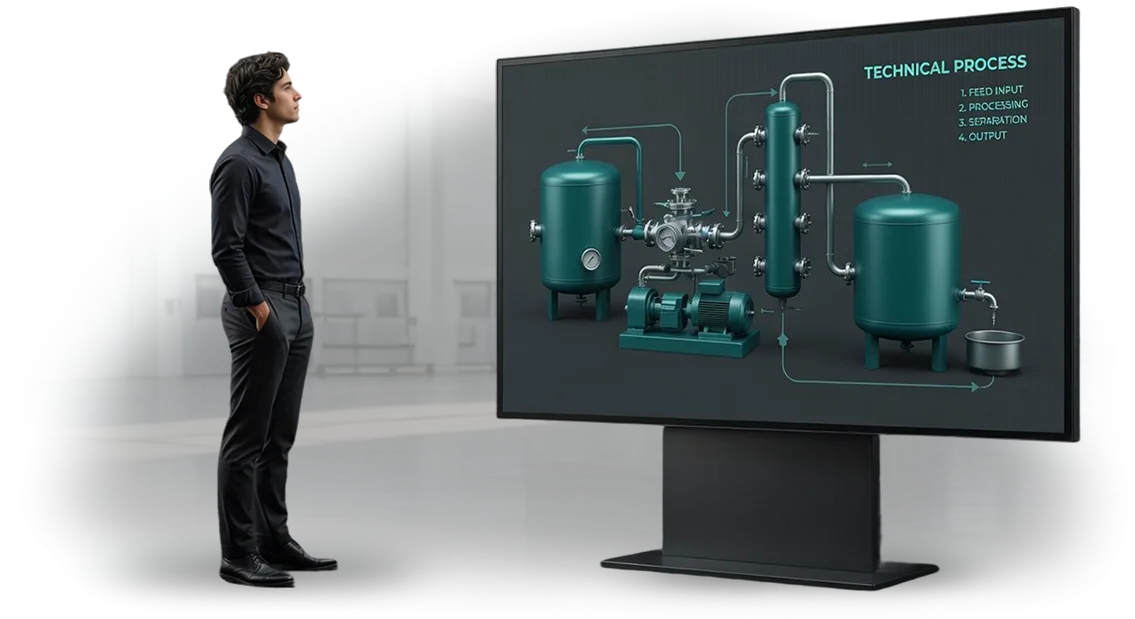
The Cost of Safety Errors in the Food Industry
Safety errors in food production cost more than they appear at first glance. Fines for non-compliance, unscheduled food product inspections, line shutdowns, and batch recalls — each such incident hits the budget and reputation.
But the most critical factor is workplace incidents: employee injuries, raw material spoilage, and incidents that can cost contracts with retail chains and distributors.
Most violations occur not because regulations are missing, but because employees do not understand or remember the rules. Text-based instructions are rarely consulted, and introductory briefings are forgotten within weeks.
Staff training becomes a formality: people sign an acknowledgment sheet but continue to act out of habit. This is where the main risk point for your business lies hidden.
Video instructions change this approach: the employee sees the sequence of actions, hazard zones, and correct techniques in motion. This format holds attention, is easier to absorb, and stays in memory longer.
We develop training video instructions that address the real needs of production — from sanitation rules to emergency response procedures.
Implementing such materials reduces the number of violations, improves staff readiness for inspections, and ultimately protects your business from financial and reputational losses.
What Video Instructions Deliver for Employee Training
When training relies on live lectures and the transfer of experience from one mentor to another, the quality of employee preparation is always inconsistent. One specialist explains thoroughly and according to standards, while another skips important details.
Video instructions solve this problem: every employee receives identical, verified knowledge regardless of who conducts the training or when.
Rapid employee onboarding is a direct saving of time and money. Instead of spending weeks studying regulations and asking colleagues questions, a new hire is productive within a few days.
They watch short videos, immediately see the correct sequence of actions, and apply it in practice. At the same time, experienced employees are not distracted from their own tasks to train newcomers — the video materials take on that burden.
In the food industry, the cost of a mistake is especially high: a violation of sanitary standards or technology can halt production and lead to serious consequences. Video-based corporate training helps reduce these risks.
The employee sees not an abstract instruction text but a real process: how to wash hands, how to handle raw materials, how to monitor temperature. Such knowledge is absorbed better and forgotten less often, which means safety standards are consistently met.
Online staff training offers flexibility: the employee works through the material at a convenient time, and the manager sees who has mastered the topic and who needs additional verification. This is not a one-time initiative but an ongoing professional development system.
Video instructions can be updated when regulations change, and the entire team is guaranteed to learn about innovations within one business day.
Ultimately, you get a predictable result: fast onboarding, a unified knowledge standard, and peace of mind regarding process safety. Training no longer depends on the human factor and becomes a manageable business tool.
Video Instruction Formats for Food Production Tasks
In food production, the cost of a mistake is people's health and brand reputation. Moreover, employees perceive information differently: some find it easier to see the process visually, while others remember diagrams and algorithms better.
There is no one-size-fits-all video, so we select a format for each specific task: from initial training of newcomers to regular re-certification of experienced personnel.
Below is a comparison table of the formats we use. Each one addresses a specific business objective and pays off through reduced risks and faster staff adaptation.
| Format | For whom and when | What it delivers to production |
|---|---|---|
| CGI animation | Demonstration of hidden processes: microbiology, air flow, contamination on equipment | Visually shows hazards that cannot be seen with the naked eye. Builds correct behavior models without contact with real equipment |
| Combined (footage + graphics) | Training for work on specific lines and machinery | The employee sees the real production area and simultaneously receives diagrams, highlights, and checklists. Minimum abstraction, maximum connection to the workplace |
| 2D animation | Briefing for new employees and mass training | Explains basic rules in plain language: personal hygiene, wearing PPE, labeling. Lowers the entry barrier and accelerates onboarding |
| 3D modeling | Analysis of emergency situations and their consequences | Allows rehearsing an emergency scenario without risk to people or equipment. Drills the action sequence to automaticity |
The choice of format depends on the audience's skill level and the complexity of the process. For example, short combined videos work best for regular refresher briefings, while animated stories work best for initial training.
When formats are combined into a single system, you get end-to-end training: from an employee's first day to advanced preparation of key personnel.
We help determine the optimal combination of formats for your regulations and budget — without unnecessary graphics where footage suffices, and vice versa.
The key criterion is that after watching, the employee clearly knows how to work safely and why it is critical for production.
How We Create Video Instructions for Your Staff
We have structured the process so that you see results at every stage and can influence them without delays or unnecessary approvals. Every stage of video instruction development is clear and transparent — from the initial brief to deployment in your training system.
-
Brief and task immersion. We document the goals, target audience, and internal regulation requirements. We study your technological processes and the areas where employees most often make mistakes — these become the foundation of the script.
-
Script and storyboard. We create the training video script with emphasis on critical actions and typical mistakes. We align the text and visual sequence before production begins so you know exactly what your staff will see.
-
Video production. We film and animate materials using professional equipment. We show complex components and hidden processes in cross-section: the employee sees what happens inside the equipment, not just on the outside — this makes the material more memorable.
-
Interim review. We show a draft version and incorporate revisions based on feedback from your technologists and safety department. At this stage, you control the accuracy of every detail and approve the final version.
-
Launch and integration. We deliver the finished videos in the required formats and help integrate them into your distance learning system. We set up access, verify playback on work devices, and track briefing completion.
-
Support and updates. If regulations or equipment change, we promptly update the video instructions. You can always request revisions — this is faster and more cost-effective than creating a video from scratch.
What Is Included in Corporate Video Lesson Development
Each corporate safety video instruction is not just a video clip but a training material designed to reinforce correct actions in employees.
Whether staff remember the sequence of actions during an emergency or process disruption depends on how the script is written and how the information is presented.
That is why we offer a complete package of work — from concept to a finished lesson that can be used in training immediately.
What is included in creating a video lesson:
- Training script. Based on enterprise regulations, food safety standards, and typical situations, we write a script in which the employee sees concrete steps. The result is clear instructions without unnecessary theory or filler.
- Storyboard. We plan the logic of every frame: transitions, highlights, and cues. This makes the material coherent and eliminates ambiguous understanding of hazardous moments.
- Computer graphics. Using 3D visualization, we show equipment, risk zones, and correct employee movements. Instead of an abstract diagram, the worker sees a visual example that is easier to apply in real work.
- Voiceover and sound track. A professional narrator places semantic emphasis on key actions. The voice accompanies the video even during background viewing — the employee remembers the sequence of operations faster.
- Editing and assembly. We synchronize the visual sequence with the audio track, add pop-up hints, and knowledge check questions. We assemble the final video in a format ready for upload to the learning platform.
- Adaptation to training formats. The same lesson can be used in in-person briefings, distance learning systems, or for self-paced viewing on a tablet. We select the appropriate resolution and duration so the material works on any platform.
This package allows you to launch training immediately after project delivery, without additional edits or approvals. Every stage is part of a unified system that reduces the risk of violations in production and helps employees confidently meet safety requirements.
Case Study: Reducing Injuries and Fines Within a Year
Standard safety briefings in food production are often a formality: the employee signs the logbook and forgets the rules within a week. The result: injuries, product spoilage, and fines from regulatory authorities.
In one of our projects, this situation cost the enterprise serious losses every year, but the problem was not the staff — it was the training method.
Zarya Meat Processing Plant approached us with a request: to rework the entire safety briefing system. Instead of paper memos, we created a library of short video instructions for every production area — from raw material intake to finished product shipment.
The videos cover real risks: working with knives and equipment, personal hygiene, wearing protective clothing, and emergency response actions.
What Changed Within a Year
Twelve months after implementation, we compared the metrics with the previous period. Workplace injuries dropped by nearly 40% — that is dozens of employees who avoided serious harm.
Fines from supervisory authorities fell by two-thirds: inspectors saw systematic safety work rather than one-off campaigns.
New employee training became four times faster: instead of two months of onboarding, it now takes two weeks. Video instructions can be conveniently shown on a tablet right at the workstation, and the tracking system records each employee's actual viewing. This allowed the plant to demonstrate compliance without unnecessary paperwork.
Most importantly, the result proved sustainable. A year later, the plant ordered an expansion of the library for other departments and now uses video instructions as part of its mentorship program.
For us, this case proves that well-crafted training videos pay off through reduced risks and lower costs for remediating violations.
How to Choose the Right Video Instruction Format for Your Enterprise?
Choosing a video instruction format is not about what is trendy but about what fits your objectives, production specifics, and audience. There is no universal solution: what works perfectly for one enterprise may not deliver results for another.
Therefore, the main criterion is not the budget itself but how quickly employees absorb the material and start acting safely.
The first selection criterion is the complexity and hazardousness of the processes that need to be shown. When dealing with multi-step operations with invisible risks (microbiology, cross-contamination, working with live electrical equipment), computer graphics are indispensable.
They allow you to "look inside" the process, show cross-sections, magnify particles invisible to the eye, and clearly demonstrate the consequences of a mistake. Standard footage often cannot convey this, which means the training will be less effective.
The second criterion is the audience and viewing conditions. If you have employees of different ages, skill levels, or shift schedules, the format must be equally understandable to everyone.
CGI instructions allow you to manage attention: highlight key actions, add emphasis and pauses, and use simple visual metaphors instead of complex terminology.
This is especially important in the food industry, where one person's mistake can stop a production line or create a risk for consumers.
The third criterion is how often regulations change. Production processes are not static: standards are updated, equipment changes, and new sanitary requirements are introduced.
In this case, the CGI format is more advantageous because edits are made faster and at lower cost than reshooting. You change one episode — and the instruction is up to date again.
If your processes are well-established and no major changes are planned, you can consider combining with live footage, but basic safety scenarios should still be built on animation.
We help you choose the right format for your tasks and budget: we analyze technological processes, target audiences, and update frequency. You get not just "a video" but a tool that reduces the risk of injuries and violations in production. Contact us — we will analyze your situation and propose the optimal solution.
Frequently Asked Questions About Creating Video Instructions
When planning employee training, you face questions: how much will the instructions cost, how quickly will they be ready, and will they become outdated within a month. We answer the key questions so you can make a decision with confidence.
How is the cost of video instructions determined?
The price depends on the format: live footage, animation, or a combined approach. The video duration and number of scenes also play a role. After the brief, we provide an itemized estimate by stage — you see what you are paying for and can adjust the scope if needed. This helps you stay within budget and avoid paying for unused options.
How long does production take?
Typically from two weeks to a month: the more complex the project, the longer it takes. At the start, we set the milestones and delivery date in the contract so you can plan the training launch.
If you need the video urgently, we discuss a separate schedule; in such cases, we select simplified formats without sacrificing quality.
How do you keep the instructions up to date?
We build the video from modules: each block can be replaced separately without reshooting the entire film. This allows instructions to be updated when standards or regulations change — quickly and without unnecessary costs. You will not have to order a new video from scratch every time.
How do you make training engaging?
Employees do not like dry lectures, so we use lively scripts, realistic situations, and short segments. This approach increases engagement and helps employees apply the rules in practice. As a result, employees remember more and violate safety requirements less often.
Get Turnkey Video Instructions Ready to Use
To order safety video instructions for the food industry, you will not need to understand the intricacies of CGI, editing, or voiceover.
Simply describe the task — we will handle the entire process and deliver finished videos that can be immediately added to your training program. Turnkey development means you see interim results and provide feedback at every stage, and the final package is fully ready for use.
We work according to a clear procedure — five steps, with no surprises in terms of timeline or budget:
- Brief and analysis of your safety instructions and regulations.
- Script and storyboard tied to your production areas.
- Creation of 3D models and process animations.
- Interim video versions and incorporation of revisions.
- Delivery of final files in the required formats and an LMS guide.
This process typically takes two to four weeks. You receive a complete set of training videos that meets safety requirements and saves time on repeated briefings. If needed, we can add subtitles, dubbing in other languages, or short versions for refresher purposes.
Order video instruction development right now: submit a request, and we will show you examples of our work in the food industry, calculate timelines, and prepare a commercial proposal. Everything turnkey — from script to finished files.