

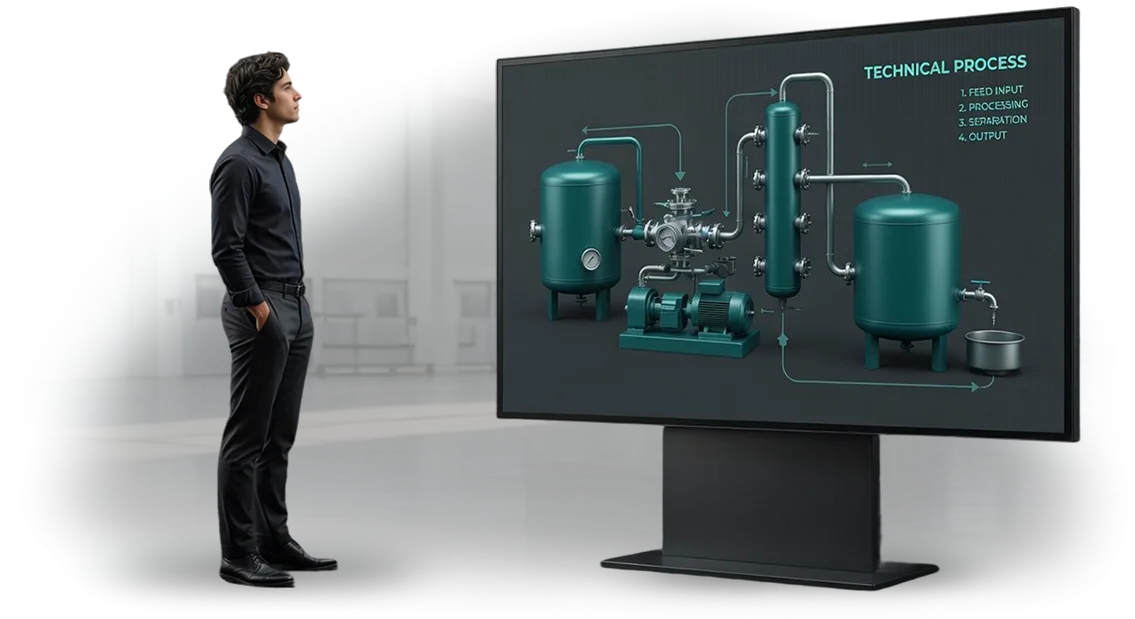
Safety in Shipping: How to Avoid Accidents and Downtime
In shipping, the cost of a mistake is measured not only in money, but in lives. An accident on a vessel means a missed voyage, damaged cargo, a fleet halted for weeks and, in the worst case, crew injuries.
Investigations by regulatory authorities, fines for violations and forced vessel downtime hit a company's budget far harder than the cost of quality training.
The problem is that traditional briefings and text-based regulations fail to hold attention: an employee reads the material, nods, and a month later acts the old way.
Video instructions solve this problem differently. They show correct actions concretely: how to secure cargo, how to act in a fire, how to behave in an emergency. A visual scenario is remembered and surfaces in memory at the right moment — when you need to act fast.
For the captain and vessel owner, this means fewer delays, predictable crew performance, and confidence that every crew member has been trained in the same way. A video lesson is hard to “turn a deaf ear to”: it cannot be skimmed diagonally like a dry document.
Moreover, the training system becomes transparent for management. You see which employees actually completed the material and which are only listed as trained. This reduces reputational risks and protects the company during inspections.
We create exactly these kinds of video instructions — based on your regulations and the specific features of your fleet. You get a ready-to-use tool that works for safety every day, rather than gathering dust in an instruction folder.
What Results Does Implementing Video Instructions Bring?
Traditional briefings and text reminders are a passive format. Employees remember only a small part, especially when it comes to safety in shipping, where the cost of a mistake is high.
Training videos hold attention through dynamics, visualization and specific scenarios — so information is absorbed naturally and stays in memory.
Implementing such videos directly affects performance metrics. Companies reduce the number of accidents and emergency situations because personnel see real dangers and correct actions in a visual form.
Employee engagement grows: staff watch instructions to the end, ask fewer clarifying questions, and become productive more quickly.
For a video to produce this effect, editing alone is not enough. We develop the scenario together with your specialists and use professional equipment and proven tools — this guarantees a stable picture, clear sound and a convenient format for viewing on any device. That is why shipping companies that are not willing to risk safety trust us.
Over 10 years of work, we have created hundreds of training videos for sea and river fleets. Our clients report lower risks after the first implementation stage: less simulator retraining, higher discipline, and a transparent certification system.
Video instructions work as a standard — every employee receives equally complete information, without distortion or misinterpretation.
Ready to see how this looks in practice? Request a pilot video for your instruction — and you will see the difference in information perception with your own eyes.
Video Instruction Formats for Your Tasks
Safety training for employees in shipping is not a formality but the foundation of accident-free operations.
However, ordinary presentations and reminders lack the needed visual clarity: it is hard to explain how to behave during a fire or a loss of containment without showing real processes.
Video instructions solve this problem, and the choice of format determines how quickly the crew absorbs the rules and starts acting correctly.
We develop video instructions for the specific tasks of your company. Below are the main formats, their audiences, and the business value they deliver.
| Format | For Whom | What It Gives the Client |
|---|---|---|
| CGI animation | For crew, port workers, contractors | Visually demonstrates emergency scenarios and the operation of ship systems that cannot be shown in real conditions. Employees memorize the algorithms without risk. |
| 3D instructions | For mechanics, engineers, repair services | Allow detailed study of ship components and mechanisms. Speeds up specialist training and reduces the likelihood of maintenance errors. |
| Interactive videos | For all categories of employees | Video with built-in questions and decision-choice scenarios. You immediately see who has absorbed the material and who needs additional training. |
| Short reminders | For all personnel before a voyage or shift | Quick review of key safety rules. Minimizes the human factor and reduces the risk of violations. |
Formats are easy to combine: for example, CGI animation explains the theory, while interactive video tests knowledge. We handle the script, visualization, voiceover and adaptation to your regulations — you get a complete package for your training system. This saves weeks of your team's work and guarantees a single standard of employee training.
How We Develop Video Instructions: A Step-by-Step Process
A high-quality safety video instruction for shipping is not just a “picture with a voice.” To ensure the video reduces risks and accelerates staff training, we structure production as a project: with stages, checkpoints and a clear approval mechanism. Here is our step-by-step workflow.
-
Brief and analysis. We study the shipping company's regulations and analyze typical crew errors. You receive clear training objectives and a description of the video's audience — before production even starts.
-
Script and storyboard. We write the text and describe every scene, showing what it will look like. You can make unlimited edits — until the script is clear for every employee.
-
Technology selection. We determine what is more effective: full 3D visualization, on-board filming, or a combination. We fix the timeline and cost of each stage to avoid unexpected expenses.
-
Filming and editing. We arrange the site, and oversee safety, lighting and sound. The result is an edited video with professional graphics and voiceover.
-
Approval and checkpoints. We show intermediate versions and accept comments from all stakeholders. We formally approve the final version.
-
Delivery and adaptation. We provide the video in formats suitable for a screen on the vessel, a training portal, or in-person sessions. We include an implementation guide.
-
Updates and support. When regulations change, we make targeted edits to the relevant scenes — without a complete reshoot. This way, the instructions stay current and costs remain under control.
What Is Included in the Delivery: A Complete Working Package
“You receive not just a video but a complete working package — from the approved script to files that can be used immediately in your training system. We have thought of everything so that a safety specialist or HR manager does not have to finish, reshoot, or adapt anything. It is enough to open the instruction and launch the training.
Here is what is included in the delivery for every project:
- Script and storyboard — an approved text broken down by shot, with descriptions of actions and the narrator's lines. You see the logic of the future video in advance and can make edits before filming.
- Final video files in multiple formats — for the corporate portal, in-person briefings, and viewing on mobile devices. Every employee can complete the training from any workstation.
- Subtitles and voiceover — the text is duplicated for cases when part of the crew works in a noisy environment or prefers reading. On request, we can add a translation into the vessel's working language.
- Methodological recommendations — tips on how to integrate the video instruction into your current regulations: at which stage to show it, what questions to ask after viewing, and how to assess comprehension.
- Implementation guide — a step-by-step manual for your administrator: how to upload the video to the distance-learning system, issue access rights, and collect completion records.
- Update block — if safety rules or regulations change, we quickly make edits to the video without a complete reshoot. You receive an up-to-date version within the agreed timeframe.
This package saves your team weeks of work. There is no need to find a filming contractor, order subtitles separately, and then figure out how to upload materials into the LMS.
Everything is already packaged and ready to use — all that remains is to assign the training and track results.
Case Study: Safety in Shipping After Implementing CGI Instructions
On board a ship, every mistake can cost lives, and training crew in real conditions is too risky and expensive. Traditional paper briefings fail to hold attention, and new employees repeat the same mistakes.
This was exactly the request we received from a large shipping operator — they needed to reduce injuries and improve the quality of team training.
Instead of dry regulations, we developed a series of CGI video instructions with detailed simulations of emergency scenarios: a fire in the engine room, a man overboard, and cargo-hold depressurization.
The employee sees the situation unfold from a first-person perspective and naturally remembers the correct sequence of actions — without rote memorization.
This approach makes it possible to practice dangerous situations without any risk to people or equipment, and the videos themselves can be reviewed on a tablet or simulator at any port.
Implementation Results
Six months later, the company recorded a 34% reduction in injuries, and the number of safety violations halved. The time for initial onboarding of new deckhands dropped from two days to four hours — while material-retention test scores rose from 60% to 92% correct answers.
The success of the case lies in the fact that videos do not replace live briefings but reinforce them: they work equally well on a tablet screen in a cabin and on a large monitor in a training classroom.
The captain is always confident that every team member knows what to do in an emergency, and the safety department gets a transparent training system that pays off through reduced losses from downtime and fines.
We are already replicating this experience for other shipping companies, adapting the scenarios to their fleets and the specifics of their cargo operations.
How to Choose the Right Format for Your Company?
There is no single “best” format — everything depends on your training objectives and the specifics of your company.
Some organizations prepare new employees for their first voyage, others regularly repeat regulations with experienced crew, and still others analyze emergency cases.
Each goal needs its own format: short briefings before a watch, a series of modules for self-study, or detailed videos reviewing abnormal situations.
It is also important to consider the realities of working on a ship: limited time, shift schedules, and a multinational crew. The video must be easy to perceive, simple to switch between languages, and leave key rules in memory.
That is why we first ask who exactly will be learning, under what conditions, and what result you expect in a month — and only then recommend a suitable format.
Company specifics also shape the choice: vessel type, team size, classification-society requirements, and internal standards. One client prefers full-length videos of 10–15 minutes; another prefers short 2–3 minute scenes that can be repeated before starting work.
It is also important that the video can be easily updated when rules change — we define the structure in advance so that edits can be made quickly without a reshoot.
We treat format selection as solving a business problem: we analyze your training scenarios, audience, and safety requirements.
Then we propose the optimal number of videos, duration, and presentation style, so that the material actually works rather than simply “being in the database.” In the end, you get an instruction that the team genuinely watches and applies in practice.
Frequently Asked Questions About Developing Video Instructions
Every client wants to see a predictable process before launching video instructions: clear timelines, a transparent budget, and a result that works.
Over the years We have heard the same fears — from “what if we don't make it in time for the inspection” to “will the video be clear to the crew.” Below we answer the key questions so you can make your decision calmly.
How long does it take to develop a safety video instruction?
The typical timeframe is three to five weeks for a standard number of scenes. It can be faster for simple instructions, and longer when detailed 3D animation of complex equipment is required.
We set the delivery date in the contract and show intermediate versions at every stage, so you see progress rather than waiting for the result at the end.
If deadlines are tight, we have an accelerated format: you receive short draft videos for each module, and the final version is assembled step by step. This way, review can run in parallel with production.
What will the development of a video instruction cost?
The estimate depends on three things: the number of videos, their duration, and scene complexity — for example, whether mechanisms need to be animated, emergency situations modeled, or voiceover added.
After the brief, we prepare a precise commercial proposal and lock in all changes in advance, so the final amount does not “grow” during the process.
For companies with large teams, we offer package development: several videos on different topics work out cheaper per minute of finished content.
How do you guarantee the video will meet internal safety standards?
We start not with the visuals but with your documentation: regulations, checklists, company standards, and industry requirements. The scriptwriter and technical editor check every scene against the source materials, and you approve the text before animation begins.
The result is a video sequence that can be shown during briefings and presented to regulatory authorities.
Each video comes with a description of the regulations used — this simplifies inspection and audit.
What if we need to make changes after launch?
It happens: instructions change, the vessel moves to a new route, or new equipment appears. We keep the source files and make changes on request — from replacing a single scene to re-voicing an entire block.
For regular clients, we offer rolling support, where edits are made at a fixed rate without reworking the entire project.
Thanks to this, your video instructions do not become outdated and always meet current requirements.
Ready to Discuss Your Project? Get a Commercial Proposal
Safety in shipping is not just an item in an instruction manual; it is a system on which lives and a company's reputation depend. Every crew member must act confidently even in unusual situations, which is why training is built on real scenarios rather than dry theory.
We create corporate videos that employees watch with interest and remember to the point of automation.
Over 10 years of work, we have developed dozens of training programs for maritime and industrial companies. We know how to turn complex regulations into visual stories that are absorbed faster than ordinary texts.
If you need CGI video instructions, we will start with a consultation, analyze your task, and offer a solution that fits your budget and timeline exactly.
Leave a request — and receive a commercial proposal within one business day. A specialist will clarify the details, answer your questions, and help you choose a format, even if you are not yet sure where to start.
What you get by contacting our team:
- a consultation and analysis of your source materials;
- a commercial proposal with a transparent cost structure;
- format recommendations tailored to your crew's specific tasks;
- a clear work plan with fixed timelines;
- support at every stage — from script to implementation in the training system.
We work throughout the country and are ready for remote collaboration and a quick start. Fill out the form on the website or message us — we will discuss the details and prepare a proposal for your project. Safety begins with clear instructions, and we will help you make them understandable for everyone.