

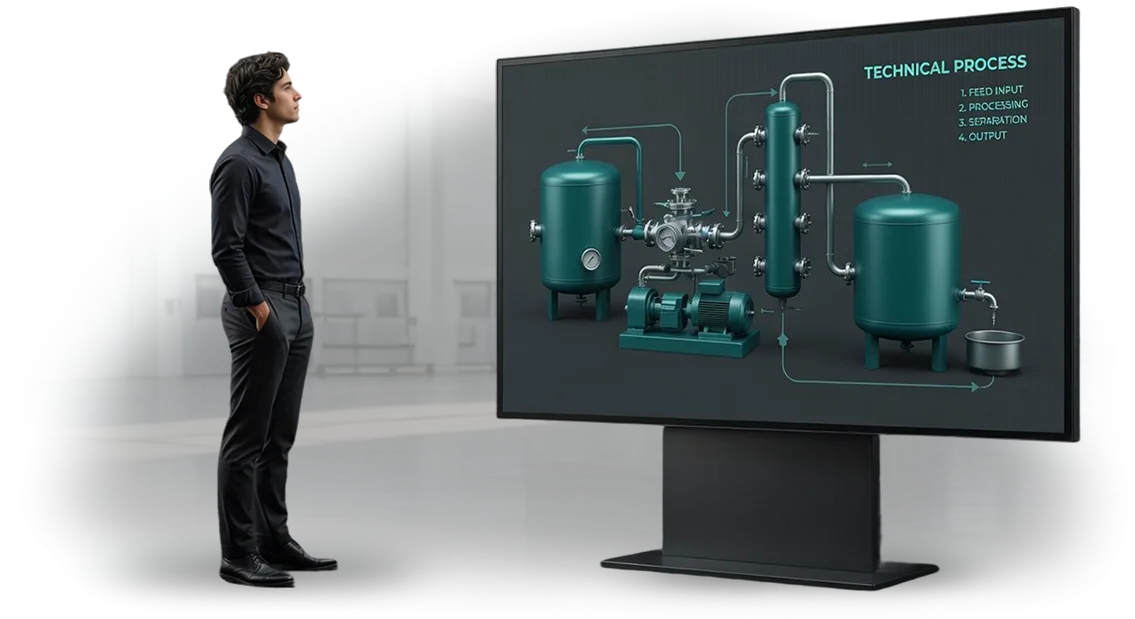
Safety in Confined Spaces: Why Briefings Don't Work
Every year, employees undergo safety briefings thousands of times: they listen to a lecture, sign their name, and return to work. But in confined spaces—manholes, tanks, and equipment compartments—it is precisely this formal attitude that leads to tragedies.
The rules are written down, but they do not become part of behavior. At a critical moment, a person acts out of habit rather than according to the instructions.
A typical briefing is built on theory and static presentations. It does not let an employee see the real danger, feel the sequence of actions, or understand the consequences of a mistake.
Therefore, after completing the course, the risk in confined spaces remains: a worker may fail to recognize the first signs of a hazardous atmosphere, fail to check their safety harness, or fail to evacuate in time. Knowledge exists, but it does not translate into skills.
For an employer, the stakes are high. An accident in a confined space leads to production downtime, fines, inspections, and reputational damage. But most importantly, it is about the health and lives of employees.
Occupational safety and industrial safety in such conditions require not formal checkmarks, but a guarantee that every worker is ready to act correctly.
Training video instructions with visualized confined space scenarios solve this problem. They show the danger and the correct actions in motion, allow employees to practice the procedure in a safe environment, and can be reviewed before starting work. This format is easy to update and adapt to specific equipment.
We help companies create such video instructions and transform training from a formality into real protection. The risks of confined spaces are thereby reduced—employees know how to act, and you gain confidence in the safety of your personnel.
What Safety Video Instructions Provide: 5 Key Benefits
What Safety Video Instructions Provide: 5 Key Benefits
Training employees to work in confined spaces is not a formality, but a direct safeguard for lives and business reputation. Text-based reminders and occasional briefings are poorly remembered: in a real threat, a person acts by guesswork.
Video instructions turn abstract rules into clear scenarios that employees see with their own eyes and remember at the level of actions. That is why we at our team create training videos that deliver five measurable results for our clients.
-
Reduced injuries and accidents. The employee sees typical mistakes and their consequences, so in a critical situation they act correctly rather than at random. For a manager, this means fewer downtime incidents and insurance claims.
-
Increased engagement in training. Short simulated situations hold attention better than multi-page instructions. Employees complete the course not "just for show," but actually delve into the details.
-
Savings in time and resources. Video instructions replace dozens of repetitive briefings. You create the video once—and use it for all new hires and during scheduled checks.
-
A unified training standard. Every employee receives the same level of knowledge, regardless of who conducts the briefing and how. This eliminates the risk of the "human factor" and inconsistency in requirements.
-
Rapid updates when regulations change. Replacing one episode in a video is simpler than transferring new requirements into dozens of documents and retraining personnel. The updated version is available to everyone at once.
Confined space safety video instructions are an investment that pays off through reduced risks and increased staff responsibility. Ask us about your situation—we will advise which format suits you.
Video Instruction Formats for Confined Spaces
Some situations are easier to show than to explain.
When working in confined spaces, the cost of an error is high, so the format of the training video must precisely match the task: sometimes attention to detail in processes is essential, sometimes emotional engagement of employees matters more.
We use three basic formats—separately or in combination. The choice depends on the content of the instructions, the level of the audience's preparation, and how the result will be used in the training program.
Video Formats for Different Tasks
| Format | For whom and when | What it gives the client |
|---|---|---|
| Computer graphics video | For occupational safety instructions where hidden risks, internal equipment structure, or emergency scenarios need to be shown | Clearly explains complex processes, eliminates risk for the film crew, easy to make edits |
| Staged (acted) video with performers | For practicing real actions: entry procedures, brigade communication, behavior in an emergency situation | High recognition; employees see a familiar environment and more easily transfer skills to practice |
| Combined format | For a full course where both realistic scenes and graphic explanations are needed | Maximum engagement: the storyline holds attention, while the occupational safety animation reinforces key rules |
For every project, we prepare sample fragments so that the client can see the final style before full production begins.
This division of formats helps companies reduce the time needed to onboard new employees and decrease the number of mistakes in limited spaces. You receive a ready-made training tool that integrates into your preparation program.
Development Stages: From Brief to Launch
We have structured the process so that you always understand at which stage the video instruction development is and what you will get as a result. You do not need to dive into production—you only need to approve key milestones; we handle the rest.
-
Brief and task audit. We discuss which specific confined space situations need to be covered, who the audience is, and what result you expect from the training. We fix the deadlines and format of the future video instruction.
-
Training video scenario. We write a script that breaks hazardous scenarios into simple steps: what the employee does, what is prohibited, and how to act in an emergency. You receive the text for approval before production begins—edits are made quickly.
-
Production plan. We select the location, actors, necessary equipment, and filming schedule. For complex scenarios, we use CGI modeling—this is safe and allows us to show even emergency situations without risk to the team.
-
Production. We film scenes or create them in 3D, ensuring compliance with the scenario and technical safety requirements. At each stage, we run intermediate checks to avoid reshoots.
-
Editing and finishing. We assemble the video, adding graphics, subtitles, and voiceover—so that key rules are memorable. You receive a draft version and a list of edits.
-
Approval and final edits. We make changes until the material fully matches your regulations. Usually two iterations are enough—after that, the materials are ready for delivery.
-
Implementation and launch. We hand over the finished video instructions in the formats you need and help with placement in your distance learning system or internal portal. We provide recommendations on how to track views and verify employee comprehension.
This process saves your time: you participate only at the briefing stage, scenario approval, and final version. We organize everything else ourselves, and the result is clear, safe training videos that employees actually watch and apply.
What's Included in Delivery: A Package for the Enterprise
The delivery package includes everything needed to launch training without lengthy setup or additional investment. It is a complete system: from the videos themselves to result tracking, with usage rights and support. Below is a full list of what you receive.
- Training CGI videos — a series of short video instructions on safe work in confined spaces. Employees clearly see the correct actions and remember the procedure faster.
- Instructor's manual — a ready-made lesson plan, discussion script, and recommendations for skill practice. Your specialist can conduct the training without preparation.
- Access to the training system — we place the materials in your system or ours; employees complete the course at a convenient time, and you track each person's progress. Monitoring does not require manual reports.
- Knowledge tests — ready-made questions and exam tickets for work authorization. Results are recorded automatically, which resolves documentation issues.
- Implementation support — we help configure everything to your internal regulations and consult employees during the first weeks. You are not left alone with the system.
- Content updates — when safety standards change, we adapt the videos and tests so that training always meets requirements. This eliminates the risk of outdated instructions.
Thus, you receive a working tool that can be used in training within just a few days. All that remains is to appoint a responsible person—and the system will start working.
Example: Reducing Injuries in Confined Spaces
Accidents in confined spaces are among the most severe in terms of consequences: a delay of even a few minutes can cost a life.
After each incident, the occupational safety department rewrites instructions, but text reminders and general lectures do not form the correct action algorithm under pressure. Employees formally know the rules, but in a real emergency they act confusedly.
We close this gap with detailed CGI video instructions that cover the entry scenario, atmosphere assessment, and evacuation. One client—a chemical industry enterprise—implemented such an instruction for the crews maintaining their tanks.
Within six months, injuries during confined space work decreased by 40%, and the number of violations during scheduled inspections halved.
The safety department head noted: "The video instruction gave what paper regulations could not—it creates muscle memory of actions before entering the tank".
Why does this work? The video instruction shows every step from the employee's perspective: how to check the gas detector, how to secure the safety rope, where to move when the alarm sounds.
The employee repeatedly sees the correct sequence and remembers it as a coherent algorithm rather than a set of abstract points. Moreover, the instruction is adapted to the enterprise's specific equipment and layout—generic phrases are excluded; only operational practice remains.
The effect is amplified by regular repetition: the video instruction is played before the start of a shift and after long breaks in work so that the skill does not fade.
According to specialists, residual knowledge three months after viewing is 60% higher than after traditional briefing.
For a business, this means fewer downtime incidents, reduced investigation costs and victim compensation, and above all—the preservation of employees' lives and health.
Such a result is achievable at any enterprise: we take your regulations, create an accurate video instruction based on them with consideration for your specific tanks and equipment, and then support the implementation.
Contact us—we will audit your current instructions and show which scenarios should be converted to video format first.
How to Choose the Right Format for Your Specific Situation?
Choosing the format of video instructions always relies on your individual requirements: the number of employees, their level of training, the specifics of working in confined spaces, and the requirements of supervisory authorities.
There is no universal solution—what works for a small team may be ineffective for training hundreds of people at different sites.
First, assess the task your employee will face: do they need to be shown a complex sequence of actions, taught to recognize danger, or trained in an emergency response procedure?
This determines whether to choose short 2–3 minute videos for quick review or an extended course divided into stages with mandatory control questions.
We approach format selection as an engineering task: we analyze existing instructions, regulations, and real working conditions, and then propose a structure that is absorbed most quickly.
If you have different departments and access levels, it is easy to assemble a combined scenario: a common block for everyone and individual modules according to site specifics.
It is important that the format not only conveys information but also allows verification of its absorption.
Therefore, the training structure often includes built-in questions after each block and a final recording of the result—this simplifies control and helps during certification.
This approach reduces the risk of human error and gives you a transparent picture of personnel readiness.
In the end, you get instructions that employees genuinely remember and apply in their work. Adapting the format to your specifics reduces training time, improves safety at sites, and lessens the burden on mentors.
Together with you, we will determine the optimal configuration and immediately move to its implementation.
Frequently Asked Questions from Clients About Video Instructions
When it comes to video instructions for confined space safety, frequent client questions almost always revolve around three points: alignment with company standards, production timelines, and guarantees on the result. We answer the main concerns—without technical details, only practical value.
What guarantees do you provide on the result?
Timelines and requirements are fixed in the contract. At each stage, we send an intermediate version—scenario, storyboard, draft render. If the video does not match the agreed technical specification, we make edits at no extra charge.
How does the adaptation of video instructions to your regulations work?
We start by reviewing your instructions and regulations. We involve your occupational safety specialists in approving the scenario so that all employee actions exactly match the official procedure. You approve each key frame before production begins.
What happens if the standard changes in a few months?
We keep the source files and project structure, so edits do not require a full reshoot. It is enough to replace individual scenes or actions—you receive an updated version in a short time and without extra costs.
Is it really possible to get a video in two or three weeks?
It is possible for standard scenarios. We always show a draft before the final render, and you approve the final version in parallel. This allows us to compress deadlines without losing quality and consistently meet expectations.
Order Video Instruction Development: The Next Step
To order a confined space safety video instruction, you do not need to understand the details of production.
We take the project turnkey: from scenario analysis to a finished video that employees will watch with interest rather than "for show." Book a consultation—we will review your situation, show examples, and offer the optimal format for your task.
We will explain how to integrate the video into your existing training program and take your site's specifics into account.
We work with professional equipment and proven tools—this means predictable timelines and stable quality. You see intermediate versions, make edits before final production starts, and always know what is happening with the project.
What you get when you reach out:
- A preliminary review of the scenario and risk areas for your site.
- A demo video on your materials—even before full production.
- A development plan with dates and responsible persons for each stage.
- A personal manager—no "handoffs down the chain."
- A full set of edits after delivery and a quality guarantee.
- Help integrating the video into your employee training system.
Submit a request now—in 30 minutes we will discuss the task, answer your questions, and show what your video instruction will look like. You will gain a clear understanding of the result and timelines, and we will begin work immediately after your confirmation.