

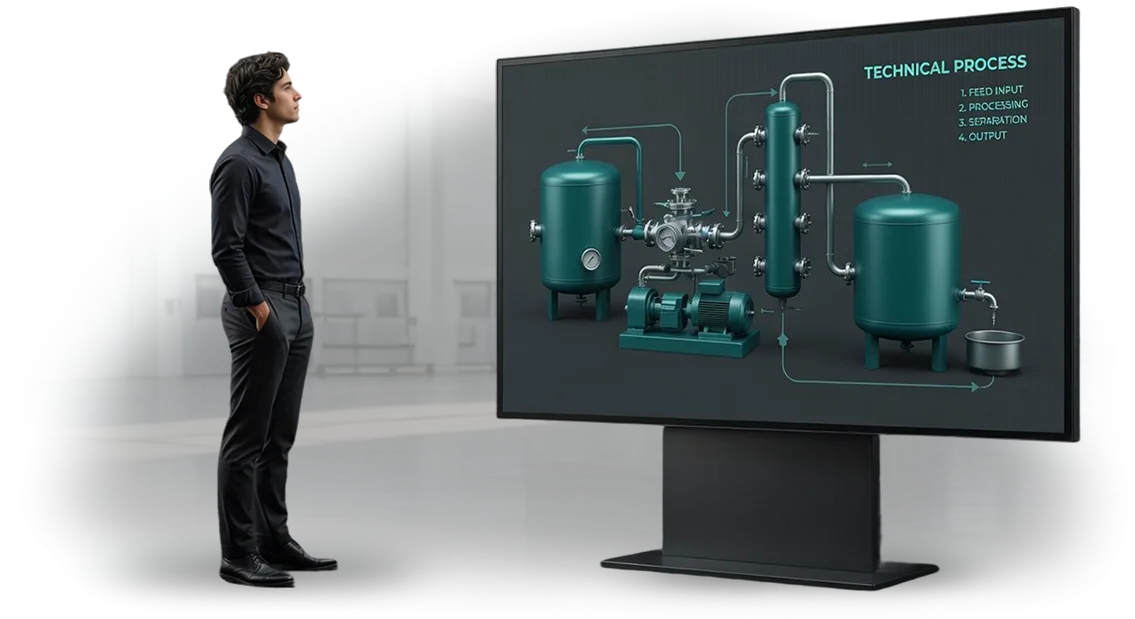
Why Environmental Safety for Employees Requires Video Instructions
Traditional environmental safety briefings often become a formality: an employee listens to a lecture, signs a log — and a week later no longer remembers how to sort waste correctly or act in the event of a spill.
Yet these very skills determine the safety of people, the company's reputation, and its relationship with regulatory authorities. Occupational safety is not about paperwork — it is about real actions that must be performed automatically.
Environmental safety requires precise algorithms: what to do in case of a chemical spill, how to dispose of hazardous materials, how to prevent contamination.
In a text handout or verbal briefing, these scenarios are easy to miss, and a single employee error can cost the company a fine or a production shutdown. Video instructions solve this problem: they show every step in action, with the correct sequence and in real workplaces.
When employee training is built on video, the company gets a unified standard.
Every employee sees the same clearly understandable visual, not an instructor's retelling "in their own words." This format builds a lasting skill: visual examples are remembered far better than text, and employees make fewer mistakes in non-standard situations.
In addition, video instructions can be reviewed and reused for onboarding new employees and for refresher briefings. This saves time for occupational safety specialists and ensures that all workers have absorbed the same material.
As a result, environmental safety stops being a formality and becomes part of the safety culture, and managers gain confidence that their personnel are truly trained.
We develop such video instructions tailored to the specifics of your production. We rely on a professional approach and many years of experience to turn environmental safety training into a clear and effective process. Leave a request — we will show you how it will work with your example.
What Video Instructions Give to Business and the Occupational Safety Department
Employees skim through text-based environmental safety briefings diagonally: the regulation exists, but nothing stays in their heads. The video format solves this — visual scenarios with real situations hold attention and demonstrate the correct actions.
For the occupational safety department, this is a manageable process, not "paperwork for inspection."
After switching to video instructions, businesses get:
- Fewer violations: the employee sees the consequences of a mistake and remembers the safe algorithm.
- Fast onboarding of newcomers: standards are mastered in a couple of days instead of weeks of reading documents.
- Engagement instead of "sitting it out": videos with scenario breakdowns hold attention better than slides and lectures.
- Knowledge control without manual checking: answers after viewing are immediately recorded in the system.
- A unified training standard: all branches and shifts receive the same interpretation of requirements.
- Less load on the occupational safety department: video explains standard topics, while specialists handle complex cases.
Our team has been creating such video instructions for companies from various industries for 10 years. We develop the script together with your ecologists and occupational safety specialists, shoot on real sites, and adapt the videos to your training system. As a result, the briefing becomes a working tool, not a formality.
Video Instruction Formats for Company Objectives
To make employees truly absorb environmental safety rules, recording a video alone is not enough — you need a format that holds attention and drives action. The same training can be delivered in different ways: from a short video to a full interactive program.
Each option solves its own task and delivers a measurable result for the business — from quick coverage to full knowledge control.
| Format | For Whom | What It Gives the Business |
|---|---|---|
| Short CGI video (1–2 minutes) | For mass onboarding briefings of new employees | Quick introduction to key rules, high engagement, easy memorization through an emotional storyline |
| Animated instruction (5–7 minutes) | For detailed breakdown of a specific procedure, work with equipment or hazardous substances | Visual demonstration of steps, fewer errors, reduced time spent on supervisor explanations |
| Interactive video with questions | For knowledge verification after training | Assessment of material comprehension for each employee, automatic completion report, possibility of retraining for low results |
| Full training program | For regular professional development of all departments | Unified training standard, systematic risk reduction, protection from fines and reputational losses |
When choosing a format, start from the goal: if you need to quickly introduce all personnel to basic standards, a CGI video will work — but if the topic involves complex regulations with liability for violations, an interactive program with result control is better.
We will help you select the optimal option and create a video that truly works for safety, not just exists for the record in reports.
How We Create Environmental Safety Video Instructions
To make environmental safety video instructions change employee behavior, a single video is not enough. You need a clear process built on video production stages: from studying regulations to built-in knowledge verification.
That is why we manage the project so that you see the result at every stage and can make edits before expensive rework.
- Brief and regulation analysis. We study the documents and typical scenarios, and examine where employees most often make mistakes. We determine the topics and the format of the series.
- Video instruction script. We write the text in short scenes that any worker can understand. We approve the structure before video production — we edit words, not finished videos.
- Layout and visual style approval. We show the storyboard, animation examples, and color scheme. We align everything with your corporate style so the video looks like part of the training.
- Video production. We create CGI videos using professional equipment, and add voiceover and subtitles. Short modules are easy to integrate into a course and update.
- Training implementation. We adapt the videos to your distance learning system, and set up the completion order and knowledge verification. The employee follows the path "watched → checked → reinforced."
- Launch, support, and refinement. We help launch the training, prepare instructions for administrators, and collect feedback. If regulations change — we update the modules.
This process saves your team's time and delivers a clear result: employee safety, reduced risks, and a ready-made training system without your own video production.
What Is Included in the Complete Video Instruction Package
When preparing training video instructions for employees, it is important to understand exactly what you receive after project delivery. We put together a complete package so you can launch the training immediately, without additional work or unexpected costs.
The transparent scope of delivery covers not only the videos themselves, but also all materials, rights, and support.
Here is what the package includes:
- Finished video instructions — final videos that can be placed in the LMS, on the corporate portal, or shown at induction sessions. The formats are chosen so that employees can watch them on any device.
- Source materials — working project files. If you want to change a wording, add a new block, or re-record a fragment, there is no need to order the project from scratch — edits are made quickly and by your own team.
- Script and instruction text — approved documentation with all lines, explanations, and the logic of each frame. This is the foundation for updating the training and aligning it with internal regulations.
- Methodological recommendations — a guide on how to integrate the video instructions into the training and knowledge verification process. We advise on how to organize viewing, reinforce the material, and track that employees have truly absorbed the rules.
- Usage rights — you receive the necessary rights to the videos and can use them within the company without restrictions on time or number of employees.
- Post-project technical support — a dedicated specialist available during the agreed period. We help with launch questions, integration into your system, and resolve technical issues if they arise.
This package covers the entire cycle: from receiving the materials to confidently using them in practice. You are not left alone with a finished file — you get a tool that is easy to implement and develop. If questions arise during use, we are available and help resolve them promptly.
Case Study: How a Manufacturing Company Reduced Violations in Training
Let us look at a real project from our practice: we received a request from a manufacturing company with 600 employees.
The client complained that environmental safety briefings were conducted "for show" — people skimmed through slides but kept repeating the same violations at work: incorrect waste disposal, failure to follow standards when handling reagents, carelessness in emergency situations. Fines and line downtime cost the business more than any expensive training.
We proposed replacing dry presentations with CGI video instructions: realistic scenarios in the form of short videos — how to act during a spill, how to sort waste, how to safely stop a line. The videos showed hazardous situations visually, without any risk to the film crew or employees.
What Changed After Implementation
Within just two months, the number of violations dropped by 43%, and follow-up knowledge checks showed that employees remembered the correct sequence of actions four times better than after a text-based instruction.
The training itself took three times less time — people no longer had to be pulled away from production for long periods.
Return on Investment and Repeat Order
The investment in video production paid off within one quarter through reduced fines and equipment downtime.
Six months later, the company returned with an order for a second series of videos — this time for an adjacent department — and plans to scale the format to all workshops in the coming year.
This case study shows that quality video instructions are not a decoration for the training process, but a working risk management tool. If your employees are also going through training formally, the problem is not discipline — it is the format of the material.
We help turn mandatory briefings into clear, memorable algorithms that are actually applied on the job.
How to Choose the Right Video Instruction Format for Your Task?
Let us start with the main point: each training task has its own optimal video instruction format.
There is no universal solution — the choice depends on what exactly employees need to remember, how complex the process is, what budget is available, and how quickly the finished material is needed.
There are only four selection criteria: the complexity of the material, the number of employees and their skill level, the available budget, and the urgency of deadlines.
For a simple briefing, animation is enough — but for hazardous production operations, you will need detailed 3D graphics that show every stage without risk to people.
| Format | For Whom / When | What It Gives the Client |
|---|---|---|
| CG video instruction (3D) | Complex technological processes, environmental and industrial safety | Complete visual clarity, can show internal mechanisms and hidden risks, reusable |
| 2D animation | Quick general rules, short regulations, induction courses | Low budget and tight deadlines, easy to update individual frames |
| Combined (live action + graphics) | Real workplaces where it is important to show equipment and actions | Familiar visuals for employees plus graphic explanations of complex components |
| Interactive video format | Knowledge retention control, scenario practice without consequences | High engagement, errors and areas for retraining are immediately visible |
If the budget is limited and deadlines are tight, choose 2D animation: it is cheaper and faster, and for most regulations it is sufficient.
However, when it comes to environmental safety, where the cost of a mistake is high, investment in quality CG graphics pays off through fewer accidents and violations.
In that case, we develop the script together with your technologists and create an instruction that eliminates ambiguous interpretation.
The remaining question is how to understand which format you need. We help you decide: we analyze the task, show examples of similar projects, and give realistic timelines and pricing before the work starts.
You get not "video for the sake of video," but a tool that genuinely reduces training time and the number of errors. Just describe the task in a couple of words — we will take care of the rest.
Frequently Asked Questions About Developing Video Instructions for Employees
Any employee training project starts with questions — that is normal. We hear the same objections: difficult to implement, unclear how to track viewing, what happens when regulations change. Here we answer the main ones so you can see how we mitigate the risks.
How difficult is it to integrate video instructions into existing processes?
Implementation is part of your training system, not a separate construction project. We study the regulations and task specifics in advance, so the videos fit into your processes without stopping work.
We help place the materials and set up access. You do not need additional specialists — we handle the technical side.
How do we control whether employees actually watched the video?
We track views: you can see who completed the training, who missed it, and with what result. The data is collected automatically and available to the manager in a convenient report.
If your company uses a distance learning system, we integrate the video with it — control remains in the familiar interface, without manual data collection.
Videos will quickly become outdated — what happens when regulations change?
We make instructions modular: each video consists of individual blocks. When a regulation changes, we update only the needed block, not the entire material from scratch.
We also provide an update plan — you always know which parts to replace and within what timeframe, so the videos remain current without unnecessary costs.
Are the videos compatible with our distance learning system?
We work with popular platforms and with client-built internal systems. At the brief stage, we identify your platform and choose a format that displays correctly and is tracked in the statistics.
If needed, we offer an alternative solution — a closed corporate cloud or a training portal. We verify compatibility before launch, so there are no surprises.
What if we are not satisfied with the result?
We work in stages: first the script and storyboard — you see the layout of the future video and make edits before production. This eliminates the situation where the finished video does not meet expectations.
The timeline and scope of work are fixed in the contract — you are protected from project delays and unforeseen expenses.
Ready to Discuss Creating Video Instructions for Your Team?
We invite you to start a conversation: tell us what tasks your team faces, and together we will choose the right environmental safety video instruction format.
We will discuss the task, clarify the specifics of your production, and show how a CGI video will meet your employees' needs without taking them away from work.
For a preliminary estimate, it is enough to send a description of the scenario, regulations, or instructions that need to be turned into video.
If you do not have ready-made materials — no problem: we will help structure your specialists' knowledge and turn it into a clear training video. Based on this information, we will prepare a proposal and calculate the cost within one working day.
The consultation is non-binding. You will get an honest assessment of timelines, budget, and project complexity — without technical details, only what matters for your decision.
We work remotely and have already delivered projects for companies across various industries, so we will quickly get up to speed on your task.
When you order a video instruction from us, you get:
- a finished video that employees will complete in 5–10 minutes instead of an hour of reading regulations;
- a unified training standard for all departments and branches;
- reduced risk of environmental safety violations through visual scenarios;
- the ability to quickly update material when standards change — without reshooting;
- support at every stage: from brief to integration into your distance learning system;
- files in the required formats for any devices and internal platforms.
Leave a request for the project — and tomorrow we will discuss the details and propose a solution that fits your timeline. To get started, just write to us — we will respond within one working hour.