

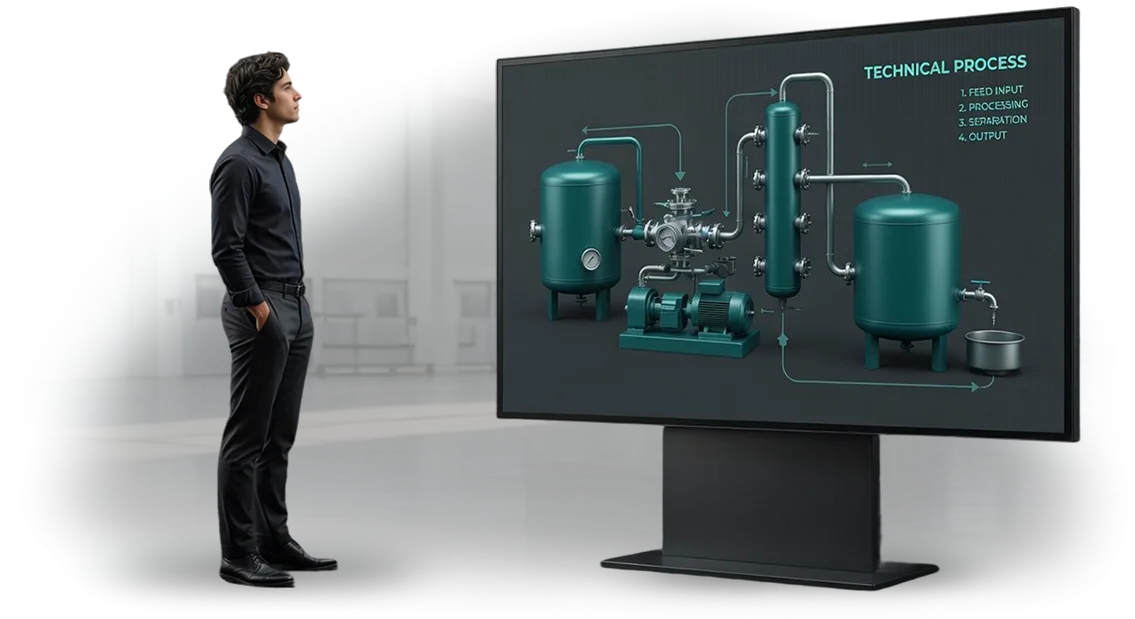
Chemical Safety Video Instructions: Why They Work
Employees ignore text-based chemical safety instructions — a situation every manager knows well. Reminders and regulations gather dust in folders, while violations repeat themselves time and again.
The result is a growing risk of incidents, injuries, and fines, while staff training becomes a mere formality that doesn't affect how people actually behave.
Video instructions change the approach to training. Instead of dry text — a visual scenario: how to work with reagents properly, what to do in a leak, how to use protective equipment.
This format is clear to every employee, regardless of experience, and is much easier to remember. Video shows actions in motion, so workers build the right behavior model before they ever face a dangerous situation.
Switching to online training with video instructions delivers measurable results for business: fewer violations, a lower likelihood of accidents and related downtime.
Managers get a tool that's easy to update when regulations change, and employees get the ability to learn at their own pace without leaving work. Workplace safety stops being a checkbox and becomes part of the safety culture.
We develop corporate video instructions for chemical safety that integrate into your training system. Our experience — more than 10 years and hundreds of projects — helps us create videos that employees watch to the end and put into practice.
Tell us about your challenge — we'll show you how video instructions can address precisely your risks.
Why Employees Remember Training Video Instructions
Employees remember not the text of an instruction but images and scenarios. Training video instructions from our team turn complex rules for working with chemicals into clear visual stories — this directly improves material retention and reduces the risk of errors.
Here's what this format brings to corporate training:
- Fast comprehension. Visualizing processes takes several times less time than reading regulations. An employee sees the sequence of actions from start to finish and remembers it from the very first viewing.
- Employee engagement. Dynamic visuals, realistic scenarios, and breakdowns of specific situations hold attention instead of forcing employees to "just sit through it." This improves the effectiveness of video training without extra effort from HR.
- Uniform standard. All employees get the same picture: one sequence of actions, one safety logic. No discrepancies from verbal knowledge transfer or paper reminders.
- Visual clarity. Hazardous processes — leaks, fires, reagent contact — can be shown in close-up detail without putting anyone at risk. This kind of visual clarity embeds correct reactions at the level of automatic response.
These principles work together. When training is visual, clear, and consistent for everyone, employees apply their knowledge faster in practice, and the company gets measurable results: fewer violations, greater awareness, and peace of mind for managers about process safety.
Chemical Safety Video Instruction Formats: Choose the Right One
Training video instructions for chemical safety solve different problems: some need to quickly introduce new hires to basic rules, others need to practice emergency response, and some need to verify knowledge before allowing employees to work.
The video format directly affects how employees perceive the material and how firmly they remember it. We match the format to your specific goal and audience so training takes less time and errors on the production floor become fewer.
Here's how the main chemical safety video instruction formats compare.
| Format | For Whom | What It Delivers |
|---|---|---|
| CGI animation | All employees, especially new hires | Visually demonstrates hazardous processes and hidden risks that can't be captured with a camera. Clear even without reading the instructions. |
| Voice-narrated video | Mass training of frontline workers | Quickly communicates key rules to a large audience. Can be used in onboarding briefings and refresher checks. |
| Interactive video | Authorization for hazardous work and knowledge checks | Employees choose their own actions in a simulated situation. It's immediately clear who has absorbed the material and who needs additional training. |
| Short video reminder | Daily rule reinforcement | Fits into the routine: before a shift, employees review critical requirements in a minute. Reduces violations caused by inattention. |
How to Choose the Right One for Your Situation
For a basic briefing, a voice-narrated video is enough, but for work with aggressive substances, CGI animation is a better fit: it shows chemical reactions, leaks, and protective measures without risk to the filming crew.
If you need to certify employees or practice responses to emergency situations, choose an interactive format — it delivers measurable results and also instills discipline in the team.
Clients often combine formats: CGI animation for demonstrating hazardous scenarios, voice-narrated videos for mass training, and interactive video for final assessments.
This creates a complete safety training system that meets workplace safety requirements and genuinely reduces the likelihood of incidents.
We'll help you determine the optimal set of formats for your specific needs and budget — start with a brief, and we'll offer a ready-made solution.
How Corporate Video Instructions Are Created: 7 Steps
We've structured the video instruction production process so you control the outcome at every important step. You get not just a video but a ready-made employee training tool that's easy to integrate into your chemical safety program.
- Video brief. We pin down the goal: who we're training, which safe chemical handling actions need to be shown, and what level of detail is required. The output is a clear technical specification approved by you.
- Script and storyboard. We write the instruction text and a visual plan for every frame. You can see what the future video will look like before production begins and make edits without extra costs.
- Layout approval. We prepare key frames in the final style, incorporating your brand graphics and design standards. Once you give the "OK," we launch full production.
- CGI graphics production. We create dynamic 3D scenes of chemical processes and employee actions — from tilting a flask to emergency equipment shutdown. This shows the instruction in a way regular filming never could.
- Voiceover and editing. We record professional narration, sync it with the visuals, and add subtitles and emphasis on hazardous moments. The video is ready for use in your LMS, on tablets, and in in-person training.
- Review and revisions. You receive the finished video and a review checklist: compliance with regulations, accuracy of terminology, legibility of subtitles. We make final edits until you're completely satisfied.
- Training launch and support. We hand over all source materials and an implementation guide. We help you connect the video to your distance learning system and answer employee questions after launch.
This approach saves your time and eliminates surprises: every stage is approved in advance, and the final video precisely matches safety requirements and your corporate style.
In the end, you get a video instruction that genuinely reduces risks and speeds up onboarding of new employees.
What's Included in the Video Instruction Delivery Package
When you order a chemical safety video instruction, it's important to get not just a video but a complete training solution. The full delivery package spares your team from reshoots, developing lesson plans, and transcoding files. We deliver a set that can be used immediately.
What's included in the package:
- Video script — approved text with storyboards, so every frame matches your regulations and is approved before production begins.
- Finished animation — a clear visual instruction showing the correct sequence of actions when working with chemicals, protective equipment, and behavior during emergency situations.
- File formats for different channels — video for your training platform, short versions for messengers and presentations, and files for large screens at meetings.
- Trainer's methodical materials — a lesson plan, key questions for knowledge checks, and a ready-made template for recording employee results.
- Adapted versions — separate videos for new hires, experienced staff, and different production areas, so training accounts for the level of preparedness.
- Implementation guide — a short checklist on how to upload the video to your system and organize training without involving contractors.
With this package, all that's left is to schedule the session and invite employees — all training materials, handout formats, and knowledge checks are ready. This saves your team two to three weeks of preparation and approval work.
Case Study: How a Video Instruction Reduced Errors on the Production Floor
For a large chemical plant, the main goal was to reduce the number of errors when working with hazardous reagents. Paper instructions and lectures failed to hold attention, and even a minor violation could cost downtime or an employee's health.
We proposed replacing part of the briefings with short CGI video instructions — with precise demonstration of every action and emphasis on critical points.
Together with the technologists at the chemical plant, we analyzed the five most common violations: incorrect sequence for draining reagents, untimely equipment lockout, and errors during sample collection.
For each scenario, we created first-person videos — the employee sees the process with their own eyes instead of reading abstract text. This format reduces the load on mentors and makes it possible to train several groups at once without losing quality.
Training Results
- A 40% reduction in violations in the first quarter after launch.
- Briefing time was cut in half: instead of an hour-long lecture, employees watch a 7–10 minute video.
- Shift handover errors nearly halved — meaning less downtime and fewer complaints.
- New employees started their shifts a week earlier because they received a ready-made action model instead of theory.
Importantly, the effect was sustainable. Six months later, the metrics had not returned to previous levels, and training effectiveness continued to grow: more than 90% of employees passed post-video assessments on the first attempt.
The client expanded the project to the remaining departments and ordered an additional series of videos for refresher briefings. This video instruction case study showed that a properly presented sequence of actions changes production habits faster than any regulation.
How to Choose the Right Video Instruction Format for Your Task?
There's no one-size-fits-all format — the choice depends on the specific task your video instruction needs to solve. If you need to quickly teach employees what to do during a reagent leak, a short 2–3 minute video with a clear algorithm is enough.
If it's about planned training for new specialists, you'll need a series of modules with knowledge checks. So first it's important to determine: who the audience is, what knowledge level they already have, and how you'll measure the results.
For chemical safety, videos that show the invisible are especially valuable. Animation makes it possible to safely demonstrate how an emergency develops, how substances mix, and what the consequences of a mistake are — without risk to people or equipment.
This format is remembered better than text or slides because the employee sees the process with their own eyes and remembers the correct sequence of actions.
Consider three scenarios. For regular rule reinforcement, short videos of up to a minute work well — they're easy to show before a shift. For in-depth training, use full video instructions that break down each operation.
And for practicing rare but dangerous situations — interactive scenarios where the employee makes their own decisions and sees the consequences.
The key is not to pick a format "by eye." We've launched dozens of employee training projects and know how the same material can be presented in different ways.
Book a consultation about video instructions: we'll break down your task, show you format examples, and propose a solution that will genuinely reduce the number of errors on your production floor.
Frequently Asked Questions About Corporate Video Instruction Development
Clients most often ask the same questions: how long it takes, what makes up the cost, whether edits can be made, and whether scenarios might leak to competitors. We answer honestly, without fine-print asterisks — so you can make your decision calmly and with complete clarity.
What are the realistic timelines for developing a video instruction?
The timeline depends on scenario complexity, the number of scenes, and the video format. On average, the work takes two to four weeks: simple instructions are done faster, large-scale ones with multiple scenarios take longer.
The key point — we set the schedule in the contract and stick to it, so you can plan the training launch.
What makes up the development cost?
The cost is determined by the runtime, number of scenes, level of detail, and number of versions (different languages, subtitles, departmental adaptations). From the start, you get a transparent estimate showing exactly what you're paying for.
No hidden charges: an additional cost is possible only for new requirements that didn't exist at the time of approval.
Can edits be made to the finished video?
Yes, the cost includes two to three rounds of revisions. Edits can cover text, visual details, and scene logic — as long as they don't break the overall concept. If you decide to rework the script after approval, we'll price it separately and let you know in advance.
How is the confidentiality of your data ensured?
We sign a non-disclosure agreement, don't share materials with third parties, and work through secure channels. After project delivery, the source files remain with you or are destroyed upon your request. Your regulations and internal information never leave the agreed perimeter.
What happens if rules and regulations change?
Video instructions are easy to update: we redo not everything, but only the fragment that's needed. The modular structure of the videos makes it possible to replace an outdated scene with a new one and reuse the rest. This saves budget and time when safety requirements change or new regulations appear.
If you still have doubts — ask your question directly. We'll answer in a focused way, taking into account your industry and the specifics of video instructions.Discuss Your Task — Get a Proposal Within 1 Day
Tell us which employee actions need to be shown and which training format works best for you: short videos, full courses, or a series of instructions.
After a short brief, we'll prepare a proposal with clear timelines, scope of work, and cost — no fine-print asterisks or hidden charges.
- Submit a request — in whichever way is convenient: via the form, email, or messenger. We'll get back to you within one business day.
- Video cost estimate — we'll lock in the cost after clarifying the task, and it won't change during the process.
- Video instruction examples — we'll show our work on chemical safety and related topics so you can see the quality level.
- Custom proposal — we'll suggest the video structure, runtime, and style tailored to your specifics and corporate standards.
- Turnkey development — we handle the script, production, editing, and final version: you get a ready-made product for employee training.
You'll get not an abstract price list but a concrete plan for your task. If you're in a hurry — mention it in your request, and we'll offer an expedited option. After approval, we'll handle all the stages ourselves, and all that's left for you is to launch the training.