

Why Text-Based Instructions Hinder Onboarding of New Employees
When a new employee joins a company, they are greeted by folders of regulations, PDF memos, and dozens of emails. Training instructions in plain text fall entirely on the newcomer: they reread paragraphs, search for the right section, and try to memorize sequences of actions.
But human memory works differently—text without visual support is absorbed slowly, and without practice it is forgotten within the first few days.
As a result, training new employees turns into endless questions to colleagues and mentors. Experienced specialists get distracted from their own work to explain the same thing several times.
Mistakes caused by misunderstood instructions cost the business time and money, and the onboarding period stretches from a couple of weeks into months.
Worst of all, a newcomer's lack of confidence directly affects staff turnover. When a person doesn't feel prepared, they quit within the first 90 days, and the company pays again for recruiting, hiring, and retraining.
The loss from every such departure is not only budget, but also the strain on the team that had already invested effort in the new colleague.
Text instructions also fail because people have different perception channels. Some read, some listen, and most need to see the process in action. That's why video onboarding becomes the solution: a short video shows what to do, how to do it, and what result to expect.
We use this format to turn boring memos into clear scenarios that employees grasp in one viewing and reproduce without errors.
How Video Instructions Help New Employees Adapt
New employee onboarding is always a burden on the team and the mentor. The first weeks are spent explaining basic processes, and the mentor repeats the same thing for the tenth time.
Well-made video instructions for employees remove this burden: the new person learns at their own pace, while experienced colleagues focus on their tasks instead of answering the same questions.
Fast immersion without losing quality is the main result. Short videos show every step, from setting up a workstation to working in an accounting system. An employee sees how to perform a task correctly and immediately repeats it.
As a result, onboarding is accelerated by 30–40% compared to text instructions and live lectures. At the same time, learning transparency grows: a manager can see who has completed the material and who has just started, and can provide timely help. That is what reducing mentor workload looks like in practice.
For HR specialists and managers, this also means order in processes. All instructions are stored in one place, available at any time, and independent of vacations and sick leaves.
It’s important that instructions are easy to update. Processes change, and instead of rewriting documents, you simply record a new video—the system immediately shows the current version. This way, you maintain a unified standard across all branches and departments.
We create such video instructions using professional equipment and well-thought-out scripts. As a result, employees get up to speed faster, mentors spend less effort, and training quality remains stable even with staff turnover.
Formats of Training Video Instructions for Different Tasks
Onboarding new employees solves different tasks: introducing processes, training on system work, and testing material comprehension. Each task has its own format of video instructions. Let’s look at three main options and a table that will help you choose the right one.
The format directly affects how quickly a person starts working and how many questions they ask mentors. A well-chosen video reduces training time by up to 30% and lowers turnover during the probation period. That's why it's crucial to match the goal with the format.
| Format | For Whom | What It Gives the Client |
|---|---|---|
| Short videos (1–3 minutes) | For quick introduction to processes, rules, and systems | Employee gets up to speed faster, fewer questions to mentors, unified delivery standard |
| Full course (modules of 5–15 minutes) | For deep training of newcomers and retraining | Systematic material comprehension, fewer mistakes, ability to return to complex topics |
| Interactive videos (with tasks and scenarios) | For practicing practical skills and testing knowledge | Comprehension control, employee feedback, reduced testing time |
The choice of format depends on the training stage and material complexity. Often a company takes a combination: short videos for introduction, a full course for the base, and interactive videos for reinforcement.
We can help you determine the optimal set of formats for your task and budget—without overpaying for unnecessary options.
How We Create Video Instructions: Stages of Work
Developing video instructions turns into chaos if each stage goes its own way. Our team structures the process so that you always know what is happening and who is responsible for what. From the first brief to launch—seven clear steps with intermediate results.
Seven Steps from Brief to Launch
- Brief and goals. You tell us which position and which result the instruction is needed for. We clarify what actions the employee must be able to perform after watching.
- Script and approval. We write the text in the language of your employees. You check the wording, and we make edits before filming.
- Storyboard and style. We show how each frame will look: graphics, voice, dynamics. Approving this stage eliminates most surprises.
- Preparation. We prepare the location, props, and supplementary materials. If your employees are needed, we set up a schedule so their workday isn’t disrupted.
- Filming and editing. We shoot on the agreed day, edit, and add emphasis, pauses for retention, and subtitles when needed.
- Draft and revisions. You watch the preliminary version and give comments. We make corrections and show the result again within 2–3 business days.
- Launch and handover. We deliver the files in the required formats and help you upload the videos to your internal portal. At handover, we provide usage instructions.
What You Get in the Delivery Package
We prepare a package that covers the entire onboarding journey of new employees—from day one to independent work. You don't get scattered videos; you get a delivery set where the video instructions, scripts, and mentor materials are all thought through.
Inside the project are all elements ready to be used in an LMS, on an internal portal, or in in-person training. Nothing needs to be reshot, re-voiced, or manually adapted.
- Ready-made video instructions—in popular video formats, so you can upload them to your learning system and assign them to new employees right away.
- Instruction video files with and without subtitles, as well as versions for different screens—everyone can watch on a phone, tablet, or computer.
- Scripts and text transcripts of the videos—easy to turn into tests, memos, and cheat sheets for reinforcing knowledge.
- Methodological materials for mentors—recommendations on how to integrate the videos into the onboarding program and how to check material comprehension.
- An onboarding checklist for new employees tied to each video—a step-by-step plan for the first work week: what to show, when to show it, and how to check.
- Recommendations on content updates—if the product, regulations, or processes change, you can quickly adjust the videos or order additional scenes.
The entire package is organized in a structured project folder and is delivered with access to the materials.
This is your ready-made training set: upload it, assign it to employees—and they go through onboarding faster, with clear instructions and no unnecessary questions to mentors.
Case Study: Faster Onboarding After Implementing Video Instructions
How We Accelerated Onboarding in Manufacturing
Industrial holding "TechnoProm" faced a typical pain: new employees reached full capacity only after 2–3 months. Training consumed mentors' time, and beginners' mistakes were costly. At the same time, staff turnover remained high, and the company spent resources on rehiring.
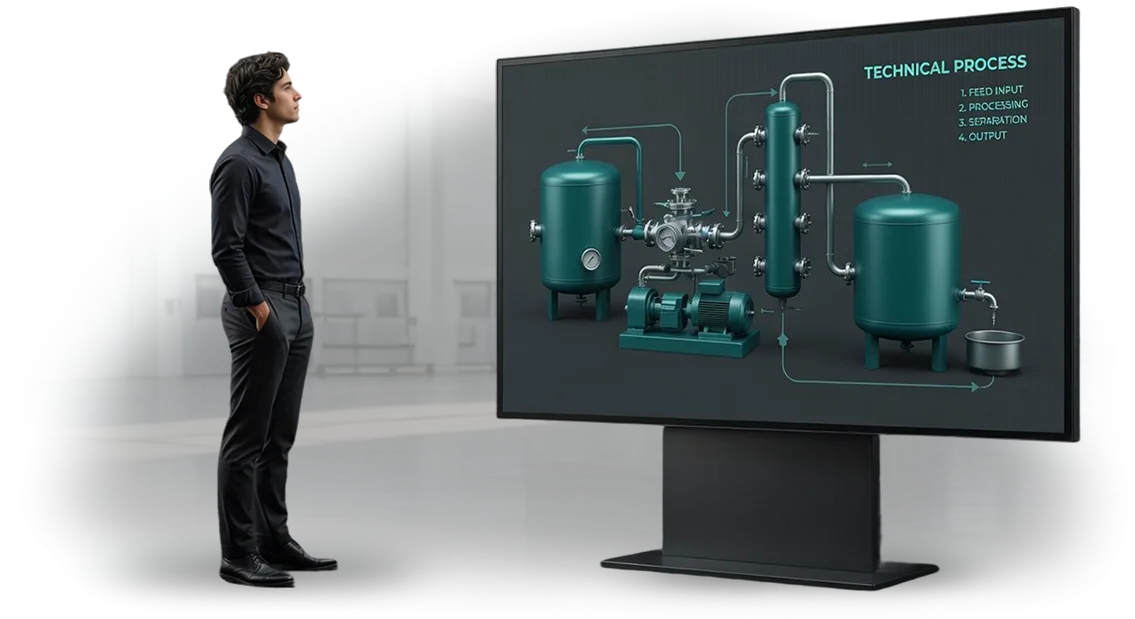
We developed a series of video instructions for key operations and typical situations. The scenes were rendered in Unreal Engine—this technology provided photorealistic visuals to accurately show each step, including equipment operation and safety procedures.
The employee sees an example of correct actions and remembers it faster than text or a live demonstration.
The result exceeded expectations: the time to reach full capacity dropped by 40%—from 10 weeks to 6. The number of errors in the first weeks nearly halved, and mentors gained at least 30% more free time. According to the HR director, video instructions became the main onboarding tool for new employees.
Why It Works
The secret isn't technology but a unified standard. Video shows the same action to all employees, regardless of the workshop or shift, and a newcomer immediately learns the correct sequence.
Such instructions are easy to scale—both for a team of 10 and for a plant with a thousand employees.
Investments in training video content pay off within the first quarter, and the effect of accelerated onboarding keeps working continuously. If you need to shorten the time to full productivity, this approach can easily be applied to your company.
How to Choose the Right Video Instruction Format for Your Task?
When a company employs people in different roles—from warehouse to office—there is no single "ideal" training format. A universal instruction is either too abstract for a new hire on the production floor or too detailed for a manager.
So first, we determine what exactly an employee needs to learn and how they will use it in the first weeks.
For positions where following a step-by-step sequence is critical (operating equipment, cash registers, or software), a dynamic instruction focused on process logic is a good fit.
For scenarios where communication standards and responses in non-standard situations are crucial (managers, support, sales), scenario-based videos with examples of proper dialogues and analyses of typical mistakes work best.
And if you simply need to quickly introduce a newcomer to how the company works, a short 3–5 minute overview video is enough.
How We Determine the Right Format
We don't guess and we don't force a one-size-fits-all template. At the brief stage, we break down your specific tasks: which processes need to be covered, how many new employees are coming, and how quickly they need to reach working proficiency. After that, we propose a format, duration, and presentation style tailored to your needs.
As a result, you get training that is clear to a newcomer and doesn't require constant mentor presence, while the material itself becomes a working tool that pays off from the first month of use.
Employees engage with their tasks faster, make fewer mistakes, and don't distract colleagues with basic questions.
Frequently Asked Questions About Developing Video Instructions
Clients often postpone developing video instructions because of typical doubts: "the video will become outdated," "we won't make it before the hiring wave," "we won't know who actually watched it." Below, we address the most frequent questions—short and to the point, without technical details.
Instructions will be outdated in a month—why make them at all?
We build videos using a modular approach: each step of the process is a separate logical block. If a single regulation changes, we update only that fragment instead of reshooting the entire video.
If needed, we establish an update procedure—you send the changes, and we make edits within the agreed timeline.
How long does it take to develop one video?
A standard 2–3 minute video instruction takes two to four weeks, including approvals. We set the deadline in the contract and stick to it: the steps are scheduled in advance, from brief to editing. The materials will be ready by the time your onboarding program launches.
How can we verify that employees actually watched the instruction?
We integrate the videos into your LMS or CRM: the system tracks viewing, watching to the end, and reopening. If you don't have a separate platform, we provide a report for each employee via a secure link.
Our processes are specific and confidential—can you handle it?
We sign an NDA and work in a closed environment: your regulations never leave the project, and access to materials is restricted. The content is described by you or your technologist—we turn it into a clear video script. No arbitrary changes to your processes.
Request a Quote for Video Instructions for Your Team
Training new employees takes hours away from mentors and managers, and text instructions simply don’t work—information gets forgotten, and everyone learns at a different pace.
Video instructions provide a unified standard: a newcomer sees a clear example, remembers the algorithm, and achieves results faster. To get such a tool, you don’t need to reinvent anything from scratch—just order video instructions tailored to your team’s specific tasks.
Request a cost estimate—we’ll study your specifics and propose a tailored project. Tell us about the processes and issues that need to be addressed, and we’ll choose the optimal format, duration, and lesson style.
After your request, you will receive:
- a production plan: from script and visualization to editing;
- a transparent cost estimate with no hidden items or overcharges;
- implementation timelines aligned with your hiring schedule;
- adaptation of scripts to your company’s internal regulations;
- recommendations on integrating the videos into your overall onboarding program;
- the ability to make changes at every stage.
We’ve been working in corporate team training for ten years, creating instructions that employees actually watch to the end and apply in their work. Leave a request—we’ll call you back within one business day, clarify the details, and prepare a preliminary estimate. To order video instructions, fill out the form below—it will take just a couple of minutes.