

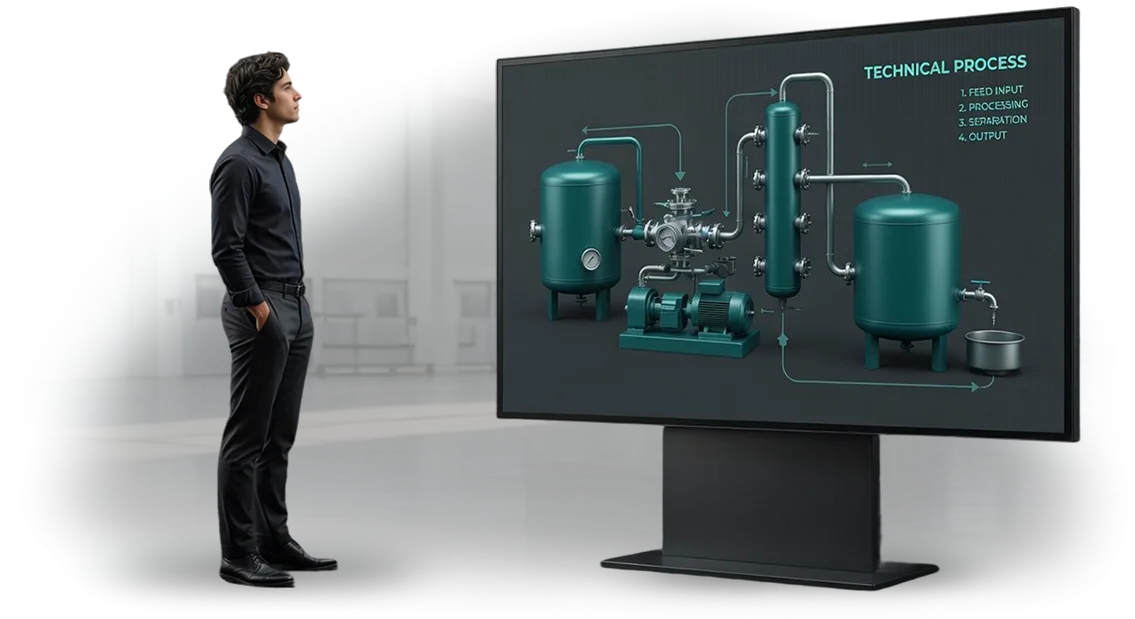
Errors in Production Processes: Video Instructions Are the Solution
Every error in a production process is not just a glitch — it is a risk of line stoppage, damaged raw materials, employee injury, and reputational losses.
One wrong step during equipment setup or maintenance can result in downtime lasting several shifts and losses measured not in single units but in dozens of percent of profit.
Text-based regulations and verbal briefings stop working in real situations: a person remembers only part of the information and, under stress, acts out of habit rather than following instructions.
Video instructions for manufacturing solve this problem — they show every step in the correct sequence and eliminate double interpretations and "personal creativity" on the operator's part.
The employee sees the reference performance of the operation and repeats it without losing the meaning.
Training video instructions standardize the actions of all workers — from newcomer to experienced specialist.
Newcomers get up to speed faster, experienced workers miss important steps less often, and the manager gains a quality-control tool that does not depend on the human factor.
At the same time, we develop the occupational safety block separately: the videos capture key control points that help prevent accidents and injuries. For production, this is not only protection for people but also a reduction in costs associated with downtime and investigations.
We integrate video instructions into your employee training system and focus on measurable results: fewer errors, higher productivity, and transparent processes.
This format pays off from the first weeks of use — by reducing defects, cutting employee onboarding time, and improving operational discipline. Tell us about your task — we will show how the solution will work specifically on your production line.
What Problems Corporate Video Training Solves
Corporate video training solves problems that are difficult to handle with text regulations and live lectures. The employee sees the process in action, remembers the sequence of steps, and repeats it without errors. For the business, this means predictable results and less routine work for experienced specialists.
Onboarding New Hires
A new employee gets up to speed faster when there is a clear visual example in front of them. The video instruction can be studied at a comfortable pace, paused, and revisited for difficult steps.
As a result, the newcomer reaches the required skill level within the first weeks rather than months.
Professional Development
Training videos are also useful for those who have been on the job for a long time: they help refresh knowledge, master related operations, and learn about process updates.
Regularly building up the instruction library turns training from a one-time event into continuous team development.
Process Standardization
When employees learn from the same videos, differences in working methods are reduced to zero. Everyone performs the operation to a single standard — this simplifies quality control and reduces the number of errors. This is especially relevant for companies with multiple sites or departments.
Saving Mentors' Time
Experienced specialists spend hours on personal explanations and get distracted from their own tasks. A recorded video instruction replaces most of these consultations: the mentor explains once, and the whole team benefits. This frees up time for truly complex issues.
Our team creates video instructions for your processes. We integrate them into your training system, and you get fast onboarding, high qualifications, and uniform standards at every level.
Video Instruction Formats: Which One Fits Your Company
The choice of video instruction format directly affects the budget, timelines, and how quickly employees master the production process.
For simple operations, live filming in the workshop is enough; for complex mechanisms, 3D graphics are needed to show the parts in cross-section. We have compared the main formats by key parameters — see the table below.
The table covers typical scenarios found in manufacturing. Exact timelines and cost depend on the number of scenes and the level of detail, but the ratio of complexity to budget remains roughly the same. This will help you plan the project in advance.
| Format | Complexity | Budget | Timeline | When to choose |
|---|---|---|---|---|
| Live-action filming | Low | Medium | 2–3 weeks | Simple operations, showing the real process clearly |
| 2D animation (motion design) | Medium | Medium | 3–4 weeks | Diagrams, algorithms, operating logic |
| 3D graphics (CGI) | High | High | 4–8 weeks | Complex components, parts, cross-sections that cannot be filmed |
| Interactive video | High | High | 6–10 weeks | Skill practice, simulating error situations |
We will help you choose the right format for your process without overpaying for excessive graphics. We will advise on timelines and budget and offer combined solutions — for example, live filming for overview shots and 3D graphics for key components. You will get instructions that actually work.
Step-by-Step Plan for Implementing Video Instructions in Production Processes
Video instructions only work when implementation is thought through from the first brief to final support. Our team have split the project into clear stages — you always know what is happening and when you will get the result.
- Brief and process audit. We study your production operations, identify bottlenecks and errors. We document the training goals.
- Script development. We break the process into short steps and prepare the text and storyboard. You approve the script before filming begins.
- Filming the processes. We coordinate the schedule so as not to stop production and film the real operations at your site.
- Editing and voiceover. We assemble the videos, add explanations, and emphasize key moments. You receive the finished videos.
- Integration into training. We provide the files in the required format or upload them to your learning management system — employees get access immediately.
- Support and updates. If the process changes, we update the materials. You do not spend time on a complete reshoot.
What Is Included in the Video Instruction Package
The delivery is not just a link to videos. You receive a set of materials and rights that lets your team start working right away: from scripts to LMS-ready files.
- Finished videos in the required formats — for in-person training, the corporate portal, and the LMS. Each video is filmed at a real production site, so employees see exact operations and gestures rather than abstract animation.
- Scripts and frame-by-frame storyboards — all the logic of the explanations is captured in text. This simplifies approval, and if the process changes, edits can be made within hours.
- LMS-ready files — in standard formats accepted by your system. The employee completes the training at a comfortable pace, and you can view completion statistics at any time.
- Text version of the instruction — duplicates the video for printing and distribution at workstations. Ideal for those who absorb material better through text and serves as a job aid.
- Unlimited usage rights in time and territory — you own the content and can place it on any internal resources, including distance learning platforms.
- Updates on request — if the production process changes, we quickly reshoot the necessary fragment or extend the video. You are never left alone with an outdated instruction.
In the end, you get not scattered files but a complete training system. Assign someone responsible for uploading — and you are ready to launch the training.
The Result: How Errors Were Reduced in Production
When the manufacturing company Stal-Profil approached us, the problem was typical: new employees made assembly errors, and some instructions existed only on paper.
Seasonal workers were especially challenging — they arrived for peak orders and had to be trained from scratch in a matter of days. Training took almost three weeks, and every error on the line caused downtime and rework.
We proposed replacing text regulations with short CGI video instructions that show every stage — from equipment start-up to final part inspection.
Within two months, we created a set of video instructions for five key production areas. The effect was visible from the first months: within six months, the number of defective products dropped by 37%, and workplace injuries were almost cut in half.
We also noted faster training: a new employee now reaches the planned pace in five days instead of three weeks, and line output rose by 22%. All figures are confirmed by the client's internal reporting, not by our promises.
"We used to spend weeks on mentoring, but workers still made mistakes in non-standard situations. Video instructions gave us a clear standard that every employee understands. Defects dropped by half, and micro-injuries became almost zero. This is the best investment in training we have ever made," says the production manager.
This plant's story shows that a well-prepared video instruction pays off not as a nice-looking video but as a tool for cutting costs and improving safety.
If the same errors keep recurring in your production processes, the problem is probably not the people but how knowledge is transferred.
A set of video instructions delivers measurable results in the first quarter after implementation, and full payback usually takes no more than a year. The videos also adapt to changes in equipment and regulations, so the effect lasts for a long time.
How to Choose a Video Instruction Format for Your Task?
The choice of video instruction format depends directly on three things: the complexity of the production process, the budget, and the timeline.
If you need to show the general sequence of actions, a short overview video is enough; if it is a multi-step operation with critical details, you need a detailed visual sequence with emphasis on every component.
Understanding these criteria helps you avoid overpaying for excessive detail and avoid losing training quality where it is essential.
Production complexity is the first guide. For simple operations, you can use flat 2D graphics or a combined format where key moments are highlighted with diagrams.
For complex assembly processes, 3D visualization is better — it shows how the component works from the inside and lets you examine the part from any angle.
Such an instruction resolves the question "what does it actually look like?" and shortens the new employee's time to proficiency.
Budget and timeline work as a pair: the more realistic and detailed the visuals, the more resources are required.
But that does not mean choosing between "expensive and slow" and "cheap and bad." We know how to combine formats: for example, show a complex component in 3D and simple steps as a diagram.
This way, you get the level of detail you need while staying within reasonable timelines and budget. This approach lets you launch training quickly and scale video instructions to new processes as needed.
The main criterion is value for the employee. The format should answer the question "what to do and what the result will be" in minimal time.
That is why, before starting, we define the target audience and its experience together with you: newcomers need explanatory content, experienced workers need short reminders. This directly affects the format choice and video length. Our job is not just to create visuals but to solve your business problem of staff training.
If you are not sure where to start, simply send us a description of the process and a video or photos from the workplace. We will propose an option that meets your training needs without unnecessary costs.
And if the process changes, the video instruction can be updated without reshooting everything from scratch.
Frequently Asked Questions About Creating Training Videos
When ordering video instructions for production processes, customers most often ask about cost, timelines, and integration into the existing training system. Here are our answers — without technical jargon or hidden conditions.
We hear these questions regularly at the start of training, so we have prepared short answers — with no fine print.
How much does developing video instructions cost?
The cost is calculated after audit of the script complexity, the number of operations, and the duration of the videos. We fix it in the contract before the start and split it into stages so it does not strain the budget.
How long does production take?
One process usually takes two to four weeks. The schedule is fixed in the plan, and at each stage you can review intermediate versions and make edits without moving the deadlines.
How do the videos integrate with our LMS?
We deliver the videos in a standard format that works with most learning management systems. If needed, we adapt the launch settings and navigation to your platform.
What technical requirements do employees need?
A regular computer or smartphone with internet access is enough. No additional equipment or special training is required.
Get a Cost Estimate for Video Instructions for Your Production
We understand that production video instructions are an investment and you need to know the budget in advance. That is why we have made the cost estimation process simple and transparent: you submit a request, and we handle all the technical side of preparing the proposal.
How it works:
- You submit a request for an estimate — through the form on the website or by phone.
- We contact you within one business day and provide a consultation.
- We clarify which production processes need video instructions and how many employees will be trained.
- We analyze your scenarios, the number of operations, and the video viewing format — computer, tablet, or smartphone.
- We prepare an individual proposal: options for timelines, scope, and cost — based on your tasks.
- We finalize the details and adjust the estimate if necessary.
You receive a document that shows what you are paying for and what exactly you will get. No hidden conditions — only clear stages, timelines, and results. The estimate comes with no obligation; you can make your decision at your own pace.
Submit your request right now — we will call you back, answer your questions, and calculate the cost of video instructions for your production. A consultation and an individual proposal will help you plan the budget and launch the project in the near future.