

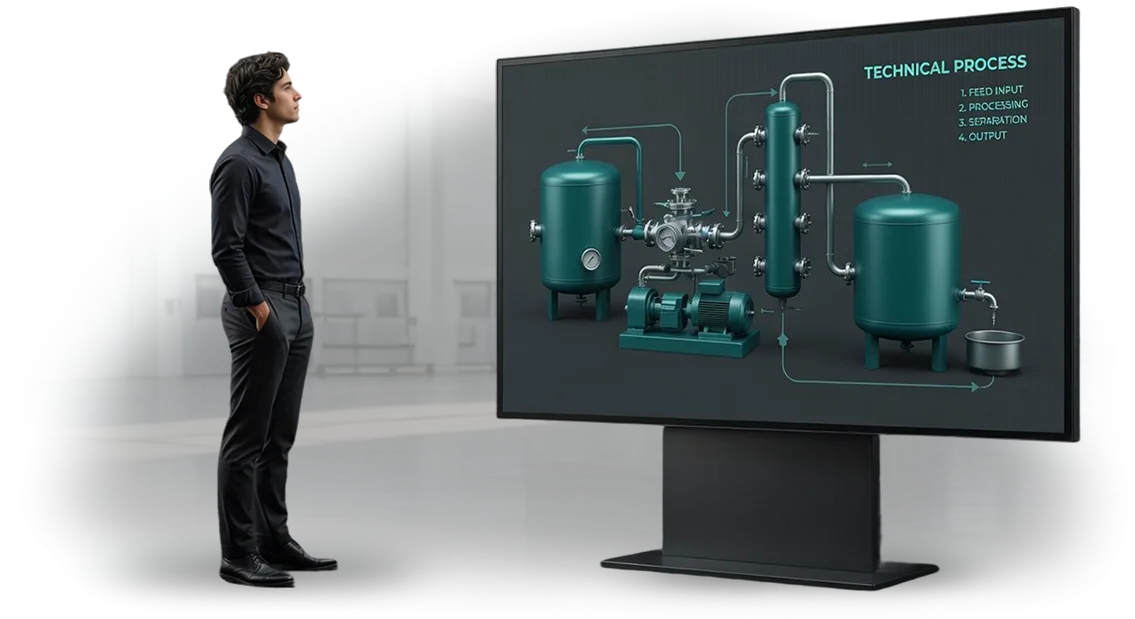
Why Do Employees Violate Industrial Safety Requirements?
Managers often see a fine for violating industrial safety requirements as the main threat. But it's not just money at stake: every employee mistake can lead to an accident, injury, or fatality.
Most often, these mistakes happen not because of negligence, but because the worker does not realize the danger or does not understand how to act correctly.
Reasons for violations are almost always the same: formal check-the-box briefings and outdated text-based regulations that no one reads. Employees are overloaded with daily tasks and have no time to dig into multi-page documents.
As a result, critical occupational safety steps slip from memory, and a person goes to the machine without a clear action plan.
Safety video instructions close the gap between the instruction and real behavior. A short video shows the sequence of actions in a visual form, highlights dangerous zones and typical mistakes.
Such staff training takes minutes, not hours, and is perceived by employees as help rather than a mandatory chore.
Companies that switch to video format notice a significant reduction in violations after just the first few views. Workers begin to see risks they previously ignored and are more willing to comply with safety requirements.
For a manager, this means smooth inspections, no accidents, and confidence that every person on the site knows what they are doing.
Professional industrial safety video instructions solve exactly these problems: they protect staff health and preserve the company's reputation. They turn occupational safety from a source of fines into a clear, trustworthy system.
What an Educational Video Gives a Company: Savings and Order on the Production Floor
Educational videos for employees solve three tasks at once: they speed up onboarding, reduce the number of mistakes, and free up instructors' time. Instead of repeating the same thing ten times to a new employee, a manager records a video once — and the material works on its own. This is especially important in plants where safety directly affects uptime and company reputation.
Video instructions create a unified training standard. Every employee sees the same correct action scenario: how to prepare the workplace, what protective equipment to use, how to act in an emergency.
The problem of "one supervisor teaches one way, another a different way" disappears. Safety on the production floor becomes systematic instead of depending on a particular mentor's mood or experience.
The time savings from video instructions are also noticeable. Instructors no longer need to hold multi-hour lectures for every shift or group of newcomers. Record once, and everyone watches the video—current employees during refresher training and newcomers during onboarding.
The material stays with the company forever: staff turnover no longer wipes out accumulated knowledge.
Training with video becomes more effective because people remember visual images better than text or a spoken lecture. An employee sees concrete actions on screen and repeats them in reality.
This reduces the number of mistakes on the production floor: a person understands in advance what is allowed and what is not, and therefore less often finds themselves in dangerous situations. For the company, this means lower risk of downtime, injuries, and fines.
Finally, educational videos help quickly onboard new people. A newcomer doesn't have to wait until an instructor is free—they immediately get access to the knowledge base and can study the material at their own pace.
Fast onboarding shortens the time it takes for an employee to reach full productivity. As a result, the company spends less on training, and order on the production floor is maintained regardless of shift composition.
Formats of Educational Video Instructions: Matching the Right Format to Your Task
Each educational video format solves a specific task: sometimes documentary accuracy matters, sometimes it's the visualization of processes that cannot be filmed with a camera.
Choosing the wrong format risks losing employee attention and failing to get the material across—especially when it comes to industrial safety, where the cost of a mistake is high.
We select a format for your specific task: we analyze the audience, the complexity of the material, and the shooting conditions, then propose the optimal solution. The main formats are compared in the table.
| Format | Who it is for and when it fits | What it gives the client |
|---|---|---|
| Live-action filming | Simple processes, real equipment, workplace briefings | Maximum authenticity; the employee sees familiar surroundings and trusts the material |
| CGI animation | Dangerous zones, hidden mechanisms, emergency scenarios that cannot be filmed live | Fully safe shooting, clear visualization of processes, attention to detail |
| Screencast | Work in software, electronic systems, document processing | Clear on-screen sequence of actions, easy to pause and repeat |
| Combined | Complex material where both real footage and 3D models are needed | Better learning retention: emotional engagement + precise process demonstration |
A properly chosen format reduces training time and lowers the number of staff mistakes.
It also makes it easier for employees to remember the material and easier for you to monitor how well they absorb it: video instructions can be embedded in a distance learning system and views can be tracked.
We will help you choose the format during the briefing stage—send us a description of your task, and we will propose an optimal solution for your budget and timeline.
Industrial Safety Video Instructions: Development Process
Before we start shooting, we set up the process so that you don't have to dig into production details. You receive the finished video within the agreed timeframe, and every stage has clear approval points. Below is how we work on industrial safety video instructions.
- Brief and task immersion. We request your regulations, instructions, and occupational safety requirements, and conduct a short interview with responsible employees. The output is a technical specification that captures the goals, audience, and key scenarios.
- Script development. Our writers turn dry instruction points into logical video scripts with clear emphasis on dangerous actions. You receive text with narration, shot descriptions, and timing.
- Approval and revisions. We show the script to all stakeholders and make edits until the text is both compliant with regulations and clear to employees.
- Video production. Filming at the production site or creating CGI models—depending on the complexity of the script. We use professional equipment to deliver a consistent result even in poor lighting or dusty conditions.
- Editing and voiceover. We assemble a draft version, add narration, subtitles, and graphic explanations. You receive a preview link and can request changes to pacing, emphasis, or attention to details as needed.
- Delivery and implementation. We hand over the source files and final file in the required formats and help embed the video into your distance learning system or internal portal. We also recommend how to arrange knowledge checks after viewing.
After delivery, we don't disappear: for several months we answer questions about using the video and, if necessary, update individual scenes when regulations change.
This means your industrial safety video instruction won't become outdated in a month and will continue to help prevent violations.
What Is Included in a Completed Video Instruction Package for a Company
A completed video instruction package is not just a video, but a full set of materials for training and implementation. The client receives everything needed to launch the briefing and track completion: from the script to instructions for working with the video.
- Script and storyboard — a well-thought-out video structure with text, timing, and shot descriptions. Approved materials prevent errors during filming and editing.
- Final video — a finished video with professional editing and voiceover, in the required formats and resolutions: from a training portal to a production floor screen.
- Source materials — all video clips, graphics, sound files, and editing projects used. They remain yours, so you can easily make changes or create new versions.
- User guide — a simple document on how to embed the video into your training system, which devices it works on, and how to set up knowledge checks.
- Supporting documentation — certificates and descriptions needed for accounting and acceptance of work.
- Implementation support — we help connect the video to your training portal and answer employee questions at launch.
Depending on the task, the package can be supplemented with subtitles, knowledge-check tests, or printed handouts. The key point is that you receive a transparent set of materials that supports employee safety and requires no additional work from your team.
Case Study: How an Animated Video Instruction Cut Staff Errors in Half
At first, employees at the new SeverKhim workshop were trained using standard handouts: dry text, diagrams, and a signature in a logbook.
A month later, it turned out that up to a third of operators confused the sequence of actions during an emergency line shutdown, and violations while working with equipment were recurring systematically.
Management concluded that the problem was not discipline but the way the material was presented—the instructions were not being remembered.
We developed three animated video instructions for key scenarios: equipment preparation, normal operation, and emergency situations. Instead of text, we created 2–3 minute videos with clear visualizations of every step. Employees trained on tablets in the classroom and then took a test.
The head of the occupational safety service noted the key point: "Previously, reviewing an instruction took half an hour and people got distracted.
Here, in 5 minutes they see the whole process on screen and remember the sequence of actions." After the videos were launched, the number of errors during planned inspections fell by half—from 14 violations to 7 per quarter.
A workshop operator described the practical effect: "When you see actions on video instead of reading abstract points, the image stays in your head.
In an emergency, muscle memory kicked in—I remembered the video and did everything right." For the company, this is not only safety but also savings: less downtime, less scrap, and a lower risk of injuries.
The client was pleased and ordered four more instructions for neighboring areas. According to the production manager, onboarding time for new employees fell by a third, and refresher training took a couple of hours instead of a full day.
Animated video instructions turned a boring obligation into a clear tool that genuinely changes employee behavior.
How to Choose a Video Instruction Format for Your Task and Budget?
Choosing a video instruction format starts not with visuals, but with the task. What exactly do you need to show the employee—a simple sequence of actions, work on complex equipment, or an analysis of an emergency situation? The answer determines the video length, the level of detail, and the way the material is presented.
Budget is the second important benchmark. For short regulations and general rules, flat animation with diagrams and text is enough.
To demonstrate real equipment, you need production filming or a CGI model, which can show internal structure and hidden processes more safely and clearly than regular video.
At the same time, CGI is not necessarily more expensive than filming: it often wins because there is no production downtime and individual scenes can be updated without a full reshoot.
The third factor is the specific requirements of your site. If the work involves hazardous substances, working at height, or complex machinery, the instruction must not just show actions but explain the physics of the process, risk zones, and typical mistakes.
Here CGI offers more possibilities: you can "look" inside a mechanism, slow down a dangerous moment, and highlight exactly where the threat appears. This reduces the number of mistakes during real work.
Finally, assess the skill level of your employees. Beginners need a detailed breakdown of every step; experienced workers need emphasis on emergency situations. The right format takes this into account—not overwhelming some, but not oversimplifying for others either.
For example, a modular instruction allows you to assemble a video adapted to a specific group without extra production costs.
We help you choose a format for your tasks and budget: we analyze your equipment specifics, audience, and safety requirements, then propose an optimal solution—from animated diagrams to full-scale CGI instructions.
Come in for a consultation—we'll review your case, show relevant examples, and calculate the cost after a thorough review so you don't overpay for unnecessary options.
Frequently Asked Questions About Creating Corporate Video Instructions
Implementing corporate video instructions raises many questions among managers. The most common questions concern timelines, product rights, the possibility of edits, and cost. We answer the key objections right away—so you understand what to expect.
How long does it take to develop a video instruction?
Timelines depend on the scope and complexity of the script. On average, production takes from two weeks to a month: during this time we design scenes, approve the text, and edit the video. The schedule is fixed in the contract, so you know the exact delivery date.
How is the price of a video instruction calculated?
The price depends on the number of scenes, the video length, and the level of detail. We don't quote figures in advance—first we study the task and then provide a transparent estimate with no hidden fees. You pay only for what your team really needs.
Can changes be made to the finished video?
Yes, revisions are possible. We approve the script, storyboard, and interim edit at every stage, so final corrections are usually minimal. If they do come up, we make them within a few working days.
Who owns the rights to the video instruction?
You do. After full payment, you receive exclusive rights to use the video and all source materials. The video can be placed on the internal portal, training stands, and in the distance learning system without restrictions.
Another important question is how to make sure employees actually watch the instructions and change their behavior. To achieve this, we use short videos with realistic scenarios and an emphasis on the consequences of violations. This format holds attention and reduces the number of incidents.Leave a Request — We'll Develop Video Instructions for Your Regulations
Leave a request for a video, and we'll prepare an estimate of timelines and scope of work for your industrial safety regulations. You don't need to write a technical specification: just briefly describe the task, and we'll handle the rest.
After you contact us, you'll receive a consultation, a commercial proposal, and a clear turnkey development plan. Below is what happens after you submit your request.
What happens after your request:
- We'll discuss the task: we'll clarify which operations, risks, and regulations need to be covered so the video instructions fit into your employee training system.
- We'll consult with you: we'll explain which formats are best for your specialists—step-by-step videos, emergency scenario breakdowns, or short knowledge tests.
- We'll send a commercial proposal with a fixed scope of work and timelines—no hidden stages or unnecessary approvals.
- We'll show examples of industrial safety projects so you can see the quality and style before we start.
- We'll align the script and visual approach with your internal documents and corporate style.
- We'll launch turnkey development: script, graphics or filming, editing, voiceover, and subtitles—you receive finished videos ready to upload to your training system.
After delivery, we stay in touch: if needed, we'll quickly make revisions or adapt the instructions to new regulations. Leave a request, and by the next business day you'll know how to solve the task.