

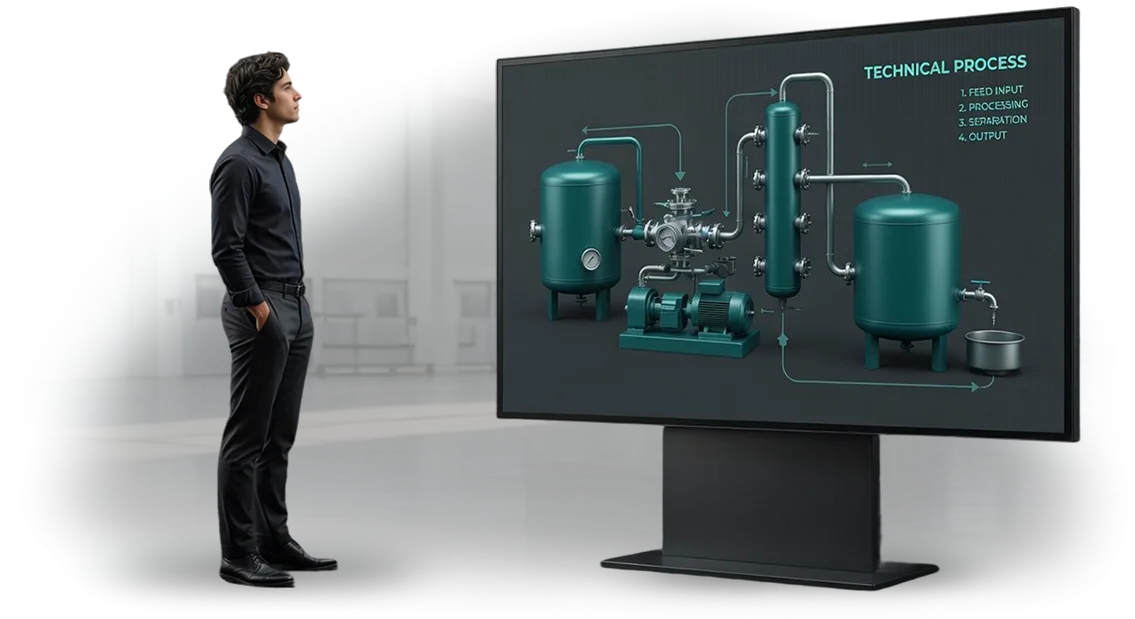
Mistakes in Warehouse Logistics — the Main Cause of Business Losses
Any mistake in a warehouse is not just a human factor but a direct loss of money. Mix-ups in product grades, damaged goods, shipment delays, incorrect order picking — each of these situations results in both correction costs and customer dissatisfaction.
Over a month, these "little things" add up to a serious amount that directly reduces business profit.
Most often, the root of the problem is weak training of warehouse staff. Newcomers are given text instructions or a short lecture, and a week later they still act in their own way.
Moreover, warehouses have high staff turnover, and every new employee goes through this path of trial and error again. The result is that the same losses repeat over and over, but now at the expense of new people.
Video instructions for personnel solve this problem in a fundamentally different way. Instead of abstract descriptions, the employee sees the correct sequence of actions with their own eyes: how to receive goods, how to put them into storage, how to pick orders.
A short visual video is remembered faster, and if necessary, it can be reviewed at any time — right at the workplace or during a break. Training becomes uniform for everyone, regardless of the experience and abilities of a particular person.
This means the warehouse works like a well-oiled mechanism: fewer mistakes, fewer losses, higher order processing speed.
That is why we create professional video instructions for warehouses — so that your staff acts correctly from the very first day, and the business does not lose money fixing other people's shortcomings.
5 Benefits of Video Instructions for Warehouse Employees
Warehouse staff training is not a one-time event but an ongoing process: regulations change, new operations appear, and mistakes cost money. Video instructions address this need systematically: they give employees a unified standard of knowledge and work at any time. Below are five proven advantages a business gets after implementing such materials.
-
Onboarding newcomers without distracting mentors. A new employee watches short videos about their operation and immediately gets down to work.
Time-to-competence is reduced, and experienced warehouse workers continue handling current tasks instead of explaining the same thing to a third newcomer in a week.
-
Skills development in a convenient format. Video instructions can be updated and supplemented: from working with data collection terminals to procedures in non-standard situations. Staff learn at their own pace, review difficult moments, and master new processes faster.
-
Fewer defects and errors in order picking. A clear example of the correct process works more effectively than text memos and retellings of "how I was taught." The employee sees every step: labeling, stacking, moving between storage zones. This reduces grade mix-ups, product damage, and the number of returns.
-
Safety and reduced injuries. Dedicated scenarios demonstrate the rules for working with loading equipment, racks, and hazardous areas. Systematic training turns safe actions into a habit rather than a formality — and this directly affects staff downtime and insurance risks.
-
Time savings and predictable results. Once you create a video library, you use it for all branches and new employees. There is no longer a need to repeat briefings at every meeting, and training quality stops depending on the mentor's workload and mood.
Implementing video instructions is an investment in process controllability. We create such videos according to your regulations and warehouse specifics: from script and filming to final editing. You get a ready-made knowledge base that is easy to scale across the entire company.
Video Instruction Formats for Warehouse Logistics Tasks
One video format is not enough: it is one thing to show how to fill out an electronic document, and quite another to show how to work with a hydraulic stacker or correctly place cargo on a rack.
When the format does not match the task, employees absorb the material worse, and the number of errors and downtime in the warehouse grows.
That is why we select a specific video instruction format for each operation — from simple 2D animation to complex CGI videos. This reduces training time, speeds up a newcomer's transition to a working rhythm, and lowers the costs of fixing the consequences of errors.
| Video format | Who it is for | What it gives the client |
|---|---|---|
| 2D animation | New employees who need to quickly master standard processes — completing waybills, working with a terminal, moving around the warehouse | Clear sequence of actions without unnecessary details, easy updates when regulations change, fast onboarding without distracting senior colleagues |
| 3D modeling | Employees working with machinery and equipment — forklifts, stackers, racking systems | Clear view of how mechanisms work and safe operating techniques, lower risk of breakdowns and injuries, proper use of expensive equipment |
| CGI for warehouses | Experienced workers and personnel in complex areas — sorting, picking, handling dangerous goods | Accurate demonstration of hidden processes and emergency situations, a uniform standard for performing operations, minimized defects and losses |
This separation makes it possible not to overpay for excessive detail where a simple video is enough, and not to skimp on complexity where safety and work speed depend on it.
As a result, each instruction solves a specific task, and employees remember the correct sequence of actions from the first viewing.
Stages of Creating Corporate Video Instructions for Employees
Developing video instructions for warehouse employees is a process that must be transparent and must not take up your time. We have structured it so that you see the result at every stage and can influence it. Below is a step-by-step algorithm that your project goes through.
How the collaboration works
-
Brief for the video. We collect the tasks: what operations need to be shown, who the audience is, what mistakes employees most often make. The output is a short document with goals and criteria that let you understand whether the instruction works.
-
Structure and plan. We propose a breakdown into scenes, timing, and deadlines. You immediately see how long the project will take and what each block consists of — no surprises along the way.
-
Script approval. We write the text for the frames: what happens on screen, what actions are demonstrated, what captions and voice-over are needed. Here you make edits once, rather than redoing the animation after editing.
-
Creating the animation. We show the processes visually: cargo movement, working with equipment, safety zones. We use professional tools so that the picture is realistic and understandable even to a new employee.
-
Editing and voice-over. We record the narrator's text, add emphasis to important actions, subtitles, and final graphics. You receive a finished video that can be immediately integrated into your training system.
-
Launch and refinement. We test the video on a group of employees, look at which moments raise questions, and make adjustments if necessary. After that, you receive final versions for all formats — from a screen in the workshop to mobile devices.
This order guarantees that the instructions will be understandable to people, not just beautifully drawn. You control quality at every step, and we handle all the technical work — from script to final file.
What Is Included in the Video Instruction Package for the Client
You receive not just one video, but a complete package for launching warehouse staff training. Everything inside is designed so that you can implement the video instructions into your process without bringing in additional contractors or long approvals.
The delivery package includes:
- Technical specification and script. A detailed description of each scene, the text, and the logic of the video — you approve them at the start and see what will be in the frame before production begins.
- Finished training video. Several versions with different runtimes: a full instruction for studying, a short one for quick review, and separate fragments covering key operations.
- Knowledge check materials. Test questions and assignments for monitoring how well the material is understood — no need to develop them from scratch.
- Methodological recommendations for the manager. How to integrate the video into the training program and evaluate employee progress.
- Files for any training system. Adapted formats for a corporate portal, distance learning systems, and mobile devices — employees will watch the videos from any device.
- Usage rights and source files. A complete delivery package without hidden conditions — you are free to use the materials in your work.
This package covers the entire cycle: from setting the task to monitoring results. All you have to do is choose which operation to start training with.
Example: How Video Instructions Reduced Warehouse Errors
Any warehouse logistics faces the human factor: grade mix-ups, packaging damage, picking errors. Each such mistake is lost money and shipment delays, while text regulations remain unread. Training newcomers stretches out over weeks.
A large logistics operator, Alpha-Warehouse, came to us with exactly this problem. At their sites, order picking errors reached 7%, and onboarding training for an employee took about two weeks. They needed a solution that would quickly communicate the requirements for each operation.
We developed a series of CGI video instructions for five key processes: receiving, put-away, picking, packing, and shipping. Employees received reference videos where each step is shown with the correct sequence of actions. Such instructions are easy to watch at the workplace and easy to review when in doubt.
After two months, picking errors decreased by 43%. Training time for new employees dropped from 14 to 7 days, and the number of questions to mentors fell by a third. Turnover during the probation period declined because newcomers began working independently faster.
Within six months, the operator ordered 12 more video instructions for other processes. According to the company's assessment, the savings from reduced errors covered the development cost within the first quarter.
Such a result confirms that high-quality video instructions are an investment in warehouse stability.
How to Choose a Video Instruction Format for Your Warehouse Tasks?
There is no universal video briefing — the format is chosen for a specific warehouse, operations, and team. Therefore, the first thing to consider is the warehouse's specific nature: one facility requires detailed 3D graphics, while another only needs short videos. The second filter is the training goal and the video budget.
For complex operations involving equipment — forklifts, racking, sorting lines — detailed 3D graphics work best. They show mechanisms and hazardous zones from the right angle and remove everything unnecessary.
For simple actions such as receiving goods or completing documents, schematic animation or footage with an employee is sufficient: it is faster to produce and easier to replace when regulations change.
Next, assess the audience. People with different experience levels work in a warehouse, and the video must be equally understandable to a newcomer and an experienced employee.
Complex topics are better divided into 3–5 minute videos than made into one long video: this way the material is absorbed better, and individual scenes can be updated without reshooting everything.
The video budget is not a question of "cheaper or more expensive," but how to spend wisely. A large set of instructions is better made in a unified style: the first videos set the template, and the following ones cost noticeably less.
If the need is urgent, we choose a modular format that can be expanded without a full reshoot. We calculate the cost of the entire package in advance so there are no surprises along the way.
The right format choice pays off through fewer errors, faster onboarding of newcomers, and reduced mentor workload. We help at the start: a short audit of operations, priority topics, and a specific format for your budget and warehouse specifics.
Frequently Asked Questions About Developing Warehouse Video Instructions
Before ordering warehouse video instructions, clients usually have three main questions: how long it takes, what happens with revisions, and who is responsible for the result. We answer directly — no fine print and no hidden conditions.
We work as partners, not just "shoot a video." At the start, we lock in the script, stages, and deadlines, and at every step you see the intermediate result. Below are answers to the questions most often asked before the project starts.
How long does it take to develop a warehouse video instruction?
The timeline depends on the scope of the script and the number of scenes that need to be shown in CGI. A typical project takes from 3 to 6 weeks. At the start, we create a calendar plan with dates for key milestones so you know when you will receive the finished video. If deadlines are tight, we discuss priorities and find a solution.
What quality guarantees do you provide?
We work under a contract that specifies obligations and the result. Each stage — the script, visual style, draft video — is approved by you before the final render. If the video does not match the approved script or technical specification, we make corrections at our own expense. This protects you from surprises and unnecessary costs.
What about revisions after the video is delivered?
The cost includes two rounds of revisions based on justified feedback. We collect comments in a single document, pass them into production, and show you the updated version.
After approval, you receive the final files in the required formats — ready to upload to your training system.
Leave a Request for Warehouse Video Instruction Development
Every day without high-quality video instructions is time spent on repeated explanations, newcomer mistakes, and warehouse delays.
The video format lets an employee see the correct process with their own eyes and remember the sequence of actions faster — instead of reading regulations and guessing.
By ordering turnkey development, you receive a complete set of materials that keeps working after launch. We are the team at our team with 10 years of experience creating corporate training videos.
We will figure out your processes ourselves, prepare the script, create the animation and voice-over — all you have to do is accept the work and show the videos to your employees.
With video instructions, you reduce the load on mentors, shorten the adaptation period, and increase the share of employees who perform operations correctly the first time. This pays off within the first weeks — which is why most clients come back to us with new tasks.
The request takes 10 minutes; after that, we handle everything:
- We conduct a brief audit of the warehouse and typical mistakes — and choose a format that solves exactly your task.
- We prepare the script and storyboard — you see the logic of the future video before production starts.
- We create CGI visualization of work processes so complex operations become clear.
- We approve every stage with you and make revisions without additional payment.
- We deliver the files in the required formats and help integrate the video into your training system.
- We stay in touch after launch: we update the videos when regulations and standards change.
Leave a request through the form below or call us — we will respond within one business day, guide you on timelines and cost (the cost is calculated after an audit), and start work immediately after the plan is approved. Focus on developing your employees, and leave the production stage to the specialists.