

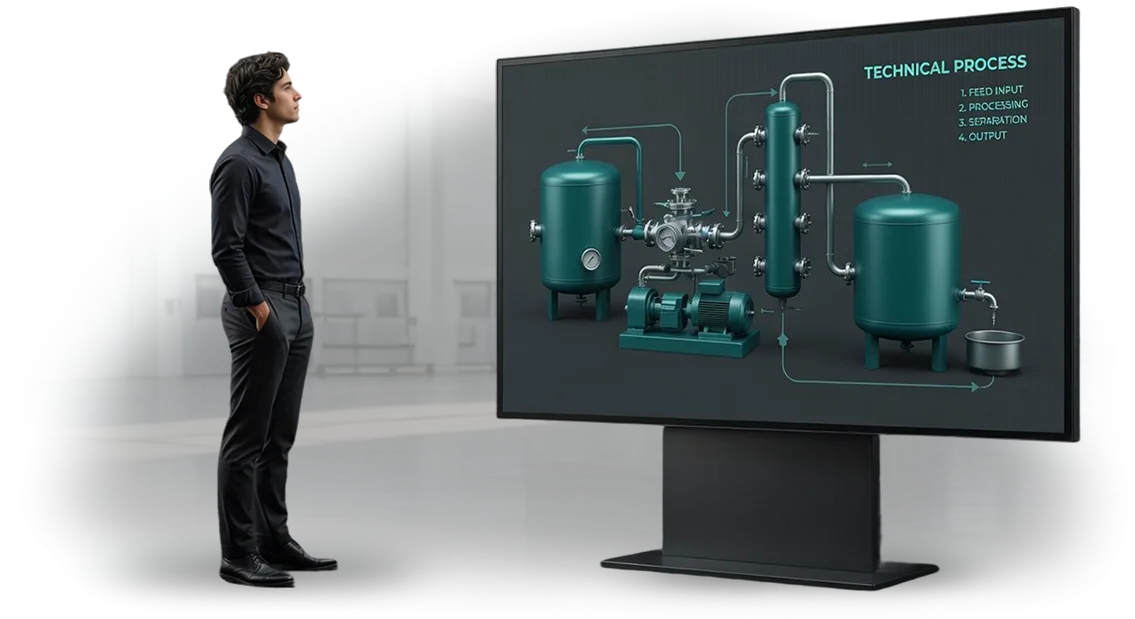
Video instructions for property management: solving the training problem
Every manager in real estate knows: new employees take a long time to get up to speed, and experienced staff work their own way instead of following a standard.
Text-based regulations and PDF instructions rarely get read to the end — which leads to staff errors: an incorrectly drafted contract, a wrong property handover, a failure in client communication. Each such mistake costs time, money, and the company’s reputation.
Video instructions for staff solve this problem in a fundamentally different way. People remember a visual sequence of actions far better than a wall of text.
A short video shows the entire process from start to finish: how to accept a property, conduct a viewing, complete a deal — without misinterpretation or “personal interpretation.” Real estate employee training becomes fast, clear, and predictable.
The video format is especially important for compliance with real estate procedures. When every step is captured on screen, a newcomer finds it easier to act according to the standard, and a manager can control quality more easily.
This reduces the number of errors, shortens onboarding time, and boosts employee confidence from the first days.
The result is stable staff performance, uniform standards, and less manual oversight. A manager no longer repeats the same instructions, and new employees understand from the first week how to work correctly with properties, documents, and clients.
We have been creating corporate video instructions for business needs for over 10 years. We analyze your processes, write scripts, and produce videos that employees actually watch and apply.
You get a complete training system that saves resources, reduces risk, and protects your business from the costs associated with human error.
What training video instructions bring to your business
Every day, employees make mistakes because they do not understand the regulations — leading to operational failures, accidents, and client dissatisfaction. Explaining in words takes time, and text-based instructions are easily forgotten.
Video instructions solve the problem: the employee sees the exact sequence of actions and remembers it through images. You no longer depend on how a particular person interpreted the task.
When training is built on video, everyone works according to one standard. This reduces the number of errors and rework, saving managers’ time and budget. You do not need to explain things from scratch every time — just play the video.
A single standard simplifies monitoring and audits: it is easy to check whether an employee’s work complies with established rules.
New employees get up to speed faster. Instead of weeks of mentoring, a person watches a few short videos and starts working. In property management, this is especially important: staff need to know engineering systems, premises acceptance procedures, and how to work with tenants.
With video, you reduce the load on experienced employees and accelerate newcomers’ path to full productivity.
CGI graphics show what a camera cannot capture: hidden elements, internal processes, disassembly of components. Our team creates such instructions using professional equipment — every detail matches your regulations.
We also develop scripts together with your experts to account for the specifics of your particular property.
In the end, you get a standard that stays with the company for a long time. Training becomes much faster, and errors become rare. That is a measurable result for your business: fewer costs for fixing mistakes and a higher quality of client service.
Formats of video instructions for employee training
Every business solves training differently: one needs to quickly introduce newcomers to the regulations, another needs to polish equipment skills to the point of automaticity.
The format of video instructions directly affects how quickly employees absorb the material and begin to apply it — and therefore affects your timelines and budget.
We distinguish several main formats that cover different tasks. Below is a summary table to help you estimate which option, or combination of options, would suit you.
| Format | Target audience | What it gives the client |
|---|---|---|
| Animated video | For explaining processes that cannot be captured on camera: engineering systems, action algorithms in emergency situations | A clear diagram without unnecessary detail; easy to update when regulations change |
| Computer graphics (3D visualization) | For showing buildings, floor plans, equipment locations | A complete view of the property from any angle; an accurate model that can be reused multiple times |
| Training film (live footage) | For demonstrating real actions on site, including first-person views with a wearable camera | Maximum authenticity: the employee sees real equipment and typical situations, which accelerates the transfer of skills into practice |
| Interactive video | For practicing scenarios and testing knowledge | The employee chooses the course of action and immediately sees the consequences — training becomes a hands-on exercise with feedback |
In most cases, it is more effective to combine formats: use animation to show a diagram and live footage to show real application. We will help you choose the optimal set for your task and budget — and produce a video that truly drives results.
How we create video instructions in 5 steps
You order training videos for employees who work with real estate: you need to quickly bring newcomers up to speed, reduce errors, and stop depending on the “human factor.” We structure the process so that you see results at every step rather than waiting for a “picture” at the end. Below are the five stages that every video instruction we make goes through.
- Brief and site review. We collect regulations, instructions, interview your experts, and observe how employees actually work. We identify which operations need to be shown and which need to be simplified.
- Script approval. We create a step-by-step script: what happens on screen, what actions the user performs, and what mistakes need to be highlighted. You approve the text, and only after that do we begin producing the training video.
- Visual development. We create 3D scenes and animations that accurately recreate your properties: floor plans, facades, engineering systems. Employees see your actual property, not abstract images.
- Interim quality check. We send you a draft version of the video. You check it against your regulations, and we make edits — to visuals, text, or the logic of the steps. At this stage, details can be changed easily without missing deadlines.
- Final version and handover. We edit the final video with voiceover and subtitles and package it into a convenient format for your training system. We provide usage instructions and, if necessary, adjust the video within a month.
Each stage ends with an approval checkpoint: you see the script before animation and the draft before the final version. This eliminates the risk of “this is not what we wanted,” while you stay in control of quality without diving into technical details.
As a result, employees learn property management processes faster, and you get a training tool that works without your involvement.
What is included in a complete video instruction package
When we deliver a project, you receive not just a set of videos, but a complete training system that can be implemented immediately. Below is the full scope of delivery, so you know exactly what will remain with you after the project and how to use it going forward.
- Final video instructions in required formats — finished videos for each scenario, adapted for different channels: from a learning platform to messengers and an internal portal.
- Project source materials — all working files used to assemble the videos: scenes, graphics, animation, voiceover. This is your asset: when procedures change, you can update the video quickly without a new tender.
- Supporting text documentation — transcripts of the video sequences, scripts, and usage instructions. Convenient for review, approval, and future edits.
- Implementation guidelines — a short guide on embedding video instructions into new-hire training and the certification of current employees.
- Update procedure — a clear process for making changes to the videos (staff changes, new rules, or new equipment). You will know how long it will take and who is responsible.
- Post-delivery support — technical support and consultations during the period when the materials are being integrated into your training. We stay on call until the instructions are fully operational.
The entire package is structured and delivered in a convenient form — you do not need to understand technical details to use the materials. Open the documentation, take the video you need, load it into the system — and employees start learning on the very first day.
Example: reducing staff errors in a management company by 43%
Staff errors in a management company are not just resident dissatisfaction — they are direct financial losses: wasted resources, repeat visits, fines, and conflicts. This is especially true when new employees have to learn the regulations on the go. We decided to test this in practice.
Case study: how video instructions changed a management company’s operations
Our team developed a series of short video instructions for a management company that serves 35 residential complexes. It employs 180 frontline workers: engineers, dispatchers, and maintenance staff.
Previously, training took three weeks and was based on paper regulations, while errors in equipment acceptance and maintenance cost the company up to 15% of its maintenance budget.
We produced 12 videos covering the most failure-prone processes: from apartment acceptance to responding to resident requests. Each video is 3–5 minutes long, with scripts built around common mistakes and the correct sequence of actions. Employees trained in a mobile format, without taking time away from work.
Results after four months: the number of reporting violations and operational errors fell by 43%. The average onboarding time for new employees dropped from 21 days to 9 days.
Repeat requests from residents fell by a quarter — because staff began doing things correctly the first time.
Within six months, the client ordered a second block of video instructions for related departments and extended support. This confirms that high-quality video instructions pay off not as a one-off service, but as a systematic tool for company performance.
How to choose a video instruction format for property management?
The question “which video instruction format should we choose?” is really about what the employee needs to do at the moment of training.
There is no universal solution for a management company: the same property maintenance task looks different in a residential building, a shopping center, and an office building.
So choosing the right format starts with two questions: how complex is the operation, and who will perform it — a new hire or an experienced specialist?
For standard scheduled procedures — for example, monthly equipment inspections or safety briefings — short step-by-step videos of one to three minutes work well. The key is to show the normal workflow and common mistakes so the employee immediately remembers the sequence.
For rare emergency situations where the speed of response determines the safety of the property, an interactive 3D diagram is a better fit: the employee sees the entire building layout and quickly locates the right floor, electrical panel, or pipeline without rewatching long materials.
The second important factor is the audience.
If the company has high turnover or employees of different ages work on site, choose video instructions with voiceover narration and close-up shots: they reduce the burden on mentors and allow a newcomer to open the needed video on a smartphone right at the property.
If the employees are experienced engineers, a brief review of a non-standard case is enough; in management company staff training, what matters most is not a basic overview but practical nuances that are hard to convey in a paper instruction.
To avoid guessing, start with an audit of typical scenarios: list five to seven tasks that take up the most time and cause the most staff errors. Each task gets its own format — from an overview video to a diagram with room-by-room navigation.
In our practice, this approach halves the time needed to bring an employee up to speed and noticeably reduces the number of errors during property operation. That is why we recommend starting with one problem operation and creating an exemplary video instruction for it.
Frequently asked questions about creating video instructions for employees
For a manager, the key priorities are that employees get up to speed quickly and stay focused on their work. That is why the most common questions are about timelines, cost, and how video instructions will be used going forward — let’s answer these directly and to the point.
How quickly can we get a finished video instruction?
The timeline depends on the amount of material and the complexity of the scenes. Simple videos take a couple of weeks; more detailed ones take a month. At the start, we set clear stages and dates so there are no surprises during the project.
How much does it cost to create a video instruction?
The budget depends on the number of scripts, the duration of the video, and the format of the shoot or 3D graphics. After the brief, we prepare a precise estimate — it does not change during the process unless the original requirements change. You pay for a clear result, not for hours of work.
What if the procedure changes in a year?
We make video instructions modular: individual steps are self-contained blocks. When the procedure changes, you only need to replace one block without reshooting the entire video. This saves your budget and ensures employees always work with the current instructions.
Do we need our own equipment, studio, and editor?
No. We handle the entire production ourselves: from script to final edit. All we need from you is access to the regulations and 1–2 hours of an expert’s time to clarify the details. Your employees stay on their tasks and receive the finished training material.
Let’s discuss your video instruction project for employees
To avoid wasting your employees’ time on endless back-and-forth, we start with a short consultation. It comes with no obligation: you describe the task, we suggest a format and an approximate budget.
Submit a request, and within one business day we will send you a cost and timeline estimate for your specific situation. From there, it’s simple:
- You send your instruction or technical specification — we assess the scope and complexity.
- We offer 2–3 script and style options suited to your audience.
- We agree on timelines and cost — this usually takes 1–2 days.
- We launch production: script, storyboard, live shooting, or 3D graphics.
- You receive the finished videos with revisions until full approval.
- If needed — integration into your training system and ongoing support.
This approach lets you order video instructions without surprises: you know in advance what you will receive, by when, and at what cost. No hidden extra charges and no endless approvals at every step.
We provide the cost estimate in a format convenient for budgeting. Just tell us how many instructions you need, for what tasks, and for what period — we’ll take care of the rest.
Send your request for a video instruction consultation right now. We will respond within a few hours, find the right solution, and show you how it will work for your team.