

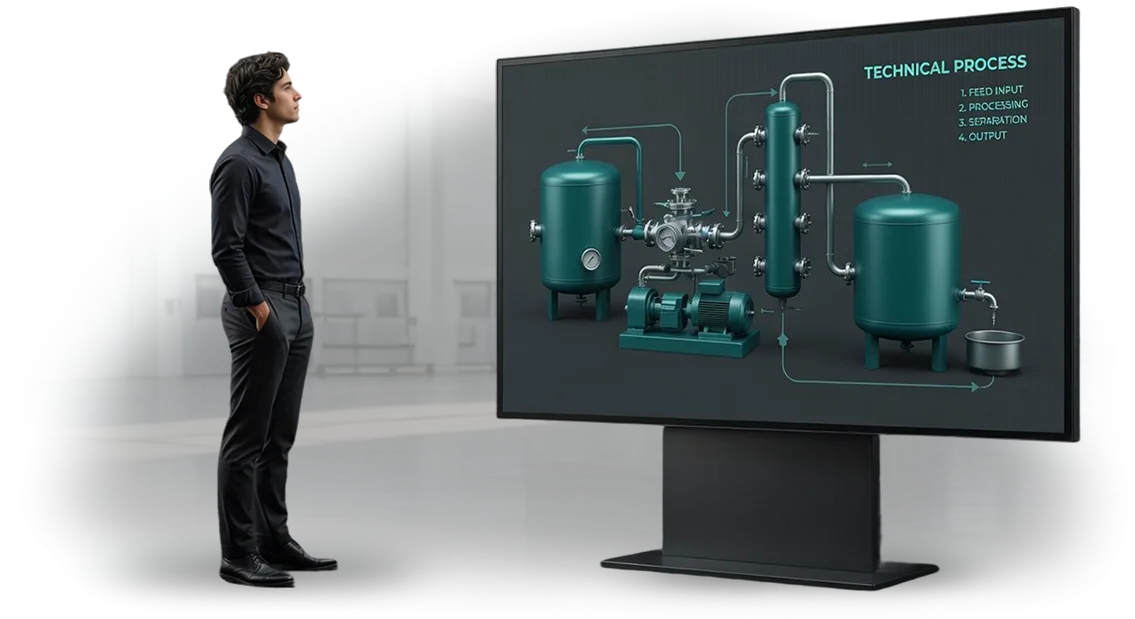
Violations of explosion safety requirements: how video instructions reduce risks
Text-based occupational safety briefings exist at every enterprise, but employees still violate explosion safety requirements. The reason is simple: long regulations and memos are skimmed diagonally, and under routine conditions important details fade from memory.
The price of such inattention is not a fine or a reprimand, but the risk of severe consequences for people and production.
This is felt especially acutely in industrial safety, where the cost of a mistake is measured in employee health and workshop shutdowns.
When a personnel training specialist sends out updated instructions time after time, they cannot control how deeply each person understood the material.
A formal checkmark in the log does not guarantee that the worker understands the danger and acts correctly in an emergency situation.
Short safety video instructions solve this problem. Instead of abstract items, the employee sees real scenarios: what happens when requirements are violated, what the safe zone looks like, how to act correctly during a leak or gas contamination.
Video holds attention, shows the consequences of mistakes without real risk, and stays in memory longer than text.
Video instructions are easy to integrate into an existing personnel training system: they do not require hours of distraction from work, and they can be watched on a tablet before a shift.
This format reduces the number of explosion safety violations, accelerates the onboarding of new employees, and helps pass inspections by supervisory authorities.
We help companies create exactly such videos — we take on the script, filming, and editing, leaving only the integration into your process.
What changes after implementing video instructions
Traditional employee training on explosion safety almost always relies on oral briefings and text memos. As a result, each newcomer remembers the material in their own way, and actions in an emergency depend on who conducted the training and how.
Video instructions eliminate this difference: all personnel receive the same, visual explanation of the procedure — regardless of shift, seniority, or the mentor's experience.
Faster onboarding. Instead of accompanying a new employee for weeks and personally explaining each step, you provide a ready-made video instruction. The newcomer watches the video, sees the correct sequence of actions, and starts working independently faster. This reduces the load on experienced employees and cuts adaptation time from weeks to several days.
Higher material retention. People retain visual information more effectively than text or spoken speech. A short video with a clear demonstration of each action stays in the employee's memory, and they recall the order of operations exactly when needed. Re-watching before starting work reinforces the skill without an instructor.
Reduced injuries and errors. A video instruction shows every stage of work from preparation to completion, including typical mistakes and dangerous zones.
The employee sees the consequences of incorrect actions and understands why to follow the regulations, rather than just memorizing rules. As a result, the number of violations, emergency situations, and related downtime decreases.
A uniform training standard for all shifts. You no longer depend on the subjective approach of different instructors. All employees — at any site, on any shift — receive the same knowledge and act according to a single regulation.
This simplifies training quality control and allows you to quickly update material when safety requirements change.
Formats of explosion safety video instructions for an enterprise
Different video instruction formats solve different tasks: one quickly familiarizes employees with general rules, another practices actions on specific equipment.
The choice of format directly determines how quickly personnel absorb the material and, ultimately, the safety level at the enterprise.
We have prepared a comparison table of the main formats we use when developing video instructions. These are practical scenarios for manufacturing companies with different facilities and budgets.
| Format | Who it suits | What it gives the business |
|---|---|---|
| Animated videos | For mass training, when you need to show dangerous processes that cannot be filmed with a camera (chemical reaction, explosion) | Safe demonstration of emergency situations, a uniform knowledge standard, easy comprehension of complex topics |
| 3D modeling of the facility | For training at a specific production site: workshop, line, tank, unit | The employee recognizes their workplace, remembers routes and procedures faster, makes fewer errors in real work |
| Filming with a mentor | For transferring practical experience, when a live example of a real employee matters | High trust in the video, clear demonstration of correct techniques and typical mistakes |
| Interactive video instructions | For knowledge testing and practicing decision-making skills | The employee chooses actions themselves, immediately sees the consequences, and you get statistics on material absorption |
The formats can be used separately or combined. For example, general theory can be delivered via animation, and practice on specific equipment via a 3D model. We will help you choose the optimal combination for your tasks and budget.
How video instruction development works
We have structured the process so that you understand at every stage what is happening and when you will receive the result. No "black box": you see intermediate versions, make edits, and control deadlines — from the first call to the final file.
- Initial survey and brief. We discuss your task: which employee actions need to be shown, which mistakes to eliminate, who will watch the video. You receive the structure of the future video and an understanding of the scope of work.
- Technical specification and storyboard. We fix the content, style, duration, and key frames. This is a "script on paper" — you approve it before production begins, so there are no unexpected reworks later.
- Draft version of the video. We create the main animation, add voiceover and text prompts. You receive a working version that can be watched and commented on.
- Review and edits. We gather feedback from your side and make changes — to text, timing, and emphasis. We show the updated version until you are satisfied with the result.
- Final acceptance. You approve the final video, and we deliver it in the required formats — for LMS, messengers, internal portal, or in-person briefing.
- Material handover. In addition to the video, you receive a concise implementation guide: where to place the video, how to check views, and how to update the material when regulations change.
This process saves your time: edits are made at early stages, when they are inexpensive, rather than after the final edit. The standard cycle takes 2–4 weeks depending on script complexity — the exact timeline is fixed in the contract before work begins.
What is included in the delivery package
The delivery package is not just a final file with the edited video. We provide the training department with a complete working set: from the approved script to methodological recommendations.
You won't have to figure anything out or redo anything — everything is ready to launch immediately after delivery.
- Video package. Final files in the required formats for the LMS, corporate portal, and in-person classes. Including versions for different screens — from a projector to an employee's smartphone.
- Instruction script. The approved text with frame-by-frame breakdown, narrator lines, and semantic emphasis on explosion safety. Based on it, you can update the video without involving the contractor.
- Source files. Project working materials — graphics, animation, soundtracks, and editing projects. They are your property; if necessary, your team can make edits using internal specialists.
- Methodological materials. Recommendations for the instructor: how to integrate the video instruction into the training program, what points to emphasize, and how to verify that employees have absorbed the material.
- Video instruction passport. A brief card for each video — topic, duration, target audience, and learning objectives. Convenient for training planning and reports to management.
- Subtitles and text version. A ready-made transcript for employees with hearing impairments and for use in handout materials. This covers accessibility requirements and helps reinforce knowledge.
- Update guide. A clear instruction on how to replace an outdated frame or add a new block without losing quality or semantic integrity of the video.
This package covers all the needs of the training department: you get not just a "picture," but a ready-made system for quickly launching an explosion safety course and its ongoing maintenance.
Case study: reducing workplace injuries
At production facilities with dangerous equipment, the cost of a mistake is a human life. Text-based briefings are poorly absorbed: after a week, an employee remembers only half of the requirements, and in an emergency acts contrary to regulations.
Video with a clear demonstration solves this problem, but ordinary filming does not show hidden risks.
For a petrochemical plant, we developed a series of 3D video instructions on explosion safety. The employee sees every step of the technological process, the boundaries of dangerous zones, and the consequences of violations — without risk to life.
Training takes place in a virtual environment, and the instructor monitors progress remotely in the system.
Results of implementation
| Indicator | Before implementation | After implementation |
|---|---|---|
| Safety requirement violations (per month) | 12 | 3 |
| Time to test one employee's knowledge | 1.5 hours | 20 minutes |
| Workplace injuries (per year) | 5 | 1 |
The plant's occupational safety department head noted that the main result is the reduction in injuries and a new attitude toward training: "Employees have stopped perceiving the briefing as a formality.
The video clearly shows the consequences of violations and is remembered better than text." KhimProm, where these video instructions have been implemented, has already ordered an expansion of the package to other workshops.
We offer the same approach for your production: we develop instructions based on your regulations, coordinate them with technologists, and hand over a knowledge control system. Tell us about your task — we will select the format for your specifics.
How to choose a video instruction format for your task?
There is no universal video instruction format — and that is good news. The choice comes down to what exactly the employee needs to absorb: simply see the sequence of actions or understand the physics of the process and react correctly in an emergency.
When it comes to explosion safety, the cost of a mistake is high, so the video format should not just show, but form the correct behavioral model.
For dangerous production scenarios — gas leaks, smoke, threat of explosion — CGI animation is optimal. It allows you to safely demonstrate an explosion, show the affected area, the movement of the shockwave, and the consequences down to milliseconds.
Live filming cannot do this: you would not risk people and equipment for a shot. Animation also removes the unnecessary — the employee sees only the key elements, and their attention is not distracted by environmental details.
If the task is simpler — teaching how to use a fire extinguisher, throw the switch, fill out a work permit — a regular video instruction with filming of the real workplace is sufficient. This format is faster to produce, familiar, and does not require expensive graphics.
But remember: it is poorly suited for scenarios that need to show hidden processes or an accident. In that case, the video will be either staged or unconvincing.
Therefore, we start not with "what video will we make," but with the task. We study your technological process, hazardous factors, and audience, then propose a format: classic filming, CGI, or a combined option.
For explosion safety, it often turns out to be more advantageous to make a CGI video right away — it can be updated when regulations change and used for all shifts.
As a result, you get a video that actually works to reduce risks, rather than just being listed in the training plan.
Frequently asked questions about video instructions
Clients rarely doubt the usefulness of video instructions — questions usually concern practice: how to quickly make edits, see real statistics, and integrate videos into existing training. Below we address common concerns on these topics.
How often should explosion safety video instructions be updated?
Video instructions are updated when regulations or technological maps change, or when new equipment appears. We initially build videos so that individual scenes can be reshot or adjusted without completely replacing the video. Therefore, the current version is delivered within a few days, not weeks.
How to track employee views?
The videos are placed in your LMS, which records the fact of viewing, time spent on each block, and repeat accesses. You can set up a mandatory viewing before testing — an employee will not receive clearance until they watch the video to the end.
If necessary, we will help configure reports and reminders for those who have not yet completed the briefing.
Can video instructions be integrated into our LMS?
Yes. We deliver the videos in a ready-made LMS format — they load into the corporate portal or training platform without modifications. If your system has specific features, we will adapt the course package, verify the launch on your side, and show you where to view statistics.
What to do if the regulation changes after launch?
Just send the new script or a list of edits. We will update the affected scenes and provide a fresh version, while the rest of the video remains unchanged.
During the support period, we assign a contact manager so that all approvals happen quickly and without unnecessary meetings.
Order video instructions for employee training
Leave a request for video instruction development — and we will prepare a timeline and format estimate for your production task.
Employee training should not depend on the instructor's personal experience: a properly structured video course levels the preparation of all employees and reduces the risk of human error.
By ordering video instructions from us, you get a ready-made tool that works immediately after launch. We handle the script, filming or 3D modeling, editing, and adaptation to your training system.
You don't need to understand the production details — just set the task, and we will organize everything from there.
- Clear script: complex regulations are turned into step-by-step actions that are easy to remember.
- Clarity without risk: dangerous situations are shown visually, without threat to people or equipment.
- Flexible learning pace: the employee re-watches the material as many times as needed for confident absorption.
- Uniform standard: everyone trains using the same instructions, regardless of shift and experience.
- Result control: video instructions are easy to integrate into a testing system and track completion.
- Transparent working terms: we fix deadlines and stages in the contract, and you always know at what stage the project is.
We work remotely, so you don't need to arrange a venue or spend time on meetings. Just leave a request — we will send a preliminary timeline estimate and propose a format that suits your specifics. Write to us to get a consultation and test material to assess quality.