

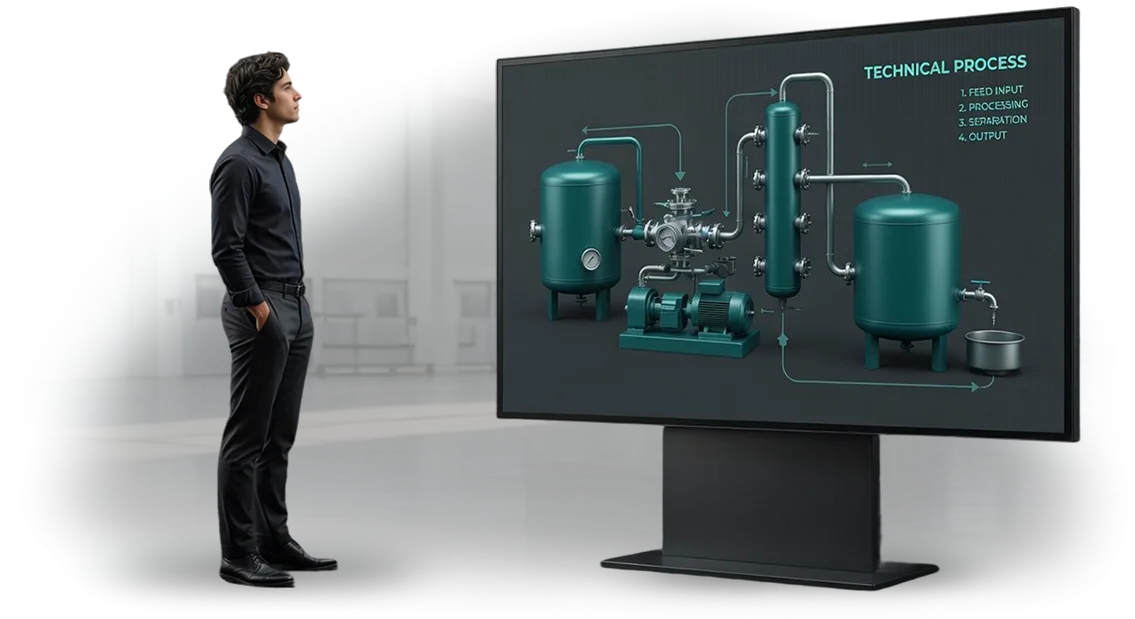
Pesticide Contact Is Unavoidable: How to Train Your Staff
Contact with pesticides is an inherent part of work at agricultural companies: treatment of fields, warehouses, greenhouses, and storage facilities happens continuously.
Even with strict compliance with regulations, employees inevitably interact with agrochemicals — when preparing solutions, loading sprayers, servicing equipment, or disposing of containers.
Any mistake at this stage leads to serious consequences: poisoning, burns, production downtime, fines from regulatory authorities, and reputational damage.
And due to staff turnover and the human factor, knowledge quickly fades, while new employees often receive only a formal safety briefing "for show." Paper memos and lectures do not provide the necessary level of engagement — the worker does not see the real risks and does not remember the safe action algorithm.
That is why systematic occupational safety training using video instructions becomes a necessity. We develop CGI videos that simulate pesticide contact in the most realistic conditions possible, but without any harm to health.
The employee sees all stages — from choosing protective equipment to actions in an emergency — and remembers the correct sequence through visual imagery and repeated scenarios.
This is not just a video, but a full-fledged training tool: it can be used during initial safety briefings, scheduled knowledge checks, and incident reviews.
The result for business is predictable and safe employee behavior, fewer accidents, and reduced administrative risks. Employees clearly know how to act when in contact with agrochemicals, which reduces downtime and preserves the health of the team.
The video instruction becomes part of the occupational safety system that can be easily scaled across all branches and updated when regulations change.
What a Quality Training Video Delivers: 5 Key Benefits for Business
Working with pesticides involves health risks and serious responsibility. An employee mistake can lead to injury, poisoning, fines, and loss of reputation. A quality training video reduces these risks and delivers measurable results for the business.
Five Measurable Benefits
-
Reduced injury rate. The employee sees the correct technique on screen and remembers safe actions. Fewer accidents mean less downtime, fewer sick leaves, and lower compensation payouts.
-
Unified standards. The video instruction sets the same procedure for everyone — new hires, experienced specialists, and different shifts. Work quality stops depending on the instructor's personality, and knowledge is not "lost" when an employee leaves.
-
Fast onboarding. New people study the material at their own pace and start working sooner. There is no need to wait for a mentor to become available — the video is accessible at any time.
-
Savings on instructors. Create the video once and use it for years for all subsequent hires. This reduces ongoing training costs and frees up time for experienced specialists.
-
Protection from fines. The fact of training completion is recorded, and you always have proof for inspectors. This reduces the company's legal and reputational risks.
We help agricultural companies and chemical manufacturers turn internal regulations into clear video lessons. With 10+ years of experience, we know how to create material that genuinely improves training effectiveness and standardizes processes.
Formats of Corporate Video Instructions: Choose What Suits You
The choice of training video format directly affects how well employees absorb the material and apply it at work. This is especially important for instructions related to pesticide contact, where a mistake costs dearly.
We have prepared a table of the main formats so you can compare them by key parameters: who they are for, what tasks they solve, and what results the business gets.
| Format | Who it's for | What tasks it solves | What it delivers to the client |
|---|---|---|---|
| CGI simulation | Employees working with pesticides: agronomists, operators, warehouse staff | Realistically shows the contact process, consequences of violations, and the correct action algorithm | Reduced production risks, skill practice without real danger, staff confidence |
| Interactive video (action choice) | New employees, teams that need to verify their understanding of regulations | Engages in the scenario, forces decision-making and shows the consequences | Material retention through practice, quick knowledge checks, higher engagement in training |
| Screencast (screen recording) | Office employees, operators of accounting and document management systems | Shows work in the interface, settings, and procedures step by step | Fast creation and easy updates, clear step-by-step instructions without leaving the workflow |
| Combined format | Large departments with mixed processes | Combines realistic CGI scenes, live-action footage, and graphic explanations | Full material coverage, flexible presentation, a unified training standard for all skill levels |
Each format covers its own task: CGI simulation immerses in real conditions and reduces risks, interactive video tests reaction and retention, screencast saves time explaining routine tasks, and the combined option suits complex multi-stage processes.
We help you choose the optimal format for your production specifics and audience characteristics so that training delivers measurable results — from fewer errors to faster adaptation of new employees.
How a Training Video Is Created: 7 Steps from Brief to Launch
We have structured the training video production process so that you see results at every stage and control the timeline. You don't need to understand production — you only need to participate at key points: setting the task, the script, and final approval. This helps avoid delays and deliver a video that actually changes employee behavior.
-
Brief and audit — we immerse ourselves in your specifics: which pesticide operations employees perform, where they most often make mistakes, which safety rules they violate. The output is a document with training objectives and success criteria.
-
Script and storyboard — our methodologists and scriptwriters turn regulations into clear video instructions: what the frame shows, what actions the operator performs, what warnings appear on screen. You receive the script for approval.
-
Approval and revisions — we make adjustments based on feedback from your technologists and occupational safety specialists. Two or three iterations is standard practice and is already built into the timeline. You approve the final version of the script.
-
Production of CGI graphics and simulations — we create realistic 3D models of packaging, protective equipment, machinery, and pesticide contact processes. This allows us to show even dangerous situations without risk to people and without stopping production.
-
Editing, voiceover, subtitles — we assemble the video, record a professional voiceover, and add text explanations for viewing without sound. We verify that the video opens correctly on any device — from a computer to a tablet on the warehouse floor.
-
Test run — we show the video to a small group of employees. We check how clear the instructions are, record questions and shortcomings, and make revisions. This reduces the risk that the training will not produce results.
-
Launch and handover of materials — we deliver the finished video in the required formats and provide recommendations for integrating it into the learning management system. If needed, we place the video on your portal and remain available for refinements after trial use.
The entire process takes three to six weeks depending on the volume and detail level of the scenarios. You receive not just a video, but a ready-made training tool that works for safety and error reduction on the production floor.
What's Included in the Deliverable: A Complete Training Package for Employees
You receive not just "videos," but a complete training product that can be put to work from day one. All materials are gathered into a single package and organized by role: what to give employees, what to give department heads, and what to give the training department.
No need to figure anything out or search through files — all elements work together like a construction kit.
Here is what's included in the deliverable:
- Final videos in multiple resolutions — for computer-based training, employee tablets, and phones. Each file is optimized for fast loading even on a corporate network.
- Scripts and source materials — text versions of each instruction and editing source files. If requirements change in your regulations, you can make edits without a new production cycle.
- Methodological recommendations — a step-by-step instructor guide: how to integrate the video into an in-person session, what questions to ask after viewing, how to reinforce the material in practice.
- LMS packages — ready-made training modules for your learning management system. Upload with one click, automatically track views and test completion.
- Footage library — a set of individual scenes and fragments that can be reused in presentations, memos, and internal articles without contacting us.
- Supporting documents — certificates, acceptance acts, and instructions for installing files on your equipment. No bureaucratic hiccups during handover.
Each item in the package covers a specific task: reduce training preparation time, simplify control over safety briefing completion, and answer the question "what to show a new employee first." You get everything you need turnkey — all that's left is to assign responsible staff and collect feedback.
Real Case Study: How an Agricultural Holding Reduced Violations by 40%
How It Started
One of our clients — AgroProm-Yug — faced a typical problem: employees in warehouses and in the field regularly violated pesticide handling regulations. Instructions were handed out, but in practice people acted out of habit rather than according to the document. After an internal review, management realized: they needed a format that could not be ignored.
We developed a series of short CGI videos showing all agrochemical contact scenarios: from solution preparation to container disposal. Instead of abstract slides — a realistic first-person simulation.
The employee sees what happens when a mistake occurs: where the substance goes, how quickly it is absorbed, what the health consequences are.
Numbers After Implementation
200 employees completed the training — operators, agronomists, warehouse staff. Within three months, the number of violations when working with pesticides dropped by 40%.
Final test pass rates rose from 68% to 94%, and the number of incidents involving skin contact with the product or inhalation was cut in half.
The key point — safety stopped being "on paper only." Employees remember consequences rather than instruction text, so they act correctly even in non-standard situations.
Management ordered a follow-up: videos for new hires and seasonal workers, as well as integration of the videos into the learning management system. Now every person goes through the same safety standard — regardless of the lecturer or region.
Common Client Doubts: Answering the Uncomfortable Questions
We understand that before launching a project you have questions: will employees actually watch the videos, how long will production take, is it safe, and what happens if the result doesn't match expectations. We answer honestly — no fine print and no technical jargon.
Won't employees just skip the video instructions?
We design scenarios for your specific audience: short, clear, with emphasis on actions the employee will perform right after viewing. On average, over 80% of viewers watch such videos to the end — they are perceived as practical help, not formal training.
Isn't this too slow and expensive?
Timeline and budget are fixed in the contract before work begins. For standard tasks, there are ready-made turnkey solutions: a basic video can be produced in 2-3 weeks. The exact cost is calculated after the brief — it depends on the number of scenes and level of detail.
Are pesticide contact simulations safe?
Completely safe: no real contact with substances occurs. The employee interacts with a virtual model where mistakes can be practiced without health risks. This is the best way to master hazardous operations without consequences.
What if the video style doesn't fit our brand?
Before production, we approve the script, visual style, and presentation. We offer not one but two styling options — from strict corporate to more dynamic. Revisions are made at every stage, not after the finished result is delivered.
What about result guarantees?
We fix in the contract the number of videos, timelines, number of revisions, and requirements for the finished material. If we violate the terms — we refund your money. So you only risk your approval time, not your budget.
If you still have doubts — ask us directly, we respond within one business day. We continue addressing the most uncomfortable questions below.How to Protect Employees During Pesticide Contact?
The question of employee protection when working with pesticides arises for every responsible manager. Mistakes during chemical contact can cost health, and sometimes life, so training is not a formality but a safety factor.
How do you communicate the correct actions to staff when real-life practice is associated with risk?
The answer — CGI simulations of dangerous scenarios. Video instructions with computer graphics model any situation: leaks, skin contact, solution preparation, working without protective equipment.
The employee sees the consequences and the action algorithm without any threat to health. This format is absorbed faster than a conventional briefing thanks to visual memory and engagement.
Corporate video instructions give the manager a clear result: a unified standard of action, fewer violations, and confidence in staff readiness for critical situations.
Training happens without stopping production — the video can be watched at the workplace or in an app, and knowledge checks are automated. This saves mentors' time and eliminates discrepancies in rule interpretation.
CGI also shows what is inaccessible in reality: how a pesticide affects the body, spreads through the air, and moves across surfaces. This understanding builds a conscious attitude toward safety instead of mechanical memorization. Employees follow regulations on their own — the risk of poisoning and accidents decreases.
So, protection during pesticide contact begins with systematic training using visual simulations. It covers safety objectives, simplifies new hire onboarding, and helps pass inspections by regulatory authorities.
Order videos tailored to your production scenarios — it's an investment in people's health and business stability.
Ready to Train Your Employees in Safe Work? Send a Request
Send a request — and within one business day we will prepare an audit of your current instructions and propose a training video scenario. This is an introductory consultation, not an obligation: you will receive a cost estimate and understand which format suits your employees best.
In response to your request, you will receive:
- Risk audit: analysis of typical errors when working with pesticides, hazardous zones, and weak spots in current regulations.
- Format proposal: video instruction, interactive simulator, or a combined course — with a recommendation for your task.
- A cost estimate calculated for your scope: stages, timelines, revisions — no hidden payments.
- A schedule: production dates, approval checkpoints, and launch.
- Examples of similar projects for your industry — with results assessed for the client.
- A brief: a short questionnaire so we can speak the same language from the start and not waste your time on clarifications.
Our team has been making training videos for agricultural holdings and chemical production facilities for over 10 years.
We know how to show pesticide contact clearly and safely: the employee remembers the sequence of actions and confidently applies it in practice, rather than just "watching the mandatory video."
After receiving the brief, we prepare the script and storyboard before production starts — revisions are made in advance, so final delivery is never delayed.
If you need a consultation, send a request through the form or via messenger: we will respond within one business day, recommend the optimal format, and prepare an estimate with no prepayment required.