

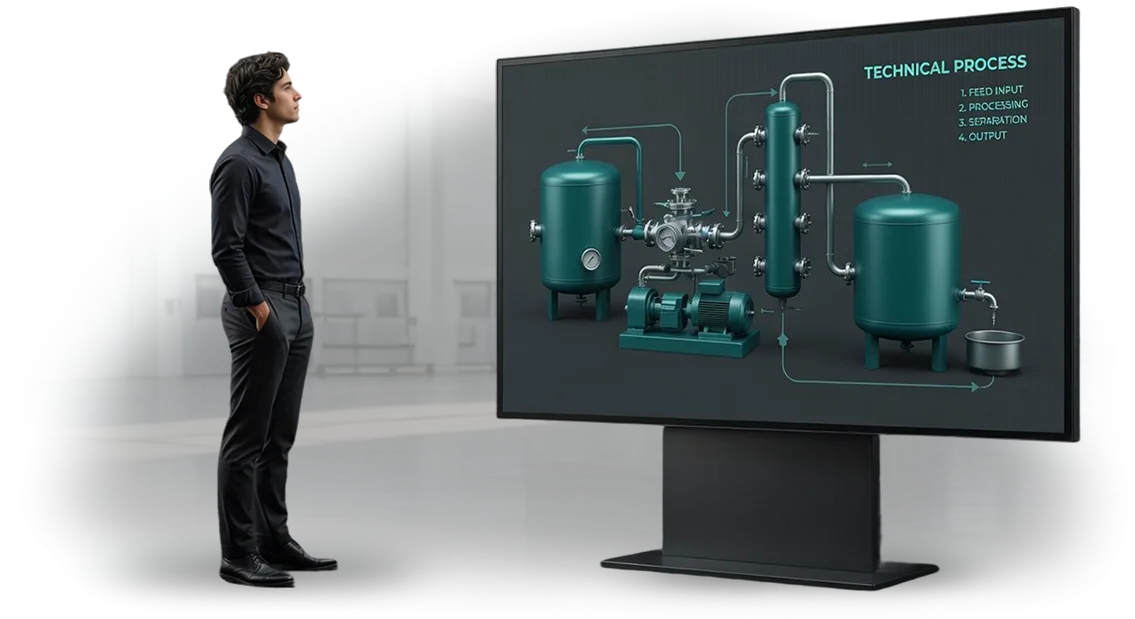
How to Avoid Dangerous Gas Poisoning: Corporate Video Instructions
Industrial enterprises face the risk of dangerous gas poisoning: leaks, safety violations, human error. Dangerous gas is often odorless and colorless, which makes detecting a leak difficult.
The consequences range from production shutdowns to serious employee injuries and legal risks. Every such incident costs the enterprise dearly — both directly and in terms of reputation.
Most safety briefings come down to reading regulations or watching outdated materials that fail to hold attention. Employees formally complete safety training but do not remember the action algorithm at a critical moment.
An emergency involving a gas leak requires an instant response — and that is exactly what traditional formats fail to provide.
Corporate video instructions change the approach. They make it possible to visually simulate an emergency scenario, show the signs of gas poisoning, and demonstrate the correct actions — step by step.
Video training is easy to review and is understandable to all employees regardless of experience or skill level. This format integrates into the corporate training system and delivers results that truly protect people.
We develop training videos that do not just inform but build lasting skills. Our video instructions account for the specifics of your production and real leak scenarios, so employees remember where to press, whom to call, and how to evacuate.
Contact us to get video instructions that reduce the risks of dangerous gas poisoning and make your enterprise safer.
Why Training Videos on Gas Safety Work
Employees remember safety rules only when they see the real consequences of a mistake. Text on a slide or a lecture about gas properties is absorbed worse than a visual demonstration of an emergency.
This is exactly what sets video training apart: it engages visual memory and emotions, which solidify the material for a long time.
A realistic simulation of dangerous gas poisoning is not just a video — it is a controlled scenario. We create an on-screen situation close to reality: a leak, the smell, first symptoms, mistakes, and correct actions.
The employee sees events develop from start to finish and remembers the algorithm — what to do, where to call, how to provide first aid. The brain perceives it as experience, not as an abstract instruction.
For the company, this means reduced risks and fewer accidents on site. An employee who has once seen the consequences reacts faster and more consciously in a real situation. That means fewer injuries, less downtime, fewer fines from inspectors.
The company our team professionally handles such video instructions, so the client receives a ready-made training product proven in practice.
Corporate videos also pay off as a training system: one video replaces several hours of lectures and briefings. It can be shown to new hires, used for refresher training and exams — without equipment rental costs or production stoppages. This is not just training material but a tool that saves the company time and money.
Formats of Training Videos on Gas Safety
Training material on gas safety is useful only when employees actually absorb and apply it. One format cannot cover all tasks: someone needs a quick reminder before a shift, someone else needs in-depth practice of actions in an emergency.
Therefore, we design videos for a specific scenario — from a short reminder to a full course with virtual reality.
Below is a table of typical formats we use in corporate programs for protection against dangerous gas poisoning. You can choose one or combine several to suit your task.
| Format | Who it is for and for what task | What it gives the client |
|---|---|---|
| Short videos up to 2 minutes | For regular briefings before starting work, for reminding key rules | An employee refreshes knowledge in a minute — no need to take them away from work for lengthy training |
| Full training course | For new employees, for scheduled staff retraining | A unified training program: every employee gets the same level of knowledge without a live instructor |
| Virtual reality video | For practicing actions in a dangerous situation: gas leak, smoke, evacuation | A person trains skills in a safe environment and acts automatically in a real threat |
| Interactive videos | For knowledge testing and material reinforcement | An employee does not just watch but makes decisions along the way — you see who has absorbed the material and who needs additional training |
Whichever format you choose, all videos are shot on professional equipment and adapted to the company’s corporate style. This means the training does not look like a faceless instruction — it is perceived as part of your safety system, and employees take it more seriously.
To choose the optimal format, simply describe your situation: number of employees, production specifics, and briefing frequency. We will propose a solution that covers safety concerns without wasting time or budget.
How We Create Training Video Instructions
We do not start work “blind” — every stage is coordinated with you so that the final video instruction truly solves the training task. Below is the step-by-step process we have refined across dozens of projects for industrial enterprises and training centers.
- Brief and immersion into the task. We analyze who exactly will watch the video, what actions need to be practiced, and what risks need to be covered. The output is a concise technical specification that you approve.
- Script outline and storyboard. Based on regulations, we turn the instruction into a clear visual sequence: what happens on screen, what employee actions are shown, where the safety emphasis is placed. You see the script before filming and can make edits.
- Preparation for filming. We select the location, equipment and, if needed, actors or occupational safety specialists. For simulating dangerous gas poisoning, we develop visual effects and safe filming conditions in advance.
- Filming and CGI additions. We shoot real employee actions, while dangerous scenarios — such as gas leaks or poisoning symptoms — are created as computer graphics. This allows critical moments to be shown clearly without risk to people.
- Editing and voiceover. We assemble the video into a unified scenario, adding a narrator’s voice, subtitles, and graphic hints. You receive an intermediate version and make final comments.
- Launch and result monitoring. We deliver the video in the required formats — for LMS, corporate portal, or in-person briefings. If necessary, we adjust the video after the first viewings.
Thanks to this scheme, you always know what is happening at every step, and approvals take minimal time. In the end, employees receive a short and clear instruction that reduces the risk of mistakes and improves the safety culture.
What Is Included in the Delivery of a Training Video Course
After the script is approved, you receive a complete set for launching training — without having to assemble contractors piece by piece. Everything needed for knowledge testing and recording results is already packed into one bundle, ready to be delivered to your employees.
The set includes:
- A ready series of videos — a clear 3D simulation of dangerous gas poisoning: how damage occurs, how to act during a leak, and which mistakes cost lives.
- A script and methodological guide for the instructor — discussion anchor points, analysis of common misconceptions, and a plan for integrating the course into the existing training program.
- Test assignments and evaluation sheets — automatic checking of material comprehension and a results record for each employee.
- Access to the distance learning system — we upload the course, configure access, issue logins, and support the first launch.
- Adaptation to internal regulations — we add your occupational safety instructions, order numbers, and specifics of your particular production.
- Editable templates and source materials — you can update the videos and methodology guide with your own team, even without the contractor.
After a short setup, employees complete the course from any device, and you receive a clear report: who has absorbed the material, who passed the test, and who needs an additional conversation.
This satisfies both the briefing requirement and the goal of actually reducing the risk of poisoning in production.
Case Study: Training Prevented an Accident at a Production Site
Chemical production is a high-risk area: an employee’s mistake when working with gas systems can cost health and life. The client was the KhimProm-Region plant with a continuous production cycle, where staff turnover in line positions reached a third of the workforce per year.
Every new employee had to quickly learn safety rules, but the classic briefing did not provide the needed engagement.
We developed a series of CGI video instructions simulating dangerous gas poisoning. Employees saw a realistic scenario: how gas behaves, where it accumulates, what happens when regulations are violated, and how to evacuate correctly. The video became part of the initial safety briefing and the annual knowledge check.
Implementation Results
Within three months, the number of gas leak incidents on the site halved. The head of the occupational safety service noted that employees began recognizing dangerous situations faster and acting according to the algorithm.
An additional effect was reducing briefing time from two days to four hours. The plant could bring new people into shifts faster without sacrificing training quality.
Why the Client Stayed with Us
After the first results, the client expanded the project to other hazardous areas: work with acids and high pressure. We continued to support the videos and update them when regulations changed.
The repeat engagement was the best proof of effectiveness — the company now uses video instructions as the training standard for all workshops.
How to Distinguish Dangerous Gas Symptoms in Production?
Signs of a dangerous gas leak in production often do not look like “something extraordinary”: slight weakness, barely noticeable dizziness, a dry throat, or a strange taste.
In the noise of a workshop, these are easily dismissed as fatigue or a draft — which is why most incidents develop unnoticed until the situation becomes critical.
Dangerous gas leak symptoms cannot be memorized from posters — in reality, they manifest differently. One person feels drowsiness, another has eye irritation, a third loses coordination.
The key is to teach people to notice such signs in themselves and in colleagues, even when the odor is not obvious.
Every minute of delay increases the risk to people and the cost of downtime. If personnel are not trained, the first reaction is mistaken for fatigue, and evacuation starts too late.
Correct behavior must be automatic: one person notices a sign — gives a signal — the others stop work.
This is where CG video instructions from our team help. We create videos where leak symptoms are shown in a realistic but completely safe simulation: how a person’s behavior changes, what details indicate danger, and what action looks like when time is short. The employee remembers visual images, not abstract text.
For business, this means fewer incidents, less downtime, and confidence during inspections. Personnel who recognize the signs of dangerous gas at an early stage are an investment in safety, not a cost item. One prevented incident is enough for the training to pay for itself many times over.
Common Doubts When Ordering Training Videos
When it comes to corporate training videos, especially with simulations of dangerous situations, clients raise the same questions: will deadlines slip, will the budget go over, is it difficult to integrate the videos into the existing training system, and who is responsible for the result. This is normal — you are responsible for employee safety and you want predictability.
We have been working on such tasks for more than 10 years and are used to addressing objections as early as the brief stage.
So let us set the record straight: the process is transparent, deadlines are fixed in the contract, integration takes minimal time, and quality is checked on intermediate versions. Below are answers to the most common doubts.
Will the deadlines slip?
Deadlines are fixed in the contract before the start. We break the project into stages with checkpoints: brief, script, 3D scene, draft and final video. You see progress at every step and are never left alone with uncertainty.
Will it cost more than planned?
The cost is determined after the brief and fixed in the estimate. We do not add hidden fees: all revisions within the agreed stages are already included. If you need to expand the scenario, we will discuss it in advance, not after the fact.
Is it difficult to integrate the videos into our training system?
Our goal is for the videos to work where employees will watch them: in the LMS, on the corporate portal, or on workstations. We deliver the videos in standard formats and help with setup if needed. You will not have to restructure processes — you simply add content and assign it to employees.
What guarantees that the video will actually train employees?
We build the script based on your production’s real regulations and hazardous factors. The video does not just show how dangerous something is — it provides a clear action algorithm and checks its absorption through questions. You receive a tool, not a “picture for show.”
If any doubts remain, we will discuss them personally. Below are answers to the questions our clients most often ask before starting.Order Training Video Instructions for Employees
Ready to make employee training clear and safe? Leave a request to develop a video instruction — including a video with a simulation of dangerous gas poisoning.
We handle all stages: from script to final editing. You receive ready-made material that can be used in initial briefings, advanced training, and distance learning systems.
What you get by ordering a video:
- A personal consultation — we analyze your task and suggest the appropriate video format.
- A cost and timeline estimate in the form of a commercial proposal — with no hidden terms.
- A clear script aligned with your regulations and safety procedures.
- A video that employees will understand the first time: a clear simulation of a dangerous situation.
- The right to use it in any format — briefings, distance learning, certification.
- Support after delivery: we make revisions and help integrate the material into training.
To receive a commercial proposal, contact us in any convenient way — through the form on the website or by phone. A manager will respond within a business day, clarify the details, and prepare an estimate for your task.
Do not put off employee safety. Order a training video today — within a few weeks you will have a ready-made tool for fast and effective personnel training.