

How to Train Employees Without the Risk of Steam Burns?
Every year, employees suffer steam burns because occupational safety training remains a formality: text on a slide, a signature in a logbook — and the person goes out onto the line without a real understanding of the danger.
An ordinary lecture does not show exactly how steam behaves under pressure, where it is invisible but already burning, and which seconds decide whether a worker gets injured.
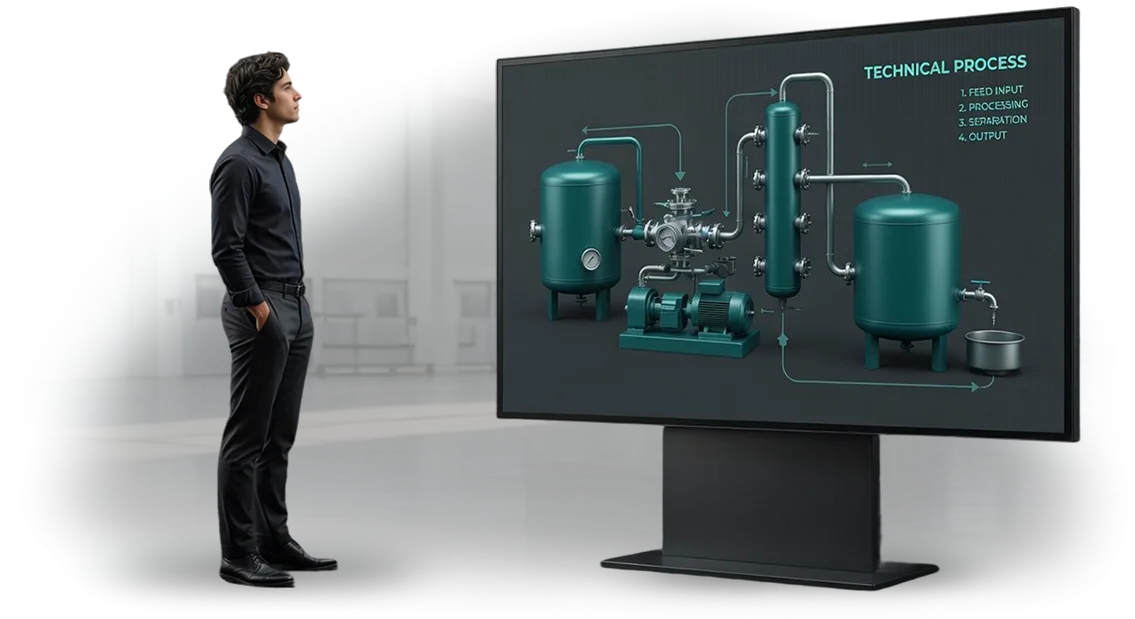
A video instruction solves this problem: the employee sees the process with their own eyes — from steam supply to emergency shut-off of the valve.
A scenario filmed at a real production site or recreated in CGI is remembered better than text and forms the correct reaction to danger before it arises.
Thus, training ceases to be a checkbox and becomes a tool for reducing injuries. The manager gets a predictable result: employees not only know the rules, but understand the physics of steam burns and act safely.
We create video instructions tailored to your technological process — taking into account your equipment, facilities, and typical staff errors.
Who Video Safety Instructions Are Suitable For
Industrial safety concerns not only large plants and chemical productions — the risk of steam burns exists everywhere there are boiler rooms, heating networks, autoclaves, or pressure equipment.
Video instructions with CGI simulation make it possible to show the danger visually, without risk to people or work downtime. This format is useful both for initial training of newcomers and for scheduled safety briefings of existing personnel.
| Type of enterprise | Where steam burn risk occurs | What the video instruction gives |
|---|---|---|
| Factories and plants | Heat exchangers, steam pipelines, drying chambers | The employee sees in advance the consequences of violating regulations |
| Boiler houses and thermal power plants | Boiler piping, condensate discharge, emergency blowdowns | Quick memorization of safe actions in routine and emergency situations |
| Food production facilities | Sterilizers, cooking kettles, bottling lines | Fewer errors when working with hot media |
| Housing and utilities, energy networks | Heating mains, central heating stations, repair work | Clear briefing for contractors and own crews |
| Logistics and warehouses | Tank washing, tank steaming | Minimization of injuries during tank cleaning |
A video instruction works equally effectively for a workshop, office, and remote sites. It can be embedded into a distance learning system or shown as an introduction before granting permission to work.
The video clearly demonstrates the physics of a steam burn: why a protective suit does not save from a contact burn, how quickly a steam cloud spreads, and what distances are safe.
With more than ten years of experience, our team suggests that CGI simulations work best in hazardous industries where the price of a mistake is a person's health and the cost of downtime is measured in hours.
Instead of dry instruction text, the employee gets a memorable picture of "what not to do and what happens next." It is precisely such images that come to mind at the moment of real danger and prevent fatal actions.
Formats of Video Instructions with Steam Burn Simulation
When it comes to staff training, format decides everything. A short memo and a full-fledged course with knowledge testing serve different purposes: the former is for a quick reminder, the latter for reliably reinforcing a skill.
A steam burn simulation using CGI animation looks equally convincing in a thirty-second video and in a ten-minute training film.
We select the format according to your task, audience, and production specifics. Below are typical options that our clients most often order.
| Format | For whom | What it gives the client |
|---|---|---|
| Video card (1–2 minutes) | New employees, briefing before shift start | Quick introduction to the rules, less time for adaptation |
| CGI video with scenario analysis (3–5 minutes) | Personnel working with steam and hot surfaces | Visual demonstration of risk without a real threat, memorization of the action algorithm |
| Full training course with testing (10–15 minutes) | All employees, mandatory certification | Knowledge check, training confirmation, company protection during incident reviews |
This division prevents overpaying for unnecessary functionality: for regular reminders, a short card is enough, while certification requires a full cycle. All formats use the same high-quality CGI animation, so the employee sees a unified picture of danger in any material.
Our team will select a format tailored to your production specifics and teams' work schedules.
The same scenario with a steam burn simulation can be adapted into several videos: the first for introductory briefing, the second for scheduled training, and the third for final knowledge testing.
Stages of Video Instruction Development: From Brief to Launch
A managed process is the key to a predictable result. We have broken down the creation of a video instruction into stages so that you can see the status at each step and influence the details.
- Brief and audit. We discuss which errors the videos should eliminate and in what situation the risk arises, for example when working with steam. We record the goal and success criteria.
- Script and storyboard. We turn the regulations into a narrative, showing each step from the employee's point of view. We approve the text and key frames before production starts — this reduces the number of edits.
- Animation production. We create a realistic scene with a steam burn simulation — safe and visual, without filming on real equipment. The employee sees the consequences of an error and the correct sequence of actions.
- Voice-over and subtitles. We add voice and text prompts so that the video remains understandable in a noisy workshop or without sound. We emphasize key safety points.
- Approval. You review the draft and provide feedback. Edits are made before the final cut, so the process does not drag on.
- Launch. We deliver the file in the required format for a corporate portal or learning system. We help with uploading so employees can start going through the material right away.
Thanks to this process, you get the video on time and with a predictable result.
What Is Included in the Training Video Package
After development is completed, you receive not just one video, but a complete set of training materials. We put it together so that the person responsible for training can launch the briefing the very next day — without finishing touches or rework. The delivery includes:
- Approved script and frame-by-frame plan — a ready-made text for your training program; it can be approved and used as a summary.
- Video files in multiple formats — for corporate LMS, offline screening in class, and mobile viewing.
- Source project files — you remain the owner of the material and can make edits without paying again.
- Methodological guide for the instructor — how to embed the video into a lesson, place emphasis, and verify topic comprehension.
- Employee memo — a short summary of steam burn safety rules, convenient for distribution after viewing.
- Test questions for knowledge checking — a ready-made block for monitoring and recording training results.
- Delivery documentation — the acceptance certificate, a description of the package contents, and usage rights.
All materials are provided electronically, with documentation and an acceptance certificate — this is your asset that stays with the company and can be used repeatedly.
The documents are prepared so that they can be easily attached to internal regulations and occupational safety inspections.
After training is launched, we stay in touch: we will help adapt the package to your LMS formats, make targeted edits, or distribute the video to new groups of employees. This allows you to keep instructions up to date without starting development from scratch.
Case Study: How We Reduced Injuries at an Enterprise
The client — a machine-building plant — faced recurring cases of steam burns in its boiler shop. Despite regular briefings, employees violated the regulations: they removed protective gloves and opened valves without pausing for cooling. The losses were serious — days of disability, downtime, and insurance payments.
For the plant, we developed a series of short video instructions, with a CGI video featuring a steam burn simulation as the central element. On screen, the worker sees the real consequences of an error while remaining safe themselves.
This works more effectively than any slides: the image is remembered, and the emotional impact changes behavior.
The videos were integrated into the training system, and knowledge testing was conducted for all 1,400 shop employees. Importantly, training did not take a week of back-to-back lectures, but two days in the work schedule: 15-minute sessions are easily held before a shift.
A quarter later, the plant measured the results. Overall injuries at the enterprise decreased by 35%, and incidents specifically involving steam burns were nearly halved.
The management continued the collaboration: it ordered the same instructions for three other shops, and the occupational safety service included the videos in the mandatory program for hiring new employees.
This is an example of a systemic effect: one high-quality video solves the safety task, saves on fines and downtime, and pays off within a few months.
How to Choose the Right Video Instruction Format?
Choosing a video instruction format starts not with a pretty picture, but with conditions: how many people need training, what budget is allocated, and how you plan to control the result.
For a local team of 20 employees, a short demonstration video is often enough, while for a branch network, a module with testing and result storage is needed. This is the basis we use when selecting a solution.
This is especially important when a mistake costs a lot. A steam burn simulation in production is not an ordinary briefing, but a scenario where the price of a mistake is an employee's injury.
Realistic CGI animation makes it possible to show all the details of a hazardous process without risk to people and rehearse correct actions to the point of automaticity. This format requires a budget, but it pays off through accident prevention.
Having an LMS simplifies corporate training: the video is embedded into the system, and you automatically see who has completed the course and who has not. If there is no LMS, we will offer a standalone format that guides the employee on its own and issues a completion mark. No complex integrations — only a clearly understandable result.
Scale also affects the cost. For regular training of 50–100 people, a recorded instruction with clear graphics is sufficient.
For larger teams, it is better to create a module with chapters and short quiz questions so that employees not only watch but also consolidate the material.
At the brief stage, we will ask three key questions: audience size, budget, and requirements for knowledge control. After a short conversation, you will receive a recommendation for a format that solves the task without overpaying. The rest is our job: script, animation, editing, and packaging for your training system.
Addressing Doubts: Safety and Return on Investment
Having doubts before ordering is normal. Especially when it comes to scenes with steam burns: it seems that filming is dangerous, complicated, and unlikely to pay off.
In practice, the opposite is true — modern technologies make it possible to create a realistic simulation without any risk to people, and the result benefits the business for years.
Below we address the main concerns we hear from clients. Briefly and to the point — the way we would tell you at a meeting.
Is it safe to film a steam burn scene?
Yes, completely safe. There is no real steam or open heat sources on the set — everything is created using computer graphics and 3D modeling.
Employees do not come into contact with the hazardous environment; filming takes place in an ordinary studio, and the frame features either a digital character or an actor with overlaid graphics.
Health risks are eliminated, so the safety briefing for participants is no different from a standard one.
How long will creating the video take?
A standard cycle is two to four weeks depending on the volume and complexity of the scenes. We record the stages and dates in the contract in advance, so you know the exact delivery date.
At each stage, you receive intermediate versions and make edits — this helps deliver the project on time and without surprises.
When will the training pay off?
Payback comes after the very first uses. A video instruction replaces several hours of live lectures and does not require equipment rental for training.
Employees memorize the action algorithm faster and make fewer mistakes, which means — risks of injuries and costs of their consequences decrease. One high-quality video works for the company an unlimited number of times, and its cost easily fits into the annual training budget.
We take responsibility for filming safety, meeting deadlines, and a transparent financial model. All you need to do is set the task and receive a finished product that will protect employees and save company resources.Get a Scenario Estimate for Your Production
Every production facility is unique: its own layout, equipment, regulations, and typical situations in which an employee can get a steam burn. For this reason, the cost of a CGI video cannot be the same for everyone — we prepare an estimate according to your conditions and goals.
Fill out the request, and within two business days you will receive a scenario estimate, scene composition, and implementation timelines.
What is included in the estimate:
- Analysis of your site and typical situations where a steam burn is possible — we take into account the real risks of your production.
- Selection of a realistic simulation for your type of equipment, so that employees recognize their workplaces.
- Scenario description: from operator actions to the consequences of a burn, with an emphasis on safety rules.
- Recommendations on video duration and number of scenes — the optimal format for material comprehension.
- Transparent cost and production schedule estimate without hidden additional payments.
As a result of the estimate, you will receive a demo version of one scene to evaluate the quality of the graphics and presentation even before the project starts.
This allows you to make a decision without risk: you see how the instruction will look on screen, and only then launch the full production cycle.
Leave a request on this page — our manager will clarify the tasks, and a scriptwriter will prepare a personal estimate. We will show the demo scene using an example close to your production.