

Why Working at a Machine Carries a High Risk of Pinch Point Injuries
Training on real equipment always involves risk — especially at the stage when an employee is just learning the feed motion and does not yet feel the mechanism's inertia.
A split-second mistake, an incorrect approach angle, or a lapse in concentration can put a hand into the pinch point. The price of such a mistake is a serious injury, weeks of rehabilitation, and production downtime.
Classic occupational safety briefings do not solve this problem: diagrams in the regulations and an engineer's explanations do not convey the real speed, force, and trajectory of the working component.
The employee sees the safety rules on paper, but no mental image of the danger zone takes shape. When they first approach the machine, they have no muscle memory or visual experience to stop in time.
As a result, the injury risk is highest precisely among newcomers and when switching between equipment types.
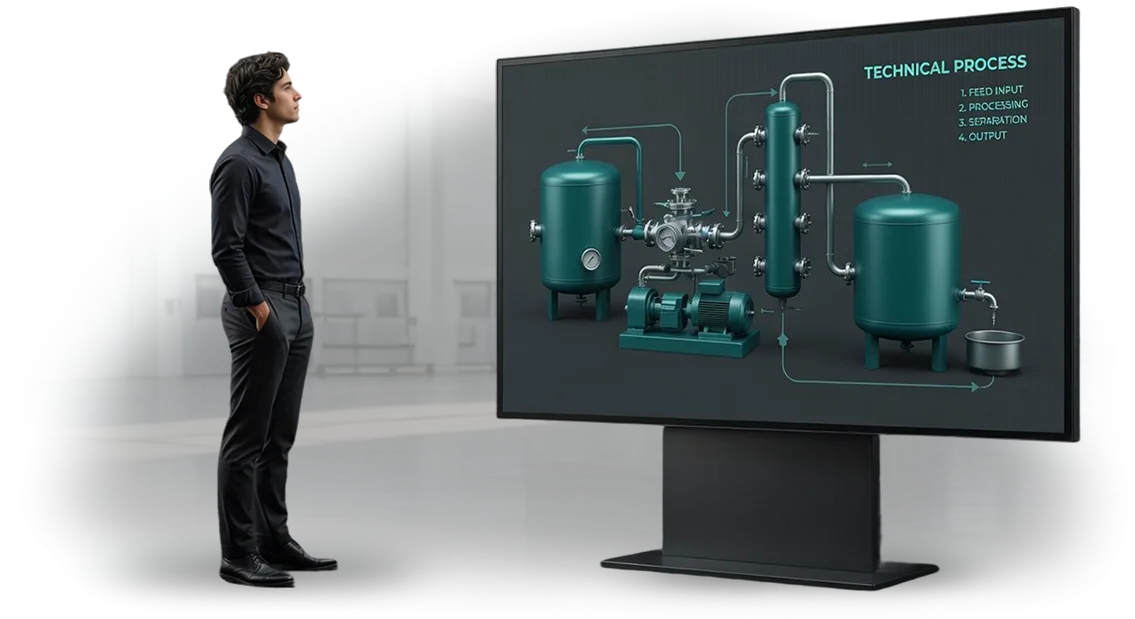
Our training video instructions close this gap: the employee sees the correct feed motion, the pinch point, and the consequences of an error over and over — but in a safe digital environment. This is how the right skill is built before the first contact with a real machine.
What CGI Video Delivers Instead of Real Training
Safe Practice of Precise Motion
Real training means a risk of injury, line downtime, and material consumption. Video training based on 3D animation removes these limitations: the employee enters an exact replica of the work environment and practices the pinch point operation without stopping production. A mistake here costs nothing — it can be reviewed and corrected before starting a real shift.
Several Times Faster Onboarding
A newcomer does not have to wait for a machine or an instructor to become available. The CGI video is available at any moment: the employee reviews complex operations as many times as needed.
The company shortens training time, gets a qualified specialist faster, and reduces the load on mentors.
Fewer Errors and Defects
3D animation shows the process without extra detail: only the necessary components, the correct force, and checkpoints. The employee sees in advance what the result should look like, so they make fewer mistakes during their first independent work. This reduces defects, rework, and emergency stops.
High Learning Retention
People remember visual information more reliably than text or a verbal instruction. Video training forms the correct mental image of the action before the first contact with the equipment, so knowledge is consolidated faster and retained longer. The employee starts the shift confident and ready to work correctly.
Video Formats for the Customer's Task
Every employee action with equipment is preceded by one critical moment — correctly gripping the contact point. A mistake here means defects, downtime, or a safety risk.
Ordinary text instructions do not convey the exact hand position and force, while live training cannot be scaled across all shifts and branches.
Video solves this problem — it shows the movement, the angle, and the sequence. But different tasks require different formats: sometimes a short reminder is enough, while a complex operation calls for a full-fledged simulator with skill practice. Below is how we select the format for a specific customer task.
| Format | For whom | What the client gets |
|---|---|---|
| Short video up to 1 minute | Operators who already work but make typical grip errors | Quick skill refresh without leaving the workstation, fewer errors on the line |
| Detailed video instruction with pinch point close-up | New employees at the onboarding stage | A clear action sequence with emphasis on the key moment — correct pinch point approach, fewer questions for mentors |
| Interactive simulation | Employees before being cleared for complex or expensive equipment | Safe training: repeat the operation in a virtual environment until the grip is consistently correct, with no risk of breakage |
| Series of videos for typical operations | Cross-functional teams and adjacent departments | A single standard for performing operations across all shifts and branches, less dependence on "knowledge holders" |
Each format uses a 3D equipment model and an accurate pinch point simulation, so the employee sees exactly the geometry they will encounter in the workshop.
We select the format to match the specifics of the operation and the skill level of the staff — so you get a fast result rather than "video for the sake of video."
Development Stages: From Brief to Training Implementation
Developing a video instruction is not just a clip; it is a managed process with several stages. Our team structure the work so you understand at every step what is happening and when the result will be ready. No surprises: only agreed stages, fixed timelines, and clear milestones.
- Brief and task analysis. We immerse ourselves in your specifics: which operations, which equipment, which errors employees make most often. We set the training goals and quality criteria.
- Script and storyboard. We turn the technical specification into a narrative: shots, voiceover text, and emphasis on complex moments. You approve the script before 3D modelling begins — this saves time and budget.
- 3D modelling and simulation. We create an exact copy of the equipment and rehearse the pinch point approach with the correct trajectory and forces. This way, the employee sees the procedure without risk to themselves or the machinery.
- Interim review. We show a draft video, collect revisions from your experts, and adjust the details: camera angles, speed, and highlighting of the grip zone.
- Final render and quality control. We generate the final video in several formats — for learning management systems, tablets, and large screens. We verify that it matches the original script.
- Training implementation. We deliver the files and usage instructions; if required, we integrate the video into your learning management system or training portal. After launch, we support and update the material.
With this approach, you always know which stage the project is at and can influence the result before all resources are spent. In the end, you get an instruction that genuinely reduces time-to-competency and lowers the number of errors.
What You Get as a Result: The Delivery Package
The result of the project is not just a folder with videos but a complete delivery package that can be used in training immediately.
You receive ready-made video instructions, scripts, and training materials — everything needed for employees to master the correct equipment grip faster and make fewer mistakes.
The package includes:
-
Ready-made video instructions. A series of videos where each step is shown from the required angle — from preparation to the precise pinch point approach. The employee sees how to perform the operation correctly and repeats it without guesswork.
-
Scripts and storyboards. A text description of each frame with explanations. This simplifies approval with technologists and allows individual fragments to be updated without reshooting the entire video.
-
Training materials. Quick-reference cards, checklists, and tests for knowledge checks. The employee immediately sees whether they have absorbed the material, and you see where the gaps are and who needs retraining.
-
Access to the learning management system. The entire package is loaded onto your corporate portal or the platform you use. With role-based access, view statistics, and results — you can see who has completed the training and who has not.
-
Implementation support. We help deploy the materials, train administrators, and provide instructions for employees. You are not left alone with the new content — support continues after the project is handed over.
After the package is delivered, you get a working training system: employees watch the videos, pass the assessments, and statistics confirm that the skill has been formed. If the procedure changes, we will update a single video or manual without redoing the entire package.
Case Study: Reducing Injuries with Video Instructions
Production safety is a headache for any factory. Every incident on the production floor means a disrupted plan, compensation costs, and reputational risks.
Most often, injuries are caused by the human factor: an employee misjudges the hazard zone of the equipment or misses a critical step during setup.
A machine-building plant, Tochmash, came to us with this problem. In one year, the plant had 11 incidents while working with presses — operators made mistakes at the pinch point and suffered serious hand injuries.
Classic briefings and posters did not change people's behavior: workers ignored the rules because they did not see the real danger.
Results After Implementation
We developed a series of short video instructions with a detailed simulation of the work zone and practice of the correct trajectory to the pinch point. Training became visual and safe: the employee saw the danger from the outside, memorized the algorithm, and made it automatic.
After six months, the number of incidents fell by more than 60%, and injuries resulting in lost work time fell by 80%.
The plant received not just a briefing but a working system for onboarding new employees. Costs for staff replacement and line downtime decreased significantly — management noted that the video instructions paid for themselves within a few months.
Why It Worked
The main secret is visibility and repeatability. Video allows the employee to "walk through" the scenario multiple times before approaching the machine, and the pinch point simulation makes the error visible and understandable without any real risk. This builds a lasting safe-working skill, not a temporary effect from a dry briefing.
After the first stage, the company ordered additional modules from us for another workshop. It is already clear that a well-designed video instruction pays off by reducing downtime and, most importantly, by preserving the health of employees. This is a case where safety numbers translate directly into business benefits.
What Equipment Can Be Simulated for Training?
We model almost any industrial equipment where precise pinch point approach and a safe sequence of actions are critical. This includes CNC machine tools, robotic manipulators, conveyor and packaging lines, presses, lifting mechanisms, and forklifts.
The employee works with a realistic digital model and masters the operation without stopping production and without the risk of injury.
For each model, we separately work out the hazard zones: we show where the pinch point is located, how the working components move, and what happens if the procedure is violated. This way, training forms not just a movement but conscious, safe behavior.
Below are typical scenarios we have already visualized.
| Equipment type | What the employee practices | What the client gets |
|---|---|---|
| CNC machines | Part setup, pinch point approach, machining zone control | Fewer defects, faster newcomer preparation |
| Robotic manipulators | Pinch point targeting, conveyor synchronization, emergency stop | Safe work next to the robot, less downtime |
| Conveyor and packaging lines | Part gripping, work in the hazard zone, operation changeover | Stable rhythm and packaging quality |
| Presses and stamping machines | Part positioning, hazard zone control, interlocks | Reduced injuries, compliance with occupational safety standards |
| Lifting mechanisms, forklifts | Precise load grip, movement, emergency actions | Cargo integrity, careful logistics |
Any scenario is made for your equipment: we take into account the actual dimensions, the location of control panels, and typical risk zones. As a result, the employee trains hands-on in a safe environment, and you get a predictable result without stopping the workshop.
Frequently Asked Questions About Video Instructions
Most of all, clients worry about three things: whether a complex operation can be explained, whether we will meet the deadlines, and what happens if an employee still has questions after watching. We answer these concerns directly.
Over 10 years of working on training videos, we have collected solutions for various industries — from machine tools to medical equipment.
Therefore, our team guarantees: even the most intricate technological operation will become a step-by-step video algorithm that is easy to repeat.
Can you explain a complex technical process — the operation of reaching the equipment pinch point?
Yes. We break the technical process down into simple actions and show them from the correct angle, with video inserts and an emphasis on the pinch point. The employee sees exactly how to align the tool and repeats it without errors.
The complexity of the process is not a problem for us — it is a task we solve together with your technologists.
How long does developing a video instruction take?
A typical project takes two to four weeks. At the start, we agree on a schedule so you know when you will receive the script draft, when the edit will be ready, and when the final video will be delivered.
We accept urgent tasks, but we honestly warn: speed must not reduce the quality of the operation breakdown.
How many revisions are included in the work?
The cost includes two revision iterations after the script and the video sequence are approved. This is enough to take into account your technologists' comments and make adjustments without additional approvals.
If new requirements appear at a late stage, we will offer an extended support package, but most clients stay within the basic iterations.
What if employees still make mistakes?
After the launch, we do not disappear. You can come back with clarifications, and we will adjust the video or add the missing emphasis. The guarantee on the result is stated in the contract: if the video does not help training, we rework it.
Start a Project — Request a Cost and Timeline Estimate
Each project is unique: the number of scenes, equipment complexity, video instruction length, and detail requirements directly affect the final cost and timeline.
To provide you with an honest estimate without "surprises" at the approval stage, we need to discuss the task from the very beginning.
Even a short exchange helps determine the budget, scope of work, and a realistic schedule — you make a decision based on numbers, not on gut feeling.
Submit a request for an estimate — the team will come back with a commercial proposal and a step-by-step work plan.
The response will include the production cost, the duration of each stage, and the boundaries of responsibility, so you can align internal processes in advance: from the script to the approval of the final version. No obligations: the estimate is prepared, and all details are fixed in the contract.
After your request, you will receive:
- An individual cost calculation for your task: the number of videos, scenes, and the level of detail
- A clear production schedule with dates for key stages — without a generic "ready in a month"
- Format recommendations: for initial onboarding, a simulator with knowledge checks, or a knowledge base
- Examples of similar projects and references for your industry
- A fixed estimate without hidden surcharges: the final price does not change after the start
- A dedicated manager who responds within 15 minutes during business hours
We create corporate video instructions with an accurate simulation of the equipment pinch point — the employee sees the correct technique from any angle and repeats it at the workplace.
This format reduces the number of errors and accelerates newcomers' progress to a normal working pace. Request an estimate — after a short description of your task, we will send the cost, timeline, and format proposal.