

Guests in agritourism leave without ordering: how the terminal brings revenue back
Guests in agritourism come for experiences: to try products, sign up for a tour, buy souvenirs, or book a tasting. But when information is scattered across paper brochures and verbal hints from staff, some orders are simply lost.
Visitors don’t see the full list of services, don’t know where to go, and leave with whatever they happened to find.
This is especially acute on peak days: guests are not willing to wait in line at the checkout or information desk. They don’t ask about tours and farm products they don’t know about.
Each such moment is not just a lost sale, but also a lower average check, and a missed opportunity to interest the guest in returning.
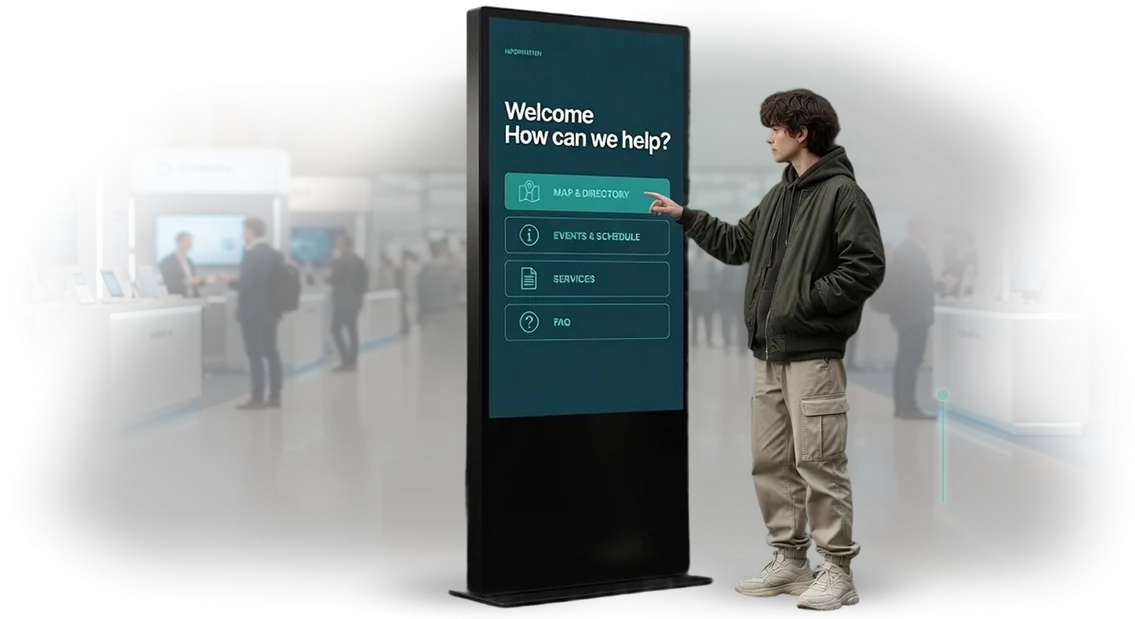
An interactive kiosk at an agritourism site changes the scenario. The guest terminal works as a showcase of products and services: it displays items, tour descriptions, promotions, and routes.
The guest chooses, compares, and submits a request on their own — without staff involvement and at their own pace. As a result, orders are placed faster, and the share of guests leaving without a purchase decreases.
We create interactive catalogs that require no staff training and are easy to update. The client gets a tool that turns spontaneous visitor interest into clear orders — from tasting sets to farm tours. We handle the project turnkey: from scenario to launch at the site.
What an interactive catalog at your agritourism estate will give you: 5 measurable benefits
Growth in average check
Guests rarely know about all your services. The interactive catalog prompts: honey tasting, cheesemaking workshop, souvenirs. Each such prompt is an additional line in the check, and over the season they produce a noticeable increase in sales without advertising costs.
Guest loyalty
When a guest discovers an interesting route or learns the story behind a product, they become more attached to the place. A convenient catalog turns a one-time tour into a reason to return with the family. Repeat visits cost less than attracting new guests and provide a steady stream of orders.
Brand recognition
The interactive screen is not just navigation but part of the estate’s image. Guests photograph it, post it on social media, and your name gets free reach. Such a modern tool clearly sets you apart from neighboring agritourism estates.
Self-service
Guests resolve some questions themselves: what’s on the menu, how to get to the apiary, how much tours cost. Staff aren’t distracted by repetitive answers and spend more time on those ready to buy. At peak hours, the catalog reduces load and speeds up service.
Clear analytics
The catalog shows which products and services are viewed most often and what goes unnoticed. You see real demand and understand what to add to your offering, where to step up advertising, and which seasonal product to promote. These are data-driven decisions, not guesses.
Interactive catalog formats for a terminal in agritourism
Guests come to an agritourism estate for experiences: to try cheese, choose honey, or order a lunch made from local products. If they have to search for a price tag or wait for an employee to become free, the first impression is spoiled.
An interactive catalog on a terminal solves this problem — it instantly shows the product, composition, and price, and the guest makes a decision without extra steps.
The same kiosk works differently depending on its installation location. For a tasting room it’s one scenario, for a souvenir shop it’s another. Below are typical formats already used in agritourism projects.
Choose your format
| Catalog format | Where to place | What it gives the owner |
|---|---|---|
| Showcase catalog | Souvenir shop, farm store | Guest sees product photo and price, places an order immediately — no need to wait for an attendant |
| Menu with photos | Cafe or tasting area | Dishes and farm sets look appetizing, order is placed in a couple of minutes |
| Tour program | Lobby, waiting area | Guest chooses route and session time on their own, rather than crowding at the administrator’s desk |
| Interactive map | Entrance, open area | Visitor finds the right spot in 10 seconds and stays on the grounds longer |
| Product catalog with delivery | Any point of sale | A liked item can be ordered to take along — repeat purchases without staff involvement |
The formats combine perfectly: you can merge an estate map with a souvenir showcase, and in the cafe keep only a menu with “stars” on popular items.
You choose the scenario for your area, and we implement it so guests can easily navigate and the average check grows without extra investment in staff.
How an interactive terminal launch works: 7 steps for your site
Launching an interactive terminal at your site is a clear process that we manage from the first call to the kiosk’s daily operation. You don’t need to understand the technology: you receive a ready-made solution, and we handle all the complexities.
Below is the path a project takes so that by the season opening the terminal is already welcoming guests.
-
Kiosk brief — a short meeting or questionnaire where you tell us about your guests, location, and goals. We find out what matters more: showing routes, selling local products, or telling the estate’s story. The result is a clear technical specification without unnecessary details.
-
Launch plan and timeline — we set the stages, approval dates, and readiness day. You know in advance when the mockup will appear, when the installer will arrive, and when the terminal can be turned on for visitors. No surprises: all deadlines are stated in the contract.
-
Interface design — we develop screens in your brand’s style: your photos, colors, logo. The guest sees a clear menu with large buttons — even those using a touch kiosk for the first time will figure it out in seconds. This increases trust in the site and reduces staff workload.
-
Mockup approval — you receive the finished screens for review. We make edits until the design is 100% to your liking. This step protects against flaws: better to fix before installation than redo after launch.
-
Content filling — we upload your descriptions, prices, photos, and contacts. If needed, we help write copy that sells and guides. All information is easy to update in the future — you can change the assortment yourself or order updates from us.
-
Installation and setup — we install the terminal at the right spot, connect power and internet, and test operation. You get a kiosk ready to use from day one. We also plan dust and moisture protection — this is important for open areas at agritourism sites.
-
Training and support — we show your team how to manage the system and stay in touch after launch. If a question arises or something needs refinement, you write to our chat and receive help within a business day. By the end of the season, the terminal runs stably and you have full control.
This process makes the launch predictable: from brief to working kiosk takes no more than a few weeks, and throughout that time you understand what is happening at each step.
What’s included in delivery: a package for your agritourism project
When choosing a contractor, you’re not buying “hardware” but a working solution that pays for itself from the first season. We structure the delivery package so the kiosk is useful to guests from day one and staff don’t waste time deciphering instructions.
The standard package for an agritourism project includes:
- Kiosk stand — a vandal-resistant housing that withstands outdoor conditions and heavy use. The design can be adapted to the style of your estate or farm.
- Touchscreen — bright and responsive, with anti-glare protection so guests can use it comfortably even on a sunny day in an open area.
- Interface tailored to your infrastructure — a catalog of your services, routes, tours, and products. The guest sees current prices, seasonal offers, and can leave a request right on the screen.
- Admin panel — a simple system through which your manager can update prices, add new tours or promotions without a programmer.
- Staff training — we conduct a short hands-on training for your team so employees can confidently work with the system and help guests.
- Warranty and support — technical maintenance and consultations to keep the kiosk running smoothly throughout the season.
Pay attention to each item: the delivery package determines whether the kiosk becomes a full-fledged sales tool or just an expensive stand in the corner. We are responsible for the entire system working “turnkey” — from the metal structure to the training course.
As a result, you get not scattered parts but a single mechanism that increases the average check and reduces staff workload.
Case study: a farm store near Moscow doubled orders from the terminal
A farm store at an agritourism estate in the Moscow region is a place where guests come for farm products. But the owners noticed that visitors take only what they see on the counter and learn about cheeses, smoked meats, and semi-finished products only after they’ve left.
Describing every item at the checkout means slowing down the line, and hiring an extra consultant for weekends is extra expense.
our team specialists suggested installing a touch terminal with an interactive catalog. On the screen, the guest sees the full assortment: photos, composition, weight, price, availability.
They can build a cart and send the order to the checkout — the seller only needs to gather the purchase and hand it to the customer.
What changed over three months of operation
- Orders from the terminal doubled — guests began adding related products to their main purchases more often.
- The average check increased by 30%: sauces, cheeses, and desserts that customers never learned about before were added to meat and milk.
- Service time decreased by 40% — the cashier doesn’t spend minutes describing items; all information is already right in front of the buyer.
For the farm, this is not just “another screen.” The catalog became a sales tool: the owners see which categories are viewed most often and adjust their purchasing. A month after launch, they asked to add a “Gift Sets” section — it is now one of the most popular items.
We continue to support the project: we update the catalog, add seasonal items, and make sure the system runs stably. For us, this is a standard approach: not just install a terminal, but make sure it delivers measurable results.
How to choose the right interactive catalog format for your task?
There is no universal catalog — the right format is determined by your task, guest traffic, and installation location.
If visitors to an agritourism complex need to quickly learn about available tours, routes, and local products, an interactive catalog with large buttons and photos will shorten the checkout line and increase the average check.
If the main goal is to showcase a farm store’s assortment, a format with category search is more convenient.
When choosing, it’s important to consider how often the information changes and who will use the kiosk: families with children, elderly people, or organized groups.
A compact touch stand works for a small tasting area; a full-fledged terminal with a large screen suits a spacious visitor center. We’ll also advise where to place the kiosk so it doesn’t block passage and is clearly visible.
We don’t offer a “standard solution for everyone.” First, we study your situation: number of visitors, their behavior scenarios, and the team that will update content. Then we recommend two or three suitable options, explain the difference in simple words, and let you choose. You get a solution for your task, not the most expensive or trendy option.
Kiosk requirements are our concern. We take into account operating conditions: humidity, sunlight, wear and tear, and protection from accidental impacts.
You don’t need to understand the specs of touchscreens or housings — just describe how the terminal will be used, and we’ll prepare the specification and implement the project turnkey.
Leave a request for a consultation — we’ll tell you which format suits you, and how long development and launch will take. This way, you can make a decision without the risk of a mistake and get a catalog that immediately starts working for sales and guest experiences.
Common doubts before ordering an interactive terminal
Any interactive terminal order starts with doubts: will the equipment break down, who will look after it, and can staff handle it without technical training.
In agritourism, these risks seem especially acute because guests come during the season, and every error means lost experiences and orders. Let’s look at the most common fears and show how they are addressed at the design stage.
What if the kiosk breaks down at the height of the season — and guests are left without the catalog?
For your site, terminal downtime means inconvenienced visitors and lost profit. That’s why we use industrial components with a large safety margin, and remote diagnostics allow us to notice a problem before it becomes visible.
If a failure still happens, the service team will respond quickly, and during peak season for agritourism projects, priority on-site service is available.
Who will maintain the kiosk? I don’t have an IT specialist
Your site’s employees can handle it on their own. The admin interface is designed so you can update the catalog, change a product photo, or add a new service in minutes.
At launch, we train administrators on site and provide a clear instruction manual — without complex terminology or programming.
What risks are there that the terminal won’t fit the eco-farm atmosphere and will put guests off?
We design kiosks taking into account the style of your site — from housing design to the interface color scheme.
The terminal becomes part of the space, not an “ATM in the middle of a meadow.” Before launch, we approve placement and usage scenarios, so guests perceive it as a natural element of a tour or tasting.
How long will launch take, and when can I start using it?
Exact timing depends on the catalog size and design, but usually from mockup approval to delivery takes no more than two to three weeks. After installation, the kiosk is fully ready to work: upload your content, and guests can start browsing your catalog on the very first day.
What does the warranty cover, and how does maintenance work?
We provide a warranty on equipment and workmanship, as well as post-warranty maintenance under a contract. Regular scheduled checks, prompt replacement of components, and consultations are included in the support — you’re not left alone with a possible breakdown. Everything that could affect the terminal is specified in the contract in advance.
As you can see, most fears are linked to uncertainty. We are ready to answer your specific questions, show case studies for agritourism sites, and offer a solution that will work to attract guests and grow revenue.Leave a request for the development of an interactive catalog for your agritourism estate
Leave a request for a kiosk — and we’ll take on the entire journey from idea to a working terminal at your agritourism estate.
We’ll prepare a cost estimate within a day or two, and the turnkey project will spare you from diving into technical details: we’ll develop the design, content, and logic of the catalog, approve it with you, install it, and launch it.
If necessary, our specialist will visit the site to account for the space’s features, the location of power outlets, and guest flows. This happens at the task evaluation stage — you’ll receive recommendations even before signing the contract.
What you get after submitting a request:
- A fixed estimate with no hidden payments — you know the budget before work starts.
- An interactive catalog of products and services that guests will easily master without staff assistance.
- Adaptation to your agritourism estate: a site map, descriptions of tours, farm products, and services.
- Fast launch — from mockup approval to installation and testing in live mode.
- Post-launch support: assortment updates, content replacement, phone consultations.
- A specialist visit for installation and setup if the site requires on-site presence.
Set your task now — in a few days you’ll receive an estimate, and within the next season guests will be able to find the information they need, place orders, and return to you again.