

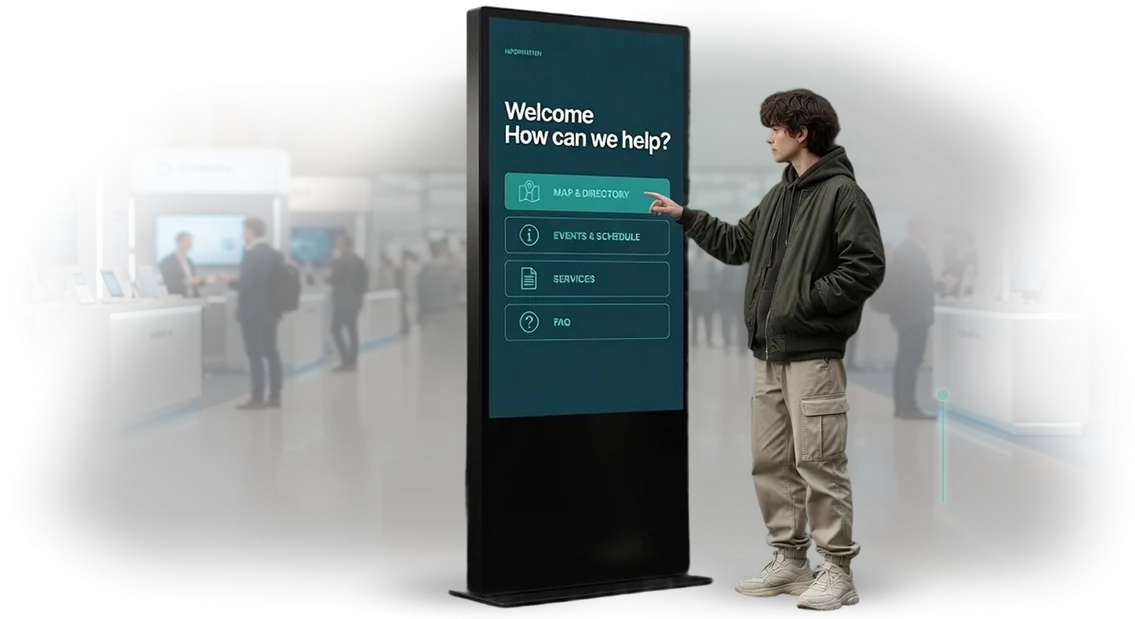
Medical Kiosks: Patients Get Lost and Leave Without an Appointment
During peak hours, the registration desk is overwhelmed: in the morning — a stream of patients needing to book an appointment, in the afternoon — those coming for a certificate or referral, in the evening — a line for specialists.
People get frustrated when they have to wait 20-30 minutes just to get an appointment slip. Then comes finding the right office: there are signs, but they are not easy to follow, especially for elderly patients or first-time visitors.
Registration lines and confusing navigation become the main source of complaints in reviews about the medical facility.
As a result, some patients get lost in the corridors and leave without ever seeing a doctor. They do not come back — they choose a paid clinic or a nearby medical center, and share their impressions on social media.
Meanwhile, administrators are forced to take time away from real people to endlessly repeat the same things: where to go, how to book, which office is seeing patients.
An overloaded registration desk and poor navigation in the polyclinic quietly erode patient loyalty and the facility's budget: every lost visit is not only missed revenue but also reputational risk.
Medical kiosks change this picture. The patient books an appointment themselves in a couple of taps, sees the route to the right office on the clinic map, and gets guidance at every step.
The registration desk is freed from routine, lines dissolve, and patients feel cared for and come back. We design and launch such kiosks turnkey: from workflow scenarios to installation and technical support, so you get a ready solution without needing to understand the details.
Medical Kiosks: How to Retain Patients and Improve Service Quality
Patients value time and attention, not endless registration lines. A medical kiosk removes the main pain points: self-service appointment booking takes a couple of minutes, and navigating the polyclinic is no longer a quest.
As a result, the clinic gains more loyal patients and unburdened staff — without expanding the headcount.
For Patients
- Self-service appointment booking without a line — choose a doctor, date, and time in a couple of screen taps, without going to the registration desk.
- Improved patient navigation — an interactive map shows where the required office is and reduces search time.
- Less waiting — visitor flow is distributed evenly rather than piling up at a single window.
For Staff
- Relief for the registration desk — administrators stop getting distracted by repetitive questions and can focus on complex cases.
- Reduced call center load — part of the bookings moves to the kiosk, freeing up phone lines.
- Clear statistics — doctor workload and popular services are visible, enabling more accurate schedule planning.
The results are confirmed in practice: after kiosks were deployed at one city polyclinic, self-bookings grew to 60%, and average waiting time in the lobby was cut in half.
As the chief physician noted: "Patients no longer associate visiting the polyclinic with queues" City Polyclinic.
We help configure the same scenarios for your clinic: from model selection to staff training. Leave a request — we will show how the kiosk pays off in your conditions.
Formats and Configurations for Your Task
Polyclinics share the same pain: a line at the registration desk, calls asking "where is the office?", and administrators who physically cannot help everyone.
An info kiosk for the polyclinic relieves this load: patients book appointments themselves, find the right office, and get a reminder — without staff involvement. Self-service at a medical facility makes visitor flow predictable and frees employees to work on complex cases.
But one format does not solve every task, so we have created three base configurations — for different entry points and patient scenarios. Choose based on your space and flow, and we will adapt the design, logic, and integrations with your booking system.
| Format | For Whom | What It Gives the Client |
|---|---|---|
| Doctor appointment info kiosk | Polyclinics, diagnostic centers | Booking without a queue, less registration desk load, 24/7 access to schedules |
| Navigation kiosk | Large clinics, hospitals, multi-specialty centers | Patients find the office themselves — fewer late arrivals and fewer questions for staff |
| Touchscreen directory | Lobbies, pediatric departments, private clinics | Information about doctors and services in two taps, fewer calls to the information desk |
In any configuration, the feature set can be changed — from booking and payment to facility maps and lab result display. We connect the kiosk to your medical system, so data is always up to date.
If you are not sure which format suits you, we will come, look at the lobby, and propose a solution with load calculations.
How the Project Works: From Brief to Launch
We follow a clear roadmap: you always know what stage the project is at and what you will get at the end. We handle all organizational and technical matters, while your team keeps working with patients instead of coordinating contractors.
- Brief and analysis. We document the tasks: which services should be available, who the main kiosk audience is, where it will be placed, and which systems the clinic already uses. This is the implementation stage where the scope of responsibility and timelines are defined.
- Information kiosk design. We work through the scenarios: doctor appointment, schedule, navigation to departments, payment, or result retrieval. The screen structure is designed so that patients can manage without staff assistance.
- Interface design and content. We adapt the look to the clinic's brand, using large elements, clear icons, and readable fonts. We take into account the age of the audience and their level of digital literacy.
- Prototype and approval. Before development starts, you receive an interactive mockup and see how patients will go through each scenario. At this stage, changes are easy to make without extra costs.
- Development and integration. We assemble the kiosk and connect it to your booking system and databases. We test load and performance under real queue conditions.
- Testing with real users. The kiosk is checked for usability and correct operation. We fix any issues found and make sure all scenarios complete without errors.
- Launch and support. We install the kiosk, train administrators, and provide instructions. We stay in touch after launch: we update content, monitor stability, and respond quickly to requests.
This sequence eliminates surprises: every stage ends with an approved deliverable, and the final product is fully ready for daily use.
What Is Included in Delivery and Maintenance
You get not just a device but a fully ready information point: from design concept to launch and ongoing support. We handle all stages, so you do not need to coordinate multiple contractors — one team is responsible for the result.
The standard package includes:
- Equipment — a professional enclosure that fits the interior and load of your facility. The kiosk withstands daily use, and the vandal-resistant design protects against damage.
- Software and interface — simple navigation through services, doctor information, schedules, as well as appointment booking or ticket issuance. The design is adapted to the clinic's corporate style.
- Installation and commissioning — we deliver, install, connect, and configure the kiosk to your schedule and requirements. We verify all scenarios before the first visitor approaches it.
- Staff training — we conduct a short training session for administrators and registration staff on how to update schedules, add news, and track booking statistics. We demonstrate everything hands-on so your employees can work independently right away.
- Technical support and maintenance — in the event of a failure or questions, staff receive help during business hours. When necessary, we update content and software remotely, and in the event of a breakdown, we quickly restore the kiosk's operation.
- Warranty and service terms — we provide a warranty on the equipment and define maintenance conditions so you know the response times and responsibilities in advance.
This approach covers the main risk for any manager: you get a predictable result within agreed timelines and do not get distracted by technical details. Everything the kiosk needs to operate is already included in the price.
Case Study: How a Medical Center Cut Its Queue by 40%
The AlphaMed clinic network was looking for a way to handle the patient flow during morning hours. Lines at the registration desk stretched to 20-30 minutes — visits started with frustration.
Administrators worked at full capacity: they had to answer calls, process appointments, and calm waiting patients all at once.
We installed medical information kiosks in the lobby. Patients confirm their visit themselves, select a department, and receive a ticket — without talking to an administrator.
The interface was designed with large buttons and hints at every step, so even elderly visitors use it confidently. Each patient takes 2-3 minutes instead of 12-15 at the counter, and in the first month the kiosks handled more than 2,000 visits — about a third of the total flow.
Results After Launch
The queue shrank by 40%, and registration time more than halved. Administrators shifted to tasks that require live interaction: booking complex cases, insurance policy consultations, and helping patients in the lobby.
"Before, mornings started with queues and tension," says the clinic's chief physician. "Now patients get to their appointments on time and are not exhausted by the hallway. We can finally breathe."
The financial effect is also tangible: the clinic sees 15% more patients without expanding staff, and the share of repeat visits rose by 20%. After the successful pilot project, management ordered the same kiosks for two branch locations. We continue to support the system: we update scenarios, add departments, and monitor stability.
How to Choose the Right Format for Your Task?
There is no one-size-fits-all format — the choice depends on what problem the kiosk needs to solve. A medical facility needs not just equipment but a working tool that speeds up service and reduces staff load.
If patients need to book a doctor's appointment, pay for a service, or get lab results on their own — that is an info kiosk with a touchscreen and integration into the facility's system.
If visitors get lost in the corridors and waste time finding offices — a navigation station with an interactive map is sufficient.
Selection criteria include the intensity of visitor flow, scenario complexity, the presence of waiting areas, and the installation point. A floor-standing station suits a high-traffic lobby, while a wall-mounted panel works for narrow corridors.
Hygiene also matters: the enclosure must be easy to clean, and the interface must be understandable for elderly people and first-time visitors.
According to our lead engineer, the right format is determined not by screen size but by patient scenarios: "If navigation solves the problem, there is no need to complicate things.
If booking and payment are required, the station must work with your internal system without downtime." Our specialists help select and configure a kiosk for the specific needs of a medical facility, including integration and support.
Frequently Asked Questions About Implementation and Cost
The typical concerns of a clinic manager when introducing a kiosk come down to three questions, not screen or enclosure choices: what happens if it breaks down, will patient data be compromised, and what will this really cost. Here is how our work is structured — no fine print and no unexpected terms.
What happens if the kiosk breaks down at the busiest time of the day?
We include maintenance in the contract from the very start, not just "in words." Our engineers monitor kiosk health remotely and often spot a problem before the clinic staff even notices it.
If a failure does occur, you do not need to figure out the hardware — we handle it. The contract covers remote diagnostics and, if necessary, prompt replacement or repair of components.
The average time to get the kiosk back up ranges from a few hours to 1-2 days depending on complexity, and we commit to this timeframe in writing. A registration desk queue caused by a kiosk failure is the exception, not the rule.
How is patient data security ensured?
For medical kiosks, personal data protection is a fundamental requirement, not an option. Data is stored and transmitted in encrypted form, and access to internal information is permission-based: patients see only their own scenario, staff see only their part.
We operate within personal data regulations. This means the responsibility for security does not fall on your IT department — you get a solution that already meets industry requirements.
How is this integration better than buying an off-the-shelf kiosk, and what does it cost?
An off-the-shelf kiosk requires adaptation to your processes, and you pay for that adaptation separately. We, on the other hand, design the interface and logic around your clinic's specific scenarios — booking a specialist appointment, issuing referrals, payments, feedback.
The budget consists of the software component and the equipment. That is why we first work out the solution and lock in the budget for your tasks, with no "surprises" at the launch stage.
The average range for a reasonable integration is calculated after an audit depending on the number of kiosks and scenario complexity.
Request a Consultation and Cost Estimate
Every medical kiosk requires an individual calculation: equipment model, software, integration with the registration desk and booking system.
So that you get an accurate estimate rather than average figures from a price list, we start with a consultation and clarify your requirements.
Fill in a short implementation request — and within one business day our engineers will prepare a cost estimate for a kiosk tailored to your facility. What you receive right after your inquiry:
- The full turnkey project cost: equipment, software, delivery, installation, and launch.
- Configuration options matched to your patient flow and lobby or corridor space — from a compact stand to a full-fledged terminal.
- Enclosure options and vandal-resistant solutions for 24/7 operation in public access areas.
- A description of how the kiosk integrates with your doctor booking system, electronic health record, and registration desk kiosks.
- Implementation examples for polyclinics and hospitals with photos and real results.
- Exact turnkey timelines and work stages — from brief to acceptance and staff training.
Leave a request for a consultation — and by the next day you will know how much the implementation will cost, when the kiosk will start working, and what tasks it will cover in your facility. The estimate and consultation come first.