

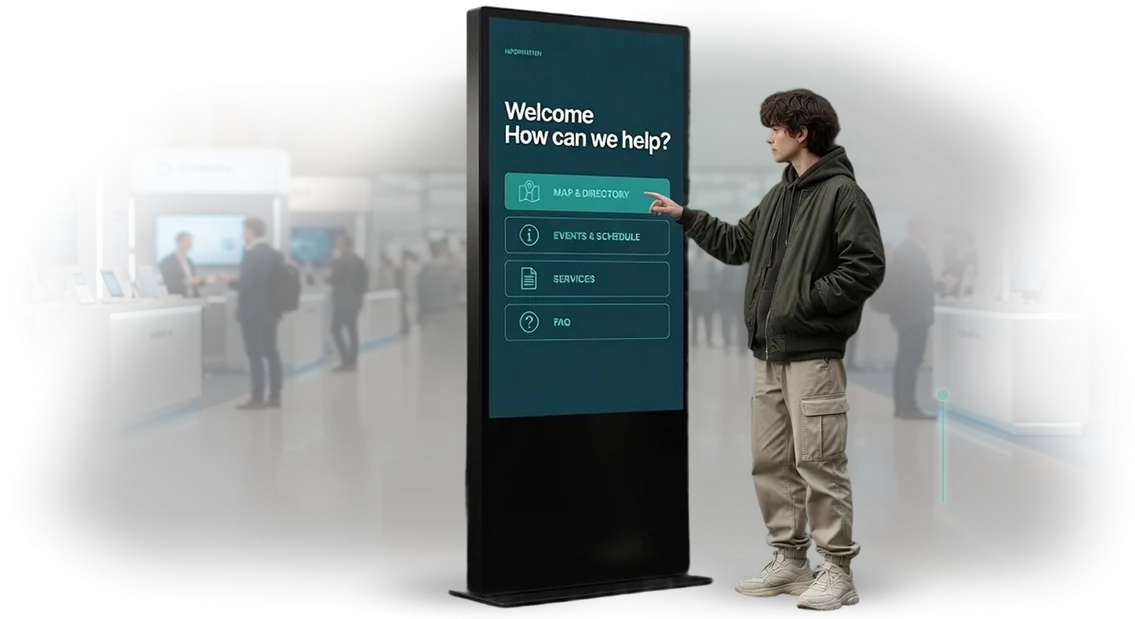
Customers can't find the way and you're losing profit? Wayfinding kiosks will fix that
A visitor who cannot find the right department is lost revenue. People spend time wandering, get frustrated, and often leave without buying.
By various estimates, up to a third of visitors are willing to give up on a company's services because of inconvenient in-building navigation — a steady revenue drain that is easy to overlook. Such lost customers can be won back by showing them a quick and clear route.
In-building navigation today is not just signs on walls. Customers expect the route to their destination to take minutes, not turn into a quest with endless questions.
The need to retain visitors is pushing businesses to look for systematic solutions: automatic navigation cuts travel time, reduces staff workload, and boosts loyalty. This directly affects the customer journey: less friction means more repeat visits and recommendations.
Wayfinding kiosks solve this where foot traffic is highest: at entrances, in lobbies, near elevators and passageways. A person selects the desired department on a touchscreen and immediately gets a clear route — no queues, phone calls, or repeated questions.
Guests reach their destination faster, and the overall impression of the company noticeably improves.
We design and deploy such kiosks for your specific needs: from a single screen in a reception area to a network of devices throughout a complex.
We handle the interface, content, and launch, so you get a working service rather than a “screen on a wall.” The result is felt immediately: fewer lost customers, higher purchase conversion, and less stressed staff. Plus, you save on printed signs and information desks that constantly need updating.
What navigation kiosks bring to your business
Information kiosks Wayfinding are not just touchscreens in a lobby; they are a tool for improving customer experience and growing revenue. The main advantage is that customers find the right department themselves without distracting staff, and leave with a positive impression.
Benefit: customers find their own way
While a visitor searches for an office or product, they waste time and get anxious. A navigation kiosk shows the route in 10 seconds — no queues, no confusion. This increases satisfaction and the likelihood of a repeat visit.
Benefit: attention and reach
A bright touchscreen stand becomes a point of attraction in itself. While a customer interacts with the screen, they see promotions and new products.
And if you add a photo zone or a QR code to social media nearby, every guest generates extra mentions — reach grows without an advertising budget.
Benefit: collecting contacts and leads
The kiosk can offer to book a consultation, subscribe to a newsletter, or get a promo code. This turns anonymous visitors into a contact database for future sales. A single kiosk can collect dozens of leads per day.
Benefit: increased loyalty
When customers find it easy to navigate and enjoy being in the space, they remember the brand and recommend it to others. Regular guests return more often, and the average check gradually grows. Deploying kiosks pays off through repeat visits and new customers.
Wayfinding kiosk formats for your customer's needs
The same kiosk won't work for both an outdoor parking lot and a business center lobby — they have different needs and different traffic. A format that helps visitors of the Мега shopping mall quickly find stores won't work for navigating a factory grounds.
How precisely the format is chosen determines how much time a person spends searching and whether they come back.
We design kiosks for your site and visitor scenarios — from compact wall-mounted signs to full-size outdoor terminals. Below are popular formats that most often solve business tasks.
Formats and benefits
| Format | For whom | What it gives the customer |
|---|---|---|
| Outdoor kiosks | Areas with parking lots, campuses, parks, stadiums | Visitor builds a route to the entrance even before reaching the property — fewer lost guests and fewer questions for security |
| Indoor navigation stands | Shopping malls, business centers, clinics, airports | Reduce time searching for a department or office, free up administrators, and increase loyalty |
| Touchscreen kiosks | High-traffic locations, cinemas, museums | Fast search by categories and events, increased foot traffic to target points and extra sales |
| Universal anti-vandal stands | Streets, railway stations, stadiums | Work in any weather, require no constant supervision, and last longer without service |
How digital navigation implementation works
What happens at each stage
We start with a brief, not with discussing equipment. First, we figure out where your visitors go, what questions they ask most often, and what should be on the screens to reduce staff workload. This lets us design navigation that matches the real scenarios of the facility.
Main implementation stages:
- Brief and goals. A short interview with your team: key points of interest, typical visitor routes, expectations for navigation.
- Space audit. We study the floor plan, people flows, and high-traffic areas to determine the best locations for kiosks.
- Implementation plan and mockups. We agree on section structure, texts, visual style, and timelines so you see the result before work begins.
- Navigation setup. We build the facility map, plot routes, and configure category filters. The interface is clear from the first screen, with no training needed.
- Kiosk installation. We mount the enclosures, connect power, and test operation in real conditions.
- Project launch. We publish the required sections, train staff briefly and to the point, and make sure all scenarios work.
- Ongoing support. We update content, monitor system performance, and respond quickly to requests. One clear communication channel with us.
After launch, you get a managed navigation system, not a collection of devices. Changing routes and adding new screens takes days, not months — navigation evolves together with the facility.
What a complete navigation solution includes
A complete solution is a fully assembled package that is installed and launched within the agreed timeframes. You don't need to separately find contractors for equipment, design, and programming: we deliver the kiosk, software, content, and support on a turnkey basis. All that remains is to turn on the device and start using it.
- Kiosk hardware. We select an enclosure for your space: from compact floor stands to large panels for lobbies and outdoors. All models are durable and run non-stop.
- Software. An interface with a map, search, and company information sections. Content updates are done without stopping the kiosk — through an administrator's personal account.
- Interactive map. Floor plans, routes to offices or stores, a list of points of interest. Visitors understand where to go in a couple of taps.
- Content and design. We prepare the menu structure, texts, and visuals to match your brand. You don't need to develop materials separately.
- Installation and configuration. An engineer visits your site, installs the kiosk, connects the network, and tests all scenarios.
- Staff training. A short guide for administrators: how to change the map, add an event, view request statistics.
- Support and updates. We answer staff questions, monitor performance, and update content on request after launch.
This package covers everything: from supply to daily operation. You get equipment that delivers value immediately — it helps guests find their way and takes the load off the information desk.
Case study: a shopping mall increased conversion by 25%
At a regional shopping center called «Палас», visitors got lost right at the parking lot and elevators, and only a few ever made it to tenants on the far floors. Ordinary signs couldn't handle it: guests left without finding the store they needed and came back less often. For the management company, this meant falling turnover and unhappy tenants.
We installed touchscreen wayfinding kiosks at the main entrance, in the parking lot, and near the food court. The interface is designed for people of all ages: large buttons, search by store name and category, and a route with travel time.
The kiosks also display current tenant promotions — turning navigation into an additional sales channel.
Three months after launch, we measured the metrics and compared them with pre-deployment data. Here's what we found:
| Metric | Before deployment | After deployment |
|---|---|---|
| Share of visitors who reached their target store | 54% | 79% |
| Purchase conversion for upper-floor tenants | 12% | 37% |
| Average check of a guest who used the kiosk | — | +18% |
The main takeaway of the case is a 25% increase in the mall's conversion with the same traffic.
Upper-floor tenants gained a flow of shoppers that previously went to competitors, and the management company got measurable navigation results and an argument for negotiations with new brands.
Payback took four months: the investment was covered by increased rent based on a percentage of turnover and greater guest loyalty.
Within six months, the center ordered an expansion of the system — we added building plans for kiosks at a second entrance and integration with a mobile app. We use this approach in all projects: first we establish a baseline, then we deploy and show the numbers.
Answers to common questions about navigation
Customers often postpone investing in navigation kiosks because of three fears: it seems complicated, expensive, and unreliable. In practice, most concerns are resolved at the briefing stage, and launch takes just a few weeks.
Below, we answer the questions we hear most often — briefly and based on experience from dozens of completed projects.
How long does it take to launch kiosks?
A standard project takes two to four weeks from mockup approval. This includes interface design, assembly, configuration, and testing. If you need a simple map with search, we can do it even faster. Remote configuration allows launch without downtime for your facility.
What is included in the cost and will there be hidden payments?
The cost estimate is fixed before work starts and includes everything: scenario design, licenses, hardware, installation, and staff training. The typical budget is calculated after an audit and depends on the number of touchpoints and interface complexity. There are no “surprise work” surcharges — all changes are agreed in advance.
What if the kiosk breaks down or stops working?
We provide a warranty on hardware and software, and we supply a replacement unit while warranty repairs are being made. Round-the-clock support responds to a request within an hour. We update maps, catalogs, and promotions remotely — you don't need to call a specialist each time.
Can you match our brand style?
Yes, we adapt the interface to your brand guidelines: colors, fonts, logo. We'll show several design options at the briefing stage so you can choose the right one. Even complex building architecture we turn into a clear diagram with your navigation in mind.
Who will service the kiosks after launch?
We take maintenance on ourselves: we monitor device health, update software and content on request. You don't need to hire a separate administrator. Our team handles everything, and you get consistently working navigation.
Get a project estimate for your facility
Every facility is unique: a shopping mall has one footfall, a clinic has a different visitor flow, and a business center has its own navigation challenges.
We have already completed projects for retail, healthcare, and business centers, and we know what nuances arise during deployment.
That's why we'll prepare a solution that fits your budget and timeline, and provide a commercial proposal with precise figures — no hidden extras or vague estimates.
Submit a request for an estimate, and within two business days our engineers will analyze the task and suggest implementation options. You will receive:
- An individual technical specification and equipment selection tailored to your facility and load;
- A transparent cost estimate covering everything from development to delivery and launch;
- An implementation schedule with precise stages and deadlines;
- A forecast of kiosk return on investment and payback based on your footfall;
- A comparison of options: lease, purchase, or installment plan — whichever is more beneficial for you;
- Support at all stages and a software warranty.
The estimate does not obligate you to order: you'll receive a document, review it with your team, and calmly weigh the decision. If the option works for you, we'll launch the project turnkey: from interface mockups to installation and staff training.
Ordering a kiosk is easier than it seems: contact us via the form below or by phone — we'll provide a consultation. We'll advise which option solves your problem and prepare an estimate for your facility within the coming days.
How to choose the right navigation system?
Choosing the right navigation system is a decision that affects every day of your facility's operation. A guest who finds their way easily approaches staff less often and gets what they came for faster. The right system reduces staff workload and increases visitor satisfaction.
Selection criteria are determined by the specific requirements of your industry: how many zones need to be connected, what foot traffic patterns dominate, whether navigation for people with disabilities is required, and whether there are any layout peculiarities.
Sometimes a single kiosk is enough; in other cases, combining stationary stands and mobile signs is more effective. We help you see these nuances.
Our engineers don't offer one-size-fits-all solutions. They study visitor routes, measure peak loads, and account for interior features.
Based on this, we select the optimal format for your tasks — so the kiosk doesn't look like an alien element but works for convenience and image.
Selecting a kiosk isn't just about choosing an enclosure and screen. It also includes usage scenarios: how visitors search for a location, what information is needed first, and how data is updated. We handle all of these matters so you get a turnkey solution without diving into details.
To move forward, a consultation is all you need. We'll ask questions about your facility, offer options, and show how the chosen system will change daily operations. You'll get a clear plan and can make a decision without the risk of overpaying for unnecessary features.