

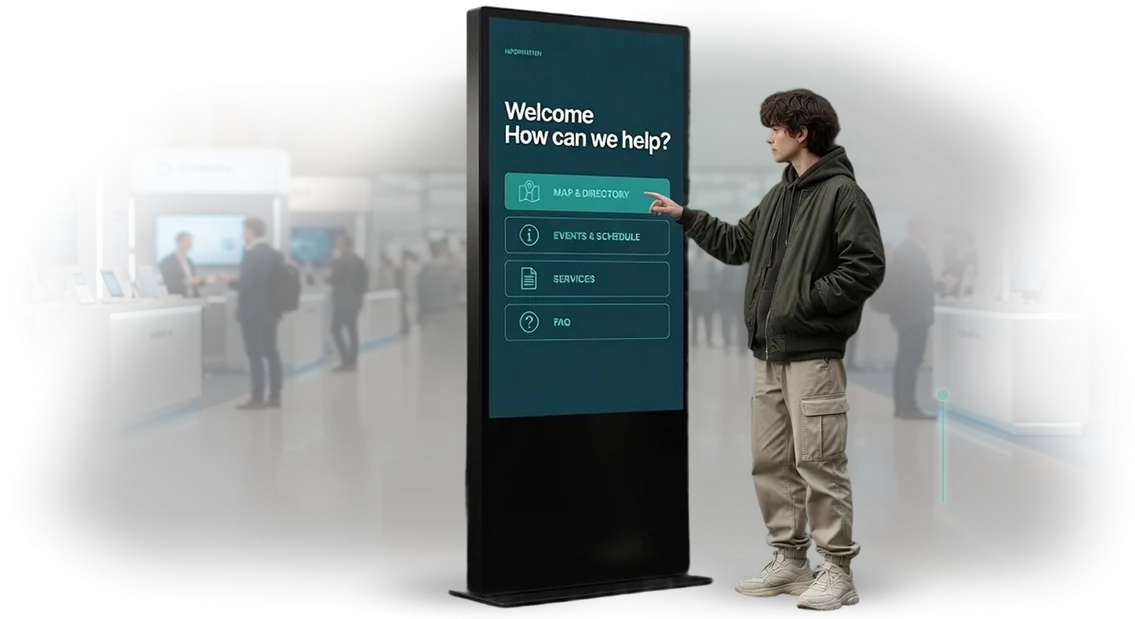
Electronic navigation for kiosks: guests find what they need in seconds
Visitors to a shopping center or business center often get lost: the store or café they need is at the other end of the building, and precious time is spent searching.
The longer a guest searches, the higher the chance they leave without making a purchase — you lose revenue, and the impression of the property suffers.
Electronic navigation on an interactive kiosk solves this problem in seconds. The guest sees a map of the property, enters the name of the desired point or chooses a category — and receives a short route.
No paper signs or confused staff: visitors find what they need on their own, while your employees focus on actually helping guests.
An interactive kiosk with map search works like a personal assistant: it shows where the nearest elevator, restroom, or ATM is, displays travel time, and guides the guest step by step.
The guest not only reaches their destination faster — they stay at the property longer, manage to visit more locations, and spend more. This is direct visitor assistance that increases loyalty and purchase conversion.
Navigation in a shopping center becomes part of the service that brings guests back.
The kiosk can be supplemented with information about promotions and events — so every search session becomes an opportunity to tell visitors about your offers and increase the average order value.
We develop such kiosks turnkey: from interface design to installation and support. Contact us to calculate the economic effect for your property.
5 benefits a business gets after launching kiosks
An interactive kiosk is not just a screen but a full-fledged electronic navigation tool that turns boring waiting into useful interaction. Visitors find the department they need on their own, check product availability, and immediately receive personalized offers.
You don't need to expand your staff or redesign the information desk — the kiosk takes over the routine while your team handles live sales.
The first benefit is improved customer experience. Guests stop wandering around the hall and wasting time searching: a route to the desired point is built in seconds. The second is increased loyalty: visitors feel cared for when they get an instant answer at any time. And if the kiosk remembers their preferences, every subsequent visit becomes even more comfortable.
The third benefit is reduced staff workload. Routine questions (“where is the checkout?”, “where is this item?”) stop distracting employees, allowing them to focus on consultations and closing deals.
The fourth is additional sales: the kiosk offers related products and promotions, increasing the average order value. According to Forrester, companies using self-service digital solutions see revenue growth of 10-20% in the first year.
The fifth benefit is real-time analytics. You see which products are searched for more often, which routes guests choose, and where the flow is lost. This data allows you to adjust product placement and make electronic navigation even more precise.
Investment in kiosks pays off through reduced staff workload and increased repeat visits — the experience of convenient service brings guests back.
Electronic navigation formats for different tasks
The electronic navigation format should be chosen not on the principle of “the more, the better,” but according to the specific task and placement location.
This determines how convenient it will be for visitors, how quickly they find the needed information, and what implementation and maintenance costs will be reasonable for your business.
Below is a comparison table of three popular formats: a freestanding kiosk, a wall-mounted terminal, and an interactive table. For each, we have listed typical use cases and the benefit the client receives.
| Format | Suitable for | What it gives the client |
|---|---|---|
| Freestanding kiosk | Business center lobbies, shopping malls, train stations, waiting areas | 24/7 information desk without staff involvement, attracts attention, helps visitors find their way independently |
| Wall-mounted terminal | Narrow corridors, elevator lobbies, entrance groups, areas near offices | Saves space, quick access to a route map or employee list along the way, simple navigation in limited space |
| Interactive table | Museums, demonstration halls, exhibition areas, presentation spaces | Engages visitors, allows interactive content exploration, creates a sense of presence and boosts brand interest |
If you are unsure which format to choose, send us your floor plan and a description of your tasks. We will help you select the optimal option and calculate the budget and implementation timeline.
How the project goes: from brief to launch and support
We have structured the process so that at each stage you understand what is happening and what you are paying for. The main development stages — from brief to kiosk launch — are fixed in the plan, and after the project is delivered, technical support remains.
- Brief and task analysis. We meet, discuss the installation location, audience, and usage scenarios. We determine what tasks the kiosk should solve: navigation, information, booking, presentation. We record goals and success criteria.
- Concept and design approval. We develop the menu structure, visual design, and screen logic. We show mockups, you make edits — so the interface becomes convenient before development starts.
- Implementation and content filling. We build the functionality and populate the kiosk with your materials: maps, lists, instructions. We connect additional systems if needed. At this stage you see intermediate versions.
- Testing and debugging. We test the kiosk in real-world conditions: how quickly a user finds what they need, how the system behaves under load. We fix errors and optimize speed.
- Kiosk launch. We install the equipment, configure it, and launch it. We train your staff to work with the system and provide instructions and guidelines.
- Support and development. After launch, we stay in touch: we update content, monitor performance, and add new features. If you wish, we connect analytics — you can see which sections are popular.
What is included in the delivery: a package for a confident start
You won't have to assemble the delivery from separate contractors and wonder why the screen doesn't recognize the map. We deliver an already configured package: every component fits together and is tested before shipping.
It's a ready-made “workhorse” for a lobby, shopping center, or administrative building. Just plug the kiosk into an outlet — and visitors start using the navigation.
The basic package of an information kiosk includes:
- Enclosure and touchscreen — a durable structure that fits into the interior and withstands a constant flow of visitors.
- Control module — ensures stable operation without freezes or reboots throughout the day, even under peak load.
- Navigation interface — a map with search and routes, adapted to your premises and corporate style.
- Admin panel — staff can independently update information about offices, floors, and promotions through a simple form, without involving a programmer.
- Staff training — a short session after which your employees work confidently with both the kiosk and uploading new content.
- Warranty and support — we record our commitments in the contract and stay in touch after launch, quickly resolving any issues.
Before shipping, each package is checked by our engineers, so you receive a working service, not a set of components for self-assembly. The warranty covers both hardware and software, and technical support responds during business hours. We are responsible for the result before and after launch.
Case study: how a commercial property doubled information desk inquiries
Task and solution
Managers of commercial properties often think that a navigation kiosk is just a “panel with a map.” In practice, such a kiosk relieves the burden on the live desk and turns chaos into a predictable flow.
In our navigation kiosk case for the “Atmosfera” shopping center, visitors spent hours looking for departments, the queue to the administrator reached 10-12 people, and some guests left without making a purchase.
We installed an interactive kiosk with convenient navigation: search by store name, category, and “how to get there.” The interface was presented in simple language — without diagrams full of small details that intimidate people.
Within two weeks, it became noticeable that the stream of requests to the administrator had decreased, and guests stopped wandering around the floors.
Implementation results
A month later, we recorded a 2-fold increase in inquiries to the desk compared to the period before the kiosk was installed. The paradox is simple: previously people wouldn't even approach the desk for fear of the queue, but now they came specifically for complex information. Response waiting time dropped from 10-12 minutes to 3-5.
In terms of return on investment, the kiosk paid for itself in 4 months thanks to an increase in visits and average order value.
This was the first time a client was not merely satisfied but returned with a request for a second kiosk and regular map updates — the best indicator of the solution's value.
How to choose the right format for your task?
The right kiosk format is determined not by equipment specifications, but by three questions: what the visitor needs to do, where the device is located, and who will use it.
Choosing a kiosk to match the task saves budget and nerves: you don't pay for unnecessary options and get exactly the scenario that pays off from day one.
The first question is the guest's route. If a person is looking for a specific office or product, a powerful navigation scenario with search and a map is needed. If the goal is to explore an exhibition or be entertained, a multimedia content mode is enough.
Also important are the requirements of the facility: area, lighting, foot traffic, availability of power outlets and security. We assess all this at the start to offer a format that fits the interior and doesn't create queues.
We help you choose a navigation format based on your data — number of visitors, types of requests, and the audience's level of technical proficiency. You don't need to be a specialist to make a decision: just tell us about your task, and we'll take care of the rest.
You get a device that your staff and visitors can use without training, while we address service and content update issues already at the design stage.
The more precisely you articulate your expectations, the more affordable the solution will be. That's why at the first meeting we ask specific questions: how many people pass through the location per day, how often information changes, and who will update the content.
The answers turn into a clear framework: you get not just a kiosk, but a tool that solves your task on the very first day and remains useful a year later.
Common doubts before ordering and our answers
Many managers postpone ordering an interactive kiosk because of common fears: “what if it's hard to figure out,” “what if it breaks,” “what if it ends up costing more.” Here is how these risks are covered by our guarantees and work approach.
Is kiosk maintenance complicated and does it require a whole team?
No. We give the client a simple instruction manual and train staff in one day. The device itself reminds about service, and most issues are resolved remotely: our engineers can see the device's status and update content without visiting the site. Scheduled maintenance is performed once a quarter, according to an agreed schedule.
A kiosk is hardware that can break down.
Yes, no equipment lasts forever, but we reduce the risks: we use components from proven manufacturers, for example Advantech, and offer a two-year warranty with no hidden conditions.
If a problem does occur, we will replace the device within 2-3 days while yours is being repaired. Our complaint rate does not exceed 2%.
Aren't there hidden costs?
We state the final cost before we start and fix it in the contract. Additional payments only arise if you yourself change the scope.
The estimate already includes licenses, equipment, installation, and the first year of service — you won't receive any unexpected invoices after launch.
What if we need to change contractors and redo everything?
We provide complete documentation and access, and the system is not tied to a specific employee.
If you decide to develop the project with another team, nothing will stand in the way, but 90% of clients stay with us after the first launch because they don't want to lose an established process.
This approach delivers a stable result, not a “garage build.” In one shopping center, our kiosks handle more than 5,000 requests per month and have operated without failures for three consecutive years.Contact us — we will calculate your project in one day
You can find out how much electronic navigation for your property will cost in just one day. There's no need to prepare a complex technical specification — simply leave a request for a kiosk.
We will contact you within a couple of hours, clarify the number of locations, scenarios, and specifics of the premises, and send you an estimate by the end of the business day.
You will receive not just a number, but a transparent estimate with a breakdown of work, timelines, and options to fit your budget. This way, you can make a decision, align the costs, and plan the launch without lengthy negotiations or hidden payments.
What is included in the kiosk cost estimate:
- Application review and task clarification — within 2 hours of your inquiry.
- Selection of kiosk configurations based on your scenarios: usage frequency, number of visitors, installation location.
- Estimate for equipment, interface design, installation, and ongoing support.
- Production, delivery, and launch schedule aligned with your dates.
- Recommendations on placement and content so that navigation delivers value immediately.
Leave a request to order navigation with a clear budget and no overpayments. We will send you an estimate within one business day — with no obligation. Choose your preferred contact channel: the form on the website, by phone, or via messenger.