

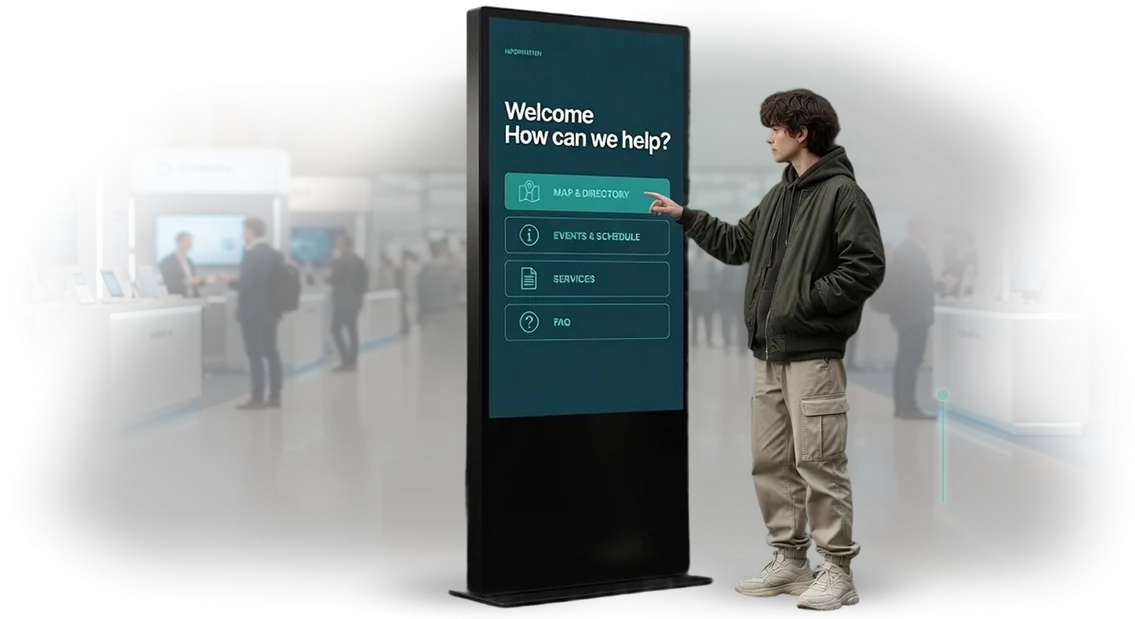
Specialized Modules: How to Eliminate Queues and Chaos for Your Clients
A visitor shouldn’t have to think about how your service works. They want to get the service quickly and leave.
But without a working navigation and queue-management system, even a moderate influx of clients turns the lobby into chaos: queues, crowds at counters, irritated people, and overloaded staff. Sound familiar?
Specialized interactive kiosk modules solve exactly this problem. An electronic queue for a multifunctional center (MFC) directs the visitor to the right window and relieves the administrator.
A virtual concierge for a hotel accepts requests for housekeeping, wake-up calls, or taxi — without calling the front desk.
An interactive kiosk for a clinic schedules appointments and issues tickets, and a kiosk for a bank helps select a product, book a manager meeting, or pay for a service — without long waits in line.
Director of a regional MFC describes the effect: “In peak hours, every terminal used to have a crowd around it. The specialized module distributed the flow, and visitors began spending three times less time waiting. Staff stopped being distracted by repetitive questions — and clients noticed it immediately.”
Implementing such a module does not require adapting your processes to a rigid system. We configure the scenario for a specific institution’s needs, and then the kiosk itself guides, schedules, informs, and collects feedback.
Your employees focus on real people, not paper routine. The result: order in the lobby, less load on staff, faster service, and satisfied clients who return and recommend you.
Benefits of Implementing Interactive Kiosks for Your Company
An interactive kiosk for business is not just a stand with a screen, but a working automation tool. Visitors choose whether to browse the catalog, book a service, or place an order — independently of queues or staff availability.
This is the main advantage of kiosks: speed and control for the client plus a predictable flow of operations for the company.
Increased loyalty starts with eliminating waiting. Shorter queues reduce peak-hour stress, and staff focus on complex issues and sales instead of repeating information. Service becomes more attentive, and the impression of your company remains consistently positive.
Brand awareness is enhanced through kiosk design: corporate style, thoughtful interface, non-standard content presentation. The device attracts attention, sparks interest, and encourages visitors to share it on social media.
Application Areas
In retail, a kiosk helps navigate the assortment and arrange pickup; in beauty salons and clinics, it schedules appointments; in cafes, it takes orders without a waiter; in banks, it issues statements without a manager. Scenarios are tailored to industry-specific tasks and integrate into current processes.
Additional Leads
The dialogue logic can be designed so that at the end, the visitor leaves a contact, signs up for a trial session, or receives a promo code. This turns the kiosk into a lead-generation tool, providing the marketing department with measurable inquiries.
One screen covers service, promotion, and sales tasks — and pays off through reduced staff load and increased contact volume.
Implementation Formats for Specialized Modules Tailored to Your Task
Specialized modules are not “a kiosk for the sake of a kiosk,” but a tool for a specific operation. Instead of a universal terminal with a dozen functions, you get an interface that takes a visitor from goal to result through one clear scenario.
These kiosk formats reduce service time, remove staff routine, and make the service accessible without employee involvement.
Electronic Queue
A module for high-traffic places: MFCs, clinics, bank branches, administrations. Visitors take a ticket or book an appointment themselves — no front desk needed. The queue becomes transparent, and you gain load statistics by hour and service to plan shifts.
Virtual Concierge
Replaces an employee at the entrance: provides directions, explains working hours, calls the right specialist. Suitable for business centers, hotels, exhibition spaces, and hospitals. Guests get an answer in seconds, while you save on hiring and training additional staff.
Interactive Archive
A digitized catalog of documents, exhibits, or company projects. Visitors find the desired item via filters, study materials, and download them to their email.
Ideal for museums, libraries, showrooms, and admission committees — access to information without an employee, at any time.
| Format | For Whom | What It Gives the Client |
|---|---|---|
| Electronic queue | MFCs, clinics, banks, administrations | Reduced queues, staff relief, flow analytics |
| Virtual concierge | Business centers, hotels, exhibitions, hospitals | Instant navigation, staff savings, 24/7 service |
| Interactive archive | Museums, libraries, showrooms, educational institutions | Self-service access to catalog, employee time savings |
Formats can be combined in one kiosk: electronic queue and virtual concierge often work together, complementing each other. We will select a configuration for your task, customize the design to your brand, and remain on support after launch.
How We Create an Interactive Kiosk: Stages of Work
This process is designed so that you don’t just get “a piece of hardware with a screen,” but a tool that actually solves business problems. We remove all uncertainty: you see in advance how the kiosk will look and operate, and you can influence the result at every step.
Phase 1: Immersion and Plan
It all starts with a brief and a short interview with your team. We need to understand who will use the kiosk, what scenarios are needed (information, booking, navigation, sales), and how the kiosk should fit into your business processes. Then we analyze the audience and placement points to propose scenario logic and menu structure.
At the output, you receive a kiosk project plan and an approved interface mockup — before the development stage. This allows you to approve all details on paper, avoid redesigns, and clearly understand timelines and budget.
Phase 2: Design and Launch
After mockups are approved, we move to design and prototype assembly. You see the first working version of the kiosk, try it out, and make changes before the system is filled with content. Then integration with your services takes place, if needed, and testing on a real device.
When everything is ready, we launch the kiosk at your site and provide post-launch support. Content can be changed and updated without stopping operations, and we remain available for updates and technical support.
- Conduct a brief and interview with your team, recording the objectives.
- Analyze the audience, placement location, and desired scenarios.
- Approve the kiosk project plan and menu structure.
- Develop interface mockups and approve them with you.
- Assemble a prototype, fill it with content, and test it.
- Launch the kiosk at the site and tune it to real conditions.
- Provide post-launch support: update content, refine scenarios.
This approach has already helped dozens of clients launch kiosks without missed deadlines or extra costs. You always know what stage the project is at and what comes next.
What You Get as Part of the Interactive Kiosk Package
You receive not just a device, but a complete turnkey solution — from the first screen to staff training. The package includes everything needed for stable kiosk operation from day one: software, design, content, documentation, and support.
No hidden work or additional fees — we fix the delivery scope in the contract, so you know exactly what you are paying for.
Full Package: What Is Included
- Kiosk software — a licensed system for managing the interface and content updates. It runs without failures and automatically recovers after a reboot.
- Kiosk design — adaptation of your corporate identity to the screen: grid, fonts, colors, button layout. The appearance matches your brand.
- Content delivery — section structure, texts, images, and video materials. We gather information from your materials and standardize it.
- Instructions and regulations — short guides for staff on startup, replacing consumables, and handling typical situations.
- Staff training — an online session or recorded video lessons for your team. Employees will be able to change content and manage the kiosk independently.
- Warranty and support — warranty on hardware and software, plus a communication channel with an engineer for consultations. The term is specified in the contract.
Content: Material That Solves Problems
The key part of the package is proper content. We analyze the questions your visitors or clients most frequently ask and turn them into a clear screen structure. Each section addresses a specific need: find an office, check a price, view a promotion, submit an inquiry.
Content is presented in a format convenient for quick understanding: large visual blocks, minimal text, clear navigation. You receive not an empty template, but a working tool that reduces staff load and speeds up service.
If needed, we help update materials after launch — by separate request or as part of a support subscription.
Implementation Example: How We Accelerated Client Service
At a large hotel, the front desk couldn’t handle peak hours: guests waited 10–15 minutes, the administrator was distracted by repetitive questions, and there was no time for individual care of visitors.
We installed touchscreen kiosks with a virtual concierge and electronic queue — and eased the staff’s workload while speeding up all routine operations.
How It Works and What Changed
The kiosk took over check-in, ordering additional services, hotel navigation, and answers to common questions. The electronic queue distributed the flow evenly: the guest saw their number, sat in a comfortable chair, and knew when the administrator would be free. The crowd at the desk disappeared, and employees gained time for personal interaction.
Results from the first month of operation:
- administrator workload decreased by 40% — they focused on complex requests and improving service quality;
- queue wait time dropped from 12 to 3 minutes;
- the hotel’s NPS rose by 12 points — guests noted the speed and modern approach.
The client achieved measurable results and, within a season, ordered two more kiosks for the restaurant and spa center. This repeat order confirms: we didn’t just “install a device,” but built a working process that improves efficiency across the entire property.
“Guests no longer see a queue. Now they smile during check-in, and administrators have time to greet everyone personally. We didn’t just get a kiosk — we got a tool that changed the impression of the hotel.” — hotel chain manager
Example from the our team portfolio — details available under NDA upon request.
How to Choose the Right Format for Your Task?
When the question arises of how to choose a kiosk for an office, exhibition, or public space, most people look at the screen and design.
In practice, what matters most are the use scenarios: who will be standing at the kiosk — visitors, customers, or employees — how many people pass by daily, and what goal the module must accomplish. These inputs determine the format, not the screen size.
Specialized modules are created precisely for a specific task. For a busy shopping center, a compact kiosk with fast search and a hardened body works well. For an exhibition, bright visualization and photo opportunities are more important.
If the task is standard — a catalog, list of services, navigation — a standard module is enough. When you need to stand out and strengthen your brand, we create a custom solution: a non-standard shape, unique interface, integration with a booking system.
Such specialized solutions take up less space and combine several functions in one unit, which is convenient for both guests and your team.
To make format selection quick and accurate, we start with a short brief. We clarify the location, traffic, audience age, and the kiosk’s main objective. Then we offer 2–3 options with differences in budget and timeline, explaining how they differ for the end user.
You choose not abstract hardware, but a ready-made tool that will immediately fit into your project. We also advise which modules to add right away and which to plan for the future.
Kiosk consultation with our team is an initial stage. You send a description of your task and receive a recommendation: a standard module or a custom solution.
If you are unsure which functions you need, we will help you decide and design a solution that works to your advantage — reducing queues, increasing visibility, or creating a new customer experience.
Frequent Questions and Concerns Before Ordering a Kiosk
Before ordering a kiosk, every manager has the same questions: will the equipment fail at the most critical moment, will we meet deadlines, will the kiosk fit into current processes. This is normal — we work with such projects regularly and are ready to address every concern.
How the Process Works So You Don’t Worry About Deadlines
The project follows a clear procedure: brief and task analysis, project design, approval of mockups and logic, assembly and setup, testing, then launch. At each stage you see the interim result and understand exactly what is happening with your order.
That is why we state development timelines upfront and fix them in the contract. Delays happen only because of untimely decisions on the client’s side — we warn about this in advance and help you approve everything quickly.
Warranty and Maintenance — the Kiosk Works as Long as Your Business Runs
We provide an official warranty on all hardware and software. If anything fails due to a manufacturing defect, we replace the part free of charge. But more importantly, we offer service maintenance: regular checks, cleaning, content updates, and remote status monitoring. You are never left alone with the equipment.
Integration with Your Systems — Without “Ritual Dances”
The kiosk easily connects to your CRM, accounting system, or order database. We export analytics in the required format and configure data exchange with your services. All integration work is on our side — you don’t need to hire a separate developer.
Cost — a Transparent Estimate Without Hidden Fees
We provide the final price after the brief and fix it in the contract. You know exactly what you are paying for: design, logic, components, installation, and setup. No “pay extra for a third iteration” — all work included in the estimate is completed without additional charges.
What happens if the kiosk breaks down in the middle of an event?
Breakdowns are unpredictable, and that is the main fear of any client. That is why we design kiosks with a safety margin: industrial components, protection against power surges, and a reinforced body.
The built-in self-diagnostic system warns about a problem in advance — before it becomes visible to a customer.
If an emergency still occurs, you call us — an engineer connects to the kiosk remotely and usually resolves the problem within minutes. In a critical case, we will arrive on site and replace the component. During repairs, we provide a replacement kiosk so your visitors are never left without service.
Order Interactive Kiosk Development for Your Business
Tell us where the kiosk will be placed and what task it should solve — we will select the format and specialized modules for your scenario. Leave a request to get an engineer’s consultation and a kiosk cost calculated after audit within one business day.
Our team develops kiosks turnkey: from the body and screen to the software part and integration with your systems. Ordering a kiosk from us means getting a complete solution instead of dealing with technical details. We take on design, production, setup, and launch, and you get a tool that works for your business.
After your inquiry, you will receive:
- analysis of the use scenario and selection of specialized modules for your task;
- a preliminary kiosk cost calculated after audit and realistic timelines;
- recommendations on placement, design, and interface content;
- an integration plan with existing services and accounting systems;
- a clear estimate with no hidden work or unexpected extra charges;
- a commercial proposal with a warranty on equipment and post-launch support.
“We ordered kiosks for a showroom. The engineer helped choose the modules, and after launch we received inquiries on the first day. Support is available whenever something needs adjusting.”
Leave a request on the page or write to us on messenger — we will call back, clarify the details, and offer a solution within your budget. The engineer consultation is non-binding, but you will immediately understand whether this format suits you.