

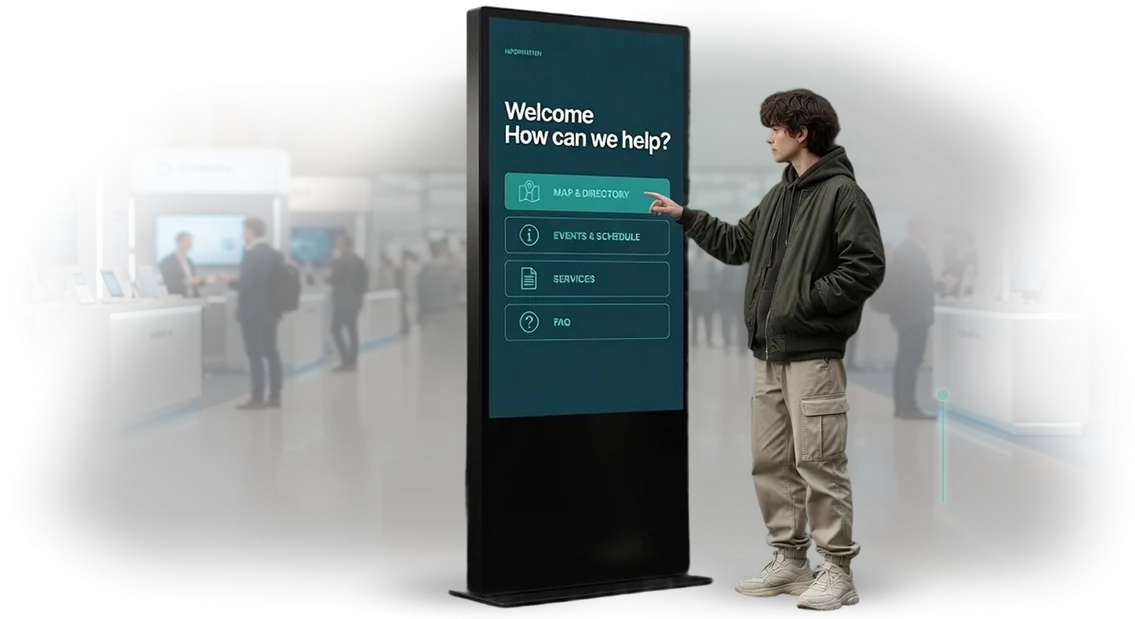
Why a developer's sales office loses clients
A visitor comes to a developer's sales office ready to make a decision, but often faces a chaotic queue and no clarity on when a manager will be free.
Waiting in the corridor without feedback ruins the first impression of the company, and the person leaves without even leaving their contact details. This is a direct loss of clients: every missed contact means not only lost revenue, but also damaged visitor loyalty to the brand.
Managers are overloaded: they are simultaneously answering calls, manually scheduling viewings, and getting distracted by the flow of people. Instead of dialoguing with a client, they constantly have to decide who is next, while viewing appointments get lost or forgotten.
The client does not plan a return visit because they never received a clear invitation — it is easier to go to a competitor whose waiting system has been thought through.
An interactive kiosk with an electronic queue and scheduling solves this problem: the visitor immediately sees the order and estimated consultation time, and can choose a convenient slot for a property viewing.
Managers see who is scheduled and prepare for the meeting instead of handling "manual" coordination. The queue stops being chaos, and every person receives attention that builds loyalty.
We implement such a kiosk specifically for your sales office — taking into account the layout of the premises, typical visitor scenarios, and existing processes.
You will not have to change your familiar way of working: the system integrates into your current client reception logic and quickly pays for itself by reducing losses at the entry point. This solves the developer's main pain — visitors stop leaving without booking an appointment.
What an interactive kiosk will give your sales department
A visitor to a sales office does not like to wait — every minute of waiting reduces their interest and increases the chance they will go to a competitor.
An interactive kiosk removes the chaos from the first contact: the person immediately enters a clear process, and the manager is not distracted by organizational issues.
Automated scheduling turns a spontaneous flow of people into a manageable schedule. The visitor chooses a convenient time themselves, while the manager sees the schedule and prepares for the meeting in advance.
This eliminates overlaps, forgotten visits, and queues of people who simply "dropped by to ask."
The kiosk works on conversion even before the conversation with the manager. While the person waits, they study layouts, timelines, and terms — meaning they arrive at the conversation already warmed up.
Such engagement noticeably increases the share of successful deals: fewer visitors leave having "just looked."
Management gets full control over inquiries: every request is recorded automatically, and it is clear who came, when, and regarding which property. No inquiry gets lost in conversations and notes — the entire sales picture is collected in one system. This allows honest assessment of manager performance and quick identification of weak points.
Service speed is another obvious plus: the kiosk handles the routine, while managers focus on sales. Short waiting times and a clear process increase visitor satisfaction, and therefore the likelihood of a return visit.
Ultimately, the kiosk pays for itself not as a technical solution, but as a tool that brings order, transparency, and additional revenue.
Formats of interactive kiosks for your task
An interactive kiosk in a developer's sales office solves three tasks: shows layouts, schedules viewings, and manages the queue to the manager. The right form factor determines whether the kiosk becomes a working assistant or remains an expensive interior decoration.
We select a floor stand, wall-mounted panel, or mobile structure based on the area and visitor flow, so that every scenario delivers a measurable result.
Equipment selection starts with the question: "How do guests enter the office and how long are they willing to wait?" If you need to relieve the administrator and speed up scheduling, a compact panel is enough.
If the space is spacious and the flow is large, a floor stand with a large screen becomes the navigation center. And for off-site promotions and temporary locations, a mobile version that can be set up in minutes is convenient.
| Format | For whom | What it gives the client |
|---|---|---|
| Floor stand | Spacious showroom, constant flow | Electronic queue, layout presentation, viewing scheduling without manager involvement |
| Wall-mounted kiosk | Compact waiting area, corridor, meeting room | Quick scheduling, property viewing, reception relief in a limited space |
| Mobile kiosk | Off-site promotions, exhibitions, temporary sales points | Quick setup, lead collection, viewing scheduling anywhere |
All options run on a single platform, so data about visitors, queues, and interest in layouts is not lost between formats. You get statistics on peak hours and repeat visits — meaning you understand when to add more managers and which properties to show more often.
As a result, the kiosk becomes not just a screen, but a tool that increases conversion to viewings and reduces staff idle time.
How the project goes: from brief to launch in 4 weeks
We have structured the process so that you get a working tool for your sales office not in six months, but in just 4 weeks. We coordinate every stage with you — you always understand what is happening and what comes next.
- Brief and objectives. We discuss what your office specifically needs: electronic queue, viewing scheduling, layout showcase, contact collection. We record visitor scenarios so the kiosk solves real manager tasks.
- Mockup and screen logic. We show how the interface will look and what steps the client will follow. You make edits before development starts — this saves time and budget.
- Functionality approval. We approve the design mockup and the set of screens. You see how a visitor will choose an apartment, join the queue, and leave a request — before the first lines of code are written.
- Development and installation. We build the interface on professional equipment and connect the kiosk in your office. At this stage, you receive a working prototype for testing on real scenarios.
- Testing and debugging. We check all scenarios: queue, scheduling, information printing. We make sure a visitor seeing the kiosk for the first time can manage without manager assistance.
- Launch and support. We turn on the system and train your staff. We help with the first visitors, collect feedback, and stay in touch if something needs to be refined.
In the end, you get a kiosk that relieves managers, reduces waiting time, and collects contacts of potential buyers. No surprises at launch and no long waits — 4 weeks from brief to full launch.
What is included in the delivery: a ready-made turnkey solution
You get not just a kiosk, but a fully configured working tool ready to receive visitors from day one.
We remove all the routine launch issues: you do not need to think about how to connect the program to your accounting system, how to update information, or what to do if something goes wrong.
The standard delivery includes:
- A workflow scenario for the sales office — well-thought-out visitor steps: selecting a property, viewing layouts, booking a manager, or submitting an online request. The scenario is adapted to your sales funnel and requires no programmer involvement.
- Interface in your corporate style — design with your logo, brand colors, and layouts. The visitor immediately understands that it is part of your brand, not a foreign device.
- Integration with your accounting system — data exchange setup with a CRM or electronic queue system. Requests from the kiosk automatically go into the manager's workflow — without manual entry or errors.
- A module for quick information updates — you change prices, promotions, and layouts yourself without calling a contractor. This saves days and money on every update.
- Instructions and staff training — a short procedure for the administrator and managers: how to change the schedule, add a presentation, or print a report. Staff start working immediately.
- Technical support and updates — round-the-clock monitoring, scheduled system updates, and rapid response to failures. You are never left alone with the device.
This package allows you to launch the kiosk in days, not months. The client gets stable operation without constant IT oversight — full responsibility for performance lies with us. In the end, you handle sales, not equipment setup.
Case study: how a kiosk increased residential complex bookings by 40%
In one residential complex, the developer "Northern Park" faced a typical problem: on peak days, managers could not keep up with scheduling visitors, and guests left without a consultation.
The manual queue created chaos, some potential buyers were lost due to waiting, and no statistics were kept. The solution was an interactive kiosk with an electronic queue and booking module in the sales office.
The kiosk took over self-service booking for viewings, queue registration, and contact collection. In the first month of operation, residential complex bookings grew by 40%.
On a peak Saturday with 120 guests, the kiosk processed 87 sessions in 2 hours — without a live queue and without lost leads. Managers saw the request before the conversation even began, and visitors no longer stood around the reception desk.
What changed after launch
- Bookings at the residential complex grew by 40% in the first month.
- 87 sessions in 2 hours on a peak day with 120 guests.
- Complete elimination of the manual queue — managers work on a schedule.
- Repeat order — two more kiosks for other sales offices.
An info kiosk for a developer is not just a screen, but a sales tool. It reduces lead loss, relieves the administrator, and gives management numbers for planning.
If you need to increase bookings at your sales office, we will design and implement a similar solution for your needs.
How to choose a kiosk format for the specifics of your property?
The kiosk format is not a technical parameter, but a decision that must work for your business objective.
For a developer's sales office, it is especially important that guests can easily get the information they need about layouts, apartment availability, and mortgage programs, while your managers spend time on live negotiations rather than repeating the same information.
The choice depends on three things: the area of the premises, the typical visitor flow, and which scenarios you want to cover.
In a small showroom with one or two managers, a compact floor terminal is enough — it takes up little space and quickly provides all the necessary information.
In a spacious office with a large weekend flow, it makes more sense to install several stands with different functions: one for booking viewings, another for an interactive property catalog.
The interaction format also matters: some prefer a touchscreen with large buttons, others prefer a stand with an additional monitor for demonstrating 3D layouts. We select the configuration for your tasks, not the other way around.
At the discussion stage, we visit the site or request the floor plan to offer the optimal solution: the number of devices, their placement, and operating scenarios — from electronic queue to issuing cards with suitable apartment options.
After that, we approve the interface prototype with you: it is important that the client sees exactly how a visitor will travel from the first touch to receiving the needed information.
We even take into account details such as the installation height of the screen and the angle of inclination — so that it is comfortable for adults, children, and people with disabilities.
If you are unsure which format is right for you, call or write to us. In a 15-minute short consultation, we will determine the main parameters: area, flow, scenarios.
Then we will propose a standard configuration or develop a custom one — with a focus on the kiosk paying for itself through increased conversion to viewing bookings.
Common concerns: what if the kiosk breaks down or is not liked
Before launching a kiosk in a sales office, the same questions always arise: will the equipment stop working in the middle of a showing, can staff quickly teach guests to use it, what happens in case of a breakdown.
This is normal — any new system without proven support raises doubts. Here is how we eliminate these risks already at the implementation stage.
Below are answers to the most common customer concerns. They are based on experience from dozens of projects for sales offices and showrooms.
What if the kiosk breaks down or freezes during operation?
The kiosk is built on professional components with a safety margin for continuous operation. We test it in real scenarios: long idle periods, a queue of five people, simultaneous touches.
If a failure does occur, the system automatically restarts within a couple of minutes, and we quickly arrive under warranty.
How quickly will you respond to a breakdown?
Warranty support covers the entire contract period — usually up to 12 months. While repairs are being made, we provide replacement equipment so your sales office does not sit idle.
Requests are accepted by phone and messenger, and the average response time is fixed in the contract.
Our staff will not understand the kiosk. Do we need to hire an administrator?
The kiosk is designed so that training takes one hour. Your managers will be able to accept bookings, change prices, and launch presentations without special knowledge. We conduct a briefing for administrators and connect remotely if questions arise.
Breakdowns are rare, but we structure our work so they do not affect your revenue or guests' mood. You receive a clear procedure, spare modules, and live support — not just a "box with a touchscreen."Order kiosk development for your company
Ordering turnkey kiosk development is a clear process that we take on from the first call to launch and support. You get a ready-made solution for your sales office tasks, not just equipment.
- You leave a request on the website — we contact you within one business day.
- We clarify the tasks: visitor flow, booking scenarios, integration with your accounting system.
- We prepare a solution and a cost estimate — you see the structure and timelines before work begins.
- We approve the interface design to match your brand and sales office style.
- We develop and test the kiosk, and configure professional equipment.
- We launch and train staff, and hand over clear instructions.
- We provide post-launch support: updates, refinements, feature expansion.
In the end, you get a kiosk that reduces the load on managers, shortens queues, and collects requests even during peak hours. The solution easily integrates into office operations and quickly pays for itself through a higher number of handled visitors.
Leave a request — we will prepare a solution for your task. Tell us about your sales office, and we will suggest the appropriate format, timeline, and cost.