

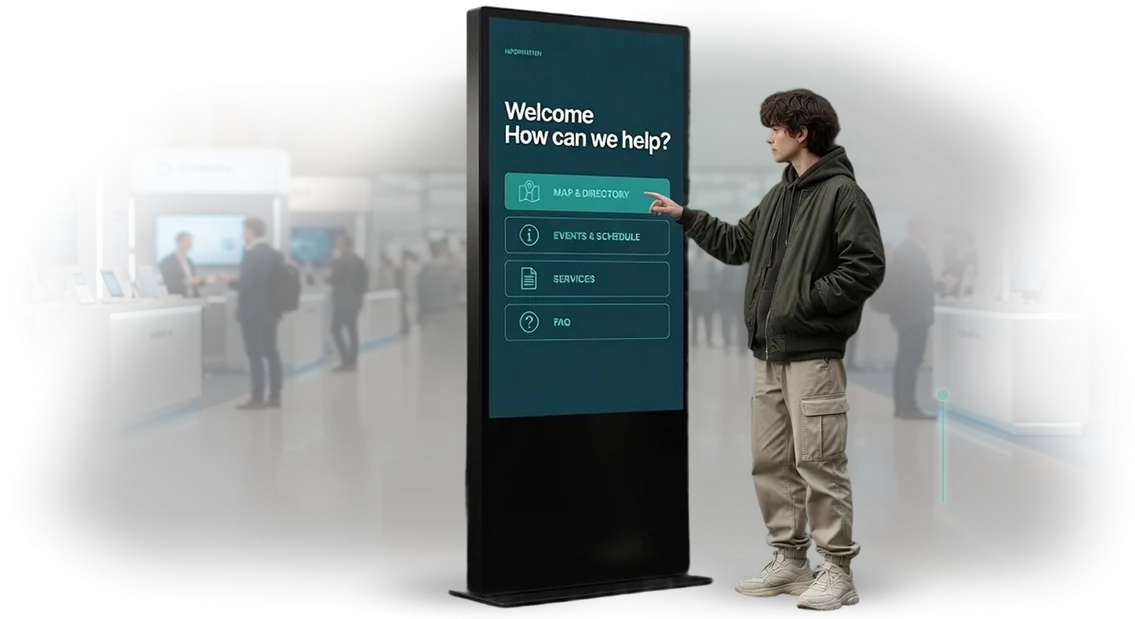
Kiosk Application Platforms: Why Visitors Get Lost and Leave
A visitor walks into a building and cannot find the right office, department, or exhibition. They look for a sign, ask security, but the answers don't help, and the queue at reception only adds frustration.
If a person doesn't get the needed information within 2–3 minutes, they simply leave for a competitor — and that visit will never happen again.
Every such departure is a lost customer and missed revenue, plus a negative impression the visitor will share with colleagues and on social media.
In a shopping mall, business center, or clinic, in-building navigation becomes part of the service by which the company as a whole is judged. When visitors cannot orient themselves, they feel that the level of care matters less here than the facade.
An interactive kiosk solves this problem before the guest has a chance to get annoyed. A touchscreen terminal at the entrance shows a map, points of interest, services, and events, answers frequently asked questions, and works without staff involvement.
Kiosk application platforms make it possible to quickly update information and adapt the interface to any task — from building navigation to product catalogs or specialist schedules.
Speed also matters: a person needs just 30 seconds to find what they need and head in the right direction. This takes the load off administrators and security guards, who no longer have to explain the same thing a hundred times.
And for the client, it creates a manageable, convenient space where guests get answers on their own.
We have been developing such turnkey systems for over 10 years. You get a stable platform that solves the issue of lost customers and makes visiting your company clear and comfortable.
What an Interactive Kiosk Delivers: 5 Key Business Benefits
An interactive kiosk is not just a screen with a menu, but a full-fledged tool that changes visitor behavior and delivers measurable results for business.
For the event industry, retail, and services, it addresses five key tasks at once: from visitor emotions to collecting contacts for repeat sales.
The first and most obvious benefit is increased visitor engagement. Live interactivity holds attention for much longer than a static sign or paper flyer: visitors choose their own path, browse the catalog, and explore promotions.
This format triggers a natural response — people take photos of the screen, share the experience on social media, and come back to the kiosk again, meaning brand awareness grows without additional advertising spend.
The second benefit is faster service. The kiosk handles routine operations: navigation, booking, issuing certificates, and scheduling consultations.
Lines get shorter, and employees shift to tasks that actually generate profit — consultations, sales, and assisting important guests. For the customer, it's speed and comfort; for the business, it's reduced staff workload.
Third is a modern company image. A high-tech kiosk in a lobby or at an exhibition immediately reads as a sign of a reliable, progressive brand.
Guests begin to trust the service even before their first contact with a manager, and partners see the company as a leader that follows trends. This builds reputation and sets you apart from competitors.
The fourth benefit is attracting new customers. The kiosk itself is a point of attraction: a bright touchscreen, animation, and the ability to "play" with content draws the attention of passersby.
People approach out of curiosity and leave with a conscious interest in your product. Such live contact generates more qualified inquiries than ordinary advertising, and it is completely non-intrusive.
The fifth is lead generation. The kiosk doesn't just show information; it collects data: visitors leave contacts, answer questions, and state their preferences. You get a database of interested people ready for dialogue and can personalize future offers. This turns a one-time event into a source of ongoing sales.
As a result, an interactive kiosk pays off not only through guest emotions but also through concrete metrics: more engaged visitors, faster service, higher loyalty, and a new lead database. It's a universal solution for a business that wants to grow.
Kiosk Application Platforms: Choosing the Right Format for Your Task
A kiosk only works when its format matches the business task. Simply placing a screen with a catalog isn't enough: a visitor won't stay if the interface doesn't help them quickly solve their problem.
We select a kiosk application platform for a specific scenario — from quick navigation to extended product interaction.
Below is a comparison of the most popular formats, so you can get a rough idea of which option addresses your task. We'll then adapt it to your brand, audience, and space.
| Kiosk Application Format | Who It Fits | What It Delivers to the Client |
|---|---|---|
| 3D Navigation | Shopping malls, business centers, hospitals, campuses | The visitor builds a route to the desired point in 30 seconds — fewer questions for staff, higher loyalty |
| Product Configurator | Furniture, kitchen, door stores, car dealerships | The client assembles the product themselves and sees the price — the manager spends time on selling, not explaining |
| Virtual Try-On | Opticians, beauty salons, clothing and accessories stores | The client "tries on" the product without touching it — increases engagement and average order value |
| Equipment Presentation | Industrial companies, B2B suppliers | A complex product is shown clearly, in detail, and across scenarios — the deal cycle shortens |
| Museum Exhibit | Museums, exhibitions, showrooms, event venues | Interactivity holds attention and immerses visitors in history/product — they stay longer in the space |
This is a basic guide. Within a single kiosk, we often combine two formats — for example, navigation and service presentation — so the screen covers two visitor tasks at once. The key is to keep the interaction logic simple and intuitive.
Bring us your challenge — we'll advise which format will deliver the maximum return in your scenario, and show examples of similar solutions.
How We Build a Kiosk: 6 Steps from Brief to Launch
We work without hidden stages or "surprises" in the middle of a project. The process is set up so that at every step you can see what's happening with your kiosk: from the first brief to the moment the first visitors start using the scenario. Below are the six steps every project goes through.
-
Kiosk brief and objective. We establish where the kiosk will be located, who your audience is, and what task it will solve: scheduling, navigation, catalog, questionnaire. We discuss expectations for design and functionality and create a clear technical specification.
-
Plan and cost estimate by stages. We agree on timelines, the scope of work, and checkpoints. You receive a schedule showing when the mockup is ready, when scenario assembly begins, and when testing is planned.
-
Mockup and scenario. We design the screens and interaction logic: how many steps the user needs, which buttons and hints will help. We approve the mockup using real texts and images — before development begins, so revisions are inexpensive.
-
Development and assembly. We configure all screens, connections, and workflows: returning to the start, timeouts, error handling. You see the finished version in action and can make scenario adjustments while iteration continues.
-
Pre-launch testing. We test the kiosk on real hardware: touch response, response speed, text readability in different lighting conditions, and behavior during failures. We fix any identified issues so that visitors won't encounter them after installation.
-
Kiosk launch and support. We install and configure the device on site and conduct a final check together with your team. We stay in touch: after launch, we answer questions, update content, and promptly resolve any unusual situations.
What's Included in the Delivery: A Complete Launch Package
When you order a kiosk application, it's important to understand: you receive not just a program, but a working tool that can be launched on the day of installation.
We structure the delivery so you don't have to buy anything extra, finish anything, or deal with someone else's code.
Here's what's included in the package:
- Ready-to-use kiosk application — installed and configured for your task: catalog, scheduling, surveys, navigation, or presentation. Works the moment it's turned on.
- Admin panel — a simple web interface for changing content yourself: texts, photos, promotions, prices. No developers needed for every update.
- Staff instruction manual — a clear guide on how to turn on the kiosk, replace content, and handle common situations. Your employees will get the hang of it in one day.
- Team training — a short online session or video tutorials so your staff can confidently work with the system and help visitors.
- Software license — the official right to use the application without restrictions or hidden fees.
- Technical support — a dedicated communication channel: we help with setup, updates, and any questions during business hours.
The complete package saves your time and nerves: you don't need to find contractors for every little detail. Everything is in one contract, with clear timelines and contractor accountability. You get a ready kiosk that delivers value from day one.
Case Study: Kiosk for Residential Complex Presentation — Results in Numbers
A homebuyer makes a decision faster when they see the future building through the eyes of a resident, not a flat model. It's hard for a manager to explain floor plans, views from windows, and infrastructure with words alone, and the client leaves with doubts instead of a request.
We developed an interactive kiosk for a developer and installed it in the sales office. Visitors control the 3D presentation of the residential complex themselves: they switch floors, look into apartments, explore the courtyard and social facilities.
The manager joins the conversation once the client has already selected interesting options and helps them submit a request.
Project Numbers
In the first month of kiosk operation, the number of requests grew by 40%, and the average time spent with a client increased from 10 to 25 minutes. Repeat visits to the sales office doubled — people returned with their families to show off "their" apartment.
These results came from a single complex, but they confirm the key point: interactive presentation turns viewing into an emotional experience. The client stops hurrying, asks more questions, and is more willing to leave contacts. The developer received a tool that is already used at new projects — not a one-off stand.
How to Choose a Kiosk Platform Without Overpaying?
When choosing a kiosk platform, it's easy to overpay — or, conversely, to save on quality and end up with a device nobody uses. The question isn't which technology is more fashionable, but how it solves your task: speeding up service, increasing conversion, collecting data. So you should start with your business scenario, not equipment specifications.
The first step is to determine exactly what the kiosk must do: take orders, schedule visitors, provide information, or sell additional services. The format depends on this — a tabletop stand, a floor-standing terminal, or a touch panel.
Each format has its own optimal price, and overpayment happens when you choose a device with a power reserve that will never be used.
The second step is to assess the solution's lifespan and load. If the kiosk will operate in a high-traffic environment, basic solutions quickly break down or lag, which hits revenue. If the load is small, an optimized application on standard hardware is sufficient.
The right balance between reliability and price is not the minimum budget, but the minimum cost over the total service life.
The third step is to make sure the platform allows you to change content without involving developers. Marketing and assortment change quickly, and paying a programmer for every update is a direct loss. Choose solutions where updates take minutes, not weeks.
We help clients navigate this path without prepaying for unnecessary options: over ten years of work, we've built a library of standard scenarios and ready-made modules, so launch takes several times less time than starting from scratch.
You only pay for the features that genuinely increase your return — whether it's scheduling, payment, or an interactive map.
As a result, a properly chosen platform isn't the cheapest of all, but it delivers measurable results: higher average order value, shorter queues, and visitor engagement.
And if you're unsure which format suits you, we'll do a quick audit of your task and offer an option within your budget — without pushing anything extra.
Frequently Asked Questions from Clients Before Project Start
Before a project starts, clients have similar concerns: will we meet deadlines, will the equipment break, who will update content, and what guarantees do we provide. Below are honest answers to common questions, without technical details, in the language of your results.
How long does kiosk development take?
A typical project takes 2–4 weeks: from brief to installation on site. The timeline depends on interface complexity, the number of screens, and integrations with your systems.
We set dates in the contract and show results step by step — you see intermediate versions and make edits without shifting deadlines.
What happens if the kiosk breaks down or freezes?
The kiosk runs on professional hardware and polished software, so failures are ruled out in 99% of cases. If a problem does occur, remote diagnostics and auto-restart are built in.
We provide a warranty on critical components and support the project after launch — you're never left alone with the equipment.
How do I update content without a programmer?
You get a user-friendly control panel: change texts, photos, promotions, and prices yourself in a couple of minutes. Updates apply to all kiosks simultaneously, even if you have several. No support tickets or waiting — content is always up to date.
What guarantees do you provide?
We set timelines, cost, and the scope of work in the contract. After launch, a warranty covers the software and equipment — during this period we fix any issues free of charge. You also receive instructions and brief training for staff so they can confidently work with the kiosk.
Order Kiosk Development — Get More Live Leads
Submit a request for touchscreen kiosk development — and within the next few days, you'll have a ready-made solution for your tasks.
We won't just give you a price: along with the cost calculation, you'll receive a proposal on format, timelines, and scenarios that will bring more live leads to your business.
So you understand what's included in the work, here's a short checklist:
- Audit of your task and customer touchpoints — we'll figure out where the kiosk will work best: lobby, storefront, waiting area.
- Format and scenario selection — navigation, catalog, questionnaire, service scheduling, loyalty program. We align with your goal.
- Cost and timeline calculation — we'll fix the budget and launch plan before development starts; no hidden extra charges.
- Interface prototype — we'll show how a visitor will interact with the screen before any programming.
- Development and integration — we'll connect to your systems: CRM, product database, scheduling service.
- Testing and launch — we'll check all scenarios on real hardware so the kiosk runs reliably from day one.
- Post-launch support — content updates, performance monitoring, improvements based on your requests.
Ordering a kiosk isn't just buying a device — it's launching a channel that brings in live customers every day. Submit a request on this page, and we'll respond within one business day: we'll calculate the cost, propose the optimal format, and answer all your questions. No obligations — just specifics and value for your business.