

Logistics Center Challenges: Navigation, Queues, and Lost Customers
Every second visitor to a logistics center approaches the information desk with the same question: "Where do I find the department I need?" Employees stop their work to explain directions, walk visitors to a terminal, or find an escort.
At peak hours, a queue forms at the desk, and drivers and company representatives lose time — and time is money for them.
A visitor lost in a maze of shelving is not just a scheduling disruption. It is a direct loss of revenue: while the client waits for an answer or wanders around the facility, they are spending their time and yours.
If the visit left a bad impression, they will choose a competitor next time. That is how customer loyalty and the center's reputation as a reliable partner quietly slip away.
It might seem that hiring more staff or hanging arrows on the walls would help. But paper signs become outdated, and people physically cannot receive goods and serve as guides for every guest at the same time.
The center grows, routes change, and previous solutions stop working, creating chaos where clear logistics should be.
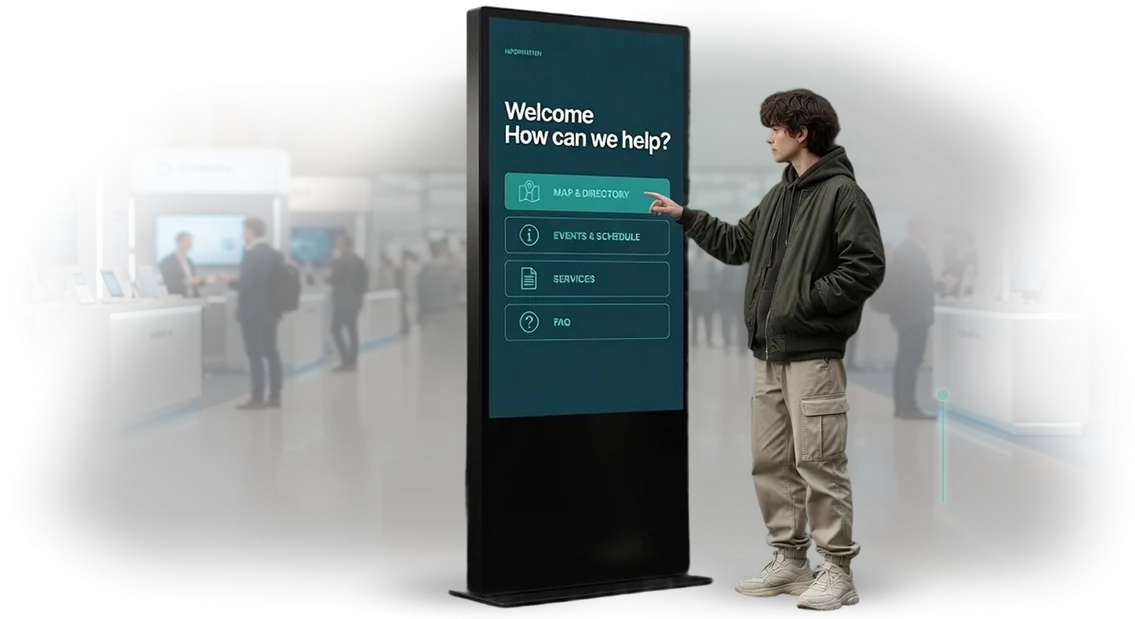
The solution is an interactive kiosk that takes on the role of navigator and consultant. It responds instantly to questions, plots a route to the required point, and relieves the staff.
We build such information kiosks for the specific needs of logistics centers — so guests stop getting lost and employees return to their core work.
What Changes After Implementing Interactive Information Kiosks
Logistics center visitors value speed and predictability above all. When a person cannot quickly find the right warehouse, receiving area, or pickup point, it creates tension, queues, and unnecessary questions for staff.
An interactive kiosk removes this problem by turning orientation into a simple and intuitive process.
The interactive map helps instantly determine a route to any zone: simply select the destination — and the kiosk will guide the way. Visitors stop walking in circles, complete their task faster, and do not block aisles, which speeds up the operation of the entire center.
Customer satisfaction grows without using additional resources. When visitors find their own way in a couple of touches, they are left with the impression of a convenient, well-thought-out service.
People appreciate independence and not having to wait for help — this boosts loyalty and the likelihood of repeat visits.
Employees stop being a help desk. Previously, most of their time went into explaining routes and answering the same questions. After deploying kiosks, staff focus on their direct responsibilities, which shortens service time and reduces the operational burden.
The terminals also work around the clock and never get tired — the benefit holds even during peak hours.
Modern touch kiosks shape the image of a tech-savvy, customer-oriented company. When a client, partner, or driver enters a terminal with interactive navigation, they perceive the logistics center as a reliable player that pays attention to detail. This builds reputation and helps you stand out from competitors.
Deploying kiosks is not about replacing people — it is about removing the routine that gets in the way of quality work. As a result, you get faster navigation, satisfied visitors, and staff focused on tasks that deliver real value.
Kiosk Formats for Different Logistics Center Needs
The efficiency of a logistics center directly depends on how quickly a visitor or driver finds the required point.
There is no one-size-fits-all "kiosk for every occasion": the receiving area, warehouse, and parking lot solve different tasks, so different equipment is required.
Matching the Kiosk to the Task
The rule is simple: the closer the kiosk is to the point of decision, the fewer errors and less wasted time. For the cargo receiving and pickup area, fixed solutions make sense, while mobile solutions work better for accompanying staff across a large warehouse floor.
| Format | Where It Is Used | What It Gives the Customer |
|---|---|---|
| Wall-mounted kiosk | Receiving area, checkpoints, pickup points | Space saving, quick status checks, no queues |
| Floor-standing kiosk | Lobby, waiting area, information center | Large touch kiosk for self-service check-in, routes, and inquiries without staff involvement |
| Mobile kiosk | Warehouse, parking lot, remote points | Assistance anywhere on the premises, inventory, and "here and now" navigation |
Each option operates autonomously and connects to your accounting system. The client gets not just a screen, but a tool that relieves dispatchers and speeds up service.
When floor-standing, wall-mounted, and mobile kiosks work together in a center, a unified navigation environment emerges. Visitors see the same interface whether they approach a kiosk or take a mobile terminal from an employee. This reduces the number of errors and accelerates request processing.
We ensure the system works reliably across all formats — from equipment selection to deployment and ongoing support. You do not need to dig into technical details — you get a solution that works for your business process.
How an Interactive Kiosk Project Unfolds: The Stages
Before placing a kiosk in a logistics center, it is important to understand how it will fit into the facility's operations. We build the project from a short brief to launch and support, so you always know where the task stands and when you will receive the final result.
-
Brief and task analysis. We start with a short questionnaire: who will use the kiosk, what functions are needed — warehouse navigation, a room directory, information for drivers, or something else. Based on this, we propose a plan and cost estimate without unnecessary options.
-
Plan and cost estimate. We lock in the scope of work, timeline, and cost. You receive a clear document that covers all project stages: kiosk development, interface approval, installation, and launch.
-
Interface approval. We show the menu structure and screen mockup so it is obvious to visitors how to find the required zone or information. After your approval, we move to development.
-
Interface development. We build the screen layouts on a professional platform, configure the logic, and link it to data — such as transport schedules or employee lists. You see a working version before installation.
-
Kiosk installation. We deliver the equipment, place it at the selected location, connect power and network, and test operation in real logistics center conditions.
-
Launch and support. We train employees, hand over instructions, and stay in touch. During the agreed period, we make edits and refine details so the kiosk works fully in the daily routine.
This sequence turns kiosk development into a transparent process with clear decision points. You are not waiting blindly for a result — you control every step and get a system that removes part of the staff's routine questions and speeds up orientation in the center.
What Is Included in the Ready Solution: The Kiosk Launch Package
You get more than just a touch terminal — you get a complete package ready for work. Everything is thought through, from the enclosure and interface to staff training and warranty service. This saves your team from hunting for separate contractors and long approval processes.
The kiosk launch package includes:
- Touch terminal — a sturdy enclosure designed for continuous use in waiting areas and high-traffic zones.
- Kiosk web interface — clear screens for visitors: site navigation, zone information, request submission, and other scenarios tailored to your needs.
- Software — all operating logic: from the facility map to data exchange with your accounting system. Updates and configuration are performed remotely.
- Staff instruction manual — a short guide on how to power on the kiosk, change schedules, or add new information without calling a developer.
- Kiosk warranty — service maintenance and technical support throughout the entire service life, so the equipment never sits idle.
- Installation and launch on site — we deliver, install, connect, and verify all scenarios before operation begins.
- Staff training — we show responsible team members how to manage the kiosk and resolve common issues.
This package allows you to launch the kiosk within days of delivery and see immediate results: fast navigation for customers, fewer staff inquiries, and up-to-date information in a consistent style.
Case Study: How a Kiosk Accelerated Navigation at a Client's Warehouse
When a logistics center spans thousands of square meters and dozens of zones, every new visitor — a driver, employee, or courier — spends time finding the right spot.
Without clear navigation, people approach staff with the same questions, which means direct losses of working time and additional burden on employees.
For one of our clients, we solved this problem with interactive information kiosks. Instead of paper maps and signs, we installed touch terminals with a warehouse map and search by zone name or type of operation. Visitors find their own route in a couple of touches, without staff involvement.
Project Results
After the kiosks were launched, the time needed to find a specific warehouse zone dropped by half — from 7–8 minutes to 3–4. This means drivers start loading and unloading faster, and the terminal's throughput grows without additional gates or staff.
The number of employee inquiries with questions like "where do I find this or that zone" fell by 30%. People now distract warehouse keepers and logistics staff from their direct tasks less often — they focus on their work instead of repeating the same directions. At the same time, the kiosks fully paid for themselves through time savings and staff relief.
Why It Works
The secret is not complex equipment but the right interface logic. We accounted for typical scenarios — "where do I deliver cargo," "where is document processing," "how do I get to the quarantine zone" — and placed them on the main screen.
A person does not need to search through menus; they immediately see clear buttons and get a route on the warehouse map.
The client was pleased with the result and is already planning to install kiosks at a second terminal. For us, this is the best indicator — the project was not just completed but delivers real value in the daily operation of the logistics center.
Common Questions Before Ordering an Interactive Kiosk
Logistics clients tend to ask similar questions before making a decision: how the kiosk will fit into current processes, whether it will require major infrastructure changes, and when it will start delivering value. We answer the key concerns so you can see the full picture — from connection to daily operation.
Is it difficult to connect the kiosk to our accounting systems?
We connect the kiosk to your 1C, WMS, or in-house development. Data exchange is configured within a few days, and you do not have to change existing processes: cargo and visitor information syncs automatically, and staff do not have to enter it manually.
Do we need a separate server?
No. The kiosk runs on your equipment or in the cloud, which we will help you set up. Data is protected, and only authorized employees get access — this meets the security requirements of a logistics center.
What about reliability and maintenance?
The kiosk is designed for round-the-clock operation and handles peak loads. We set up remote monitoring so you notice failures before they affect visitors. Support is included in the plan: updates and consultations are delivered without delay.
How quickly can we deploy it, and what does it cost?
A typical project takes 2–3 weeks, including testing on your data. The cost depends on the number of scenarios and the scope of integrations, but you receive the estimate before the start — with no hidden fees. The reduced staff burden and faster service allow the kiosk to pay for itself.
If you still have questions about scenarios for your logistics center — ask us. We will analyze your case and propose a solution that will work in your conditions.Leave a Request — We Will Estimate a Kiosk Project for Your Task
Leave a kiosk request — we will get back to you within one business day with a preliminary project estimate for your logistics center. We will send an approximate timeline, a suitable equipment format, and a list of integrations, without fluff or commitments. We will design a solution around your processes, not offer a generic template.
To make the estimate accurate, we take the following parameters into account:
- Kiosk tasks: navigation around the premises, request submission, employee directory, or customer service.
- Facility and foot traffic: area, layout, and placement points — we will determine the optimal enclosure and screen size.
- Integration with your systems: accounting records, warehouse management, CRM — we will design the connection without unnecessary costs.
- Usage scenarios: who will work with the kiosk and how — drivers, guests, or warehouse staff.
- Design and branding: we will agree on styling that matches your company so the kiosk becomes part of the space.
- Implementation timeline: we will break the work into stages and give you a launch date before the contract is signed.
- Post-launch support: we will define a content update schedule and fast equipment replacement procedure.
After the estimate, you will receive a commercial proposal with the scope of work and a fixed cost. We will provide a consultation on kiosks, show solution examples for logistics centers, and help you choose the format that addresses your specific task.
We will account for peak loads, ease of maintenance, and failure protection — the kiosk must never stop warehouse operations.
The request is non-binding. Leave your contacts — within a day you will know the cost, timeline, and next step for automating your processes.