

Visitors Leave Without Answers: When You Need Industry-Specific Kiosk Software
A visitor enters the building and cannot figure out where to go. There is a line at the information desk, staff get distracted from their work to explain directions, and some guests never find the office or department they need.
The result is wasted time, dissatisfaction, and lost profit for the business, especially when the flow of people is large and the same questions repeat dozens of times a day.
A guest is not willing to wait and search — they simply leave for a competitor or share their negative experience.
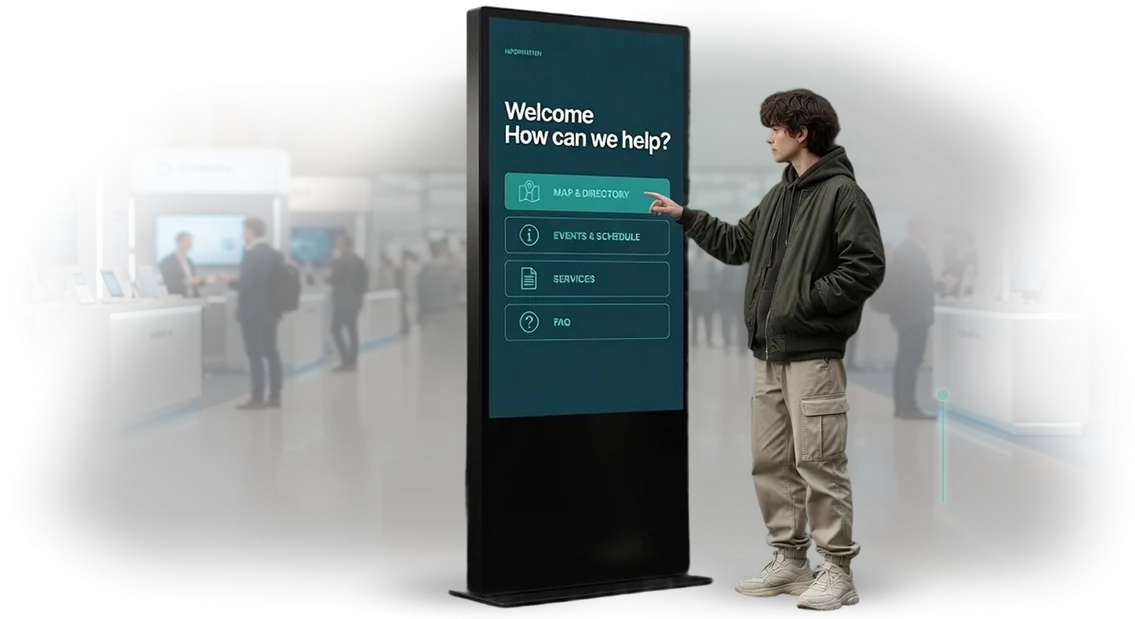
An interactive information kiosk with industry-specific kiosk software solves this problem. Instead of live assistance and paper signs, the guest gets fast visitor navigation: a map, search by name, and a route to the destination in a couple of touches.
Staff no longer play the role of an information bureau and focus on their direct responsibilities, and the crowd of waiting people disappears from the entrance.
When the software is designed for the specifics of an industry — medicine, shopping mall, government institution, or hotel — it takes into account typical guest scenarios.
This reduces the load on staff and increases loyalty: people get answers faster, worry less, and perceive the brand better. Every scenario is thought out to the smallest detail — from the first touch to leaving the building.
We create such kiosks turnkey: we analyze your tasks, configure the logic for your industry, and implement it. If visitors leave without answers, this is a signal that it is time to change the navigation system.
What Changes After Installing an Interactive Kiosk
Employees stop answering the same questions twenty times a day — the kiosk takes over the routine, while people handle live tasks that require human involvement. Guests, in turn, get instant access to up-to-date information at any time, without queues or waiting.
The main bonus for business is a transparent picture of what is happening. The system records which sections are viewed most often, at what time of day the load is higher, and what questions concern visitors the most.
Decisions are based on this data: what to improve in service, where to add navigation, how to optimize guest flows.
What the Business Gets After Launch
- Speed of service. Finding the right information takes seconds, not minutes of dialogue with staff. Queues melt away, visitors do not get annoyed.
- 24/7 availability. The kiosk works without breaks or lunch hours. Even if the information desk is closed, the guest is not left without help.
- Analytics instead of guesses. You see the real demand: which services are searched most often, which points on the map are more popular. This is a ready-made base for improving service.
- Staff relief. Employees stop being an “information bureau” and focus on tasks that generate revenue and create the impression of the company.
Why This Works in Practice
The process of service digitalization is already refined: we use professional software from <cite>TrueConf</cite> and a server architecture that withstands peak loads without failures. For the visitor, this means stable operation on any day — from ordinary weekdays to large events.
Navigation deserves special mention. If you have a large facility — a shopping center, business center, clinic, or exhibition complex — the kiosk becomes the entry point: the guest immediately understands where to go and does not waste time searching.
And if some of the audience is using touchscreens for the first time, the interface still remains clear from the first second.
As a result, not just a single point of contact changes, but the entire service logic. Guests are satisfied, employees are engaged, and you have data for further growth.
Which Kiosk Formats Suit Different Industries
Each industry solves its own task with kiosks: a shopping center — to guide a visitor to the right store, a museum — to engage with the exhibition, an airport — to unload information desks, a university — to orient applicants and students, a clinic — to automate appointment scheduling.
The same universal kiosk does not suit everyone — you need your own scenario, interface, and set of functions tailored to a specific audience.
| Industry | Client task | What the visitor gets |
|---|---|---|
| Shopping center | Navigation and advertising for tenants | Quick store search, map, promotions |
| Museum | Immersion in the exhibition | Interactive information about exhibits, audio guide |
| Airport | Reducing staff load | Self-service flight information, boarding gates |
| University | Informing applicants and students | Schedule, faculties, events, routes |
| Clinic | Automating appointment scheduling and navigation | Doctor selection, appointment booking, room location |
At our team we develop kiosk software adapted for every industry.
The interface is built in the language of your audience, and professional touch equipment and a well-tuned server-side component ensure stable operation without failures even at peak loads — during rush hour at an airport or on an open day at a university.
The right scenario pays off immediately: in shopping centers, kiosks increase tenant footfall; in museums, they increase the average viewing time; in airports, they reduce queues; in universities, they reduce the load on the admissions committee. We help you formulate the technical specification and choose a solution for your budget and tasks.
How We Implement an Interactive Kiosk: From Request to Launch
Kiosk implementation should not distract you from your current tasks. We have structured the process so that at every stage you understand what is happening and know when the result will appear. Below is the path from request to a working kiosk, including staff training.
- Request and brief. You describe the task: where the kiosk will stand, who will use it, what information needs to be displayed — this is enough to start.
- Prototype and scenario. We propose the screen structure and interaction logic. You see the future kiosk before production and can adjust the details.
- Design approval. You make edits and approve the design and texts. Nothing goes into production without your approval.
- Content production. We assemble the interactive program: menus, catalogs, maps, surveys — everything your visitors need at a specific location.
- Equipment manufacturing. We select the enclosure, screen, and mounting to match your interior and operating conditions — the kiosk will look appropriate and last a long time.
- Installation and launch. We deliver, mount, configure, and test the operation on site. You receive a ready-to-use kiosk without any self-configuration.
- Staff training. We show your employees how to turn on the kiosk, update information, and resolve common visitor questions — without a programmer or contractor.
As a result, you get a tool that works immediately and solves a specific task: informs, guides, or entertains clients. We stay in contact after launch and help with refinements when your needs change.
What Is Included in the Delivery and Maintenance of the Kiosk
You receive not a “box with software” but a working turnkey solution. The delivery package includes everything needed to launch the kiosk and run it daily — without involving programmers or a separate IT department.
- Software license for information kiosks in your industry — perpetual, without hidden fees and without tying to a specific location.
- Content administration console — a simple interface in which an employee without technical training can change texts, prices, promotions, and schedules in a few minutes.
- Instructions and regulations — clear documents for staff: how to turn on the kiosk, replace content, and handle typical situations.
- Kiosk technical support — monitoring of equipment operation and quick response to failures so the kiosk does not sit idle.
- Staff training — practical review of all usage scenarios, from content upload to working with reports. Your team starts working immediately, without a long adaptation period.
- Updates and refinements — planned expansion of functionality in line with the growth of your tasks.
Such a package answers the question “what will we do when something changes or breaks?”. You and your employees get an understandable tool that can be figured out without special knowledge. All technical complexity remains on our side.
In the end, you manage content, monitor statistics, and develop the kiosk as a full-fledged communication channel with customers — rather than solving technical problems. One call to support — and the issue is resolved, not sent to a development department to wait.
Case Study: How a Kiosk Reduced Queues at the Information Desk
One of the regional museums came to us at our team with a familiar pain point: the queue at the information desk and ticket office grew on weekends, visitors wasted time, and staff could not keep up with questions.
Paper diagrams and signs did not help — people wanted to quickly get directions, find out about upcoming tours, and not miss the main exhibits. We suggested an interactive information kiosk that would handle routine questions.
The team designed a solution for the museum’s needs: a touch screen at the entrance where visitors can view a map, choose a visit scenario, get a ticket, and see the schedule. The kiosk was integrated with the ticketing system, which relieved the operators.
Within a month, the average waiting time at the information desk had been reduced by two-thirds, and the ticket office was no longer a bottleneck.
The main result was the growth of self-sufficient visitors. Previously, about a third of guests approached the desk with simple questions; after the kiosk launch, 70% chose a route without staff involvement.
Visitors began to stay for the exhibition longer — from 1.5 to 2.5 hours — and repeat visits grew by a third.
An additional bonus is analytics. The kiosk records which exhibits attract interest, how routes pass, and when peak load occurs. The museum adjusted its opening hours and sign locations, which further reduced the load on staff.
The effectiveness of the information kiosk is confirmed by numbers: the payback period was less than six months, and the museum ordered the next project without budget approval.
We Address Doubts Before Ordering a Kiosk
Ordering a kiosk is not buying a box, but launching a service that works every day. We understand: before deciding, you want to know what will happen to the equipment after launch, who is responsible for its operation, and how quickly everything will be implemented. Below we answer the main concerns of our clients.
What warranty is on the kiosk?
We provide an official warranty on the equipment and software. During the warranty period, we support the project: update the software, respond to requests, and, if necessary, replace components. You work with one contractor — no need to look for external specialists.
What if the kiosk breaks down?
Breakdowns are rare, but we are ready for them. Preventive maintenance and remote diagnostics are provided: we resolve most issues without a visit. If a kiosk repair is needed, our specialist comes, or you receive a replacement for the duration of the repair. The key thing is that your service does not stand idle.
How difficult is it to manage the kiosk?
Management is designed so that an ordinary employee without technical training can handle it. Content upload, changing promotions, viewing statistics — all through a clear interface. We train your team, provide instructions, and, if necessary, manage some processes remotely.
What are the implementation timelines?
A standard project takes 2–4 weeks depending on the number of kiosks and content complexity. For typical tasks, we have ready-made solutions that launch faster. We fix the exact timeline in the contract before work starts and stick to it.
Will the kiosk suit a non-standard space?
Yes. We select or manufacture an enclosure for your space: narrow corridors, reception desks, areas with limited floor space, built-in structures.
Before installation, we visit to take measurements or work from drawings so the kiosk fits the interior and does not interfere with visitors.
Let’s Discuss Your Task and Prepare a Proposal
Leave a request — and you will receive not an abstract price, but a solution prepared for your task. We will analyze where the kiosk will deliver the most value, calculate the load, timelines, and budget based on understandable numbers so you can make a decision.
After you contact us, we:
- Conduct a consultation on kiosks: we clarify what task the machine solves — information, navigation, appointment scheduling, payment, or feedback collection.
- Analyze the installation location and usage scenarios: what matters to your visitors, which features will be in demand, and what can be omitted without losing results.
- Prepare a preliminary cost estimate for the kiosk: equipment, design, software, delivery, installation, and support — as separate items, so you can see what you are paying for.
- Prepare a commercial proposal with clear stages and timelines: without hidden work or “surprises” in the middle of the project.
- Offer an implementation plan: from design approval to installation, configuration, and training of your employees.
- Fix guarantees and support after launch — the kiosk keeps working, and we remain in touch.
As a result, you get the full picture even before the start: exactly what the kiosk will do, how much it costs, and when it will pay off. No obligations from your side — only a meaningful conversation, calculations, and readiness to move forward when you decide to order a kiosk.
How to Choose a Kiosk Format for a Non-Standard Task?
When the task goes beyond ordinary navigation, do not rush to choose a kiosk from a catalog. First, answer: how fast does the launch need to be, what load is expected, what matters more — low cost or a unique guest experience. The format depends on this.
| Format | When to choose | What you get |
|---|---|---|
| Ready-made kiosk | Standard scenarios: information, catalog, map | Fast launch, clear cost |
| Adaptation | Industry-specific functions needed without developing from scratch | Proven foundation + your scenarios, shorter timelines |
| Custom development | Non-standard kiosk with unique design and integrations | Full compliance with task and brand, exclusivity |
For medicine, retail, HoReCa, and services, adaptation is usually enough. We take a stable core and add your processes: appointment scheduling, surveys, documents, integration with an accounting system. This yields a non-standard kiosk with a predictable budget and timelines.
Fully custom kiosk development is chosen when the device becomes part of the experience: a museum, showroom, premium boutique. Here, design, non-standard interactions, and the depth of integrations are what matter. Such an industry-specific kiosk turns into a marketing tool.
Start with a business task, not equipment specifications. At a consultation, we will analyze your scenario, compare formats, and propose a solution that will pay off in your conditions. Even a non-standard task almost always has a suitable format without overpayment.