

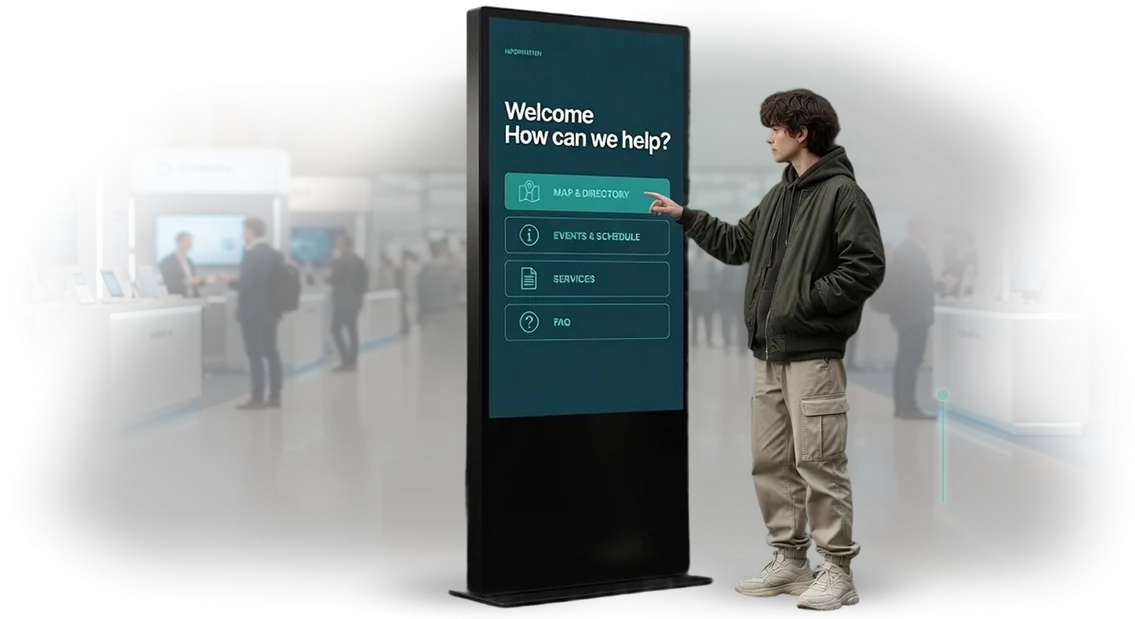
Why visitors get lost in the library and postpone their visit
For most visitors, a visit to the library begins with the hope of quickly finding the right book.
But in practice, the usual navigation cannot handle the load: confusing signs, unclear shelving logic, and lengthy catalog searches force a person to spend 10 to 15 minutes just to figure out where a publication is located.
If no result is found by that time, the visitor either leaves empty-handed or postpones the visit "for later."
This situation affects not only the reader's mood but also the library's key performance indicators. Unfinished visits directly turn into visitor churn: a person who did not get a quick answer will most likely choose an electronic version or another service next time.
Worse — they will share the negative experience with colleagues and friends, which reduces the library's reach and recognition in the eyes of the local community.
A separate pain point is long queues in the library. Even if a reader has found a book, they have to wait for checkout processing, and staff spend time on mechanical operations instead of live consultation.
During peak hours, the queue becomes an additional barrier that is especially felt by parents with children and the older generation — precisely the audiences most valuable for regular visits.
A modern visitor is used to getting answers in seconds — that's how the internet and mobile services work. Therefore, the key expectation from a library is the speed of book search and clear navigation that allows self-orientation without staff assistance.
This is where interactive information kiosks come to the rescue: they restore the reader's confidence and desire to return. We are ready to close this task turnkey — from scenario development to installation and support.
What the kiosk changes in working with readers
Readers come to the library with different requests: from "where to find a book" to "how to sign up for an event." Without prompts, they waste time, and staff answer the same types of questions dozens of times a day.
The information kiosk from our team removes this routine — readers find answers themselves, and staff focus on real tasks.
Self-navigation
The kiosk has a simple interface: floor map, schedule, shelves and racks. The reader immediately sees where the needed department is, how to get there, and opening hours. The search takes 1-2 minutes.
This reduces the flow of verbal questions and makes the library convenient for a first visit. A guest is not afraid of getting lost — they always know where to go.
Improved service and staff relief
Staff are freed from repetitive requests and engage in real work: consulting, helping in the hall, preparing events. Service quality rises, and employees don't burn out.
Visitor registration without queues
The kiosk registers visitors for events, renews books, and processes requests. The visitor enters data themselves — without queues or paper forms. The administrator receives the data immediately, which speeds up work.
Modern image of the institution
An interactive kiosk is a sign that the library keeps pace with the times. It makes an impression and increases attractiveness to a younger audience. The library becomes a place people want to return to and recommend to acquaintances.
Formats of information kiosks for libraries
Every library lives in its own space: one has a spacious lobby and high ceilings, another has narrow corridors and dense shelving.
Therefore, no universal kiosk exists — it's important to choose a format that fits the layout and tasks, so the device works like a full-fledged staff member rather than blocking the passage.
Below is a comparison of the main formats. Consider where visitors most often get lost: at the entrance, at the catalog, in the waiting area. We will help you choose a configuration for your space and place the kiosk so that it attracts attention without creating queues.
Main formats
| Format | Who it's for | What it gives the client |
|---|---|---|
| Floor kiosk | Libraries with a spacious lobby or open-access area | Free access to the catalog and navigation, high visibility, convenient for people with limited mobility |
| Wall-mounted kiosk | Small libraries, branches, children's departments | Saves space, visible from afar, doesn't block passage, easy to fit into the interior |
| Outdoor kiosk | Libraries with their own territory or a separate entrance | Works before opening and after closing, shows opening hours and event posters, accepts book returns |
| Lobby kiosk | Large libraries, scientific and city reading rooms | Organizes visitor flow, unloads librarians, helps visitors register at the library without a queue |
Choosing a format is not only a matter of aesthetics. It determines how quickly a visitor finds the right hall or book, how much time librarians spend on repetitive questions, and how comfortably mass events go.
A properly chosen kiosk pays for itself within the first weeks through staff time savings and reduced load on the circulation desk.
How the project goes: from brief to launch
We work according to a transparent process: you always know what stage the project is at and when you will receive the finished kiosk. Below are seven steps from the first brief to launch and ongoing support.
- Brief and immersion. You tell us about the library's tasks: what to show on the screen, who the users are, what scenarios are needed. We clarify the details and lock in the requirements.
- Prototype and project approval. We prepare an interface mockup and section structure. You see what the kiosk will look like and make edits before development begins.
- Development based on the approved prototype. We build the interface, logic, and admin panel, showing intermediate versions. Development stages are transparent: you control the progress and timelines.
- Integration with library systems. We connect the catalog, reader database, or accounting system — data on the kiosk updates automatically, without manual work.
- Testing and kiosk launch. We check scenarios on real equipment, fix any issues, install the kiosk in the library, and train staff.
- Handover and documentation. We provide access, instructions, and working materials. You receive a clear package — from startup steps to content updates.
- Support and development. We stay in touch after launch: we answer questions, update content, and refine features to match your tasks.
This process removes uncertainty: each stage ends with a clear result, and the kiosk launch is not delayed by hidden work.
What's included in the delivery and what you use right away
When you order an interactive information kiosk for a library, you get not just a device but a complete turnkey solution. We put the delivery package together so that the kiosk works the day after installation and staff don't have to figure out complicated technology.
Here's what's included in the basic package:
- Equipment and interface. A kiosk with a configured program: menu, hall navigation, event schedule, catalog search. Everything is already installed and tested.
- Admin panel for updates. You change the event poster, news, opening hours, and service list yourself without a programmer. A couple of clicks — and the information on the kiosk is up to date.
- Initial content setup. We help structure data about the library: halls, rules, contacts, announcements. You get a ready-made structure that's easy to expand.
- Staff instructions. Simple step-by-step guides: how to turn on the kiosk, how to update information, what to do if something goes wrong. A librarian can figure it out in a few minutes.
- Staff training. We hold a short session for librarians and administrators — showing how to work with the admin panel and handle typical situations without calling a specialist.
- Technical support. During the warranty period, you contact our team: we help remotely and visit on-site if needed.
The main thing you get is peace of mind: no need to hire a separate specialist or study code. Everything needed for launch is already in the package. From then on, the kiosk lives its own life: it attracts visitors, helps them find their way, and reduces the load on librarians. You focus on content, while the hardware and software simply work.
How the kiosk shortened the queue and boosted club enrollment
When Central City Library approached us, the problem was familiar to every staff member: in the evening and on weekends, a queue of 10–15 people formed at the registration desk.
Readers abandoned their requests halfway, parents didn't want to wait to enroll their children in clubs, and administrators spent time on the same questions instead of live work with visitors.
We proposed installing an interactive kiosk near the entrance that took over the most common scenarios: book search, renewals, club and event enrollment.
Through the screen, a visitor selects the needed service, enters their library card number, and gets confirmation within a minute — without staff involvement and without paper forms.
The launch results were visible from the first week. Average wait time at the reception dropped from 12–15 minutes to 2–3, the peak-hour queue no longer delayed visitors, and the number of club applications grew by a third.
Some people who had signed up for classes used to leave without waiting for an answer; now the kiosk accepts applications even when the administrator is busy.
An additional plus is staff relief. Employees stopped being a "reference desk" and focused on consultations: they help newcomers get a library card, recommend literature, and run club meetings.
The library itself can see through the control panel which services are in demand and prepare seats for popular classes in advance.
Six months later, the library ordered a second kiosk — for the children's department. The experience showed that even such a simple solution changes how an institution works, reduces queues, and makes club enrollment a natural part of the visit.
How to choose a kiosk format for a specific task?
Start with the task the kiosk should solve in your library: quick book search, hall navigation, self-service library card registration, or an event poster.
The format depends on this: one scenario needs a compact stand at the entrance, another needs a large touchscreen in the catalog area.
If speed and simplicity are the priority, a minimal configuration is enough, while an interactive map of the collection requires a wider panel with convenient navigation.
Think about who will use the kiosk: children, adults, or visitors with limited mobility — this determines screen height and font size.
Kiosk placement determines the construction and stability. At the entrance, it should not interfere with visitor flow; in a quiet area, it should not create noise; and next to the registration desk, it should complement the librarian's work rather than duplicate it.
Plan access to a power outlet, lighting, and space for a queue in advance: even the best interface loses value if visitors can't approach comfortably. A floor model suits a spacious lobby; a wall-mounted model suits narrow corridors and space savings.
The project budget is best assessed not by the equipment price but by the payback period and benefit to readers. Start with two or three key functions that will reduce queues or simplify searching.
This lowers the launch cost, and functions can be added later without replacing equipment. It's important that the software lets your staff update content themselves: schedules, new arrivals, and the event poster can be changed in-house, without contacting developers.
Finally, check that the kiosk format fits easily into your interior and corporate style. The body color, screen size, and mounting method affect how readers perceive the space.
We select a configuration for the specific task and premises, and after launch we provide support and scenario refinement so the kiosk remains a useful tool rather than just an eye-catching stand.
Ultimately, the right format is a balance between task, space, and budget. If you're unsure, send us your floor plan and scenario descriptions — we'll help you choose an option you won't need to redo in a year.
Answering common concerns
We understand: an information kiosk in a library is equipment that visitors rely on, and any malfunction raises questions. That's why our team takes on all the risks: we select reliable hardware, support the project after launch, and stay in touch.
What happens if the kiosk breaks down?
The kiosk runs on professional equipment, and a remote monitoring system tracks its condition — we learn about most issues before they affect visitors. If something does fail, technical support solves the problem remotely or promptly visits the site.
While repairs are underway, we provide a replacement kiosk so the library's service is never interrupted.
Is it difficult to update content?
No, updating takes a few minutes and doesn't require a programmer. A library employee logs into a simple control panel and changes the event poster, schedule, or news. Access rights are configurable: one person is responsible for events, another for the section structure.
Is the kiosk protected from hacking and vandalism?
Yes, protection is designed on two levels. On the software side, the kiosk runs in a restricted mode: visitors cannot access system settings or install third-party programs. On the physical side, the housing and screen are built for intensive use in public spaces.
Will we have to train staff?
Training takes a couple of short sessions: we show how to operate the kiosk, change content, and respond to typical situations. Staff get the hang of it quickly, and we also leave a reference sheet. After that, we help by phone and messenger.
After launch, we don't disappear: scheduled maintenance, consultations, refinements — everything is included in the support package. The kiosk works reliably, and you focus on the library, not the technology.Order a consultation about a kiosk for your institution
Leave a request for a kiosk — and within one business day we will prepare a cost estimate, implementation timeline, and format recommendation. The consultation is non-binding: you get transparent numbers and concrete options, and the decision stays with you.
We work with libraries of all sizes — from small district branches to regional and university libraries. That's why, even before design, we can tell you which kiosk type will cover your tasks: floor, wall-mounted, or a compact stand. We'll take into account visitor numbers, lobby area, premises specifics, and development plans.
What you get after the consultation:
- Kiosk format selection matched to your tasks and library space.
- Cost calculation — final, without hidden fees or fine print.
- Development, delivery, and launch timelines aligned with your plans.
- Content recommendations: library map, event poster, electronic catalog, navigation.
- Examples of completed projects for libraries and similar institutions.
- Answers to questions about integration, maintenance, content updates, and warranty.
The kiosk request takes a couple of minutes — write to us through the form or via messenger. We'll reach out at a convenient time, clarify the details, and prepare a tailored proposal for your institution.
Let's start with a consultation — after that, you'll make decisions based on experience and numbers rather than guesswork. And on our side, we'll do everything to make the kiosk a working tool for visitors and an assistant for your team.