

A pharmacy customer is lost without a consultant — how to keep them at the counter?
Imagine a pharmacy at rush hour. A line at the cash register, the pharmacist answering questions, and a customer standing alone at the display with dozens of products, unable to decide what to choose.
They don't want to wait, are embarrassed to ask, and end up leaving without buying — or buying the first thing they see and then feeling disappointed.
Losing a customer at that moment means lost revenue and a blow to reputation. Without a prompt nearby, a person relies on memory, price, and random reviews — and that rarely leads to an informed choice.
Retaining a customer starts with giving them clear, fast help at the right moment — help that doesn't depend on how busy the staff is.
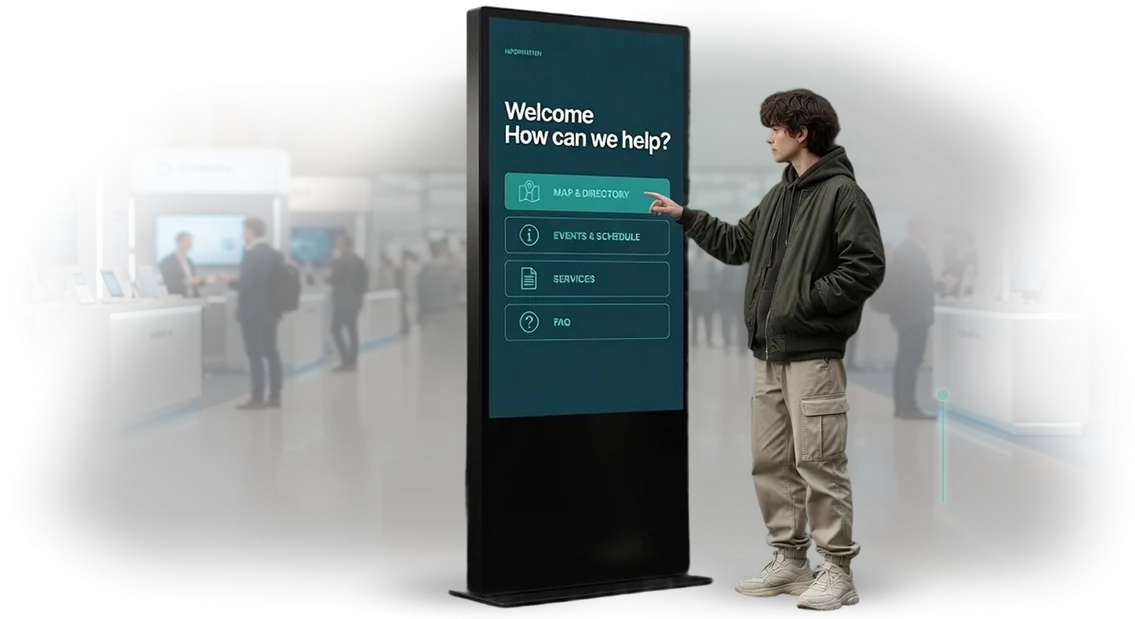
An interactive kiosk works as a "second consultant in the pharmacy." It doesn't argue with the pharmacist — it relieves them: it points out where the needed product is, compares alternatives, and explains the difference in dosages and forms.
The customer finds the answer in a couple of taps, feels confident, and stays at the counter instead of leaving to search for information on their phone.
The kiosk doesn't take vacations or get tired: at peak hours it takes the load off staff, and in quiet times it becomes a navigator and reference guide. The guest gets convenience; the pharmacy gets more considered purchases and a reason for repeat visits.
We design such kiosks around the tasks of your location: from simple navigation to choosing over-the-counter products.
What tasks does an interactive kiosk solve in a pharmacy?
A pharmacy visitor often doesn't know about new products, promotions, and related items, and the pharmacist doesn't always have time to tell them. As a result, the pharmacy loses sales, and the customer leaves with a smaller basket than they could have had.
An interactive kiosk fills those gaps and works as an extra consultant that never gets tired and is available at any moment.
We develop such kiosks for pharmacies and know what tasks they really solve. Here are the main ones:
- Higher average ticket. The kiosk offers promotional items, related products, and care products that the visitor wouldn't have noticed on the shelf. The person buys more because they learn about products in time.
- Greater visitor loyalty. Through the kiosk, customers can check their bonus balance, book an appointment with a doctor, or get information about the loyalty program. The customer feels cared for and returns to the pharmacy again.
- Product information. A catalog with descriptions, prices, and availability is available with one touch. No line to the pharmacist, no confusion — the visitor finds what they were looking for and sees what could complete their purchase.
- Relieving the staff. The kiosk handles routine questions like "something for a headache" or "where to find vitamins" — the pharmacist focuses on complex requests that require their qualifications.
- More sales through navigation. An interactive floor map and category search help customers quickly find the right department. The visitor doesn't leave without buying anything just because they couldn't find the product.
Importantly: the kiosk doesn't replace the pharmacist — it strengthens them. The visitor gets fast access to information; the pharmacy gets extra revenue and data on what really interests customers. This makes it possible to adjust the assortment and promotions and make sales predictable.
Formats of information kiosks for pharmacies and sales floors
Choosing a kiosk format isn't about dimensions — it's about what task it solves. In a pharmacy, a visitor needs to quickly find a product, learn about contraindications, or place an order, while staff need to reduce the line and avoid spending time on repetitive questions. Different configurations handle these tasks differently.
We select the device for your floor, foot traffic, and assortment. Below is a comparison of the main formats we install in pharmacies and health stores.
| Format | For whom and what spaces | What it gives the customer |
|---|---|---|
| Floor-standing kiosk | For spacious halls with a large flow of visitors | Relieves front-counter pharmacists: the customer finds the product, reviews the instructions, or places an order for an out-of-stock item themselves. Speeds up service and reduces lines |
| Wall-mounted kiosk | For small pharmacies, narrow spaces, and economical floor plans | Takes up minimal space while offering the same functions: drug search, stock and price check, discount coupon printing. Helps visitors find their way without staff assistance |
| Countertop touch terminal | For consultation zones at the prescription counter | Lets the pharmacist clearly show on screen a comparison of alternatives, a dosage schedule, and drug information. Speeds up consultations and increases customer trust |
This isn't a rigid classification: to match your tasks, we combine formats and place them in different zones of the hall. The main benchmark is that the customer quickly gets the information or product they need, and the staff saves time on routine.
How we implement an interactive kiosk: 7 project steps
Our clients — pharmacy chains and individual locations — often ask how implementation goes and what it requires. Our answer: the process is transparent, takes two to four weeks, and requires almost no manual work from your team. Here's what the project looks like from the first call to a working kiosk and support.
-
Brief — a short meeting with you to define the kiosk's tasks: drug search, hall navigation, medication ordering. We record the goal and the desired launch date.
-
Concept and prototype — in 2-3 days we show the screen structure and the working logic. You see how a customer will find a medication and make edits before development starts.
-
Cost estimate and approval — we fix the scope of work, cost, and timeline in the contract. No hidden stages and no surprise surcharges — only a clear plan.
-
Development and content — we set up a catalog with prices and stock and integrate the kiosk with your accounting system. Your involvement is to provide a catalog file or access.
-
Testing — we test customer scenarios: searching for a drug by name or active ingredient, checking availability, displaying alternatives, navigation to the shelf. You confirm the result.
-
Launch and training — we install the kiosk in the hall and conduct a briefing for front-counter pharmacists so they can help visitors in the first days.
-
Support — we stay in touch after launch: we update the assortment, refine features, and quickly resolve the pharmacy's issues.
What is included in the delivery of an interactive kiosk
When you order an interactive kiosk from us, you get a ready-made turnkey solution. You won't have to assemble it piece by piece from different contractors — equipment, design, software, and content are delivered as a single project.
- Equipment. A touch kiosk in a durable housing, selected for the pharmacy's conditions. Dust- and moisture-resistant construction, protection against accidental damage — the hardware works reliably under any flow of visitors.
- Design and branding. An exclusive interface layout in the pharmacy's corporate style: your colors, logo, and fonts. The customer recognizes the pharmacy from the first screen — this builds trust and increases brand recognition.
- Software. An installed and configured kiosk management system. You can change promotions, prices, news, and product photos without involving programmers — through a simple control panel on a computer or tablet.
- Initial content. Ready-made sections: a drug catalog with prices, a list of promotions and discounts, the loyalty program, contacts, and a route map. Content is prepared for your pharmacy before launch, so the kiosk starts delivering value on the first day.
- Documentation and training. Clear instructions for staff and a short training session for administrators. Employees quickly learn how to update information and help visitors.
- Installation, commissioning, and warranty. An engineer will deliver, install, and connect the kiosk and check all functions. Hardware and software are covered by a warranty, and prompt consultation is available through the support channel.
All components are aligned with each other and ready to work immediately after installation. You receive a single document with the delivery list and the responsibility of one team — no intermediaries and no hidden surcharges.
Real case study: sales growth with a kiosk
The "Healthy City" pharmacy chain faced overload during peak hours: pharmacists spent time consulting on standard products, while customers with prescriptions waited in line. This led to losing up to 15% of visitors — people simply walked to a competing pharmacy nearby.
To solve this, we developed an information kiosk that combined an over-the-counter drug catalog, stock checks, and an electronic queue. Most questions are resolved without a pharmacist, and prescription dispensing became faster thanks to reservation.
Results from the first two months of operation:
- Conversion from visitor to buyer grew by 23% — customers who used the kiosk reached the cash register more often than those who went straight to the counter.
- The average ticket increased by 17%: the system suggested related products for the selected medication.
- Waiting time in line was cut by almost three times, which matters especially during morning medication hours.
Additionally, 40% of customers used the kiosk again — the pharmacy gained a loyal audience accustomed to the new format. Because the kiosk didn't require a dedicated employee, the solution paid for itself in four months and was installed in five more locations of the chain.
This case is an example of how an interactive kiosk solves not only service tasks but also directly affects revenue. If you want the same numbers in your pharmacy — we're ready to discuss your project.
Answers to frequently asked questions about kiosks
Implementing an interactive kiosk means new scenarios in the pharmacy: selecting alternatives, drug search, self-service booking to see a pharmacist.
But before making a decision, owners and managers ask the same questions: how will this work under real load, who is responsible for uptime, and how long until the kiosk pays off. Below are answers to the most common objections.
How reliable are such kiosks? A pharmacy works around the clock
We build kiosks on professional equipment designed for 24/7 operation. These are not consumer tablets but industrial housings and server-grade components — they withstand constant load and voltage fluctuations.
In addition, the software can self-recover after failures and reboot into a working state. As a result, the kiosk runs stably at peak hours and doesn't need daily attention.
What happens if the kiosk breaks down anyway?
We provide a warranty on the hardware and software and also take the kiosk into service maintenance. The contract specifies engineer response times — usually arrival within one to two business days, and if the issue is in software, we resolve it remotely within a couple of hours.
During repairs, we provide a replacement device so the pharmacy doesn't lose its sales funnel. All data about the kiosk's operation is saved and doesn't disappear during failures.
How quickly will the kiosk pay off?
The kiosk doesn't just replace part of the pharmacist's routine operations — it increases the average ticket through cross-selling and product reservation. A visitor can review all promotions, find a cheaper alternative, and go straight to purchase.
This reduces staff load and increases the pharmacy's throughput. With reasonable traffic, the payback period ranges from several months to six months — we calculate an accurate forecast at the audit stage after the brief.
Who will train staff and visitors?
Pharmacists learn during one short briefing, and the interface is designed to be intuitive for visitors — large buttons, hints, voice guidance. We also place a short "how to use" instruction right on the kiosk so people don't have to ask staff.
If needed, we conduct a training session for employees right in the pharmacy and provide methodical materials that are easy to pass on to new staff.
If we haven't addressed your question — leave a request for a consultation. We'll explain how a kiosk fits into your current processes, calculate the load, and show examples of working projects in other pharmacies.Order development of an interactive kiosk for your task
Customers don't want to buy a "box with a screen" — they need a tool that speeds up service, raises the average ticket, and frees up pharmacists' time.
That's why we don't offer template solutions: each kiosk is designed for a specific pharmacy — your display, your assortment, your sales scenarios.
Fill out a consultation request — we'll explain how an interactive kiosk fits into your business and what to consider before you start. After your order, you get:
- A tailored solution — the catalog structure, design, and kiosk logic adapt to your assortment and the pharmacy's specifics.
- Clear timelines and stages — you always know what's happening with the project and can influence the result before launch.
- Staff training — your employees quickly learn to work with the kiosk and help customers instead of spending time on issues.
- Post-launch support — technical assistance and updates so the kiosk works reliably and requires no extra care from you.
- Refinements for your tasks — we'll add loyalty programs, pharmacist hints, or custom scenarios — everything your business needs.
- Fast start — minimal time from consultation to a working kiosk; you don't lose sales.
Leave a request — we'll call back within one business day, answer your questions, and offer a solution for your pharmacy. An individual approach and honest consultation start with the first step.
How to choose the right kiosk format for your business?
Choosing a kiosk format starts not with design but with the question: what task should it solve in your pharmacy? If the goal is to reduce the line at the front counter and let visitors find drug information on their own, one configuration fits. If you need to order a rare medication or launch a loyalty program — quite another.
A floor-standing kiosk is the choice for spacious pharmacies with high traffic. It lets you organize a full self-service zone: a visitor can check availability, study instructions, go to the shelf, or immediately place a delivery request.
This format is highly visible, doesn't feel cramped, and takes over part of the pharmacist's functions, freeing up time for face-to-face interaction.
A wall-mounted kiosk saves space and is ideal for small outlets or convenience pharmacies. It doesn't block the aisle, doesn't require a dedicated zone, and handles targeted tasks: showing a price, checking stock, displaying promotion information.
It's a practical option when the checkout area is already busy and you still want to give customers a self-service tool.
The main advice when choosing is to start from your customers' behavior. Estimate approximate foot traffic, note the peak hours and the typical questions that repeat day after day.
The kiosk should answer those questions without staff involvement, not just stand there as an advertising display.
Also consider placement logistics: the device shouldn't obstruct movement, should be comfortable for people of different heights, and should fit easily into the existing interior.
And one more thing: you don't have to choose strictly between the two options. Many pharmacies start with a wall-mounted model and then install a floor-standing one as traffic grows.
We design both types and help you select the right configuration for your floor area, assortment, and tasks — so that the kiosk pays off through real value for customers and relief for staff.