

Is Your Exhibition Center Losing Visitors Because of Navigation?
A visitor to an exhibition center first wants to quickly understand where to go and where things are.
If navigation is not obvious — there is no clear map at the entrance, signs contradict each other, and staff do not always know the location of halls — the guest spends time wandering, misses important booths, and gets annoyed.
This is especially critical during large forums, when dozens of sessions and meetings run simultaneously. Such an experience is memorable: instead of value and impressions, a person leaves with a sense of chaos and next time chooses a different venue.
For the owner and manager, this translates into measurable losses. Average dwell time drops — visitors walk past fewer booths, meaning exhibitors get fewer contacts and are reluctant to renew their leases.
The business program also suffers: sessions and negotiations start late, and some guests never find the right hall. Improving attendance starts not with additional advertising, but with how comfortable it is for a person to navigate the space. Navigation directly affects the image: chaos in the halls reflects on the organizer and tenants.
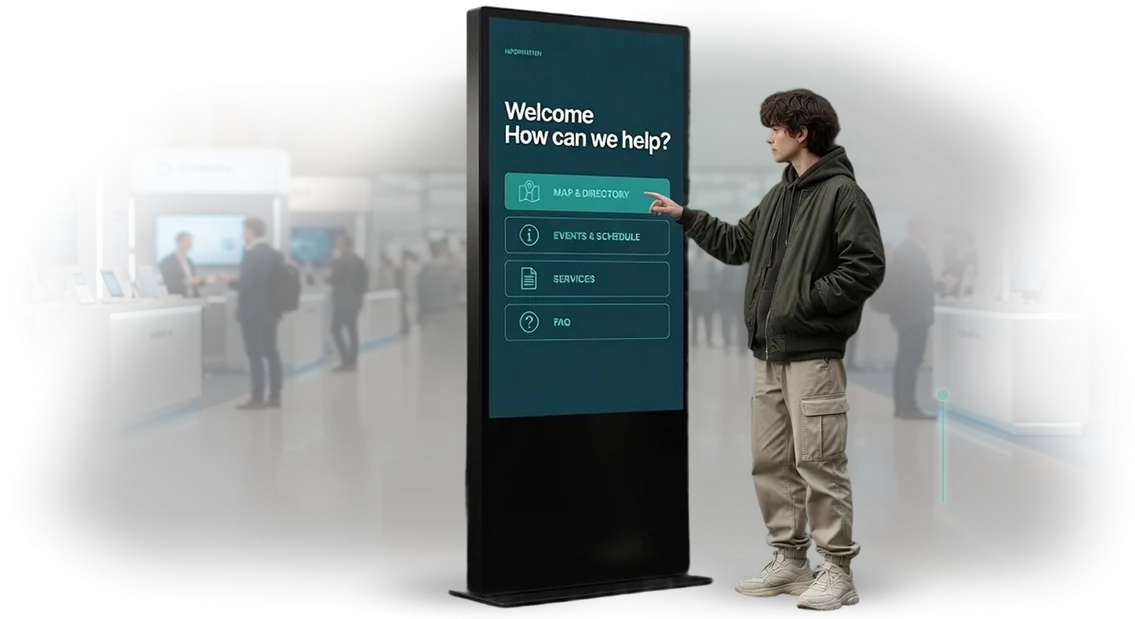
Interactive kiosks for exhibitions solve this problem systematically. The guest sees a map of the center on the screen, plots a route to the desired booth or hall in seconds, and gets the current event schedule — without queues or extra load on staff.
Navigation in the exhibition center becomes intuitive, and the visitor spends time on useful contacts and impressions instead of searching. We help exhibition centers implement such kiosks turnkey: from scenario design to launch and support.
This addresses the problem of losing visitors, increases their engagement, and makes the center comfortable for repeat visits.
What an Interactive Kiosk Will Give Your Space
An exhibition center visitor faces dozens of questions: where is the right pavilion, when does a session start, where to grab a bite. If only staff answer them, queues form, guests waste time, and employees get distracted from their core tasks.
An interactive kiosk removes this burden: the guest finds the route, schedule, and exhibitor information in a couple of touches.
That is the main advantage of touchscreen kiosks — instant help without human involvement. The visitor feels cared for, and your team gains hours for conversations with key clients.
Visitor engagement grows: the interactive format holds attention many times longer than static signs or banners. People explore the material at their own pace, return to it, and more willingly share impressions.
For the brand and marketing at an exhibition, the kiosk works like a live showcase. On its screen, you can show videos, case studies, and special offers — and change content to suit the day's audience or a specific event.
Bright design and gamification attract attention, and a photo or quiz feature encourages social media posts. In this way, the space gets additional reach even before the guest approaches the counter.
Another result is contact collection and attendance tracking. The kiosk can ask visitors to leave an e-mail or Telegram in exchange for useful material, and also record the number of touches by section.
You see which topics generate interest, how many people actually moved through the space, and when peak load occurred. This data helps plan events, optimize flows, and improve the next scenario.
Ultimately, an interactive kiosk solves three tasks at once: it increases guest comfort, strengthens the brand, and collects data for growth.
The investment in the device pays off through savings on staff, increased loyalty, and a greater number of interested contacts after the exhibition.
Kiosk Formats for an Exhibition Center
The choice of an interactive kiosk format directly affects how visitors interact with the exhibition and how efficiently the space works.
There is no one-size-fits-all solution — different scenarios are needed for the entrance area, pavilion navigation, and in-depth exploration of exhibits.
We have worked through the typical tasks of exhibition centers and selected the optimal format for each. Below is a comparison to help you plan equipment purchases and zone layout.
| Format | Where it works | Visitor's task | Benefit for the center |
|---|---|---|---|
| Floor-standing kiosk | Entrance area, lobby, registration zone | Quickly get a pass, find the right pavilion, explore the map | Reduces load on the administrator's desk and reception queue |
| Wall-mounted information panel | Corridors, passages between pavilions, elevator lobbies | Navigate the flow, understand where to go next | Helps distribute visitors evenly and reduces the number of questions to staff |
| Touch table for exhibitions | Exhibition halls, partner zones, thematic clusters | Study exhibit details, browse the catalog, view 3D models | Increases time spent at the booth and depth of engagement with the material |
If the main task is to greet guests and provide quick navigation, floor-standing kiosks and wall-mounted panels work better: they are visible, easy to use, and do not create queues.
When you need to hold attention at a specific exhibit or partner booth, a touch table offers more possibilities — people can approach it as a group, view content from different angles, and return to it repeatedly.
By combining these formats, you cover the full interaction cycle: greeting, orientation, and immersion in the material. We, in turn, handle interface development and scenario tuning for each placement point — all you have to do is set priorities and approve the mockups.
How We Create a Kiosk: Stages of Work
Here we explain how the work proceeds so you understand what happens at each stage. We handle the entire process — from the first call to launch and support. Turnkey kiosk development follows a proven scheme where decisions are made together with you, not secretly. Below are the stages of interactive kiosk implementation.
- Brief and immersion in the task. We study the exhibition's goals, visitor profile, and movement scenarios. This determines the kiosk structure: which sections to search, what data to show on the main screen.
- Aligning navigation and scenarios. We propose a convenient logic — from the main menu to a specific answer. You approve the structure before development starts, which eliminates costly rework.
- Branded design mockup. We draw the kiosk's appearance, select colors, fonts, and element layout. You see the future interface in advance and can make changes before launch.
- Development and content population. We build the interface, upload texts, maps, photos, and videos — everything is tested on the actual screen. The kiosk begins to work as a single product.
- Installation and connection. We install the kiosk in the right spot, configure the screen, touch controls, and network. We do everything carefully at an agreed time, without disrupting the exhibition.
- Testing and staff training. We run all scenarios: search, transitions, information updates. At the same time, we give your employees a short briefing — they can easily help visitors.
- Launch and support. We hand over the kiosk for operation and stay in touch. We will update content, fix navigation, or resolve a technical issue — you send a request, we take it into work. We provide a warranty on the solution and equipment.
What Is Included in the Kiosk Delivery
When you order a turnkey kiosk, it is important to understand that you get not just hardware and software, but a fully ready solution that can be plugged in and put to work.
We handle all stages — from mockup development to final setup — so you do not have to coordinate contractors or deal with technical details.
Here is what is included in the standard delivery:
- Equipment package — a touchscreen kiosk with a housing protected from external influences and a screen selected for your venue's conditions. You receive a device that works reliably even under high foot traffic.
- Software — an interactive system with a clear interface that launches automatically and does not require constant supervision. The software is developed for your tasks: map, catalog, navigation, surveys, or any other scenario.
- Interface design and housing branding — we design the interface in your brand's style and, if necessary, apply the logo or corporate colors to the housing. The kiosk becomes not just a stand with a screen, but a navigation element and part of the overall style of the space.
- Installation and commissioning — we deliver, install, connect, and verify operation on site. Floor-standing models include floor mounting, wall-mounted models include reliable fixation to a wall or stand.
- Staff briefing — we briefly show how to turn the kiosk on and off, change content, and handle typical visitor questions.
- Warranty and support — after launch, you are not left alone with the equipment. We help update materials, and if necessary, repair or replace equipment.
This format saves your time: instead of multiple contracts and lengthy approvals, you get a single result from one contractor.
All components are coordinated with each other, and responsibility for the kiosk's operation lies with us — so the risk of failures and delays is minimal.
Case Study: How Kiosks Increased Engagement at an Exhibition
Visitors walk past an exhibition booth within seconds if they do not see anything eye-catching. Even a bright display does not hold attention, and after the event the team collects only dozens of contacts.
The problem is not the exhibits but the presentation — without interactive engagement, interest fades before it even appears.
We solved this task for the Expopark exhibition center at a modern technology exhibition. We installed information kiosks at the entrances to the halls and next to key exhibits.
Instead of a dull map, guests got a live navigator: they selected a topic, built a route, opened details, watched video, and left a contact in one click to receive materials.
Measurable Effectiveness
The effectiveness of the interactive kiosks was confirmed by numbers in the first week. Average time spent at a booth tripled, the number of contacts collected increased by 70%, and one and a half times more visitors reached the far halls.
For the organizers, this meant greater interest in the exhibition without additional advertising spend: people chose what to study themselves and stayed longer.
The kiosks also collected useful statistics: which exhibits attracted attention, at what hours traffic was highest, which topics raised questions. This data made it possible to adjust booth operations the very next day and improve conversion into contacts.
The interactive kiosks paid for themselves at the first event — the client ordered a content update and expansion of the network for the next exhibition. This implementation case shows that the right presentation turns casual visitors into an interested audience.
What If You Have Specific Requirements for the Kiosk?
Yes, and this is our usual practice. Exhibition centers rarely settle for a standard solution: they need a non-standard design, a special location, or integration with your booking system. We specialize in custom kiosk development for specific tasks — not forcing tasks into a template.
Everything begins with your tasks, not with equipment specifications. The kiosk can show an exhibition map, accept applications for the business program, conduct surveys, or serve as a showcase with a schedule.
We will propose a functional solution that fits your processes and requires no extra effort from visitors.
Non-standard execution concerns not only software. It also includes the housing shape for your exhibition, materials, and screen behavior scenarios — from attention-attraction mode to in-depth help.
We think in advance about where the kiosk will stand, how people of different heights approach it, and how technicians service it.
Our experience includes more than a hundred projects for exhibition venues and events. We have encountered a variety of requirements: from multilingual interfaces to synchronization with online schedules.
Therefore, we are not afraid of non-standard tasks and offer a solution that actually works, not just looks modern.
In the end, you get a kiosk that solves exactly your task: it helps visitors navigate, collects demand data, and improves the impression of the venue. Let's discuss your case — we will show what a custom project looks like in practice.
Common Doubts When Ordering a Kiosk
Managers of exhibition centers rarely ask about technical details. They worry about something else: will the kiosk fail on opening day, who takes responsibility for a malfunction, how quickly operations will be restored.
These doubts are understandable — an interactive kiosk greets the visitor first, and the impression of the entire exhibition depends on it.
That is why we remove risks already at the contract stage: we record warranty obligations, a service schedule, and the procedure for emergencies.
Most often, clients worry about three things: equipment reliability, after-sales support, and the complexity of integration with the exhibition center's existing services. For each point, we provide written agreements rather than general promises.
The average device replacement time is one day, and during repairs we provide a replacement kiosk with the program already configured.
What warranty comes with the kiosk and what does it cover?
The warranty covers the housing, touch panel, and control module. You receive a certificate with the terms and a list of all components. If a fault occurs during the warranty period, we repair or replace the kiosk at our expense.
Who will service the kiosk after launch?
We assign an engineer to the project. He remotely monitors the condition of the devices, and in the event of a malfunction, arrives at the site — the average response time is 4 hours.
For large-scale events, we are on duty at the exhibition center to resolve issues before they become noticeable to visitors.
Integration does not fall on your team's shoulders. We test the integration with your systems in advance, train administrators, and prepare short instructions for staff. As a result, you get not just a kiosk, but a predictable service that withstands peak loads and does not let you down on the most important day.Get a Cost Estimate for Kiosk Development
Leave a request for an estimate — in response, we will prepare a cost estimate that takes into account the specifics of your exhibition center: the number of halls, visitor flows, event formats, and the need to connect the kiosk to the complex's overall navigation. This comes with no obligation.
Within two to three business days, we will conduct a preliminary assessment of the project: we will suggest suitable interactive kiosk formats, screen compositions, navigation logic through the exhibition, and design options matching your corporate style.
We will also show examples of solutions for other exhibition venues so you can understand how it will work for you.
What you get when you contact us:
- Consultation with a designer and engineer — together we will break down the task and determine the optimal kiosk format: floor-standing, wall-mounted, or mobile stand.
- Preliminary cost estimate broken down by stages — you know the budget before work starts, with no hidden extras or "surprise" tasks.
- Timeline assessment tailored to your calendar: we will calculate when the kiosk will be ready so you can launch it in time for your next major exhibition.
- Project examples for exhibition centers — we will show which interfaces increase visitor engagement and which, on the contrary, create queues.
- Recommendations on content and structure: how to present the event program, hall maps, and special offers so that guests use the kiosk more often and ask staff for directions less often.
- A clear action plan: you will receive a list of data needed from you to start development — nothing will be left to guesswork.
To get an estimate, fill out a short form: the organization name, a contact phone number, and a couple of sentences about the task are enough. We will contact you within one business day, clarify the details, and prepare an individual proposal for your exhibition center. This is not a template response, but a thoughtful assessment tailored to your venue.