

Dental clinic losing patients without an interactive kiosk?
Queues at the dental clinic reception desk are a familiar sight — and the reason a clinic loses patients. While a person waits to book an appointment with a doctor, they either get irritated and leave, or they look for another clinic with a more convenient booking process.
Every such departure is not just a lost appointment, but also a negative recommendation to friends and family.
Patients judge the clinic from the threshold: long waiting, unclear where to go, who's next. As a result, even good specialists cannot save the situation, because the first impression is already ruined.
The administrator is overloaded, answers phone calls, gets distracted, which only makes the queue grow. This is a vicious circle that directly hits revenue and reputation.
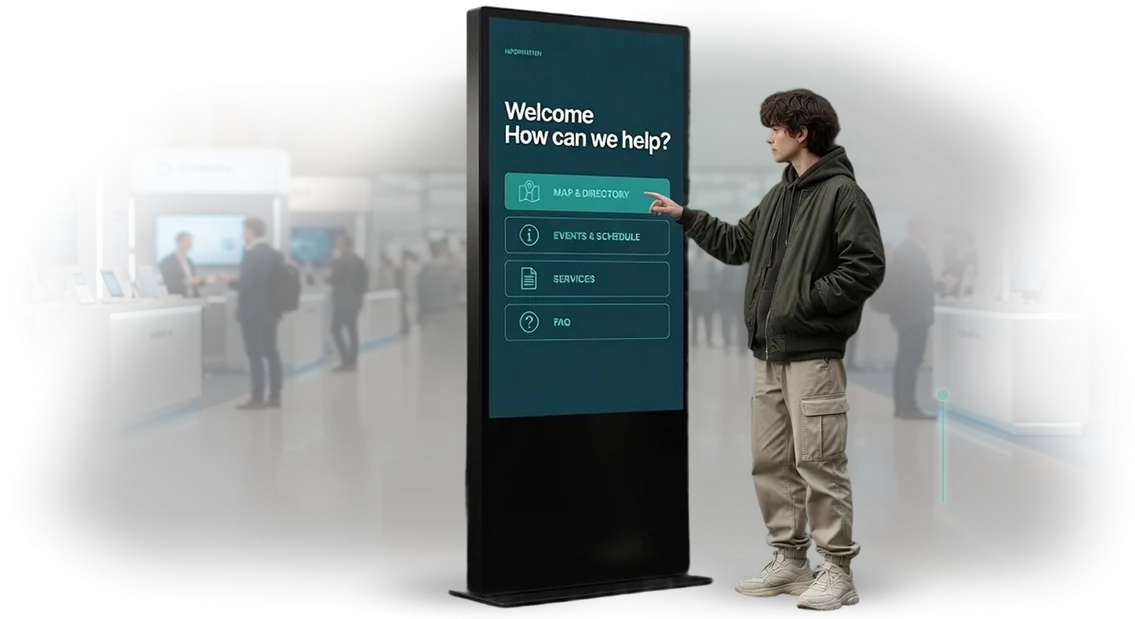
An interactive kiosk at the entrance removes the main point of tension. The patient selects a service themselves, sees the specialist's available time, and books an appointment with a doctor in a couple of screen touches — without waiting or involving the administrator.
The kiosk will tell them which office they need and guide the patient so they don't get lost in an unfamiliar space. The dental clinic gets a calmer atmosphere at the front desk, and staff can focus on patients instead of endlessly repeating the same information.
We develop interactive kiosks for dental clinics turnkey: from scenario to installation. We help eliminate queues, simplify appointment booking, and make patients choose your clinic over competitors.
Such a kiosk pays for itself through patient retention and increased loyalty — people come back and recommend the clinic to friends.
What an interactive kiosk gives patients and your team
A dental clinic patient comes not for "service" but for results and peace of mind. The interactive kiosk helps from the very first step: it shows navigation around the clinic, suggests where the right office is, and reminds about the appointment schedule. Instead of confusion, the person gets a clear route and a feeling of being taken care of.
Booking an appointment with a dentist via the kiosk takes less than a minute — no queue at the reception desk and no long phone clarifications. The patient sees available slots themselves, chooses a convenient time, and immediately gets confirmation. For busy people, this is the decisive argument to choose your clinic.
The team also gets a visible result: administrators stop answering dozens of repetitive questions like "where is the office?" and "how do I book?". The freed-up time goes into personal interaction with patients, paperwork, and non-standard situations. The load on the reception desk drops, while service speed noticeably increases.
An additional bonus is loyalty. The patient remembers a place where it was easy and clear, recommends the clinic to friends, and returns themselves. A modern kiosk becomes a sign that the clinic is developing and respects visitors' time.
In the end, the kiosk benefits both sides: patients get confidence and control, the team gets a lighter workload for administrators and more opportunities for quality service. And that is a direct path to more repeat visits and a good reputation.
Which kiosk formats suit a dental clinic
A dental visitor arrives with tension: they are worried about the upcoming treatment, not about figuring out the clinic's layout. That is why a kiosk for dentistry should remove these concerns — help patients navigate, book, fill in documents, and get to the chair faster. For the clinic, this is both care for patients and relief for administrators.
Kiosk formats depend on the tasks: one can replace the registration desk, another can become a floor navigator.
We select scenarios for a medical center based on the clinic's floor area, visitor flow, and service zones, so the equipment pays for itself from the first weeks of operation.
| Kiosk format | For whom | What it gives the clinic |
|---|---|---|
| Self-booking kiosk | Patients who have already chosen a doctor | Reduces the reception queue, the administrator handles complex questions |
| Clinic navigation | New patients, people with limited mobility | Fewer late arrivals to appointments, calmer atmosphere in the lobby |
| Questionnaires and consents | Patients before treatment | Documents are filled out without errors, data goes straight into the system |
| Reviews and feedback | All visitors after the appointment | More recommendations, visible service improvement points |
We implement kiosks on professional equipment — with reliable sensors and protected housing, which is critical for medical institutions. We supplement the software with an intuitive interface: large buttons, a mode for the visually impaired, several languages.
The patient chooses the needed scenario themselves, and the clinic gets analytics on office occupancy and service popularity.
The bottom line: a properly chosen kiosk format is a working tool, not lobby decoration. It reduces staff workload, speeds up service, and increases patient loyalty. Tell us about your clinic — we will suggest a format that fits your specific tasks and patient flow.
How we launch an interactive kiosk turnkey
An interactive kiosk is not just a screen in the lobby. It is a tool that relieves the administrator and helps patients quickly book an appointment or get the information they need.
To make it work from day one, we build a clear process: you make decisions at key points, and we handle all the technical part.
- Brief and task analysis. You tell us about patient flows, popular services, and the questions most often asked at the reception desk. We propose a scenario that addresses your specific tasks — from booking to clinic navigation.
- Design approval. We prepare mockups in the clinic's style, showing the menu structure and button layout. You approve the visual solution before development starts — the interface immediately looks like part of the space.
- Development and content. We build the operating logic, upload information about doctors, prices, promotions, and services. At intermediate stages, you see how the kiosk will look and work in reality.
- Launch and training. We install the kiosk in the lobby, test scenarios with real visitors, and make final adjustments. In parallel, we train the staff: how to help a patient with booking and how to update content independently.
- Support and refinements. After launch, we stay in touch: we update schedules, add services, and change scenarios for new promotions. The kiosk is never left without support — you get a reliably working tool.
With this process, you control the result, not the process. The kiosk launches quickly, works reliably, and continues to benefit the clinic — without your constant involvement in technical details.
What is included in the interactive kiosk delivery
When ordering a kiosk, it is easy to imagine it is just a screen on a stand. In reality, a solution that actually generates inquiries is a combination of equipment, software, content, and support.
We put together the delivery package as a ready-to-use tool for your clinic, so you do not have to finish or buy anything extra.
- Equipment: housing and touch screen that fit the lobby interior and are designed for continuous operation throughout the day.
- Software: a main screen with office navigation, service list, prices, and a booking form — styled to match your clinic.
- Pre-installed content: section structure, texts, and photos are prepared for your services and promotions, so the kiosk can be launched without lengthy preparation.
- Control panel: the administrator updates promotions, prices, and news independently — without involving a programmer or contractor.
- Booking integration: the kiosk connects to your patient booking system, shows available slots, and sends new inquiries to the shared database.
- Kiosk installation: we deliver the device, install it at the right spot in the lobby, connect it to the network, and test all scenarios — from navigation to booking.
- Staff training: a short training session for administrators and managers: how to accept inquiries, change content, and resolve minor issues on the spot.
Installation takes one day, training takes a couple more hours. After that, the kiosk is fully ready to work: patients navigate the clinic faster, staff are not distracted by endless questions, and booking proceeds without the administrator's involvement. You get not just a device, but a working channel for inquiries from day one.
Case study: how an info kiosk eliminated queues at the reception desk
A dental clinic network with several branches approached us with a typical pain point: the reception desk was overwhelmed during peak hours.
Patients called but could not get through, arrived without appointments and stood in live queues, administrators wasted time repeating the same information instead of working with visitors. We suggested starting with a pilot project — implementing an info kiosk in the busiest branch.
What changed after launch
The result was noticeable within the first weeks. The average time to complete a visit dropped from 7 to 2 minutes — the patient selects the service, doctor, and convenient time on the touch screen themselves, and the administrator only confirms the booking.
Peak queues at the reception desk disappeared: the flow was evenly distributed between the desk and the kiosk.
For the clinic, this meant not only visitor comfort but direct savings. Staff workload decreased, freeing up time for more complex tasks — consulting on treatment plans and handling objections.
The share of patients who booked again through the kiosk grew by 30% within the first quarter, and the number of "lost" calls to the reception desk nearly halved.
The network's director commented on the pilot results: "We expected it to be convenient, but we did not expect it to relieve the administrators this much. Now kiosks work in all branches, and we are planning to add on-site payment and ticket issuance."
Rolling the solution out to other branches took less than a month — we built scalability into the architecture in advance to accommodate different layouts and patient flows.
Today, the kiosk has become an entry point for the clinic's new services: patients learn about promotions and preventive programs right on the screen, which increased sales of additional procedures without staff involvement.
The story of this dental network is not a one-off case but a typical scenario for clinics with live queues. If your reception desk is losing patients and administrator time — an info kiosk solves this problem with predictable results. We will show you the payback calculation based on your numbers at the first meeting.
How to choose a kiosk format for your business needs?
Choosing a kiosk format starts not with the screen and housing, but with the tasks it must solve in your dental clinic.
It could be self-service appointment booking without the administrator, navigation to offices, information about prices and promotions, or patient questionnaires before a visit.
Once you understand the main scenario, you can easily determine which device type will pay off faster and not sit idle.
For a dental practice, a floor-standing or wall-mounted model with a touch screen and simple menu is most often optimal. A mistake many clinics make is installing complex structures with a dozen functions that confuse older patients.
One bright "Book now" button and a clear services section are enough to relieve staff and reduce waiting time in line. These are exactly the scenarios we refine when designing the interface for your clinic.
Info kiosk requirements are determined by your business processes. If the clinic has a high visitor flow, choose a model with increased durability and protection against accidental damage.
If the kiosk must integrate with your management system, plan for this at the discussion stage — then booking data will instantly appear at the administrator's desk, without manual transfer.
Our equipment runs on a stable software platform, guaranteeing uninterrupted operation even during peak hours.
We help not just sell a device, but select a format for the real needs of your dental clinic. During a short briefing, we find out which pain points you want to address: reduce the queue, boost awareness of new services, or collect feedback.
Based on that, we propose a suitable configuration and design a scenario that is convenient for patients and profitable for you.
You do not need to be a tech expert — just describe how you see the patient flow, and we will turn it into a working tool. Write to us to get a recommendation on the kiosk format and a payback calculation for your clinic.
Frequently asked questions about interactive kiosks
Many dental clinic owners postpone implementing kiosks because of typical concerns: what if the technology fails, patients cannot figure it out, or the content becomes outdated in a month? These fears are understandable, but with proper implementation they do not become problems. We design kiosks so the clinic gets value from day one, without extra burden on staff.
An interactive kiosk is not "another device that needs maintenance" but a tool that saves administrators' time and increases patient loyalty.
That is why our solutions include reliable server architecture, automatic updates, and an intuitive interface adapted to patients of any age. Below are answers to the questions most often asked before launch.
What happens if the kiosk breaks down in the middle of patient hours?
We work on professional equipment and set up remote monitoring. If the system fails, you learn about it before patients do, and in most cases we restore operation remotely.
A simple fallback scenario is provided for the repair period: the administrator accepts bookings without the kiosk, so patient flow does not stop.
Who will update information about prices and services?
Updating content takes the administrator a few minutes. We set up a personal account where it is enough to change a text or replace a file. All changes are published immediately and automatically, without calling a specialist. If desired, we take over regular maintenance and kiosk content management on an ongoing basis.
Can older patients handle the touch screen?
The interface is designed with users of different skill levels in mind: large buttons, clear labels, and step-by-step hints. The patient does not need to download anything or register — they just select a service and press "book".
Based on our project experience, 9 out of 10 patients successfully book on their own without staff assistance.
What guarantees do you provide?
We provide a warranty on the equipment and software for the entire term of cooperation. The contract specifies response times for service requests: during working hours we respond within a few hours, and if necessary, resolve the issue remotely the same day. For the clinic, this means stable kiosk operation without downtime or headaches.
Order the development of an interactive kiosk
Ordering the development of an interactive kiosk for a dental clinic is simple: you leave a request, and we handle the entire process — from cost calculation to turnkey launch. You do not need to understand the technology — just describe the task, and we take care of the rest.
Immediately after contacting us, you receive:
- A personalized calculation of cost and timelines for your tasks — a transparent estimate without hidden items.
- Format recommendations: floor-standing kiosk, wall-mounted terminal, or a reception desk tablet — whichever is more convenient for your lobby.
- A preliminary interface structure: sections, menu, booking scenarios — you see the logic before work starts.
- A fixed contract with clear stages and control points.
- A personal manager: one contact for all project questions.
- A demo version of the interface before launch — you check the usability before final payment.
- Staff training and post-launch support — we stay in touch.
A turnkey interactive kiosk is a ready-made solution for your clinic: patients book appointments themselves, choose a doctor, view prices and services, and the administrator is relieved. You get a working tool that raises the level of service and frees up staff time.
Leave a request for a cost calculation — we will respond within one business day and prepare a proposal for your clinic.