

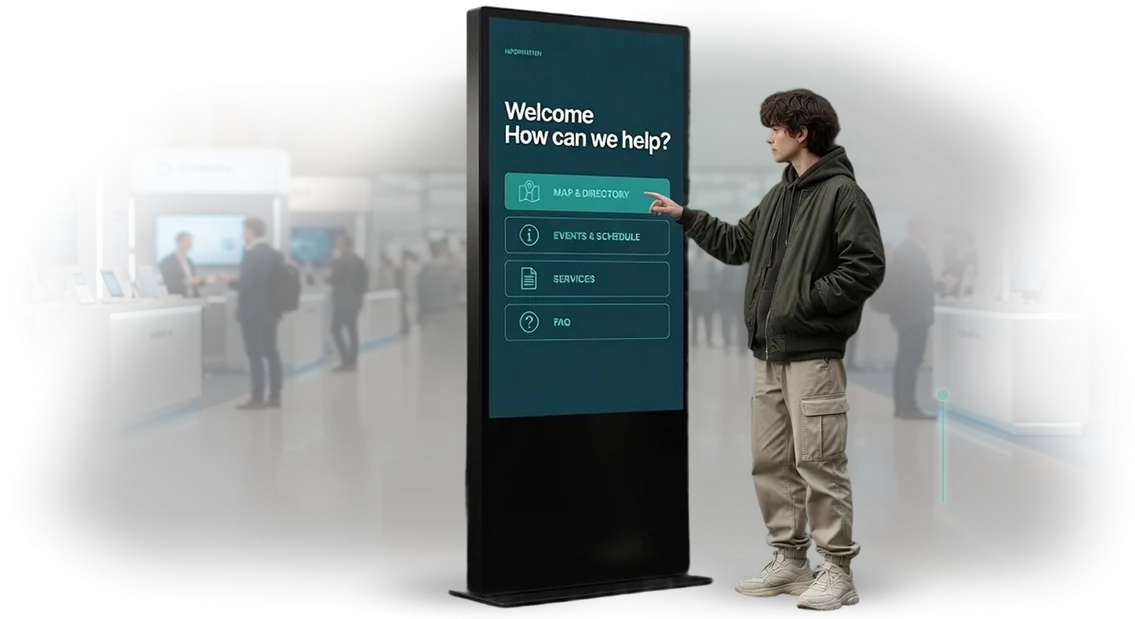
Why a Factory Loses Time and Trust Without an Information Kiosk
Every minute at a factory costs money, but visitors do not think about that. A delegation of partners, inspectors, or a job applicant all arrive expecting the enterprise to meet them in a clear and professional manner.
Instead, guests spend hours looking for the right workshop or office, run into closed checkpoints, and get information from outdated bulletin boards where data has not been updated for years.
Outdated information about an enterprise is not just an inconvenience; it is a direct loss of time for key people.
While a guest tries to navigate using a paper map or asks security guards for directions, meetings get pushed back, production processes slow down, and employees are distracted from their tasks. As a result, the factory looks disorganized even before negotiations begin.
Trust is a subtler but equally critical matter. If an information kiosk or bulletin board shows old data about products, outdated contacts, or incorrect navigation around the plant, guests unconsciously project that onto the whole company.
The question arises: if they cannot keep simple reference information in order, how reliable are their equipment and production processes? Such an impression damages the factory's image more than any technical flaw.
The solution is a modern kiosk for the factory that always shows up-to-date information and helps people quickly find their way around the premises.
It solves the navigation problem, takes the load off staff, and demonstrates to guests that the enterprise pays attention to every detail.
We help factories implement exactly these kinds of information kiosks, with a clear interface and simple data updates, so that trust is never lost for a minute.
What You Get from Implementing an Information Kiosk
A visitor to a factory or company office often gets lost: where is the checkpoint, where is the meeting room, how to find the right employee. Employees get distracted, guests wait, and the first impression suffers.
An information kiosk solves these problems right at the entrance — these are your main kiosk benefits.
An interactive kiosk is not just a screen in the lobby, but a working tool for improving visitor convenience and saving resources. Here is what you get after implementation:
Fast navigation. A guest finds the right office, workshop, or department in a couple of touches. No questions to security guards or employees — all routes are clear and easy to follow.
Up-to-date data. You update the information yourself: access maps, schedules, and enterprise news. Visitors always see the latest data, and reprinting bulletin boards becomes a thing of the past.
Improved image. A modern kiosk at the entrance shows that the enterprise is keeping up with development and cares about its guests. This adds to partner trust and market reputation.
Resource savings. Employees stop being distracted by route explanations. The freed-up time goes to core tasks, and information update costs are reduced many times over.
The advantages of the kiosk are noticeable within the first week of operation: fewer calls asking "how do we get to you," a faster pass-through process, and higher guest loyalty. Implementation usually takes 2–3 weeks, and the payoff comes from the team's saved time.
Our clients note that after installing the kiosk, the throughput of the entrance area grows by about a third. Take a ready-made solution for your format — from a simple reference guide to a full site map.
our team will help you design and launch the kiosk without unnecessary downtime and with a guaranteed result.
Information Kiosk Formats for a Factory
An employee who spends 10 minutes looking for the right workshop or office loses working time. A guest who gets lost at the checkpoint creates extra load on the security service.
An interactive kiosk solves both problems: it provides an exact route, reference information, and removes routine work from staff.
The format depends on the placement point and the goal. For navigation around the territory and buildings — floor-standing touchscreen kiosks with a map and department search.
For information about working hours, passes, and internal rules — wall-mounted terminals in lobbies and at checkpoints. For demonstrating products to guests — kiosks with presentation materials and a virtual tour of the production facility.
| Kiosk format | Where it is placed | What it gives the factory |
|---|---|---|
| Navigation | Entrance area, corridor intersections | Employees and guests find workshops faster, distract staff less |
| Information | Lobbies, checkpoints, cafeteria | Answers to frequent questions without involving a secretary or security |
| Presentation | Meeting rooms, exhibition areas | Visual demonstration of products and achievements to clients and partners |
This separation makes information available exactly where it is needed. An employee does not go to HR for a reference — they get it at the kiosk on their floor. A guest does not call the reception — they see the route on the screen. The factory saves man-hours and reduces the load on the reception desk and security service.
Kiosks are configured to your regulations: menu structure, list of buildings, visiting rules — everything is updated without reprogramming. One terminal combines navigation, information, and presentation, so the format can easily adapt to a specific checkpoint or workshop.
Kiosk Development Stages for Your Tasks
Kiosk development is not a "black box" but a managed process with an agreed schedule. You see the result at every stage and can adjust the project before it goes into production. This way you avoid rework and unnecessary costs.
- Brief and analytics. We meet and analyze the kiosk's tasks: what data to show, where it will be installed, who the main audience is — workshop employees, visitors, or clients. We record requirements, acceptance criteria, and timeline targets.
- Design and approval. We prepare the interface layout and workflow logic: scenarios, sections, and user interaction. You approve the mockup — after that, development begins without deviating from expectations.
- Development. We assemble the kiosk on professional equipment and configure it for your content. You receive intermediate versions for review, so there are no "surprises" by launch time.
- Testing. We check real user scenarios: from the first screen touch to obtaining the required information. We fix any issues before installation, not after the kiosk has been deployed on site.
- Launch. We deliver, install, and launch the kiosk on your premises. We set up content updates and train employees: who is responsible for filling content, how to quickly change materials.
- Support and development. We stay in touch after handover: data updates, technical support, and scenario improvements as tasks grow. The kiosk does not "freeze" — it lives together with your business.
The result is a working tool with clear timelines at every stage. The kiosk helps the factory speed up navigation, inform employees, and reduce the load on staff, rather than creating a new headache.
What Is Included in the Kiosk Delivery Set
A kiosk is not just a screen with a touch sensor. The delivery set includes everything needed to work immediately after connection: from the protective enclosure to software, installation, and employee training.
No hidden costs and no "where is the driver?" — you get a fully ready solution that turns on and works at your factory.
Here is what is included in the standard set:
- Touchscreen kiosk in a protective enclosure — designed for 24/7 operation in a workshop or at a checkpoint, resistant to dust, vibration, and accidental impacts.
- Software — a preinstalled system with your content and workflow logic: reference guides, floor plans, instructions, shift schedules.
- Installation and connection — an engineer delivers the kiosk, installs it at the desired location, connects power and network, and verifies functionality.
- Administrator training — we show how to independently update materials, add sections, and change schedules without calling a specialist.
- User manual and maintenance guide — step-by-step instructions for your employees: how to turn it on, clean it, and replace consumables.
- Remote management — content can be managed from a computer without going to the kiosk; changes are published instantly.
- Technical support and warranty — you can reach us by phone or chat; if necessary, we come to the site so the kiosk does not sit idle.
This composition eliminates typical factory problems: "wrong enclosure," "it won't start," "no installation rights." You get a working tool, not an item for reading manuals and guessing.
Launch takes days, not months: once the content is approved, the kiosk is ready to welcome its first users within a week.
Result of Kiosk Implementation at an Industrial Facility
At a factory with hundreds of employees, every "where do I go?" question takes time away from both the visitor and the staff.
Dispatchers get distracted from their work, newcomers look for the right workshop on paper maps, and no one controls how current the information is. Implementing an information kiosk removes this chaos: all routes, schedules, and regulations are collected in one clear interface.
We implemented a project for the production site NPO Promtech: we installed a touchscreen kiosk at the checkpoint with a map of factory buildings, a shift schedule, and a department directory.
Employees and contractors get the information they need in a couple of touches, without asking the secretary and without wasting time searching.
The results speak for themselves. In the first month, the kiosk processed over 3,000 requests, the average time to find information dropped from 10 minutes to 1 minute, and the load on the dispatch office for typical questions fell by 40%.
Six months later, the client returned for another order — the system was scaled to a second building without additional development.
The head of the maintenance service assessed the outcome this way: "Previously, we were distracted several times per shift with questions about where the warehouses and workshops were.
Now people orient themselves using the kiosk — the relief for staff is noticeable immediately, and newcomers settle in faster." For us, this is the main indicator of value: the kiosk saves employees' live time every day, not just on launch day.
This is what implementation that delivers results from day one looks like. If you want to achieve a similar effect at your factory — tell us what questions your employees and visitors ask most often, and we will propose a solution tailored to your specifics.
How to Choose the Right Kiosk Format for Your Production?
Choosing a kiosk for a factory starts not with the model, but with answering three questions: who will use it, where it will stand, and what task it solves. There is no universal format — what works well in an administrative building often does not work in a workshop.
The first guideline in format selection is the conditions at the site. Dust, moisture, vibration, and temperature fluctuations are found almost everywhere in production, so the requirements for the kiosk are higher than in an office: a protected enclosure and a durable screen.
A floor-standing kiosk is convenient in clean areas — checkpoint, cafeteria, rest area. For hot zones and entrances from the street, a reinforced version is needed.
The second guideline is the audience. Not all employees are equally confident with touchscreens: some are used to paper instructions. The interface must be readable at a glance — large buttons, minimal text, and hints at every step.
This determines the screen size and placement: the denser the flow of people, the simpler the controls should be.
The third is tasks. One kiosk can cover several scenarios: pre-shift briefing, access to current norms and standards, presence check-in, equipment repair requests.
For each task, it becomes clear where a compact wall-mounted kiosk is needed, and where a stationary one with a large screen in the waiting area.
We help you go through format selection from start to finish: we study employee routes, loads at each point, and the real conditions at the site.
You get a solution tailored to your production specifics — without overpaying for unnecessary options and with a clear implementation logic.
Frequently Asked Questions About Kiosks for an Enterprise
Before ordering a kiosk for an enterprise, the same doubts arise: will the equipment survive a dusty workshop, who will maintain the device, and how quickly can reference information be updated. Let us address the typical concerns — so you can decide based on facts, not guesses.
What happens if the kiosk breaks down?
Any equipment can fail, which is why we plan kiosk maintenance in advance. The main components are interchangeable, and remote diagnostics allow most faults to be resolved remotely.
If on-site repair is needed, an engineer arrives within the agreed timeframe — downtime is minimized.
Who will maintain the kiosk at the factory?
No dedicated employee is needed. The interface is understandable for a regular operator: replacing paper or restarting takes a couple of minutes using a short instruction. Our support handles complex issues — it responds remotely and quickly, and if required, comes to the site.
How often will the information need to be updated?
You change the information yourself through a secure web interface — without a programmer and without stopping the kiosk. Updated a price list, news item, or regulation — the information immediately appears on the screens. This is convenient when regulations or internal documents change at the factory.
Still have questions? Write to us — we will explain how the kiosk fits into your enterprise processes and prepare a preliminary estimate.Leave a Request for Information Kiosk Development
An information kiosk at a factory brings value when employees and visitors immediately understand how to use it. That is why we start development not with the screen, but with analyzing your site and tasks.
We work with manufacturing enterprises and take specific factors into account — different levels of user experience and working conditions.
To get a consultation and an estimate, simply leave a request for a kiosk. No technical specification is needed: describe the task in your own words — we will handle the rest.
What happens after you submit a request:
- We contact you and clarify where the kiosk will be placed and what tasks it will solve: navigation around workshops, information for guests, or issuing reference materials.
- We prepare an estimate: scope of work, timelines, and launch format. You see a transparent proposal with no hidden items.
- We agree on the structure and scenario: sections, menu order, texts, and hints.
- We develop the kiosk and fill it with content. At an intermediate stage, you review the version and make changes.
- We install the kiosk at your site, configure it for real conditions, and train employees if needed.
- After launch, we stay in touch: updates, improvements, and technical support. The kiosk operates without downtime.
Leave a request for information kiosk development — then follow the steps: consultation, estimate, approval, launch. Dozens of factories have already gone through this process, and every kiosk solves the specific tasks of the enterprise. Start with an estimate — the rest will follow.