

Why Patients Leave the Hospital Without an Appointment and How to Fix It
Every third patient leaves the clinic without ever seeing a doctor. The reason is not the doctors — it’s the chaos at the reception desk, endless queues, and the inability to quickly figure out where to go.
When a person arrives without an appointment, they lose 30–40 minutes just trying to see a specialist, and often give up.
You might think online services solve the problem. But a significant portion of patients — elderly people, visitors without smartphones, or out-of-towners — still rely on the information desk. And it’s exactly these people who most often leave without help.
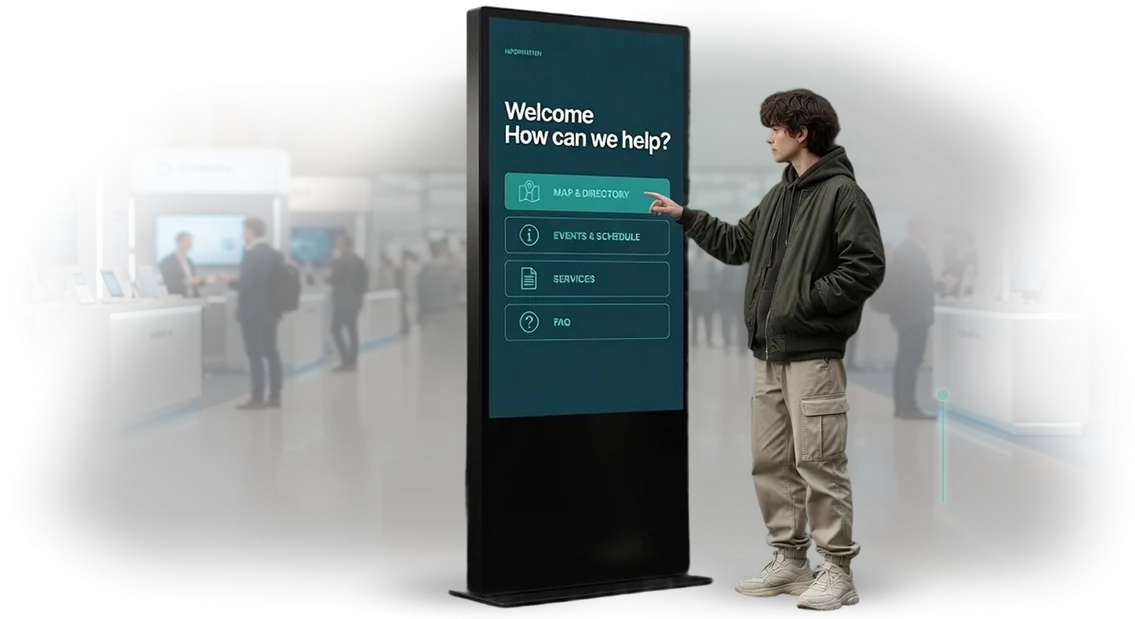
An information kiosk for a hospital changes that. A patient walks up to a touchscreen, sees the electronic queue and available specialists, and can immediately book a convenient time. No more queues at the reception desk — just a few taps on the screen.
Self-service check-in at a clinic via a kiosk relieves administrators and cuts waiting time during peak hours. Patients stop crowding around the front desk, receive a numbered ticket, and wait calmly for their turn. Those who used to leave now stay — because it’s clear exactly when their turn will come.
Implementing such a solution is a direct improvement in patient service quality. The hospital gets a manageable visitor flow, fewer conflicts in the lobby, and higher loyalty. Patients get confidence that they will be seen and respect for their time.
We design and implement kiosks tailored to a specific clinic’s needs, with a simple interface and technical support. The result: more completed visits, fewer people leaving without an appointment, and a calm, organized reception desk.
What an Information Kiosk in a Hospital Provides: 5 Measurable Benefits
An information kiosk in a hospital is not just a screen in the lobby — it’s a tool that delivers measurable results. Here are five benefits a medical facility gains after installation.
Reduced waiting time. Patients book a doctor, get a ticket, and find the right office in 1–2 minutes instead of standing in line at the reception desk. On average, this saves each visitor 15–20 minutes in the lobby.
Lower load on the reception desk. The kiosk answers common questions — schedules, document requirements, addresses. Receptionists shift their attention to patients who genuinely need help — staff workload drops by 30–40% without adding new positions.
Increased patient loyalty. People appreciate not having to wait in line and being able to quickly find their way around. Clinics with such kiosks receive 10–20% more positive reviews and repeat recommendations.
Cost savings. The kiosk handles routine operations, so the hospital doesn’t need to expand the reception area as patient flow grows. Administrative operating costs drop by 15–25%, while service quality remains high.
Accuracy and order. The system records data without errors, typos, or illegible handwriting. This reduces correction time and eliminates the conflict situations administrators dislike so much.
Taken together, these five benefits deliver the key outcome — a calm reception desk and satisfied patients who return and recommend the clinic to others.
Information Kiosk Formats for Medical Facilities and Clinics
The right kiosk format determines how quickly a patient can book an appointment, find the right office, and avoid creating a queue at the reception desk.
There is no universal solution: a clinic lobby, an emergency department, and a pediatric unit each need different configurations. Let’s look at the main types of information kiosks and their use in medical facilities.
Comparison of Medical Kiosk Formats
| Format | Location | What It Gives the Clinic |
|---|---|---|
| Floor-standing kiosk | Lobby, entrance area, waiting zone | Relieves the reception desk, accepts payments and appointments, shows navigation. Sturdy, visible, suitable for high-traffic areas. |
| Wall-mounted kiosk | Corridor, narrow spaces, near a doctor’s office | Saves space, helps solve specific tasks: ticket verification, issuing referrals, calling the elevator. |
| Stationary (countertop) kiosk | Reception desk, information counter | Compact, mounts to a counter or wall, convenient for quick tasks: print a ticket, pay for a service, check the queue. |
| Self-service kiosk | Outpatient clinic, women’s health clinic, inpatient department | Patients choose a doctor and time themselves without speaking to an administrator. Reduces staff workload during peak hours. |
How to Choose Based on Your Patient Flow
Look at three factors: number of visitors, available space, and usage scenario. If 500–700 people pass through the lobby every day, choose a floor-standing kiosk with a large screen and a vandal-resistant housing.
If you simply need to relieve the reception desk in a narrow corridor, a wall-mounted self-service stand is enough.
Ongoing support also matters: the kiosk must run without failures, and the patient must understand the interface from the first touch. We create clear scenarios for each location and, if needed, adapt the design to the clinic’s style.
This approach pays off within the first few months — through reduced staff workload and a higher share of self-service interactions.
If you’re unsure which format suits your medical facility, we’ll send a recommendation based on your layout and foot traffic. This doesn’t obligate you to order anything.
How Kiosk Development for Your Clinic Works: 6 Steps
To ensure the information kiosk is implemented without disruptions, we have built a transparent six-stage development process. Each step is clear to the client, has a specific outcome, and allows you to control deadlines and budget.
-
Brief and task analysis. We determine what your clinic actually needs: doctor appointment booking, ticket issuance, navigation between buildings, or payment for services. At this stage, we form the software and design requirements that will serve as the project foundation.
-
Kiosk design. We create a user interface prototype that patients of any age can understand — from students to elderly people. We align the screen logic, button layout, and usage scenarios so the kiosk truly simplifies appointment booking.
-
Design and content approval. We adapt the appearance to your medical facility’s style: configure the color scheme, display doctor schedules, current news, and admission rules. You see what the kiosk will look like before development begins.
-
Software development and testing. We build the solution on professional equipment, configure the software, and verify stable operation. Special attention goes to personal data protection and reliability under heavy peak-hour load.
-
Implementation and installation. We deliver the kiosk to the medical facility, install it at the chosen location, connect it to the local network, and configure integration with your medical system. We test everything in real conditions.
-
Staff training and launch. We conduct a briefing for administrators and reception staff, provide short instructions, and stay available during the first weeks of operation. We help launch the kiosk so it delivers value right away.
This approach makes kiosk deployment predictable: you know your tasks in advance, control quality, and don’t distract doctors from seeing patients. You end up with a working tool that reduces the load on the reception desk and speeds up appointment booking.
What’s Included in Delivery: A Ready-to-Use Kiosk Kit
After project completion, you receive an information kiosk delivery assembled around your hospital’s needs. The kit includes everything required for launch and daily operation: hardware, software, and documentation.
You won’t need to find additional contractors or buy missing components — the kiosk works out of the box.
What’s Included in the Kiosk Kit
- Touchscreen terminal with a vandal-resistant housing that is resistant to dust and moisture. The housing is selected to match the conditions of the lobby, corridor, or waiting area.
- Pre-installed software with an interface for booking doctor appointments, navigating departments, and accessing reference information. Patients can use the menu without staff assistance.
- Admin panel — hospital staff can update schedules, news, and the service list themselves, without a programmer. This saves time and money on every change.
- Integration with your scheduling system — the kiosk pulls up-to-date slots from your database, eliminating double bookings and outdated information.
- Full kiosk documentation package: administrator guide, patient instructions, commissioning reports. Everything is ready for working with regulatory authorities.
- Staff training — a short training session for administrators and reception staff so launch goes smoothly.
- Warranty and technical support after launch — we stay in touch and assist throughout the entire service life.
This medical kiosk configuration covers launch, daily use, and maintenance.
You don’t need to dive into technical details or look for specialists: everything is already included in the cost, and additional options — such as ticket printing or payment for services — are added during the project discussion stage.
Case Study: How a Kiosk Cut the Reception Queue by 60%
A telling example is the Medical Center Zdorovye+, where daily patient flow exceeded 500 people. The reception desk was working at full capacity: queues of up to 40 minutes, some visitors leaving without an appointment, and administrators repeating the same information endlessly. We proposed an information kiosk solution that changes the usual intake scenario.
How Implementation Went
We conducted an audit of the reception area and installed a self-service kiosk.
It’s not just a screen but a full digital assistant: the patient inserts their insurance policy or enters their card number, selects a doctor and a convenient time, and gets a ticket within a couple of minutes.
The entire project — from brief to launch — took three weeks, including administrator training and configuration to match the clinic’s internal rules.
Results Achieved by the Center
The kiosk’s impact became visible within a month: the reception queue shrank by 60%, average appointment time dropped from 15 to 2 minutes, and the no-show rate fell by a quarter.
Administrators finally stopped working as “cashiers” — they focused on genuinely complex matters: choosing the right doctor, handling documents, and helping elderly patients.
The main result is the speed of return on investment. The self-service kiosk paid for itself in 4 months through staff relief and increased reception throughput. After the pilot, the center ordered two more kiosks for its branches and added online booking.
This is a clear example of implementation where a technical solution immediately translates into a measurable business result.
How to Choose a Kiosk Format for Your Clinic’s Needs?
Let’s start with the main point: there is no ideal kiosk for every clinic. Choosing a medical kiosk always depends on the problem you want to solve in a specific department — reducing the reception queue, freeing nurses from paperwork, or helping patients navigate the building.
For the reception desk, an information stand with doctor appointment booking and ticket printing makes the most sense: it reduces the load on administrators and speeds up service.
Laboratories more often need a compact terminal for handing out test results, while an inpatient department benefits from a kiosk with a full directory of departments and route maps.
So the answer to “which kiosk should a clinic buy” is simple: first describe the patient scenario, then choose the hardware and software.
Kiosk selection criteria are usually the same: how many visitors pass through the department per day, how much space is available for the terminal, and whether you need printing, card payments, or integration with an internal scheduling system.
You don’t have to buy the most expensive touchscreen — what matters more is that the interface is clear to people of all ages and the construction can withstand constant use.
Start selecting an information stand by measuring the space and assessing foot traffic — these data will indicate the optimal size and number of stations.
We always take an individual approach: we analyze the clinic’s tasks, propose a suitable terminal format, and adapt the software to your processes. So you get a kiosk that truly speeds up service rather than simply decorating the lobby. Leave a request — together we’ll choose the best solution for each department.
Frequently Asked Questions About Kiosks in Medical Facilities: Safety and Reliability
We understand: in a medical facility, a kiosk is not a place for experiments. Any failure creates queues and frustrated patients, and data security concerns are simply non-negotiable.
So let’s address the most common fears — about breakdowns, information protection, and compatibility with your existing equipment.
We design information stands specifically for clinics and hospitals, taking into account operating hours, visitor flows, and internal regulations. Below are answers to the questions most often asked before launch.
What if the kiosk breaks down on the busiest day?
We use professional equipment with a high continuous-operation rating — it is built for intensive use from morning to evening.
If an unexpected situation does arise, fast recovery is built in: the kiosk restarts without data loss, and remote monitoring lets us spot a problem before staff even report it.
How protected is patients’ personal data?
Security is a key part of the project. System access is role-based, data transmission goes through secure channels, and the kiosk itself stores no unnecessary information.
We help configure the solution to meet your institution’s and the law’s requirements, so you can be confident about every visit.
Is the kiosk compatible with our reception desk and patient database?
Yes, we specifically work out integration with your clinic’s existing systems — from doctor schedules to the electronic queue.
During the brief stage, we study your hardware and software, then configure the kiosk to become part of your workflow rather than a separate “island.” For you, this means patients won’t need to adapt to a new interface, and administrators won’t need to retrain.
What warranty service do you offer?
We don’t abandon the project after launch. The warranty includes scheduled maintenance, content updates, preventive checks, and on-demand support. If needed, we come on-site or resolve issues remotely — so the kiosk keeps working and the queue keeps moving without interruption.
Submit a Request for Information Kiosk Development
Leave a request for a kiosk — and within one business day we’ll send you the cost estimate, timelines, and a preliminary specification. No vague promises: you’ll get a document that clearly shows what’s included in the project and how long it will take. That way you can compare terms and make a decision without unnecessary calls.
What’s included in the response to your request:
- Cost estimate based on your scenario — from a single kiosk to a hospital-wide network.
- Development and launch timelines, including approvals and equipment delivery.
- Preliminary specification: menu structure, key sections, integrations with your systems.
- Recommendations on housing format and screen size for a lobby, corridor, or office.
- List of available functions: doctor appointment booking, schedules, navigation, payment for services, referral printing.
- Step-by-step launch plan and a list of what we need from your side.
- The opportunity to ask questions to a specialist before work begins.
Turnkey kiosk development is not just software. We help with hardware selection, design coordination to match the clinic’s style, and staff training. The cost of a medical kiosk is based on configuration and functionality, so each line item is listed separately in the estimate.
You can order an information kiosk through the form on the website or by phone — and by tomorrow you’ll know how much the project costs and what steps to take first. We work under a contract, with fixed timelines and a guarantee on the result.