

Why Diagnostic Centers Lose Patients Before the Appointment
A patient walks into a diagnostic center already anxious: they need to get tests done, undergo an examination, and make it to their doctor on time. The lobby is noisy, the queues are confusing, and it's unclear where the reception desk is and in what order patients are seen.
While the patient searches for the right office, the front desk is overloaded and time keeps ticking. Some visitors turn around and leave — without booking an appointment or getting their tests done.
Losing patients at this stage is the quietest and most expensive failure. The patient doesn't file a complaint — they silently choose a neighboring center instead.
The first few minutes shape the impression: excellent doctors and equipment fade into the background if the visit starts with chaos. Navigation in a clinic isn't about signs — it's a system that guides the patient from the entrance to the examination room and back.
When it's unclear who's next to see the doctor, where to book an ultrasound, and how long the wait will be, anxiety grows. The patient begins to doubt the center's reliability, and that affects repeat visits and referrals.
For a diagnostic center, this means direct losses in revenue and reputation — even though the cause isn't medical, but organizational.
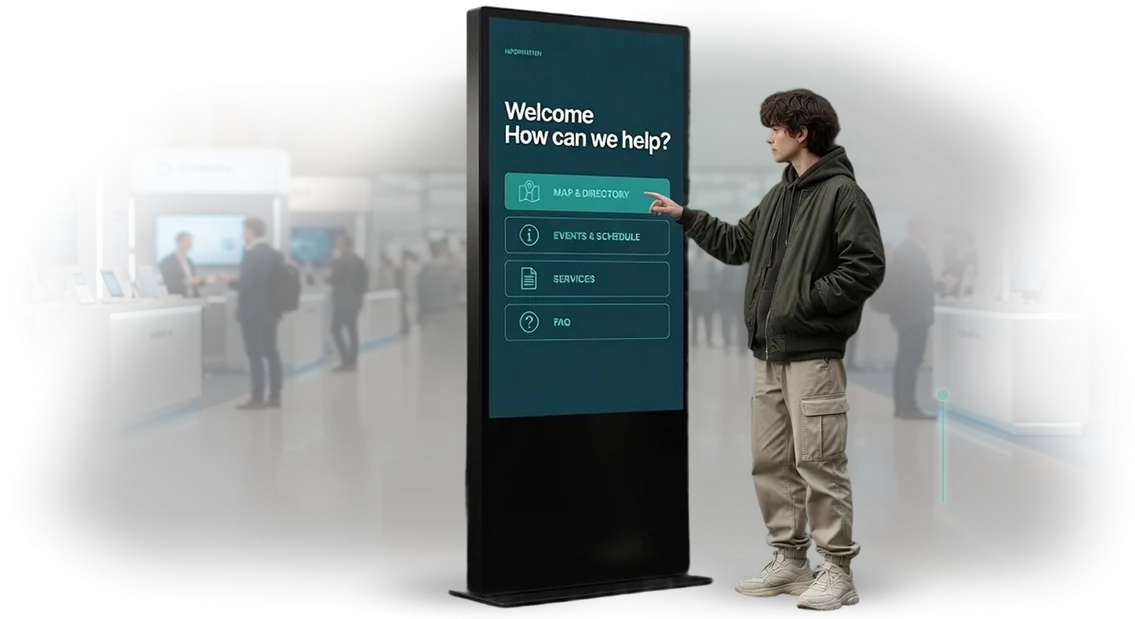
We close this gap: we design interactive kiosks and a clear booking system that remove uncertainty before the appointment. Patients select their service themselves, see real-time wait times, get directions to the examination room, and receive a queue ticket.
The reception desk stops being a bottleneck, and the doctor starts the appointment with a calm patient.
What an Interactive Kiosk Delivers: Five Measurable Benefits for the Clinic
Patients come to a diagnostic center not for technology, but for results: getting tests done quickly, seeing the doctor on time, and not wasting time in queues.
But it's precisely the navigation and waiting that shape the first impression of the clinic — and this is where up to half of patient loyalty is often lost.
An interactive kiosk addresses this pain point: it takes on the routine, freeing your staff to provide genuine care to visitors.
We've been developing information kiosks for medical institutions for over 10 years. During this time, we've refined scenarios that genuinely impact a clinic's performance metrics — here are five measurable benefits you'll get after deployment.
Shorter Queues and Reduced Reception Workload
Up to 70% of simple requests — booking, service selection, repeat visits — the kiosk handles on its own. The administrator stops being a "help desk" and focuses on complex matters, while average wait times during peak hours drop by 2–3 times.
Increased Patient Satisfaction
When a patient gets to their appointment on time without stress, they rate the clinic higher. According to our measurements, after kiosk installation the share of positive service reviews grows by 15–25%, and repeat visits become more frequent.
Additional Service Sales
The kiosk shows current checkup packages, promotions, and new departments — things the patient didn't know about but could genuinely benefit from. Smart on-screen prompts increase interest in preventive care and turn a one-time visit into a regular one.
Data Collection for Management Decisions
The kiosk records popular services, peak hours, and typical selection patterns. This data helps you plan physician schedules, optimize procurement, and launch targeted marketing campaigns — without extra costs.
A Modern Image and Competitive Advantage
A tech-enabled lobby with a kiosk signals that the clinic keeps up with the times. This is especially important for private diagnostic centers, where patients compare service against the best standards.
The kiosk isn't a replacement for human interaction — it frees staff to care for patients. Implementation takes 2–4 weeks, and the effect is visible in the first month: shorter queues, higher loyalty, more repeat visits.
Leave a request — we'll show you a benefit calculation based on your numbers and propose a solution tailored to your floor plan.
Kiosk Formats for Diagnostic Centers: A Fit for Every Scenario
In a diagnostic center, patient flows are distributed differently: the lobby is crowded in the morning, corridors are filled with people heading to procedures, and the waiting area is where people spend 20–30 minutes at a time.
A single kiosk format can't work effectively everywhere at once, so we design solutions for your specific movement patterns and patient needs.
| Format | Where to Place | What It Gives the Patient and the Center |
|---|---|---|
| Touch counter | Lobby, entrance area | Self-service booking for tests, selecting a doctor and time without queuing at reception. Reduces the administrative workload, speeds up check-in, and reduces client losses from people who didn't wait for the front desk. |
| Wall-mounted kiosk | Corridors, bottlenecks, transitions between offices | Quick navigation to examination rooms, checking if results are ready, calling an administrator with one touch. Saves patient time and eliminates a stream of repetitive questions for the staff. |
| Floor-standing kiosk | Waiting area, open spaces in the hall | Interactive map of the center, information about services and promotions, useful content while waiting. Reduces anxiety, improves awareness, and creates the impression of a modern medical center. |
We adapt the interface for each format: on the counter — large buttons and a simple booking flow in just a few touches; on the wall-mounted — a compact menu with the most relevant information; on the floor-standing — clear infographics, short videos, and interactive prompts. The system easily connects to your internal booking system and works without staff involvement.
We'll help you choose the format that fits your floor plan and patient traffic logic. We'll visit your site, assess the load in each zone, propose a layout, and prepare a solution that works for you — from the first screen to click reports. You get kiosks patients understand right away, without instructions or staff assistance.
How We Build a Kiosk for Your Task: From Brief to Launch
Developing an information kiosk for a diagnostic center isn't just installing a terminal with a touch screen. You need patients to book tests faster, approach the administrator less often, and avoid queues building up at reception.
We've structured the process so you see intermediate results and can influence them before the kiosk reaches your lobby.
Our team works on a transparent six-stage model. This keeps deadlines under control and prevents surprises at launch.
-
Kiosk brief. You tell us how booking works in your center: what services you offer, how patient flows are distributed, and what should be on the main screen. We document the requirements, constraints, and desired timelines.
-
Plan and structure. We prepare a work plan and design the screen logic: booking, schedules, information about tests. At this stage, you approve what the patient will see, where they start, and how quickly they get to booking.
-
Layout approval. We present the design and texts. We make the interface clear for people of all ages — large buttons, simple navigation, prompts. You submit edits and approve the final version.
-
Development and configuration. We assemble the kiosk using professional equipment and set up integration with your booking system. We test all scenarios: self-service booking, schedule viewing, printing referrals, calling an administrator.
-
Testing and launch. We deliver the kiosk to the diagnostic center, install it at the agreed location, and connect it. We run test scenarios with your staff, train personnel, and switch to live operation.
-
Post-launch support. We don't disappear after project handover. We update schedules, change texts and the list of services, and monitor system stability. If new tasks arise, we add features without rewriting the entire system.
Thanks to this approach, you know what you'll get at every stage and control the process, rather than just waiting for the result. Launch happens without stress for your staff and with minimal impact on reception operations.
What's Included in the Delivery: A Complete Package for a Quick Start
A diagnostic center launches a kiosk to relieve the reception desk and cut queues. But for the system to work from day one, you need more than just a screen and software — you need a full package, from hardware to trained staff. Our delivery includes everything required for a quick start.
- Kiosk package: a touch terminal with enclosure and mounting hardware — all you need to do is plug it in and install it in the lobby.
- Touch hardware: a professional screen with protection against accidental damage, designed for high visitor traffic and 24/7 operation.
- Software: an interface for self-service doctor booking, building navigation, service payment, and receiving referrals.
- MIS integration: configuring data exchange with reception and your medical information system, so schedules and patient records are always up to date.
- Staff training: a session for administrators and medical personnel so they can assist visitors and resolve common issues quickly.
- Visitor instructions: simple on-screen prompts and printed guides for patients of any age.
- Support and updates: technical maintenance, content updates, and consultations for the entire period of kiosk operation.
This package allows you to launch the kiosk within a week of delivery — without an in-house IT team or lengthy approvals. You get a single point of responsibility for the entire cycle: from hardware to the latest updates.
Case Study: Interactive Kiosk Cuts Queue by a Third at a Medical Center
The reception desk at a diagnostic center is always a bottleneck. Patients arrive without appointments, ask administrators the same questions, and get lost in the corridors. The queue grows, people get anxious, and staff burn out by mid-day.
We've already solved this challenge for a network of diagnostic centers with eight departments and a traffic flow of over 400 patients per day.
We placed an interactive kiosk right by the entrance: on the screen, patients select their service, book a convenient time, and get directions to the right office. All that's left is to walk there.
What Changed After Installation
The queue at reception dropped by a third, and average wait time fell from 25 to 17 minutes. About 70% of patients started using the kiosk — especially those coming for repeat tests.
Administrators shifted to handling complex inquiries and paperwork instead of repeating "which room is the ultrasound in?"
A welcome bonus was the reduced tension in the lobby: patients can see their queue number and exact appointment time, so they stopped crowding around the counter. Reviews began to feature more thanks for the staff rather than complaints about waiting.
The kiosk is still running at the main branch, and we've also rolled the solution out to a satellite location — the client came back on their own after seeing the effect on revenue and physician utilization. Want the same for your medical center? Tell us about your patient flow — we'll propose a kiosk format tailored to your needs.
How to Choose the Optimal Kiosk Format for Your Center?
The optimal kiosk format for a diagnostic center is determined by three factors: lobby size, patient traffic, and budget. There's no one-size-fits-all solution — a small reception area and a busy center with a thousand visitors a day need different configurations.
The key is that the kiosk speeds up booking and doesn't create queues, rather than just standing in a corner.
If your lobby is compact — look at wall-mounted panels or compact floor-standing units. They take up less than a square meter, don't block foot traffic, and still fully cover the core tasks: booking a doctor, schedules, payments, and directions to offices.
In a spacious lobby, you can install a full-size kiosk with a large screen — it's more visible, more comfortable for older patients, and handles larger amounts of information better.
Patient traffic determines not only the size of the kiosk but also the quantity. With high footfall, it's better to install two compact stations instead of one large one — so people don't stand in line and get to their appointments faster.
With a lower flow, a single universal terminal that handles booking, navigation, and payment is sufficient. This saves budget and simplifies maintenance.
Budget isn't a matter of "how much to spend" but "what will pay off faster." You can start with one model that addresses the main pain point — electronic booking. Later, you can easily add a second kiosk, a payment feature, or referral printing.
The key is to choose hardware that can be scaled and software that won't need to be rewritten from scratch.
We select the format based on your center's specific needs: we analyze the lobby layout, peak loads, and patient scenarios, then propose the optimal configuration. You get a kiosk that genuinely relieves administrators and speeds up service — not just an impressive screen.
Get in touch with us — we'll calculate which format will deliver the greatest impact in your specific conditions.
Frequently Asked Questions About Kiosk Development and Implementation
Implementing a kiosk in a diagnostic center's operations means new opportunities for patients and fresh questions for the management: what if the equipment fails, how do we integrate the kiosk into our existing infrastructure, and how long will launch take.
We've gathered answers to the most common questions so you understand the process down to the smallest detail.
What happens if the kiosk breaks down?
The kiosk is built for high loads: we select professional equipment and configure it for your visitor traffic. If an issue does arise — you get warranty service and priority support.
In most cases, we resolve the issue remotely, and if necessary, we deliver a replacement within a few days.
How will the kiosk integrate with our medical information system?
Integration runs through modern data exchange protocols, so the kiosk connects easily to your MIS. We configure the exchange so appointments and visit data are automatically routed to the right department — without manual data entry or paper referrals.
You won't need to restructure your established processes: we adapt to your infrastructure, not the other way around.
How long does implementation take?
Typically, two to four weeks pass from brief to installation. During that time, we prepare the interface, agree on the workflow logic, and carry out the installation.
We schedule the installation so it doesn't interfere with patient care — often outside working hours, so your center's operations never stop for a minute.
Didn't find the answer to your question? Leave a request — we'll explain how the kiosk will work specifically in your diagnostic center.Ready to Improve Navigation in Your Center? Let's Discuss Your Project
The first weeks of a diagnostic center's operation reveal the pattern: patients get lost in the lobbies, create queues at reception, and waste time finding their office.
This is a direct burden on staff and a hit to the clinic's impression, even if the quality of diagnostics is flawless.
An interactive kiosk addresses these issues — but for it to truly work, you need more than just a screen by the entrance: you need well-thought-out logic tailored to your patient flow.
We suggest starting with a short meeting and preparing a solution for your center — with a clear plan, timelines, and a fixed guarantee of results. Here's how the work will proceed after you submit your request.
- Get a consultation. We get on a call and discuss the task: number of departments, typical patient routes, and overload points.
- Technical audit of the premises. We review the floor plan, lighting, and traffic — to select the right construction and kiosk placement that won't obstruct flows.
- Cost and timeline estimate. We send a commercial proposal within 2-3 days with a fixed price for development and launch — no hidden surcharges.
- Design mockup and menu structure. We agree on the look and the list of sections: map, booking, reference information, promotional banners.
- Assembly and software setup. We prepare the kiosk for your tasks: building maps, physician schedules, and a file structure for updating materials.
- Implementation and in-clinic testing. We install, connect, and test with real traffic during peak hours.
- Training and technical support. We conduct an orientation for administrators, set up remote monitoring, and stay available after launch.
What you get after submitting your request:
- An objective assessment of the task from an engineer — no "eyeballed" project assumptions.
- A transparent estimate: cost of development, equipment, and implementation.
- A clear project plan with dates and responsible staff members.
- A proposal with a guarantee: we fix the timelines and results in the contract.
- Access to a closed test version of the kiosk before the official launch — so you can show the solution to executives or colleagues.
Leave a request for a consultation — we'll get back to you within one business day, clarify the details, and prepare a preliminary solution. Let's discuss your project and find the option that fits your center best.