

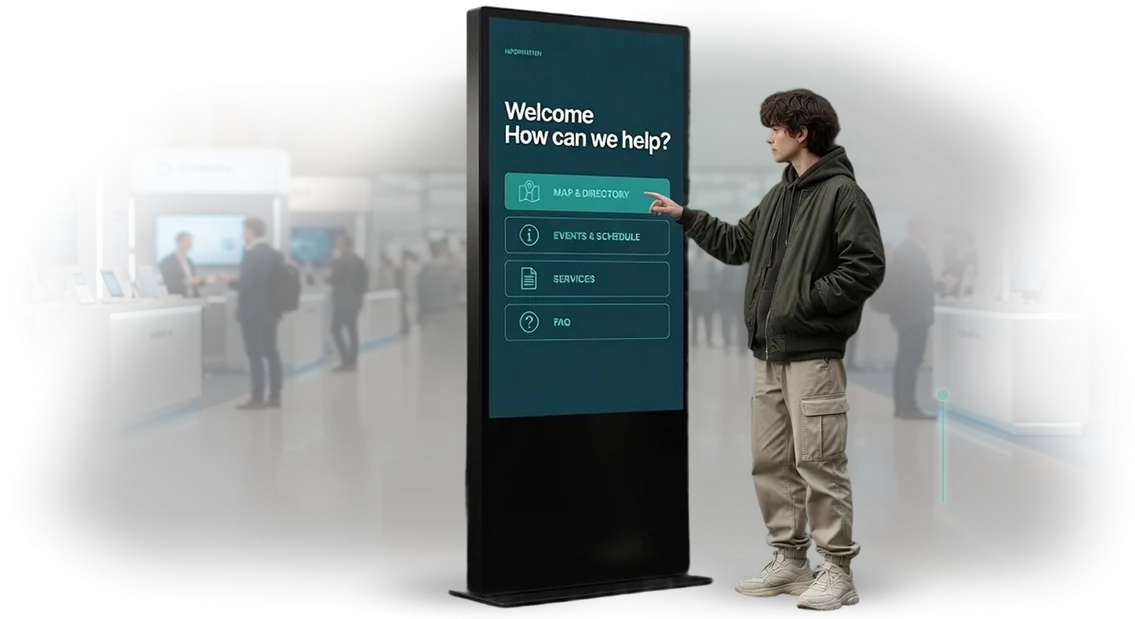
Why does a real estate agency need an interactive kiosk?
A visitor walks into the sales office, sees a queue to the manager, and realizes they won't get information about properties quickly. After a few minutes of waiting, they leave — to competitors, where the care for the buyer's time is visible right away.
This is exactly how real estate agencies lose clients without even learning about their interest: people are not willing to wait for someone to read out apartment listings to them.
Sales office problems are typical: managers are busy with one buyer, the property database is closed off, and self-service browsing is not provided at all. As a result, the visitor either leaves or receives incomplete information from a tired employee.
Self-service in real estate has long become an expected scenario — people want to explore floor plans, prices, and photos themselves, and only then ask questions to a specialist.
An interactive kiosk for the sales office addresses this need. The visitor sees a touchscreen, selects housing type, district, budget — and gets up-to-date listings in a couple of touches.
The manager is freed up to work with warm leads, and the agency stops losing inquiries due to queues and lack of time.
We develop such kiosks for the specific tasks of each agency: we populate them with your database, configure filters, and build an interface that is clear even to those who have never used touchscreens.
The kiosk becomes the "showcase" of the office — it highlights the advantages of properties before the manager arrives and shapes the impression of the company as a modern market player.
This is not just a device, but a tool that turns waiting into browsing listings and increases the chance of closing a deal.
What a kiosk will give a real estate agency: more inquiries and loyalty
Every day, dozens of potential buyers visit the agency office, but not all of them reach a manager.
While the specialist is busy showing a property or on a call, visitors glance at the window display and leave — inquiries are lost forever, and the advertising budget does not pay off.
A kiosk for a real estate agency changes this situation.
The visitor independently browses current listings, filters options by district, price, and area, and then leaves contacts in a couple of touches — the manager receives a ready inquiry and contacts a warm lead instead of spending time on the initial consultation. The growth in inquiries from the kiosk is achieved because no visit goes unnoticed.
This format relieves managers: routine work on property selection and initial information is automated, and specialists focus on negotiations and deals.
For the client, this is a modern and respectful service — they choose their own pace of browsing properties, without waiting or pressure, which directly increases loyalty to the agency.
The development is handled by our team — over 10 years in interactive projects for business. We work on professional touch equipment and use proven software, so the kiosk launches within the agreed timeline and runs reliably even during peak load hours.
Order a kiosk installation in your agency office — and get more inquiries, relief for managers, and a recognizable modern service that will set you apart from competitors.
Three kiosk formats: choose according to your task
For a real estate agency, the kiosk format is not a matter of design, but a matter of how exactly the visitor browses properties. A properly selected enclosure saves space, speeds up browsing of listings, and turns waiting into productive time. Below are three standard formats and the tasks they address.
| Kiosk format | For which tasks | What it gives the customer |
|---|---|---|
| Floor-standing | Large lobby, open plan, flow of visitors without appointments | Immediately attracts attention, works as a brand showcase, allows full-screen viewing of properties |
| Tabletop | Reception, meeting room, waiting area by the manager | Compact on the counter, helps the consultant quickly show listings without breaking the conversation |
| Built-in | Wall niche, narrow corridor, space near the entrance | Saves floor space, looks neat, does not block passage and does not draw unnecessary attention |
If you have a high-traffic office and clients walk in without appointments — go with the floor-standing model: it works as an independent sales tool. When speed of the manager's work and neatness matter most, the tabletop model is more convenient.
The built-in format suits locations where every centimeter of space counts, and the kiosk should be unobtrusive yet accessible.
It is important to understand: the enclosure itself is only half the solution. A floor-standing, tabletop, or built-in kiosk must run on your software with a property catalog, filters, and inquiry collection.
We select the format based on the office layout and customer scenario, then customize the interface to your tasks — from simple listing display to appointment scheduling. As a result, the kiosk becomes part of the sales system, not just a screen with advertising.
How the project goes: from brief to launch
For a real estate agency, a kiosk in the office solves a specific task: the client independently finds a property by the required parameters, views photos and floor plans, and leaves an inquiry for a viewing.
But for it to actually work, not just stand against the wall, the project must be structured from the first conversation to warranty service. We have developed a process that makes kiosk implementation predictable and clear.
- Brief and immersion in your task. We clarify which properties to display, who your audience is, which scenarios matter — search by parameters, office map, inquiry collection. As a result, you understand what the kiosk will do in your office.
- Project approval. We propose the concept, logic, and structure of the future interface. You make edits, approve the mockups — and we know exactly where we are heading, without surprises at the finish.
- Turnkey kiosk development. We build the interface, navigation, and management system so your staff can update properties and prices themselves without a developer.
- Testing on real scenarios. The customer is the first user: we test all scenarios like a "hot" client looking for an apartment. We polish the details to perfection.
- Kiosk launch. We install, configure, and train the staff. The kiosk starts generating inquiries on launch day, not a month later.
- Warranty support. We stay in touch: update content, fix system issues, add features for new business tasks.
This process is refined on projects for real estate agencies — from small offices to chains. You always know what stage the project is at and what you will get in the end.
What is included in the kiosk delivery for the office
Usually the customer thinks that an interactive kiosk is just a monitor with a program. In reality, for a real estate agency it is a tool that independently consults clients and collects inquiries.
The kiosk delivery includes a complete package: interface, software, admin panel, connection, and staff training.
- Kiosk interface design — we develop a user-friendly and clear screen that reflects the agency's brand style. The visitor independently finds the needed properties, scrolls through photos, and submits an inquiry without distracting managers.
- Kiosk software — we configure stable system operation, crash protection, and auto-updates. The kiosk will not freeze during peak hours or lose client data.
- Admin panel — you independently change prices, add new properties and promotions. Content updates take minutes, not days of waiting for a programmer.
- Connection and setup — our specialists deliver the kiosk, mount it, connect it to the power supply and internet, and verify operation. The device is ready to use immediately after installation.
- Staff training — we conduct a short training session for managers: how to work with the admin panel, resolve common issues, and quickly fix problems. We provide clear instructions.
- Technical support — during the warranty period, you receive consultations and help with content updates. We stay in touch and do not abandon you after launch.
This package allows you to launch the kiosk without involving third-party contractors and focus on the main thing — increasing the number of views and inquiries, not on technical details.
Real case study: how a kiosk tripled inquiries
Here is how it looks in practice. The real estate agency "Own Corner" with two offices and five managers had a typical challenge: visitors came in, crowded around the counter, and asked the same questions about mortgages, documents, and floor plans.
Managers were torn between walk-in guests and phone calls, so inquiries were lost, and there was not enough time for a full consultation.
We installed an interactive kiosk in the entrance zone. On the screen, the guest independently selected the property type, viewed current listings, and left contacts — without a queue or waiting.
Managers saw the ready inquiry in their system and returned to the client when they were free. Basic information no longer had to be repeated ten times a day, so the team gained hours for deal support.
In the first two months of the kiosk's operation, the number of inquiries tripled, and the average manager response time halved.
The office stopped being a place of chaos: visitors had time to view more properties and came to meetings prepared, while employees focused on negotiations and closing deals.
The guests themselves appreciated the self-service format — they feel in control of the process and are more willing to leave their data.
After reviewing the results, the agency ordered a kiosk for the second office, which speaks for itself: office automation pays off. The outcome of the case is simple — three times more inquiries, less burden on managers, and more time for real work with clients.
How to choose the right format for your task?
It all comes down to three questions: what is the office area, what is the client flow, and which scenarios do you want to cover. The answers determine the kiosk format — and therefore the budget and practical value for the agency.
In a small office up to 50 m², a compact wall-mounted kiosk or a tablet at the reception counter is enough. It does not take up space, is visible right at the entrance, and covers the main scenario: property catalog, mortgage calculation, appointment scheduling.
If the office is more spacious and 20 or more clients come through per day, take a closer look at a floor-standing kiosk with a large screen. It works like an additional employee: it consults while managers are busy, collects inquiries, and reduces the load on staff.
| Format | For whom | What it gives |
|---|---|---|
| Wall-mounted kiosk | Small offices up to 50 m² | Space saving, property catalog, appointment scheduling |
| Floor-standing kiosk | Offices with a flow of 20+ clients per day | Relief for managers, inquiry collection without staff involvement |
| Tablet on the counter | Showrooms and meeting rooms | Quick access to properties during a meeting |
| Window-facing kiosk | Offices with high walk-in traffic | Inquiries even when the office is closed |
The decisive factor is the use scenario. Showing a catalog is one thing; providing a mortgage calculation or guiding a client through a deal is another.
For each scenario, we select the format and interface structure so that the visitor independently finds answers and leaves contacts.
We analyze the office, estimate the flow, and propose a format that will pay off. We come over, take measurements, work out scenarios — you get a kiosk that brings inquiries, not one that sits in the corner.
Frequently asked questions about kiosk implementation
Before implementing an interactive kiosk, real estate agency owners ask the same questions: will the equipment break, who will update the information, and how quickly will everything launch. Below are answers to the main concerns — about reliability, support, and timelines.
How reliable is the kiosk and who is responsible for its operation?
The kiosk is designed for 24/7 operation and withstands the flow of visitors even in the high season. We use professional equipment for commercial use — it does not require intervention in the first years.
All equipment comes with a warranty, and after launch we stay in touch: if something fails, we will replace the part in a short time without stopping the kiosk's operation for your clients.
Will we be able to update the information in the kiosk ourselves?
Yes, you get a simple administrator interface where you can change prices, promotions, and listings without involving developers. Changes are saved and appear on the screen immediately — no special knowledge is required, just a couple of hours of training.
We provide training during implementation, and technical stability is ensured through remote updates and system monitoring.
How long does it take to launch the kiosk?
Timelines depend on the tasks: a standard solution launches in 2–3 weeks, a custom one in up to a month and a half. The date is fixed in the contract and we stick to it.
You receive a working kiosk with loaded content, a trained team, and complete documentation — all that is left is to plug it in and start welcoming visitors.
If you still have a question we have not answered, ask it in the comments or through the form on the page. We will tell you how a kiosk can speed up your managers' work and increase visitors' interest in the properties.Get a commercial proposal for your office
When a potential client walks into the office, they already have questions: what to view, how to get a mortgage, whether the property is available. If they have to wait for an answer — some buyers leave for competitors.
An interactive kiosk answers these questions in seconds, but only if it is designed for your office, visitor flow, and manager workflow.
So that you can see the concrete value before investing, we will prepare an individual commercial proposal. It is not a table of prices, but an implementation plan for your office: scenarios, timelines, stages, and expected results. Below is what the package includes.
- Cost calculation for kiosk development and launch tailored to your operating format — from one to several halls, with no hidden charges.
- An implementation plan with stages and timelines aligned with your schedule — the office continues to work while preparations are underway.
- Scenario selection: property catalog with filters, mortgage payment calculation, appointment scheduling, callback request, or agent contact form.
- An assessment of the impact on your metrics: how much time managers will free up for negotiations, how much faster inquiry processing will become.
- Recommendations on kiosk placement in the office — so it attracts attention rather than sitting idle against the wall.
- Consultation on kiosks: we answer questions, show real examples in your field, and help you plan the first step.
Leave a request for kiosk development — we will call you back within one business day, calculate the cost, and prepare an implementation plan for your office. This is not binding: you will get the numbers and understand whether the solution is right for you.