

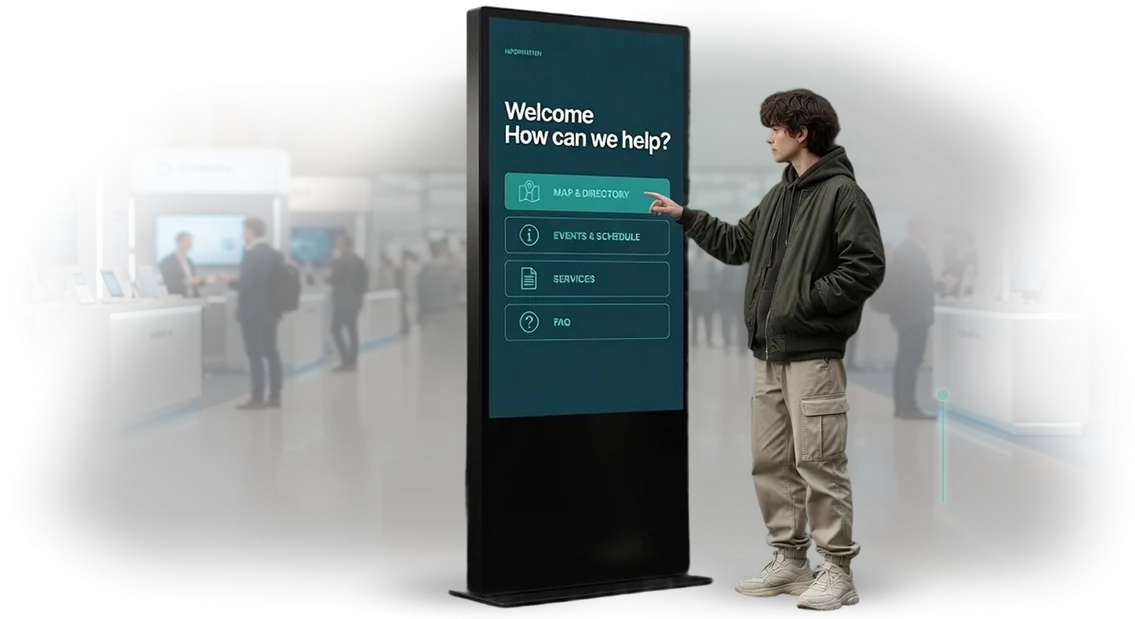
Shoppers Get Lost in the Mall and Leave Without Buying
Shoppers come to the mall with a specific intention — to find the right store, cafe, or service. But without clear navigation, this simple scenario turns into an ordeal: signs contradict each other, the floor plan is outdated, and the information desk sits empty with no staff.
After 10–15 minutes of wandering, the visitor loses patience and leaves empty-handed, without making a purchase.
For the mall owner, this is a direct loss. Each such case is not only a lost immediate sale but also damaged trust in the complex: a person will remember that it is “easy to get lost” here and will choose a more convenient venue next time. Tenants also suffer — their foot traffic and revenue drop, and so do your rental income.
Moreover, the issue is not the number of signs but their effectiveness. In a large complex, it is impossible to remember the location of every spot, so at the entrance the visitor needs a quick and intuitive tool that instantly shows the route.
He doesn’t want to squint at a small wall map — he wants to type the store name and get the optimal path.
An information kiosk solves this problem: modern mall navigation builds the optimal route to the desired store in a couple of seconds, while also showing promotions, events, and points of interest along the way.
This approach keeps shoppers inside the complex, reduces their wandering, and encourages them to visit additional locations — increasing the average ticket and tenant revenue.
We design and install information kiosks that become the hub of your mall’s navigation system. They are intuitive for people of all ages, require no training, and don’t create queues.
As a result, shoppers spend more time in the mall and leave with purchases, while you gain customer retention and steady sales growth — exactly the results that make upgrading navigation worthwhile.
What an Interactive Kiosk Gives Your Business
An interactive kiosk is not just a screen with information, but a standalone sales and marketing tool for your shopping mall. It works where the customer makes decisions: at the entrance, near the elevators, in the food court area.
A properly configured kiosk turns a casual visitor into an engaged guest who stays longer in the mall and returns again. Our team has been building such solutions for over 10 years and knows which mechanisms actually deliver results.
Here is a checklist of the key benefits you get with an interactive kiosk:
-
Attention retention. It is boring for a guest to simply read signs. A kiosk with an interactive map, promotions, and events engages them for 2–3 minutes.
During this time, the visitor has the chance to become interested in new stores and plan a route through the mall — instead of leaving immediately after a purchase.
-
Brand awareness growth. The kiosk is your own communication channel that works 24/7. It features tenant banners, event announcements, and mall news. Every interaction shapes an image of a modern and caring space, and bright animations are remembered better than static posters.
-
Additional leads for tenants. Built-in scenarios allow a visitor to leave a request: book a fitting, reserve a table at a restaurant, get a consultation. These requests go directly to the tenant’s CRM, and you help them acquire a customer without additional advertising spend.
-
Reduced staff workload. Shoppers find answers to frequent questions themselves: where the restroom is, how to get to an exit, which promotions are active today. Administrators and security stop being distracted by repetitive requests and focus on real tasks.
-
Measurable value for the management company. The kiosk gives you statistics: which sections are viewed most often, how much time is spent at the screen, which promotions generate interest. This data helps you make decisions on developing the tenant portfolio and improving navigation.
An interactive kiosk pays off not only in money — it makes your mall more convenient and modern. Guests feel cared for, tenants get traffic, and you get a manageable tool for increasing loyalty.
Take the first step: add a kiosk to the entrance or waiting area, and within a month see how the visitor flow changes.
Interactive Kiosk Formats for a Shopping Mall
Interactive kiosks in a shopping mall solve various tasks: from floor-by-floor navigation to collecting loyalty program registrations.
There is no universal solution — the right format depends on where the kiosk is located, who approaches it, and what action the visitor should take.
We tailor the hardware and scenario to each specific location: a floor-standing kiosk in the lobby acts as a flow dispatcher, a touch counter at a store entrance replaces a consultant, and an interactive panel near an escalator amplifies an advertising campaign. Here is how the main formats break down:
| Format | Tasks | What it gives the client |
|---|---|---|
| Floor-standing kiosk | Mall navigation, store locator, floor map | Fewer questions to administrators, visitors get to their destination faster |
| Touch counter | Loyalty program, registration, promo codes, requests | Collects contacts and participant database without staff involvement |
| Wall-mounted kiosk (panel) | Advertising, promotion announcements, link to website or social media | Extra reach in high-traffic areas, takes up no floor space |
| Interactive table | Education, catalog, consultation in waiting areas | Engages visitors for 5–10 minutes, convenient for large audiences |
The choice of format affects not only appearance but also how quickly the equipment pays off. A floor-standing kiosk with a touchscreen pays off through increased foot traffic to specific stores, while a loyalty counter pays off through repeat purchases.
We help you choose the format as early as the briefing stage: we calculate the traffic of the location, analyze visitor behavior, and suggest an option that won’t sit idle.
After launch, you get clear statistics — how many people used the kiosk, what they searched for, and how much the conversion of target actions increased. This way, the kiosk becomes not just a screen in the lobby but a tool that delivers measurable results.
How a Kiosk Implementation Project Works
We structure our work around your goals, not technical details. Each stage of the kiosk implementation project is documented in a plan with clear timelines and deliverables — you always know what is happening and what you get as a result. Below is a typical path from brief to launch and support.
- Kiosk brief. We record the goals: what the kiosk should provide to mall visitors — navigation, catalog, promotions, loyalty program. You receive a document that becomes the foundation of the entire project.
- Concept and commercial proposal. We propose use scenarios, placement, and equipment configuration. A transparent estimate with no hidden work — you understand the budget before starting.
- Interface approval. We create clear screen mockups and discuss the structure and logic. You approve the look and texts before development begins — no surprises after launch.
- Development and pre-testing. We assemble the kiosk and software and test stability. You see intermediate results and make revisions while it doesn’t yet require extra costs.
- Kiosk launch. We install the equipment, upload content, and set up integrations — for example, with the navigation system or product database. We conduct a short training session for mall staff.
- Support and development. After launch, we stay in touch: update content, add features, and monitor stability. If needed, we expand the kiosk network to a unified standard.
This approach helps meet deadlines and avoid typical problems — lengthy approval processes or an inconvenient interface. You run the project as a partner, not a spectator.
What Is Included in the Kiosk Solution Delivery
When ordering a kiosk for a shopping mall, you expect not just a stand with a screen but a tool that helps visitors quickly find stores, promotions, and events.
That is why the delivery package is assembled to work from day one: from interface design to staff training and ongoing support.
Here is what you get within the project:
- Interface design in your brand style — visitors recognize the mall from the first seconds, and the screen looks premium and modern.
- Clear navigation — building maps, store catalogs, promotions, and events open in just a few taps, with no instruction reading required.
- Management panel — your staff can change banners, add new tenants, and update the promotion schedule themselves through a simple web interface.
- Equipment connection and setup — we install the kiosk, configure it in real conditions, and test its operation before opening.
- Staff training — a short practical session for administrators and the information desk: how to update content and what to do in an unusual situation.
- Clear instructions and documentation — cheat sheets for the team so they can handle typical issues themselves without waiting for the contractor.
- Kiosk support — performance monitoring, remote diagnostics, and timely updates, so equipment downtime is minimized.
In the end, you get a ready-to-use navigation point that benefits visitors and requires no technical skills from your team. Everything else is our care and responsibility.
Case Study: Results After Launching an Interactive Kiosk
Case study: for an electronics retail chain in a large shopping mall, we developed an interactive kiosk with a catalog and comparison features. The goal was to reduce the load on consultants and help visitors find the product they needed faster. Three months after launch, we measured how visitor behavior changed.
What Changed After Launch
Store inquiries grew by 30% — people who used the kiosk were twice as likely to enter the sales floor and ask for a consultation.
The average time at the display increased from 1.5 to 4 minutes: instead of a quick glance, visitors studied specifications, compared models, and returned to the kiosk again.
An additional effect was a 15% increase in the average ticket, driven by showing related products and promotions.
Visitor satisfaction, according to regular surveys, increased by 25%. Guests noted that the selection process became more transparent and faster, and staff stopped being distracted by routine questions.
The retail chain extended the kiosk maintenance contract for the next season and ordered additional units in another mall.
For the mall owner, this means increased rental attractiveness and visitor retention: the kiosk adds value for guests and gives tenants a tool to increase sales.
We continue to support the project: we update content, monitor system stability, and receive analytics for each kiosk. This allows us to see which sections are in demand and adjust navigation in time for seasonal campaigns.
We turn the collected data into practical recommendations for the store — from product placement to planning advertising campaigns.
How to Choose the Right Format for Your Task
Choosing the right interactive kiosk format often seems like a difficult task — there are dozens of models in the catalog, and it is unclear how they differ from the perspective of your business. In reality, it’s simpler: the format is matched to the task the kiosk must solve in the mall.
Floor navigation, product catalog, an entertainment zone for families with children, or lead collection for marketing — each scenario has its own optimal solution, and our consultation helps you find it.
Instead of digging into technical specifications, we start with your goals. We ask a few questions about your visitors, their routes inside the mall, and the desired outcome — more time at displays, direct sales, brand awareness growth.
Based on the answers, we suggest 2–3 suitable formats: a floor-standing kiosk for the central navigation area, a wall-mounted one for installation near stores, or a compact touchscreen for collecting requests. That way, you get a solution that actually works, not just a list of hardware.
A properly chosen format directly affects payback. If the kiosk does not meet visitor expectations, people walk past it — and the investment doesn’t pay off.
When the format is chosen for the task, the number of interactions grows, the kiosk collects useful customer data, and it starts delivering value within the first weeks.
In our mall projects, we see how a smart format choice increases visitor engagement and helps stores attract repeat customers.
We are ready to give you a kiosk selection consultation. You tell us about your task, and we recommend a format tailored to your specifics, forecast reach, and launch time.
This saves you from unnecessary spending on irrelevant solutions and speeds up project launch. Just write to us, and we’ll help you choose the optimal option for your mall task.
Common Concerns Before Ordering a Kiosk
Customers often have the same questions before launching a kiosk: will it work without failures, who will update prices and promotions, how long is the wait for launch.
We have accumulated extensive experience implementing kiosks in shopping malls and prepared answers to these concerns.
What if the kiosk breaks down in the middle of the day?
No equipment lasts forever, but we minimize the risk. We use professional hardware and remotely monitor the kiosk’s condition — we react to anomalies before visitors notice a problem.
In case of failures, a warranty and spare modules are available, and an average repair takes no more than a day.
Is it difficult to update product and promotion information?
We make the interface understandable even for those who don’t work with programmers. A manager can upload new prices, photos, and texts through a personal account, and the changes appear on the kiosk almost instantly. Updates can be performed from any device without approaching the kiosk itself.
How long does it take to launch a kiosk?
We launch a typical solution in two to three weeks, and an individual project — faster than it seems: design, development, and approval stages run in parallel. You get an exact schedule at the start and clear control points so launch isn’t a surprise.
What warranty and support are provided?
Kiosks come with an official warranty, and the software is supported under a service agreement. Requests are handled within one business day; the support team assists in Russian and is trained specifically to work with kiosks.
If you have any remaining concerns — ask us directly, without retail prices and obligations. We’ll analyze your situation and tell you how to solve the task faster.Order a Project Estimate for an Information Kiosk
To get an information kiosk that truly works for your mall, start with a project estimate. It takes just a couple of minutes: you leave a request — we clarify the tasks and select a solution that fits your budget.
The estimate is non-binding, but it gives you complete clarity: which kiosk format suits you, what functionality you need, and what the launch cost will be.
After your request, you will receive:
- Consultation on kiosk types — we will choose an option for your space and visitor traffic.
- Functionality selection: navigation, product catalog, promotions, service payment — only what your tenants and customers need.
- Recommendations on the housing and hardware — taking into account the mall’s design code and operating conditions.
- Budget and implementation timeline estimate — clear, with no hidden items.
- A transparent commercial proposal with work stages and launch conditions.
- Examples of projects for shopping malls, so you can see the expected result in advance.
Leave a request on this page — and as early as the next day, you’ll have a ready launch plan. You can spend the saved time on developing your business.