

A Veterinary Clinic Losing Clients: How to Stop It?
Appointments at the veterinary clinic are declining, and the administrators just throw up their hands: the doctors seem good, but clients don't come back. Most often, the reason isn't the complexity of treatment, but the little things that spoil the impression.
Lines at the clinic, unclear where to go for an appointment, who's next, how long the wait will be. The pet owner gets anxious, and that stress carries over into their attitude toward the clinic itself.
This is especially damaging to reputation. A dissatisfied client leaves a review with a photo of the queue — and potential visitors choose another veterinary clinic without even trying yours.
Client loss becomes systemic: attracting new clients is expensive, and existing ones leave due to a lack of clarity in the process.
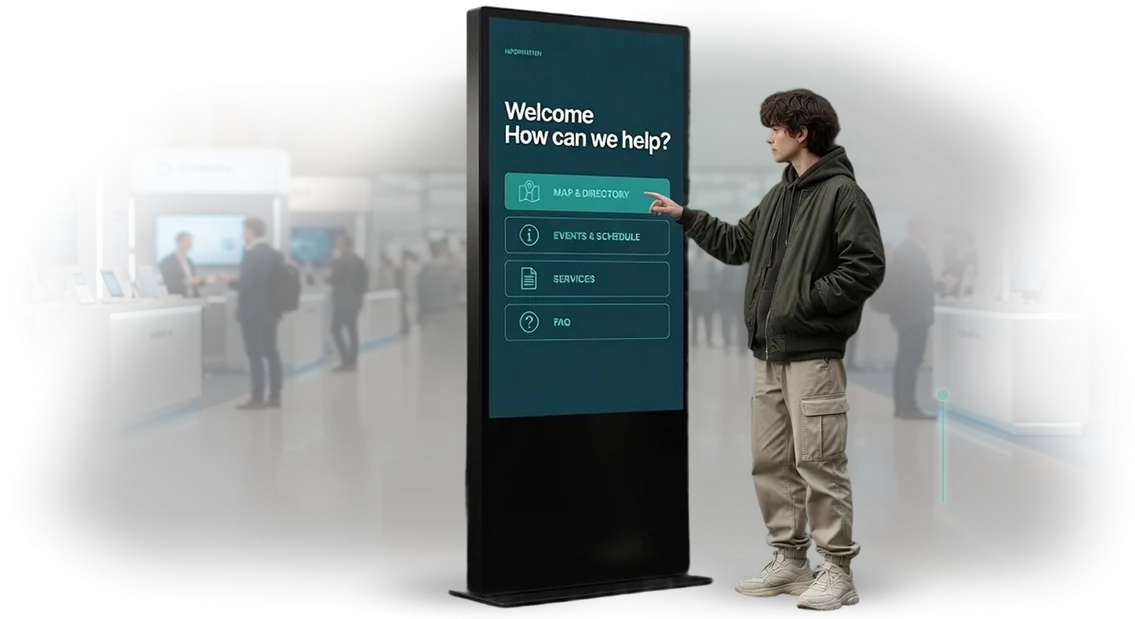
We solve this pain point with interactive information kiosks that work on the client side. A kiosk at the entrance greets visitors, shows a map of the exam rooms, a live queue status, and the nearest available appointment slot.
Navigation for clients becomes obvious: even a first-time visitor understands in a minute where to go and what to do next.
During peak hours, the line at the clinic stops being a chaotic crowd. The kiosk manages the flow: it prompts when to approach the reception desk, which exam room is open, and which tests can be done without an appointment.
This reduces the workload on staff — administrators stop answering the same questions over and over and focus on truly important tasks.
As a result, the veterinary clinic looks modern and caring. Visitors are calm, reviews become positive, and repeat visits grow. Once the kiosk is set up, you get a tool that gently retains clients every day and protects your reputation.
What an Interactive Kiosk Delivers to Patients and Staff
Reducing Staff Workload
The interactive kiosk takes over routine operations: appointment booking, visit reminders, issuing referrals and certificates.
The administrator stops being distracted by repetitive questions and focuses on truly important tasks — communicating with pet owners and managing the queue.
Patients get to the doctor faster, and staff get less tired from monotonous work. This is especially noticeable during peak hours when visitor flow is at its maximum. The kiosk works without breaks and doesn't "forget" to pass information to the system.
Better Service for Pet Owners
Pet owners appreciate not having to stand in line just to check a doctor's schedule or reschedule a visit. The kiosk lets them independently choose a convenient time, see current prices for services, and get instructions on preparing for procedures.
This increases satisfaction: the client feels taken care of. The result — more positive reviews, repeat visits, and referrals.
Growth in Upselling
The kiosk can unobtrusively offer additional services: vaccination, parasite treatment, dentistry, or pet store products. Prompts appear based on the pet's history and the current visit — the owner sees relevant options right on the screen.
As a result, the average ticket increases without active selling from staff. The client makes the decision themselves, and the clinic gains additional revenue.
Increased Loyalty
When a clinic is easy and pleasant to visit, people want to come back. The kiosk remembers preferences, stores the pet's history, and allows booking the next appointment in a couple of taps. This builds a habit of using the clinic as "their own."
Loyal clients bring friends and are less likely to switch to competitors. Staff also get data for personalized offers — for example, reminders about routine vaccinations. Together, this delivers steady growth in the regular client base.
Kiosk Formats for a Veterinary Clinic
The choice of kiosk format depends on the task you want to solve: reducing the line at the front desk, automating appointment booking, or introducing pet owners to the clinic's additional services. Each option addresses its own problem and fits into different points of client contact.
Below are typical scenarios we implement in veterinary clinics.
| Format | Who It's For | What It Gives the Client |
|---|---|---|
| Floor-standing kiosk (kiosk station) | Lobby and waiting area | Clients book appointments, pay, and print tickets themselves — the line at the front desk shrinks, and the administrator handles only complex questions |
| Wall-mounted terminal | Narrow hallways, exam room entrances, branches with limited space | Quick visit confirmation, viewing the doctor's schedule, booking a follow-up appointment — without consulting the administrator |
| Tablet kiosk | Front desk, off-site promotions, reception area | Mobile client check-in next to the doctor or in the queue, displaying services and price list on screen — increases the average ticket through upselling |
In every format, the kiosk works with your practice management system: it pulls up the pet's record, visit history, and reminds about vaccinations.
For the owner, this means transparent service without phone calls and waiting, and for you — increased loyalty and fewer booking errors.
Not sure which format suits your layout and visitor flow? We will analyze your clinic's processes, suggest an option, and show how it will pay off in the first months.
How the Project Works: From Brief to Launch
A transparent process is what removes half the questions before you even start. You always know what stage the project is at, what the outcome will be, and when the kiosk will go live. We lock in timelines and scope of work at the start so there are no surprises halfway through.
- Kiosk brief. We discuss the clinic's goals: appointment booking, price list, information about specialists, navigation, or feedback collection. We find out where the kiosk will be placed and who will use it — the interface depends on this.
- Prototype and scenarios. We show how a visitor will interact with the screen: what they see, where they tap, how many steps to the desired action. The prototype is approved before development begins — this eliminates rework.
- Design in your brand style. We style the screens to match the clinic's brand, with large buttons and clear icons. We account for the age and status of visitors so anyone can figure it out without help from the administrator.
- Development and integrations. We build the software and connect it to existing systems — for example, the doctor's schedule or the services database. We test speed and stability.
- Testing and launch. We install the kiosk on site, configure it, and run test scenarios. We train the staff and hand over instructions for the administrator.
- Post-launch support. We stay in touch: update information, monitor stability, and refine on request. This way the kiosk works as a full-fledged clinic tool.
A typical project takes three to four weeks.
The timeline is fixed in the contract, and at each stage you receive an interim result — no need to wait "until the end of the project to see something." This approach saves time and money because all corrections are made at early stages.
What's Included in the Information Kiosk Delivery
When you order an information kiosk, it's important to understand that you're not just getting "hardware with software." We put together a turnkey package — from the enclosure to training materials for staff — so that within a couple of days the kiosk is already welcoming its first visitors.
What's Included in the Package
- Equipment — a touch-screen enclosure protected against dust and moisture, with a professional display that withstands intensive use in a clinic.
- Software — an interface developed for your tasks: appointment booking, an interactive clinic map, a services catalog, information about prices and promotions.
- Installation and commissioning — we deliver, install at the right spot, connect to power and the internet, and test all operating scenarios.
- Content adaptation — we fill the kiosk with your services, prices, opening hours, and reference information. You can update the content yourself — without calling programmers.
- Staff training — in 1-2 hours we show administrators and doctors how the kiosk works, how to add information blocks, and how to handle typical situations.
- Warranty and support — service maintenance for the entire operational life. If something breaks, we come out, replace parts, update the software — the kiosk won't sit idle.
- Facility passport and documentation — a set of documents for accounting, connection diagrams, and regulations so you have no issues with regulatory authorities.
If you need electronic queue ticket printing or integration with your booking system — we'll include that in the same package. You get a single point of responsibility: one contract, one contractor, one warranty.
Case Study: How a Kiosk Increased Appointment Bookings
The front desk counter at a veterinary clinic is a perpetual line: in the morning pet owners are queued up, the phone is impossible to get through, and some bookings get lost. Those who wait an extra hour often don't come back.
We proposed moving the routine to an information kiosk to free up the administrators and give clients a fast path to an appointment without phone calls.
Our case study — the veterinary clinic chain "True Friend" with a flow of 300 visits per day. We developed a touch-screen kiosk for appointment booking, self-registration, and payment for repeat visits.
Within the first months, the system showed measurable results: the share of bookings made through the kiosk grew, the total number of reservations increased by 34%, and the project paid for itself in 4 months.
Implementation Results
- Appointment bookings grew by 34% without expanding the administrative staff.
- Reduced load on the front desk: clients choose the service and time themselves.
- Fewer lost inquiries: the kiosk works without breaks and doesn't put calls on hold.
- Fast payback: staff time savings returned the investment in 4 months.
Why the Kiosk Pays Off
Every visitor processed through the kiosk doesn't occupy an administrator at the booking stage. This frees up time during peak hours — staff focus on patients instead of paperwork.
Data goes straight into the clinic's system, eliminating double-booking errors and "lost" clients.
For the project to pay off, it's enough to attract just a few additional bookings per day through the kiosk. In our case, the growth was many times greater.
The clinic now uses the kiosk not only for booking but also for informing clients about vaccinations and service prices — another channel of care for pet owners.
How to Choose a Kiosk Format for Your Needs?
Choosing a kiosk format starts with the clinic's needs, not with a device model.
Patient flow, lobby space, the list of services, and how busy the administrators are determine what will be useful for you: a compact booking kiosk, a terminal with doctor schedules, or an interactive clinic map. The key is that the kiosk relieves staff rather than requiring constant supervision.
Think about which scenarios you want to cover: self-service appointment booking, visit confirmation, issuing referrals, or informing about vaccinations.
For quick actions, a touch screen with large buttons is enough; for more complex ones, a terminal with a pet owner's personal account. Keep in mind that many visitors are first-timers: the interface must be understandable even to those who rarely use technology.
Kiosk requirements also depend on internal processes. For appointment-based work, synchronization with the doctor's schedule is needed; for walk-in flow, a virtual queue. For a clinic chain, a unified management system and remote content updates are important.
We ask these questions at the brief stage and select a format for your situation — not from a template.
We help you choose the device, adapt the interface to the clinic's style, and test the logic on real scenarios. Launch happens without stopping the front desk. In the end, you get a tool that saves staff time and increases the loyalty of pet owners.
Frequently Asked Questions About Interactive Kiosks
Questions before implementing a kiosk are perfectly normal: you're not evaluating a tech novelty but a tool that should make life easier for your administrators and improve service quality for pet owners.
We've gathered answers to the most common concerns — about cost, timelines, security, and real benefits.
How much does kiosk development cost and what makes up the price?
The cost depends on two things: the set of features and the complexity of integration with your booking system. If you need a kiosk that books appointments, shows vaccination information, and accepts payments — that's one level of tasks.
If you need to connect it to your practice management system and set up custom design for the clinic's brand — that's another.
We always start with an estimate: you describe the scenario, we propose a solution that fits your budget. A transparent estimate without hidden fees — you know in advance what you're paying for.
In the long term, the kiosk reduces the administrator's workload: they stop being distracted by repetitive questions and can spend more time with clients who come in person.
Is the kiosk hard to implement, and will we have to change the entire clinic workflow?
Implementation takes two to four weeks — depending on how ready your patient database is. We connect the kiosk to your system, train the administrators, and provide clear instructions for staff.
Your employees will keep working as before; it's just that part of the routine operations — booking, reminders, queue checking — moves into a self-service scenario for visitors.
Within a week you'll notice that administrators are less distracted by the phone and spend more time with pets and their owners. And clients get used to the kiosk faster than you'd think: the interface is intuitive, with prompts visible on screen.
How secure is the kiosk for the personal data of owners and pets?
Security is a key focus in our design. Client data (names, phone numbers, vaccination history) is transmitted in encrypted form and is not stored on the terminal. Access to administrative functions is password-protected, and records are only shown after owner confirmation.
We work on professional equipment and use proven security tools. This is backed by a series of real projects in the medical field, where privacy requirements are higher than in most other industries.
You don't need to worry about compliance with legal requirements — we account for them at the design stage.
What if something breaks or we need changes?
We provide a warranty on the developed software and hardware. During the warranty period, we resolve technical support issues promptly — usually within one business day.
If you need to add a feature (for example, ticket issuance or integration with a new payment system), this can be done in stages without stopping the kiosk's operation.
You're never left alone with the device: we stay in touch at every stage — from the first brief to launch and subsequent system development.
What does a veterinary clinic ultimately get from installing a kiosk?
A kiosk is not just a screen in the lobby. It's a way to relieve staff, reduce waiting time for owners, and increase loyalty.
People appreciate it when a clinic has well-thought-out logistics: booking takes a minute, pet information is always at hand, and there are no lines at the reception desk.
Many clinics see growth in repeat appointment bookings: the kiosk can remind about an upcoming vaccination or show a promotional offer. This works for your revenue and simplifies staff routine — and that means it pays off within just a few months of regular use.
Order an Information Kiosk for Your Task
An information kiosk for a veterinary clinic is not just a station with a screen, but an independent assistant that relieves the administrator and speeds up booking pets for appointments.
Clients are more likely to choose a clinic where they can book an animal appointment without phone calls, check doctor schedules, and get a care guide: fewer lines, less stress, more repeat visits.
For the clinic owner, this means two benefits at once — lower staff workload and higher client loyalty. At the same time, the kiosk remains fully under your control: you decide which sections and services to show on the screen.
We handle the entire process — from the first meeting to launch and staff training. You get a ready-made solution tailored to your processes, not an abstract "software development project."
What you get when you order:
- Kiosk consultation: we'll figure out which scenarios your clinic actually needs.
- Cost calculated after audit: we lock in the scope and timeline after a short brief.
- Format selection: a touch-screen kiosk station, a queue management kiosk, or a compact option for the reception desk.
- Adaptation to your services: booking, payment, clinic map, doctor's office — only the sections you need.
- Integration with your booking system and staff training in one day.
- Post-launch support: updates, refinements, and technical support.
Leave a request for a consultation — we'll show how the kiosk will fit into your clinic and prepare a cost estimate within 2-3 days. Provide your phone number, and a manager will call you back at a convenient time.