

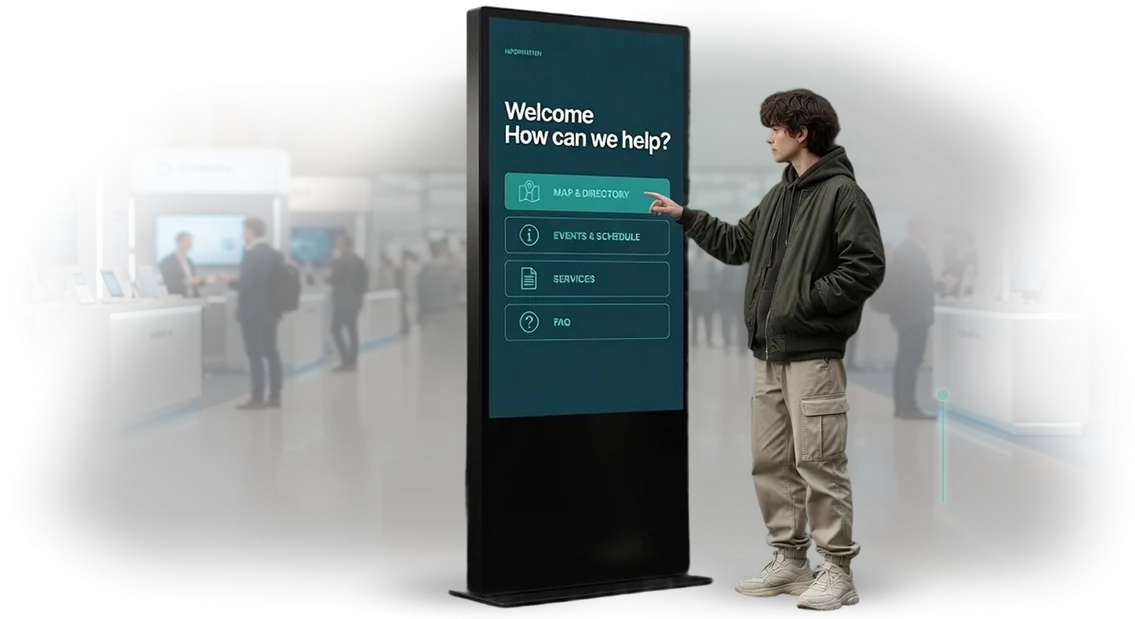
Why Car Dealerships Lose Customers Without Interactive Kiosks
A visitor walks into a dealership but leaves without a consultation — a typical lost customer for many dealership centers.
During peak hours, sales managers physically cannot give attention to everyone: some wait 10–15 minutes, others simply skim the price list and silently leave. Each such visit is unrealized revenue and an opportunity that goes to a competitor.
The problem is not just staff workload. The modern buyer arrives at the showroom already equipped with questions: compare trim levels, evaluate cost of ownership, check available options. Without fast access to this information, they lose interest and postpone their decision.
Managers are forced to repeat the same routine instead of working with warm leads and closing deals.
An interactive kiosk changes this scenario. It handles the initial consultation: it helps visitors independently explore models, colors, trims, prices, and dealership promotions.
A person gets answers in a couple of screen touches, and a manager steps in exactly when the customer has already decided and is ready to discuss the purchase. Implementing such a solution is not replacing staff — it is strengthening them.
The result — no visit goes unattended, even at peak hours. The dealership stops losing customers at the first-contact stage, expands consultation coverage, and accelerates the path to purchase.
Interactive kiosks run on professional hardware and reliable server architecture, so the client gets stable system performance on any day — from weekdays to holiday sales.
What Benefits Your Business Will Get from an Interactive Kiosk
A dealership visitor is often lost: there is a showroom, but no live contact with the brand. Employees are busy, the customer studies specifications on their own and leaves without emotion.
A touchscreen kiosk solves this problem — it holds attention, involves the customer in the selection process, and drives them to action.
We develop interactive kiosks for car dealerships that turn passive viewing into lively interaction. Over years of work, we have gained experience that helps clients achieve measurable results — not just a beautiful screen, but a sales tool.
Engagement and Time at the Showroom
Visitors choose for themselves what to view: body color, trim, interior, additional options. This kind of interaction holds attention 3–5 times longer than a regular car inspection or a paper catalog.
The longer a person explores the offer, the higher the chance they will become interested in a specific model.
Conversion to Test Drives and Sales
The kiosk not only shows information but also offers booking a test drive right on the spot. The customer sees available slots, leaves contacts — and the manager receives a hot lead without extra effort.
This shortens the path from interest to action and increases the share of visitors who get behind the wheel.
Coverage and Convenience for Staff
The interactive kiosk answers common questions and works without getting tired, freeing up managers to talk with customers ready to buy. Built-in analytics show which models and options generate the most interest — helping adjust the display lineup and advertising campaigns.
Interactive Kiosk Formats for Car Dealerships for Any Task
A dealership visitor arrives with genuine interest but often without a precise request. If they do not get an answer within a couple of minutes, they leave for a competitor.
An interactive kiosk solves this problem: customers find information about models, trims, and prices on their own, and managers are not distracted by routine questions. Wemake three kiosk formats, each covering a specific showroom need.
Main Formats
| Format | Who It Is For | What It Gives the Customer |
|---|---|---|
| Display Kiosk | Dealership entrance area, exhibitions, test drives | Immediately engages the visitor: video reviews, exterior and interior overview, model advantages. Increases dwell time and interest in the car. |
| Car Configurator | Customers who want to build "their own" car | Real-time visualization of color, wheels, and options. The visitor sees the final configuration and price — making it easier to move to ordering or speaking with a manager. |
| Price Kiosk | High-traffic showroom, waiting area | Quick search by model, trim comparison, promotions. Reduces the load on managers — the customer does not wait and does not leave without an answer. |
Whichever format you choose, we adapt it to the dealer's brand identity and connect it to current vehicle availability data. The kiosk runs on professional hardware, so it consistently handles visitor traffic and never lets you down on the busiest days.
Each format is complemented by test-drive booking or contact collection — the kiosk transforms from a display into a source of leads for the sales department.
How the Kiosk Development Process Works, from Brief to Launch
Developing a kiosk for a car dealership is a transparent process in which you participate at every stage. We start with a short brief without unnecessary questionnaires, then move step by step, getting a finished result that can be evaluated and adjusted.
-
Brief and Goals. You answer 5–7 questions: who the audience is, which features matter, what the kiosk should do — catalog, test-drive booking, or lead collection. That is enough to plan the work.
-
Prototype. We put together a screen map and logic: how a visitor selects a car, compares trims, and leaves contacts. You see the future kiosk "on paper" — without programming or extra costs.
-
Design Approval. Styling in the showroom's corporate identity: your colors, logo, fonts. The kiosk becomes part of the interior and works for brand recognition.
-
Development. We create the application: model catalog, photos, specifications, request forms. You get access to intermediate versions and make edits along the way.
-
Testing and Launch. We check it on real touchscreen hardware in the dealership, resolve the details, and install the kiosk. On launch day, it is ready to receive visitors.
-
Support. We update the catalog, add new models and promotions, and solve technical issues. Your managers focus on sales, not software.
What's Included in the Delivery: A Complete Package for Your Kiosk
When you order a kiosk from us, you get not a "program on a flash drive" but a working sales tool that can be launched within just a few days. The delivery package covers every stage: from the interface the customer sees, to staff training and ongoing support. Working together with our team — you get a turnkey solution, not a set of files.
Here is what the package includes:
- A kiosk interface adapted to your dealership — model catalog, trim levels, prices, promotions, and special offers. Visitors find the information they need on their own, without waiting for a manager.
- A server side and control panel — you can update prices, add photos of new cars, and change banners yourself, without hiring a programmer.
- Instructions and guidelines — short reference sheets for staff: how to turn on the kiosk, reboot it, replace content, or quickly solve a minor issue.
- Training for your employees — we conduct a training session for managers and administrators and demonstrate work scenarios using real car-sales examples.
- One-year warranty support — we answer questions, update the interface, and restore kiosk operation remotely or on site in the event of failures.
- Design mockups, source files, and access credentials — everything stays with you. You are not tied to the contractor and can develop the system further on your own at any time.
Such a package addresses the main fears of a business owner: no need to hunt for developers for every small detail, control deadlines, or get into technical details.
You get a clear tool that works for your sales department from day one, while all technical routine remains on our side.
Case Study: How an Interactive Kiosk Boosted Sales at a Dealership Center
At a dealership center, every visitor is a potential buyer, but during peak hours managers physically cannot give attention to everyone. People wait, scroll through their phones, and often leave without even starting a conversation.
For a car dealership, this is a direct loss: fewer consultations — fewer test drives — fewer sales. Each such departure is a lost lead, and on weekends it adds up to dozens.
We solved this problem for the Moscow dealership center AvtoPremium and installed an interactive kiosk at the entrance.
It replaced outdated brochures and took over the routine: the visitor chooses a model, compares trims, changes colors and options, sees the price, and leaves a test-drive request in a couple of touches.
The manager steps in for an already "warm" customer instead of spending time explaining the basics. The kiosk works without days off and does not get tired by evening.
The effect was felt immediately. The average wait time for a consultation dropped from 30 to 10 minutes — people stopped leaving and started exploring the cars. Test-drive requests grew by 40% in the first month, with most coming on weekends when traffic used to simply be lost.
Most importantly, the kiosk affected sales. A customer arrives for a test drive already with a chosen model and readiness to buy, so the consultant finds it easier to close the deal.
The center noted an increase in sales among visitors who used the kiosk and decided to roll out the solution across all showrooms. This confirms a simple idea: a convenient tool for the customer is real revenue growth for the automotive business.
Answers to Common Questions About Touchscreen Kiosks
Before ordering a touchscreen kiosk for a car dealership, customers ask the same questions: reliability, convenience for visitors, launch timelines, and content updates. We answer directly, without technical details.
What happens if the kiosk breaks down?
We support the project after launch: we monitor operation remotely and respond quickly to failures. If the device requires repair, we provide a replacement unit for the duration — as per the contract.
Won't the screen be difficult for visitors?
The interface is built on the principle of "goal in three touches." Catalog, prices, credit, and test-drive booking are available without hints. We test scenarios on real users so the customer never gets lost.
How long does implementation take?
From design approval to a working kiosk usually takes 2–4 weeks. While the device is being prepared, we fill the content in parallel — by delivery, it is already working.
How do we update information?
You change promotions, prices, and news yourself through a simple panel. You can set up synchronization with your website so the data stays consistent. Changes appear on the screen within a couple of minutes.
Discuss Your Project: Get a Cost and Timeline Estimate
Leave a request — and within an hour we will get back to you with a preliminary cost and timeline estimate.
For a car dealership, it is important to understand what the project will cost and when the kiosks will start working for visitors, so we immediately provide realistic figures based on your task description.
Next — a prototype. We will show what the touchscreen kiosk logic will look like: car catalog, test-drive booking, and promotion banners. You evaluate the interface through the buyer's eyes, and we refine the details before the main development begins.
What you get after contacting us:
- Your request is processed within an hour — no need to wait for days for a response.
- A cost estimate based on your scenario: how many screens, which features, whether CRM integration is needed.
- Launch timelines — we give dates and intermediate milestones so you can plan your showroom opening or renovation.
- An interactive kiosk prototype — you see the logic and design before paying for the main work.
- Recommendations on placement and usage scenarios — useful even if you have not chosen a contractor yet.
- Support after launch: content updates, refinements, and technical support by our team.
For the estimate, we only need a few details: the number of kiosks, the planned functionality, and the timeline. Leave a request on this page or call us — we will discuss the task, prepare a commercial proposal, and a prototype.
How to Choose an Interactive Kiosk for Your Business Needs?
It makes sense to choose a kiosk not based on price or design, but on what task it should solve in your showroom.
For a car dealership, there are usually three scenarios: help customers navigate the model lineup, collect contacts for the sales department, and reduce waiting time for consultations.
By answering what exactly is hindering current sales, you will understand which format and functionality you actually need, and which would just be an expensive display.
The size of the showroom and its traffic determine the number and placement of kiosks.
In a compact showroom with one or two consultants, one stand at the entrance is enough: customers explore the catalog, configurator, and vehicle availability on their own, and the manager steps in for an already interested visitor.
In a large dealership center with waiting areas and multiple entrances, it makes sense to place a kiosk in each zone — by the displays, near the coffee point, and in the service department.
This way, you do not lose visitors who are not yet ready to talk to a salesperson but are already exploring options.
The target audience profile will tell you which interface will be more convenient. If families with children and older people visit you, use large buttons, simple labels, and quick access to key models.
If the main audience is young buyers, add video reviews, spec comparisons, and clear visualization of trim levels.
A universal rule: the kiosk should answer the customer's main question within 30 seconds — "is there such a car and how much does it cost" — and only then offer a deeper dive into details.
Finally, marketing goals turn the kiosk from a reference tool into a sales tool. To collect leads and contacts, integrate a form into the scenario: first the customer selects a car, then leaves a phone number for a personal offer.
To boost brand awareness, set up branded screensavers and promotions. Seamless scenarios also work well: the customer schedules a test drive themselves at the kiosk, and the event immediately appears in the manager's calendar.
A model the visitor built on screen can be sent to their email — this helps keep their interest alive after they leave the showroom.
The main thing is not to try to implement all features at once. Start with two or three scenarios that solve your current pain point, and leave room for expansion: adding new models, CRM integration, changing promotions.
Then the kiosk will work for the business from day one, instead of becoming a "future-proof" project.
Translate the above into English. Preserve structure exactly.