

The Problem with Corporate Training Centers: Losing Learners
Learners sign up for a course, but only part of the group makes it to the finish line: some skip classes, some get distracted by work tasks, some lose motivation.
For a training center, this means not only lost revenue but also a damaged reputation — recommendations come from those who actually completed the training and applied the knowledge.
The cause is almost always the same: training is built on passive perception. Lectures, presentations, and long texts are exhausting, while the learner needs active contact with the material for attention retention to drive results.
The longer a person remains in the role of an observer, the faster they lose engagement and interest.
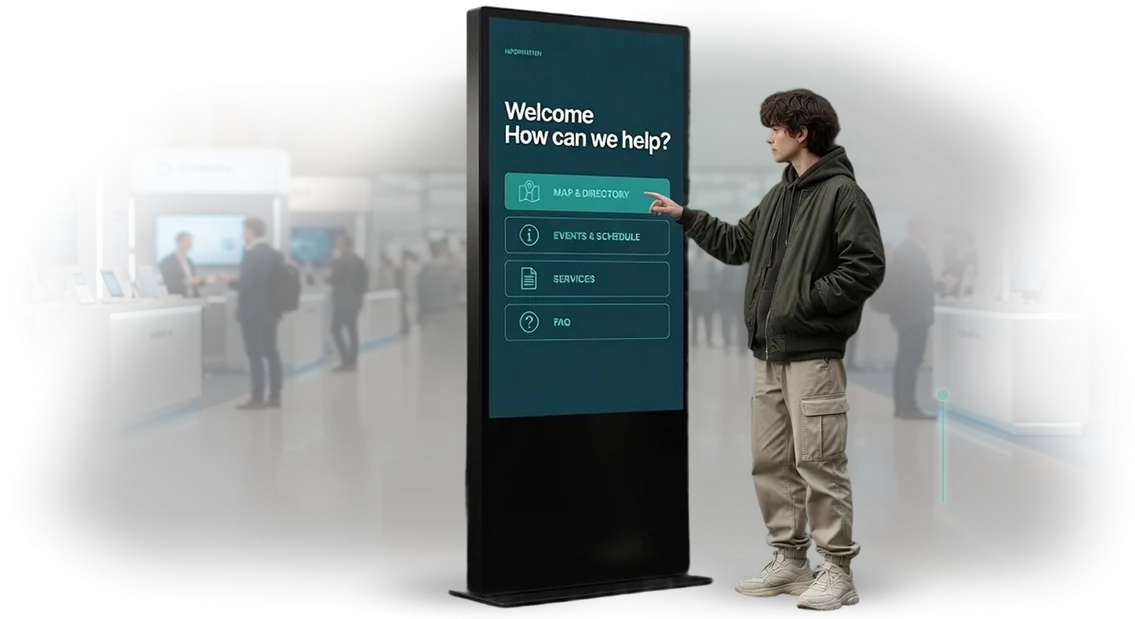
This is exactly where interactive training kiosks help. They turn complex topics into short practical sessions: the learner chooses their own pace, answers questions, works through cases, and sees results immediately.
This restores learner engagement — the person stops being a passive listener and becomes an active participant in the process.
Training center managers notice the effect within the first weeks: fewer absences, higher average scores, more people reaching final certification. Kiosks operate without breaks, relieve instructors, and create a unified standard for delivering material across all groups.
We design interactive kiosks tailored to your training center's specific needs: from learning scenarios to a design that is easy to update. This is a simple way to keep learners engaged and turn one-time visits into long-term partnerships with client companies.
What Benefits a Company Gets from an Interactive Kiosk
An interactive kiosk for a corporate training center is not just another screen in the lobby. It is a working tool that directly affects the speed of employee onboarding, the quality of material retention, and instructors' workload.
The company gets a measurable result: training becomes faster, more predictable, and cheaper at scale.
Interactivity in training changes employee behavior. Instead of passively watching a presentation, the person controls the scenario themselves: chooses topics, repeats difficult modules, answers questions.
Such engagement increases material retention by 30–40% compared to regular instruction. People actually complete the training rather than going through the motions, because the kiosk holds their attention and provides instant feedback.
Efficiency gains are achieved by relieving tutors. Typical questions — how to get set up in the system, where to find regulations, how to pass an assessment — the kiosk handles on its own.
Instructors stop spending time on repetitive explanations and focus on complex tasks, individual work with newcomers, and developing new programs. As a result, one tutor can manage a flow that previously required two or three people.
User convenience means freedom to choose when and at what pace to engage. An employee is not tied to the class schedule and does not wait for a mentor to become available. They walk up to the kiosk during a convenient break, complete the needed module, see their progress.
The interface is understandable even to those unfamiliar with technology, and on-screen prompts remove any fear of making mistakes. This is especially important for production and logistics departments, where people are used to simple and concrete actions.
Training control stops being a headache. A manager can see at any moment who has completed the course, who is stuck at a particular stage, and how many attempts were needed.
No need to collect paper signatures or maintain Excel spreadsheets manually — all statistics are collected automatically and available in a convenient report.
This makes it possible to spot problem topics in time and adjust the training program, rather than discovering gaps after certification.
In the end, the kiosk becomes the entry point to the training system, saving the staffing budget, accelerating employees to the required level of competence, and giving management a transparent view of knowledge across the team.
The investment pays off through reduced spending on tutors and increased efficiency of every training hour.
What Formats of Interactive Kiosks Are Available
Interactive kiosk formats differ in installation method, coverage area, and usage scenario.
For corporate training centers, it is important that the kiosk not only attracts attention but solves a specific task: speeds up navigation, helps with training registration, conducts testing, or replaces paper instructions.
A floor-standing kiosk looks great in lobbies and waiting areas — it is visible from afar, draws visitors in, and immediately engages them in the interactive experience.
A wall-mounted kiosk is compact, takes up no usable floor space, and is ideal for corridors, near meeting rooms and training classrooms.
A touchscreen kiosk with a display is a universal option for the training itself: you can show courses, surveys, and internal materials at any convenient time.
| Format | For Whom | What Task It Solves |
|---|---|---|
| Floor-standing kiosk | Training centers with high visitor traffic | Interactive navigation, program announcements, course registration without queues |
| Wall-mounted kiosk | Compact areas, reception, corridors | Space savings, quick sign-up with a trainer, access to schedules and materials |
| Touchscreen kiosk | Corporate training centers | Self-learning, testing, feedback collection, and launching training modules |
For the format to truly support training, what matters is not only the enclosure but also the software side. Content must be easy to update without developer involvement: changed a program or added a new trainer — the information instantly appears on all screens.
A properly chosen kiosk format reduces the time employees spend on administrative matters, while guests and students walk away with a positive experience of interacting with the center.
How Kiosk Development Works: From Brief to Launch
Working with a contractor often feels like a black box: it is unclear what stage the project is at, when the first results will appear, or whether something might surface at the last moment.
To avoid this, we have built the kiosk development process as an open system with clear stages and control points. You always know what is happening and can influence the outcome.
-
Brief and task immersion. We start by discussing your training center's goals: who will use the kiosk, which scenarios need to be covered, and what content already exists. We record your requirements and constraints — this becomes the foundation for the entire project.
-
Project approval and technical specification. Based on the brief, we prepare a document covering the operating logic, content structure, design direction, and timeline. After your approval, implementation begins — no "creative" deviations from what was agreed.
-
Prototype and design concept. We show what the kiosk screen will look like and how users will navigate through the materials. You see the interface before programming starts and can make edits — this is cheaper than reworking a finished product.
-
Development and content population. We build the kiosk itself: interface, logic, integration with your training materials, texts, videos, and tests. At this stage, you receive intermediate versions for review and feedback.
-
Testing and debugging. We test the kiosk on real touchscreen hardware: how quickly the screen responds, whether materials open correctly, and whether any "dead ends" occur in the scenarios. We fix everything before your learners ever see the kiosk.
-
Launch and support. We install the kiosk on site, test it in live operation, and train your staff. We grant access to usage statistics and remain available for refinements and content updates.
Thanks to this process, every stage ends with a concrete result that you can see and approve. If something goes wrong, it is visible immediately — not a week before launch. In the end, you get a working tool, not a "surprise" at the end of the project.
What Is Included in the Interactive Kiosk Delivery
When you order an interactive kiosk for a corporate training center, it is important to understand what the delivery consists of.
We put together a turnkey package — from the touchscreen panel to the training content — so that after installation you do not have to purchase or configure anything extra.
The delivery includes:
-
Hardware and enclosure. A touchscreen panel of the required size in a protective housing. Suitable for lobbies, waiting areas, and training classrooms, and built to withstand constant use.
-
Kiosk design. We create the exterior look in your brand colors with your logo and clear navigation. The device fits into the interior and helps employees find their way.
-
Software. A training system: course catalog, tests, result recording. The admin panel is simple — a methodologist can update materials without developers.
-
Content population. We structure the onboarding course, instructions, and cheat sheets around your program. The employee works through the needed module at their own pace.
-
Launch and integration. Installation, network setup, and connection to your internal records system so results flow into your overall reporting.
-
Warranty and support. Warranty on hardware and software, consultations, and updates after launch. In case of failure, we restore operation remotely.
This package covers the entire journey from first touch to training results reporting. You get a working tool for staff onboarding, not a box of hardware you have to "bring to life" on your own.
Case Study: How an Interactive Kiosk Paid for Itself in 4 Months
In corporate training centers, everything often comes down to administrative routine. Employees waste time in queues to sign up, trainers waste time collecting paper forms, and managers cannot see the real picture of attendance.
Our client was a large center where several hundred people undergo training daily, and every process required manual involvement.
We proposed an interactive kiosk as the entry point to training: registration, course selection, navigation between classrooms, and feedback. "Corporate University" launched a pilot across two floors — within a month it was clear the project was working.
The results are measurable. Course registration time dropped from seven minutes to one and a half, and the number of employees who completed their training rose by a third.
Administrators stopped entering data manually — the kiosk does this work faster than three full-time staff members.
Let's calculate the payback. The development cost was covered by freeing up administrators' time and reducing missed classes. By the fourth month, the project had broken even, and since then it delivers savings with every new cohort of learners. Moreover, the kiosk requires no constant oversight — it operates autonomously.
Today the center uses the kiosk as a core tool, and we have received a repeat order for two more buildings. If you have a similar workload — book a consultation and we will show you a payback calculation for your specific flow.
Common Questions and Concerns Before Ordering a Kiosk
For a training center manager and their team, an interactive kiosk is a working tool. Course registration, campus navigation, and the speed of content updates all depend on it.
That is why reasonable questions arise before ordering: will it break, who will maintain it, how quickly are problems resolved. We hear these on every second project and have prepared honest answers.
Over 10+ years, we have delivered dozens of such projects for training centers. Most concerns are resolved at the design stage: the kiosk is assembled from professional components, undergoes hours of testing, and is accepted against a checklist.
After that — warranty and a dedicated account manager on call, so maintenance will not fall on your team.
Will the kiosk break down in the first month of operation?
We use industrial-grade components designed for daily use in high-traffic locations. Before shipping, the kiosk is tested in real-world scenarios: hundreds of touches, content loading, reboots.
If something does go wrong — the warranty covers it, and we resolve the issue without involving your staff.
Do we need a dedicated employee to maintain the kiosk?
No. The kiosk reports abnormal situations on its own, and we provide remote monitoring. Your administrator only needs to wipe the screen once a week and check the connection.
We handle content updates, diagnostics, and support — on request or on a schedule, with no burden on your IT department.
What about warranty and repairs?
We provide an official warranty on equipment and work. If a breakdown occurs, you submit a request — within two business days we run diagnostics and replace faulty components if needed.
This does not disrupt the training schedule, because the kiosk is repaired quickly and a replacement unit is provided during the repair period.
How to Choose a Kiosk for Corporate Training Needs
Choosing a kiosk for corporate training starts not with the device model but with the training program. There is no one-size-fits-all solution: short video instructions for new employees are one thing; final testing or interactive simulators are another.
So first, we define what exactly the user will do at the screen: watch, read, answer questions, or work through a practical scenario. The kiosk format, screen diagonal, and interface logic all depend on this.
Next, we look at operating conditions: how many employees go through training daily, whether several people need to work simultaneously, and where the kiosk will be placed — in the lobby, a meeting room, a training classroom, or a transit zone.
For busy locations, a floor-standing unit with a vandal-resistant enclosure is the right fit; for small groups, a compact wall-mounted screen works better. What matters is that an employee does not stand in line and can complete training at a convenient time.
The third criterion is how easy it is to update content. Training materials change often: new regulations are added, new products are introduced, tests are updated. The kiosk must let an administrator upload materials without developer involvement and without stopping operations.
If content updates happen directly on the device or through an admin panel — that saves your team hours and reduces dependence on the contractor.
And the last but equally important point — results tracking. For corporate training, it is critical to see who has completed the material, which questions caused difficulties, and to help those falling behind in time.
A properly chosen kiosk collects this statistics and passes it to your learning system, giving you a transparent picture for each group.
We help you select the format and functionality for your specific training program: we analyze the scenario, audience, and infrastructure, then propose a solution that pays off through training automation and increased employee engagement.
Get a Consultation on an Interactive Kiosk
Leave a request — and within one business day we will prepare an individual solution for your training center, tailored to your learning scenario.
You will receive a consultation from a specialized expert and an accurate cost calculation for your project, without needing to dig into technical details. We will analyze your formats, facilities, and employee numbers ourselves.
What You Get After Reaching Out
- A consultation with an expert on interactive kiosks for corporate training centers — we will discuss your training formats, placement points, and expected results.
- A cost calculation for your project: no hidden conditions and a clear structure — you immediately see what you are paying for and can compare with alternatives.
- A demonstration on your content: we will show how the kiosk works with tests, lectures, and instructions before you decide to move forward.
- Recommendations on usage scenarios — how to increase employee engagement and reduce time spent on knowledge checks.
- A launch plan with concrete timelines and stages — from approval to installation and administrator training.
- Support at every stage and a guarantee on results: we stay in touch after launch.
Tell us about your task — and we will prepare a solution that fits into your training process and delivers a measurable effect within the first quarter of operation. This comes with no obligation.