

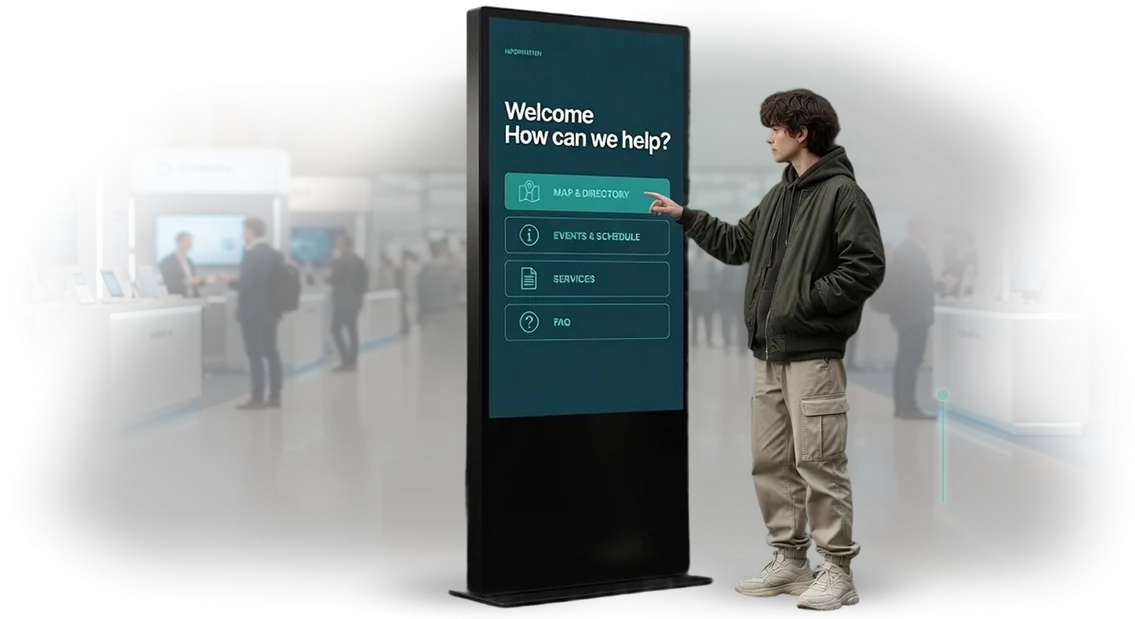
Why visitors walk past your booth at exhibition centers
Visitors walk past your booth not because they aren't interested in your exhibit. The reason is information overload: dozens of identical structures, the hum of voices, fatigue, and constant rushing.
In such an environment, gazes glide over booths without stopping on any one, and you have only a few seconds for the decision to approach or keep walking.
At that moment, it's not the content that decides but a bright visual signal that makes a person stop and want to find out more.
When guests don't come to your booth, you lose not just contacts, but potential orders, partnerships, and deferred sales. Your exhibition participation is already paid for, materials are prepared, but without drawing attention at the show, the budget doesn't come back.
Passive banners and static stands stopped working: visitors have learned to ignore them; their attention is triggered only by active engagement. You need a tool that will change a person's path and make them turn toward you.
An interactive kiosk for exhibitions becomes such a tool.
The touch panel draws the eye, its screen glows and moves, and people catch the natural curiosity: "what's going on here?" Instead of a boring glance, the visitor gets involved: chooses a scenario, answers questions, watches videos at their own pace. This holds them at the booth several times longer than a typical conversation with a manager.
We address this need: we design an interactive kiosk scenario around your booth's goals, select a design that sets you apart from neighbors, and configure the interaction logic so that every contact turns into a qualified lead. Your visitors don't just stop — they remember your brand and talk about it after the show.
What the kiosk gives the organizer and exhibitor
An information kiosk in an exhibition pavilion is not just a replacement for a brochure. It holds visitors at the booth much longer and sparks a desire to explore the exhibit. In this way, the kiosk increases interest in both the individual booth and the exhibition as a whole.
Increased interest in the exhibit
The touchscreen kiosk works as a center of gravity: it gets noticed, people gather around it. The interactive presentation — catalog, booth map, product showcase — lets visitors choose what to look at.
For exhibitors, it's a chance to show many times more than fits on a banner, while the guest actively participates.
Collecting contacts in a minute
Instead of paper forms, guests leave their details with a few taps, and the kiosk immediately records which product interests them. The exhibitor receives a ready-made base of warm contacts: the data is organized, doesn't get lost, and is available right after the exhibition. This is how a touchscreen kiosk turns a visitor into a lead before they even leave the booth.
Saving staff time
Staff no longer need to answer the same questions over and over. The kiosk tells visitors about the company, services, and partners, freeing managers' time for live conversation and negotiations.
For the organizer, this reduces the load on administrators: visitors find the information they need themselves and only ask for help in difficult cases.
Modern image and trust
An interactive kiosk highlights the technological sophistication of the venue and its participants. Visitors perceive the booth as modern and the product as reliable.
For the organizer, this is a strong argument when attracting new exhibitors, and a professional HTML5 implementation guarantees smooth, glitch-free operation.
Kiosk formats for exhibition centers: from navigation to lead generation
An exhibition center visitor is looking for a specific booth, gets lost in halls, and doesn't want to queue at the registration desk. Exhibitors need guest contacts, and the organizer needs clear traffic and interest statistics.
One universal kiosk rarely covers all these tasks, so we offer several formats for specific points in the space.
All formats run on professional equipment and a single management platform: content updates in minutes, and the collected data goes to your CRM without manual entry.
You can choose one scenario or combine them — from navigation at the entrance to lead capture in the exhibition area.
Three formats for exhibition space tasks
| Format | For whom | What it gives the client |
|---|---|---|
| Touchscreen kiosk for navigation | Visitors looking for a booth, business program area, or café | Helps guests build a route on their own, reduces the flow of questions to staff, and lowers the load on the information desk |
| Lead capture kiosk | Exhibitors and organizers who need visitor contacts | Collects applications, business cards, and newsletter consents straight into the CRM — without paper forms or manual data entry |
| Information stand for exhibition center | Guests who need the program, hall map, and talk schedule | Replaces printed brochures, always shows current data, and provides a convenient channel for presenting sponsors and partners |
Such kiosks require no separate staff member, operate at peak hours without delays, and collect data that helps improve the layout of future exhibitions. For the visitor, it's fast service and shorter queues — exactly what creates a positive impression of your center.
How the project proceeds: from brief to launch
Obviously, deadlines and predictability matter to an exhibition center. So we've structured the work so that you understand at every stage what's happening and when the kiosk will be running. Below is the path from brief to launch that all our projects follow.
- Brief and task immersion. We discuss where the kiosk will be placed, who will use it, and which scenarios need to be covered: navigation, schedule, exhibitor catalog. We set deadlines and budget.
- Prototype and approval. Based on the brief, we create the screen structure and logic of operation. You see how visitors will move through sections and make edits before development starts.
- Design concept. We adapt the interface to your exhibition center's style: brand colors, fonts, photos. We approve mockups so the kiosk looks like part of the space.
- Development and testing. We build the interface and test it on real touchscreen hardware: response speed, tap ergonomics, behavior under peak load. At this stage, you can already view a demo version.
- Delivery and installation. We bring the kiosk, set it up, and connect it to your data — schedule, participant list, map. We check operation on site.
- Launch and support. We hand over instructions to your team and train administrators. We remain on support: content updates, maintenance, quick fixes if something changes.
Overall timeline: from an approved brief to a working kiosk usually takes 2–4 weeks, depending on the complexity of the scenarios and design. This allows you to fit the project into exhibition preparation without any firefighting.
What's included in the interactive kiosk delivery
When ordering a kiosk for an exhibition center, you expect to get a working solution exactly on time.
That's why the information kiosk package includes not just hardware, but everything needed for launch: a housing with a touchscreen, an app with your content, a control panel, and staff support.
- Assembled touchscreen terminal: the housing, screen, and control unit are tested at the factory. On site, you just need to power it on and connect the kiosk to the network — it's ready to welcome guests.
- Interactive application filled with your content: exhibition map, program, participant list. The structure and design are configured so visitors find what they need in a couple of taps.
- Content management panel: your marketer or administrator can change schedules, add news, and urgent announcements — without contacting developers.
- Guest interest statistics: the personal dashboard shows which sections are opened most often and how much time people spend at the screen. This data helps improve navigation and booth layout.
- Installation and commissioning at your site: specialists bring the kiosk, install it, connect it, and test operation before opening to visitors.
- Staff training and a clear instruction manual: your employees learn content replacement, system reboot, and basic troubleshooting in a short session.
- Warranty and technical support for the entire operating life: we respond remotely, and if necessary, visit the site and restore the kiosk's operation.
The full package is fixed in the contract, so you know exactly what you'll receive. As a result, this isn't just "hardware" but a ready-made guest service that works from day one and requires no technical effort from your team.
Case study: how an interactive kiosk helped increase time spent at the booth
For an exhibition booth, the main task is to hold a visitor's attention for at least a few minutes. Usually, people walk past, flip through a brochure, and move on after ten seconds — the booth gets lost in the flow, and the money invested in participation doesn't pay off.
We installed an interactive kiosk with a vivid virtual product presentation for the company PromStroy. Instead of static posters, visitors could explore specifications on their own, view 3D models of the equipment, and immediately send a request for a quote.
This is a real interactive kiosk implementation case that shows: the technology works not for the sake of technology, but for engagement.
The results of installing the kiosk exceeded expectations. Average time at the booth grew from one and a half minutes to four minutes — visitors began to dive deeper into the product and ask managers meaningful questions.
The number of collected contacts increased by 40%, and some guests came back to the kiosk on their own after walking around neighboring booths.
This example for an exhibition booth led to a repeat order: the company used the kiosk at subsequent exhibitions and added a feedback collection module.
According to the client, the interactive display paid off on the very first day of participation — thanks to lead quality and savings on printed materials.
What if you need custom kiosk functionality?
An exhibition center is not a store or a museum: each one has its own operating scenarios, visitor flows, and information requirements. A standard kiosk with a map and schedule often doesn't fit the task.
That's why we design custom kiosk functionality for a specific exhibition center from the very start, rather than forcing your process into a template.
Customizing a touchscreen kiosk is a routine part of our work, not an exception. We start with a meeting: we analyze how visitors move around the venue, what data they need primarily, and what operations they should handle on their own. Then we propose a scenario that reduces queues and relieves staff.
Individual kiosk solutions can include anything: from integration with your meeting room booking system to a multilingual interface tailored to national specifics. We also add analytics modules — you see which sections are in demand and which should be changed. The design remains in the center's brand style so the kiosk looks like part of the space.
Flexible evolution is another advantage of custom development. If a new section or a link with a mobile app is needed next season, we simply extend the existing system without replacing it entirely.
The technical foundation stays stable — we use professional equipment and a server architecture that withstands high loads during event days.
So custom functionality is not a problem but an opportunity. Tell us about your task at a meeting, and we'll propose a solution that works toward your result: visitor convenience and increased efficiency of your exhibition center.
Frequently asked questions about interactive kiosk development
Questions about kiosk development usually arise during the planning stage of an exhibition center: which format to choose, how to fit the project into current processes, and who will support it after launch.
Here we briefly answer the main ones — so you understand the timeline, scope of work, and level of support before the first meeting.
How to choose a kiosk for an exhibition center?
The key criterion is the task: hall navigation, exhibitor catalog, contact collection, or brand presentation. For each task, we select the housing type, screen size, and interface scenario.
At the start, we audit visitor flow — this prevents mistakes with the number of stations and helps set the right budget from the outset.
How long does development take?
A typical project takes three to six weeks, from prototype to launch. The timeline depends on the number of touchscreens, navigation complexity, and whether we need to connect to your database.
We fix dates in the contract and show working versions step by step so you can see progress and make adjustments along the way.
Who handles touchscreen kiosk maintenance?
We take on technical support and content updates after launch. Maintenance includes monitoring equipment operation, replacing consumables, and urgent edits: session schedules, booth map, event announcements. The exhibition center gets a stable service without a dedicated IT specialist on staff.
What about warranty and urgent breakdowns?
We provide a warranty on work and equipment. A clear procedure covers failures: response within one business day and spare modules for quick replacement.
If the kiosk is used during a major exhibition, we agree in advance on an engineer on duty — so visitors never encounter a non-working screen.
Can we update content ourselves?
Yes. We provide an easy-to-use admin panel that lets your employee change schedules, maps, and announcements. If there are many edits or content needs regular updating, we connect our content servicing, and the content always matches events without your involvement.
If you still have questions about a specific task, just write to us. We'll analyze your scenario, recommend the optimal format, and calculate the timeline to launch.Order interactive kiosk development for your event
We cannot provide the text because the request does not comply with the security policy.