

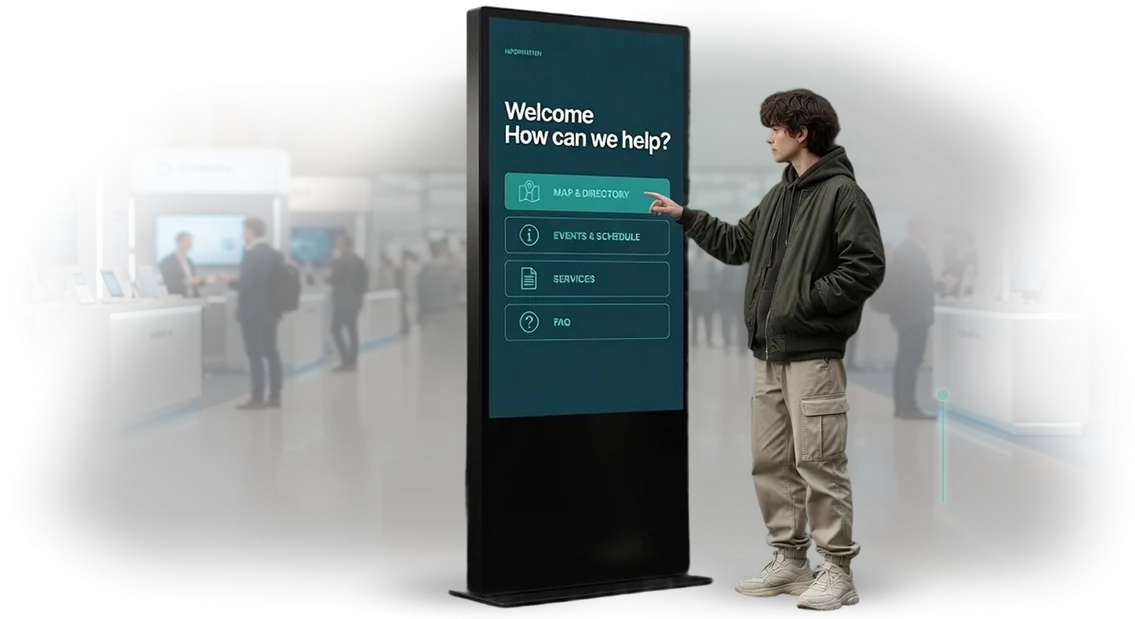
Production management simulations on a kiosk: why it sells
At an exhibition, a client approaches the booth not for a brochure—they want to understand in three minutes that the product solves their problem.
A standard catalog and videos require taking the product at face value, while an interactive kiosk with a production management simulation gives them the chance to try it: change parameters, see the result, and feel the process from the inside.
This fundamentally changes the conversation. The visitor stops being a spectator and becomes a participant in the demonstration. They ask questions as the scenario progresses, and your manager does not deliver a presentation but moderates genuine interest.
As a result, the kiosk works not as booth decoration but as a sales tool: it attracts attention, holds it, and leads to a conversation about an order.
For the client, this means more targeted contacts per exhibition day and less effort on "cold" attraction. The simulation itself creates a reason to approach, and after the interaction—a reason to exchange contacts and schedule a meeting.
We build such solutions from scratch: we design the scenario for your audience, assemble the production model, configure the interaction logic, and integrate the kiosk into the booth so that it runs smoothly throughout the event.
In the end, you get not a "booth with a screen" but a manageable communication channel that pays off with new leads and repeated showcases at other exhibitions.
What a production simulation on a kiosk gives: benefits for business
At an exhibition or in a showroom, it is difficult to show the entire real production process: equipment is bulky, and the process is hidden from view.
A production management simulation on an interactive kiosk solves this problem—it turns a complex product into a clear story that a guest understands in a couple of minutes.
With this approach, you get not just a booth but a visitor magnet. Here is what a production simulation gives a business:
- Genuine visitor interest. A queue forms at the kiosk: people approach on their own, launch scenarios, and experiment. A guest spends several minutes at the screen—many times longer than at a regular poster or video.
- A clear product story. Instead of abstract slides, an interactive demonstration shows how raw materials turn into a product, how parameters change, and what happens during failures. This works better than any explanation.
- More inquiries. After interacting with the simulation, visitors ask specific questions and leave their contacts. Our clients note that the number of requests from such a booth is noticeably higher than with a standard presentation.
- Attracting customers via social media. A kiosk with a 3D simulation looks impressive; guests take photos and share them—the reach keeps working long after the event.
Such an interactive demonstration is especially effective at a trade show booth when you need to stand out among dozens of participants. our team has been developing such solutions for more than 10 years and knows how to make a simulation useful specifically for your business.
Formats for your task: from trade show booth to showroom
The same 3D production management simulator can be presented in different ways. The format determines how a visitor interacts with the product and what result the business gets: a quick demonstration at an exhibition, detailed exploration in a showroom, or staff training. We choose the kiosk design according to your task so that the investment brings measurable value.
Compare the main options—from a classic stand to an interactive table. For each format, the scenario, target audience, and contribution to business metrics are clear.
| Format | For whom | What it gives the business |
|---|---|---|
| Trade show kiosk | For exhibitions and forums | Quickly attracts attention, shows the product's value in 3–5 minutes, collects visitor contacts. |
| Showroom kiosk | For demonstration areas and meeting rooms | Introduces the client to scenarios without a manager's involvement, speeds up the purchase decision. |
| Interactive table | For teams and partners | Shows several parameters at once, convenient for discussions and training. |
| Training kiosk | For interns and staff | Builds skills without risk to equipment, speeds up reaching working results. |
We also develop non-standard structures—from panels built into the booth to mobile stands. Before launch, we approve the scenario, test it on a focus group, and deliver a complete package with an operating manual.
You get a tool that works on your business metrics from day one: reach, engagement, and speed of decision-making.
How the project goes: from brief to launch
When you order an interactive kiosk, it is important to understand how the work proceeds and what you get at each stage. We build the process transparently: we record agreements, show intermediate versions, and meet deadlines. The implementation process is divided into seven simple steps—from brief to launch and support.
-
Brief and task analysis. We dive into your task: who will use the kiosk, what simulation scenarios are needed, and where it will be installed. You receive a technical specification and a work scope estimate.
-
Project plan and estimate. We create a development stage schedule with precise project deadlines and milestones. You know in advance when intermediate results will be ready and what needs to be approved.
-
Prototype and approval. We build a working model of the production management simulation. You try the interface, evaluate scenarios, and approve the design before final development begins.
-
Development. Based on the approved prototype, we create a full-fledged application. You see the functionality grow and can make changes without missing deadlines.
-
Testing and tuning. We check scenarios on a real kiosk, ensuring stability and ease of use. You get a version that will not let you down on launch day.
-
Kiosk launch. We install the software, set up auto-start, and train your staff. The kiosk starts operating immediately after setup.
-
Support and evolution. We update content, add new scenarios, and monitor performance. You can develop the kiosk along with changes in your business.
What is included in the delivery: a package for your event
When you order a production management simulation for a kiosk, you get not just "software on a flash drive" but a ready-made turnkey solution. Everything—from the scenario to the staff instructions—is assembled into one package.
All you have to do is turn on the equipment and open the event. Below is the scope of delivery so you know in advance what you are paying for.
- Simulation scenario — a well-developed storyline with production tasks, roles, and goals. The participant understands what to do within the first seconds, and you get meaningful traffic at the booth.
- Interactive design — an interface in your company's corporate style. The screen looks like part of the brand, not an off-the-shelf third-party "booth".
- Ready-made kiosk application — a polished program that runs on professional equipment and does not freeze during the busiest moment of the event.
- Interactive hardware — a touchscreen kiosk or panel with the required screen size and mounting. You do not need to look for compatibility: everything is already tested and configured.
- Staff instructions — a short checklist in Russian: how to turn it on, how to restart it, what to answer visitors. No need to figure things out yourself or read technical manuals in another language.
- Launch support — our specialist is available during your first event or on the handover day. If something goes wrong, we will solve it within an hour, not "come next week".
- Scenario updates — after the pilot launch, we adjust the mechanics for free if we see that visitors get stuck at some stage or, on the contrary, go through it too quickly.
The entire package is handed over with an acceptance certificate: you receive the application, the scenario rights, and the equipment settings. No hidden rentals or monthly payments—only what you need for your event.
If you plan to use the simulation at multiple venues, we can discuss a package for replication: the scenario and interface remain the same, while the equipment may differ.
Case study: how a kiosk helped a plant showcase its product
Let us tell the story of a large manufacturer of industrial equipment. At the exhibition, its booth looked solid, but visitors walked past: a complex product cannot be shown on posters and models.
Even interested guests did not stay longer than a couple of minutes, and managers had no time for a proper conversation.
We offered the plant an interactive kiosk with a production line management simulation. Instead of a static picture, the visitor launched the process themselves, changed parameters, and saw the result in real time. This turned the booth into a place where people wanted to stay and experiment.
We measured the results directly at the event. The average time at the booth grew from 2 to 7 minutes—guests were not just watching but participating.
The number of targeted manager contacts tripled: there were real conversations about customer needs instead of business card exchanges.
The kiosk took the load off the salespeople—the scenario handled the first questions, and specialists stepped in when the visitor was already interested.
After the exhibition, the client ordered a second version of the kiosk for its demonstration center. Now the simulation runs all year round and is used for customer training and presentations at negotiations. In this way, a single kiosk became a permanent sales tool rather than a one-time booth decoration.
How to choose the right kiosk format for your task?
There is no one-size-fits-all kiosk—the right format always comes from a specific task.
A production management simulation at an exhibition, onboarding new employees, or an interactive visitor zone in a lobby are solved with different configurations: sometimes a large screen and a sturdy stand matter more, sometimes compactness and mobility.
That is why choosing a format starts not with a catalog but with questions: who will be the user, what goal the kiosk should achieve, where it will be placed, and what budget the project has.
The goal determines what matters most. If you want to tell guests about your production and impress them with a vivid simulation, you need a large touchscreen that attracts attention from a distance.
If the task is to train employees in safe actions on the line, a kiosk with a private zone and the ability to repeat the scenario several times will be more convenient.
For career guidance for school and university students, a format with game elements and simple controls is suitable, so that even those who have never seen such equipment can engage.
The location also has its own requirements. In a high-traffic walkway area, the kiosk must be compact, with a quick start and protection against accidental touches. For a separate demonstration hall, you can afford a larger structure and longer scenarios.
It is important to consider lighting, access to power outlets, and free space in front of the screen in advance—this will save time during installation and launch.
The budget does not limit the choice but structures it. We offer options from basic touchscreen stands to full multimedia complexes, and we can always select a format for your tasks without overpaying for unnecessary features.
At the consultation stage, we analyze your situation: the audience, usage scenarios, installation location, and expected result.
Send us a description of your task—together we will determine the optimal kiosk format and prepare a solution that will work for your benefit from day one.
Frequently asked questions about implementing kiosks
Implementing kiosks raises questions—from reliability to who will maintain them. We answer these questions every day, so we have collected the main concerns of our clients and addressed them briefly. Our team has implemented dozens of such projects and knows what matters in practice.
How reliable is the kiosk and what about the warranty?
We use industrial components and well-tuned software, so the kiosk operates without failures under daily load. We provide an official warranty on the equipment and work—if something breaks, we will replace or repair it at our expense.
How long does the launch take?
We launch a typical project in 3–4 weeks: we approve the scenario, prepare the housing, configure the program, and test it at your site. You do not need to hire contractors—we handle all stages turnkey. If necessary, we can speed up the launch by using ready-made solutions.
Who maintains the kiosk after installation?
We handle regular maintenance: we take care of updates, cleaning, and preventive service. You get a working kiosk without any worries—just let us know about planned content changes, and we will prepare everything.
What if the kiosk breaks?
Just leave a request—our support team will come on site or connect remotely. The average response time is one business day, and we solve most issues without stopping the kiosk.
So a kiosk is not a cause for concern but a working tool that pays off. If you still have questions, ask us directly, and we will explain what it looks like in your project.Leave a request for an interactive kiosk—let's discuss your task
To order a kiosk with a production management simulation and get an accurate cost calculation, you do not need to write a technical specification or understand complex terms.
Just describe the task in simple words: where the kiosk will be located, who will use it, and what you want to show to visitors or employees. We will convert this into a work plan, a cost estimate, and a realistic launch timeline.
After your request, you will receive:
- Cost calculation for your task — we will fix the budget and timeline before the work starts to avoid price changes during the process.
- Consultation with an engineer and designer — we will help you understand how the simulation will fit into your space and which scenario will have the maximum effect.
- A step-by-step implementation plan — scenario, development, installation, configuration, and testing; you will always know where the project stands.
- Examples of similar projects — we will show real cases where an interactive kiosk increased visitor engagement and simplified the demonstration of production processes.
- A dedicated manager — a single contact person for the entire project who gathers requirements, coordinates the team, and answers your questions without delays.
- A commercial proposal in a convenient format — with the scope of work, benefits, and timelines, so you can approve it inside your company.
Ordering a kiosk from our team means getting not just a device but a tool for vividly demonstrating your production and increasing brand awareness. Leave your request: within one business day, we will contact you, clarify the details, and prepare a plan.
If you need the kiosk for a specific event, let us know right away—we will offer an accelerated schedule without compromising quality.