

Why You're Losing Customers Without 3D Product Visualization
A buyer makes a decision in a matter of seconds, but if the product is complex, large-format, or requires explanation — a regular photo and a short description don't let them grasp what it really is.
The visitor can't assess the scale, the details, or the available options, and they leave without purchasing simply because they never truly saw the product. As a result, audience interest fades before the first consultation even happens.
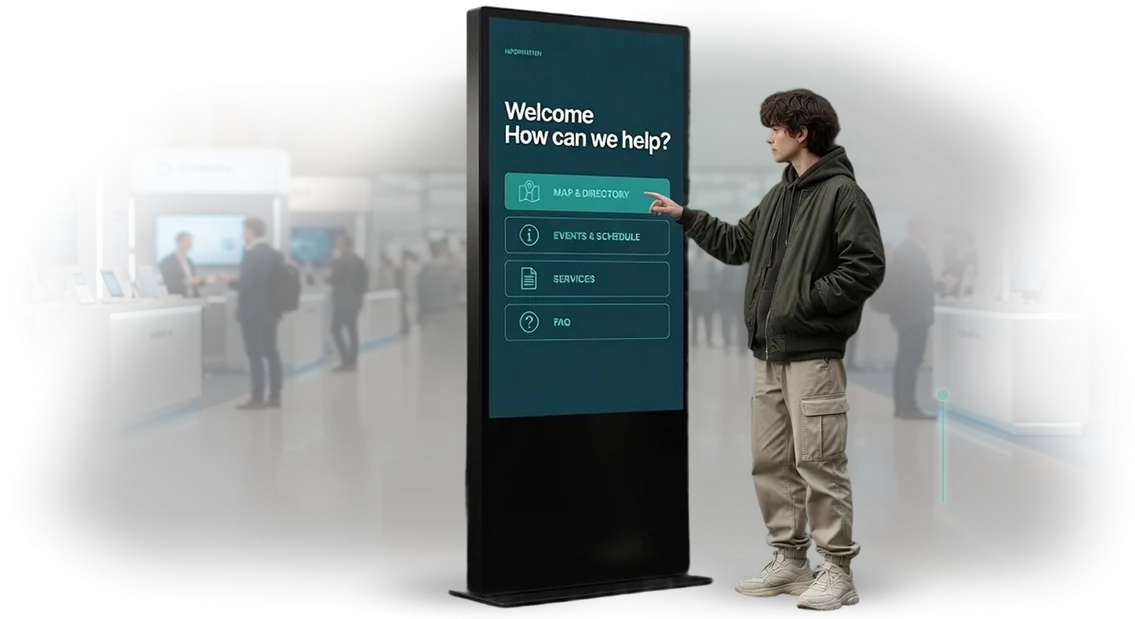
That's why showrooms, exhibition areas, and retail locations are increasingly using interactive kiosks with 3D product visualization.
Instead of a static display, the visitor gets the chance to rotate the object themselves, zoom in on individual elements, change colors, or view the product in cross-section.
The product presentation becomes visual and tangible, and the visitor engages with it without needing a sales assistant.
3D product visualization solves the core challenge — it holds attention. A person who is actively rotating and examining a product spends minutes at the kiosk, not seconds.
In that time, they genuinely get interested, ask specific questions, and feel that the product is right for them. This turns a casual passerby into an engaged potential customer.
We build interactive kiosks specifically for these scenarios: clear 3D product visualization, simple and intuitive presentation, and results in the form of growing audience interest and sales.
You get a tool that sells your product on its own — without boring lectures and unnecessary technical complexity.
How an Interactive Kiosk Boosts Sales and Brand Recall
An interactive kiosk with 3D product visualization turns an ordinary point of contact into a center of attraction.
Instead of a static stand or brochure, the visitor gets a living experience: they rotate the product themselves, zoom in on details, and change colors and configurations.
This holds attention far longer than traditional materials — which means your brand gets the time to deliver its key message to every guest.
The direct benefit is higher conversion. When a customer sees the product in detail and can "feel" it visually, they make a purchase decision faster.
The kiosk works like a virtual consultant: it guides, demonstrates advantages, and leads the visitor to action — leaving contact details, submitting a request, or visiting the website.
In practice, this means more leads from every exhibition, event, or retail location without expanding your sales team.
Brand recognition matters just as much. An interactive presentation is memorable: guests take photos, share impressions on social media, and discuss what they saw with colleagues.
This kind of word-of-mouth amplifies the effect of your event and keeps working long after it's over. The kiosk becomes more than a tool — it becomes part of the brand experience, increasing loyalty and the likelihood of repeat engagement.
An additional bonus is the ability to collect data on visitor preferences: which models were viewed most often, how much time was spent at the screen, which options were selected.
This information helps you refine your product and marketing campaigns with precision, so every subsequent interaction becomes more effective. For a manager, this is a tangible argument in favor of the solution's return on investment.
In short, an interactive kiosk solves three business tasks at once: it attracts and holds visitors' attention, increases conversion into leads and purchases, and strengthens the brand's position in customers' memory.
It's a tool that pays for itself through higher sales and long-term recognition — which is why it fits exhibitions, showrooms, and retail locations alike.
Formats of 3D Product Visualization for an Interactive Kiosk
For a business, the goal isn't just to "show the product" but to guide the visitor toward a decision: spark interest, explain the value, and handle objections.
3D visualization in an interactive kiosk accomplishes this through different presentation formats — from display-style showcasing to detailed product breakdowns.
Here's a comparison of the main formats we use in presentation kiosks and touch panels:
| 3D Visualization Format | Business Tasks It Solves | What It Gives the Customer |
|---|---|---|
| 3D Showcase | Presenting a new product at an exhibition or in a sales floor | Attracts attention, creates a "wow" effect, and increases time spent at the stand |
| Detailing / Cross-section | Explaining a complex product: appliances, furniture, equipment | The visitor explores the internal structure on their own, so fewer questions for the consultant |
| Virtual Unveiling | Product launches, premieres, special events | Creates an event and a reason for photos and videos, amplifying social media reach |
| Configurator | Choosing colors, configurations, and options | The visitor builds their own version, increasing engagement and purchase readiness |
All formats run on a touch panel: large buttons, fast response, and understandable even without instructions. The choice depends on your goal. Need an impressive product reveal? Go with the showcase. Need to explain a complex product? Choose detailing.
Launching something people will talk about? The virtual unveiling is for you. We'll select the format and scenario to fit your product.
How an Interactive Kiosk Is Developed: From Brief to Launch
Developing a kiosk for 3D product visualization isn't about buying off-the-shelf equipment — it's a joint project. We structured the process so you understand every stage and can influence the outcome, rather than watching from the sidelines until the end.
-
Brief and objectives. We start with a conversation: who your audience is, what task the kiosk should solve — 3D product presentation, navigation, catalog. We lock in the goals, timeline, and success criteria so everyone is aligned on the expected result.
-
Plan and approval. We prepare a work plan, team composition, and schedule. You approve it — we begin. No hidden stages appear along the way: everything we do is agreed upon in advance.
-
Design and scenarios. We create an interface prototype and the logic for visitor interaction. You see the mockup, try the scenario, and make edits before development starts. This saves time and money.
-
Development and assembly. We build the interactive application and configure the enclosure and screen. Intermediate versions are shown in action, not in a presentation — so you always know what you're getting.
-
Testing and launch. We test the kiosk with real scenarios, train your team, and help with installation. We launch without stress or downtime for your business.
-
Support and evolution. We stay close after launch: updating content, refining scenarios, and monitoring stability. A new task comes up? We handle it quickly and clearly.
In the end, you get not "hardware with a screen" but a tool that helps visitors discover your product and helps you achieve your business goals. Transparent stages, clear approvals, and an on-time launch.
What's Included in the Interactive Kiosk Delivery for Your Task
You receive a turnkey interactive kiosk — with equipment, preloaded software, and configured operating logic.
That means after installation, you don't need to assemble the solution from different contractors or dig into the technical side: everything works right away, and your team already knows how to use the system.
Here's the complete delivery package.
- Interactive kiosk — enclosure, touch screen, computer module, and payment terminals. Everything is assembled, connected, and tested at the factory.
- Preloaded application — the 3D product visualization software is installed, configured for your visitors' scenarios, and ready to go.
- Content management panel — a simple tool for updating 3D models, images, descriptions, and promotions. Updates take minutes and don't require a programmer.
- Full documentation — operating instructions, operator's manual, maintenance schedule, and checklists for pre-shift verification.
- Staff training — a hands-on session for your employees: how to greet visitors, how to quickly restore the screen, how to change content, and how to handle common situations.
- Warranty and support — an official warranty on hardware and software, remote kiosk health monitoring, and a technical support hotline.
- Installation and commissioning — an engineer visit, on-site setup at your location, verification of all scenarios, and signing of the acceptance certificate.
With this approach, you get a single point of responsibility for the project: we're accountable for the hardware, the 3D visualization, and the staff training. You don't need to coordinate multiple vendors — just tell us the task, and we handle the entire implementation cycle.
Case Study: Interactive Kiosk in a Showroom Doubles Sales
A telling example is a project for the Mebel-Lux furniture showroom. Customers came in but couldn't picture how a sofa or kitchen would look in their apartment: consultations took 40 minutes, and some visitors left without buying anything.
The problem wasn't the assortment — it was the presentation method. Regular catalogs and fabric swatches didn't provide a complete picture.
We installed an interactive kiosk with 3D product visualization. Visitors could choose a model themselves, change colors, materials, and textures, rotate the product to the right angle, and view it up close — as if in a real interior.
This eliminated the main objection, "how will this look in my home?" and shortened the decision cycle from several days to a single visit.
What Changed in the Numbers
In the first three months of the kiosk's operation, overall sales doubled, and the average ticket increased by 40%.
The items featured in the 3D selection process grew even faster — customers were more willing to buy products that previously "didn't move" in a conventional display.
What's especially valuable is that the effect proved sustainable: six months later, we received a repeat order to expand the catalog and add new categories. The showroom manager notes that the kiosk became more than a point of sale — it became a customer education tool. Visitors now arrive knowing which product they need and make decisions faster.
How to Choose the Right Interactive Kiosk Format for Your Task
There's no such thing as the right format in isolation from the task — the same interactive kiosk can be turned into a 3D product showcase, an exhibition navigator, or a lead capture tool. The key is determining what action the visitor should take after interacting with the screen.
If your goal is to show a product that's hard to describe in words or impossible to bring to the venue, choose a demonstration format with 3D product visualization. On the touch screen, the customer rotates the model, zooms in on details, and changes colors and configurations.
This approach works well for large-format products, engineering developments, and new items that don't even exist in physical form yet.
If it's navigation or information, the priority shifts to maps, catalogs, and search. You don't need heavy 3D graphics here — what matters is response speed and a clear structure.
For audience engagement, a game-style scenario works better: a quiz, a trivia game, or a virtual try-on.
Before choosing a format, answer this question: what should change in the visitor's behavior — remember the product, find the right booth, or leave their contact details? The screen size, interface scenario, and feature set all depend on this.
A one-off event calls for one type of kiosk; a permanent exhibition calls for another, with deeper 3D product visualization and integration with your customer database.
We help you decide at the brief stage: we analyze your product, venue, and audience, and propose a format that delivers measurable results. If you're unsure, just describe the task — we'll take care of the rest.
Frequently Asked Questions About Interactive Kiosk Development
Interactive kiosk development seems straightforward until you get to the details: timelines, embedded systems, and warranties. We've gathered the questions most often asked before a project starts and answered them concisely — so you can quickly tell whether this format fits you.
How long does kiosk development take?
Typically two to eight weeks — the timeline depends on scenario complexity, the number of 3D models, and any required integration with your systems. We lock the plan and milestones into the contract, so you know the launch date in advance.
How is the project cost determined?
The cost is calculated after audit and depends on content volume, functionality, and equipment. We prepare a detailed estimate before we start — with no hidden fees or "surprise" add-ons along the way. You understand the budget at every stage and can adjust the scope as needed.
Will the kiosk fit into our existing infrastructure?
Yes, we plan for integration with databases, CRM, and other internal systems. The kiosk works as a standalone device or as part of your ecosystem — visitor data is routed wherever you need it, without disrupting current operations.
What warranties do you provide?
All work and equipment are covered by an official warranty, and we stay in touch after launch: updating content, adding features, and monitoring stability. You're never left alone with the device after the project is handed over.
What about maintenance and content updates?
You'll be able to update kiosk materials through a simple interface on your own. If you need help, we offer a service plan: equipment maintenance, software updates, and prompt support so the kiosk always runs without interruption.
These answers aren't generic phrases — they're the principles we apply to every project. If your question isn't on the list, just reach out — we'll discuss the details and propose a solution tailored to your task.Order Interactive Kiosk Development with 3D Visualization
Ordering an interactive kiosk with 3D visualization means getting a tool that holds visitors' attention on its own, explains your product's advantages, and helps customers decide to buy.
Developing such a kiosk addresses several goals at once: you stand out from competitors, reduce the load on your staff, and turn an ordinary product introduction into a vivid, hands-on experience.
We have worked with interactive kiosks for more than 10 years, so you get more than a mockup — you get a well-thought-out solution proven on real projects. You don't need to dive into technical details — we handle the entire cycle, from idea to launch and ongoing support.
What You Get After Ordering
- Scenario design tailored to your task — we map out how the visitor will interact with your product: rotating the model, exploring details, switching configurations.
- A finished interactive kiosk with 3D visualization that accurately reflects the appearance and specifications of your product — even complex items become clear without a single word.
- An intuitive interface — anyone from a child to a retiree can use it, with no training or instructions required.
- Launch at your location — we visit your site, install the equipment, configure it, and make sure everything runs smoothly.
- Training for your team — we show you how to operate the kiosk, change content, and handle typical situations.
- Post-launch support — we stay available: resolving issues promptly and refining the solution for new challenges as they arise.
Professional development on the proven Unity platform ensures smooth 3D graphics and reliable performance even under heavy use. You get a stable, production-ready result — not an experimental prototype.
How to Start Your Project
To order development, contact us in whatever way suits you best: give us a call, send a message, or submit a request on our website. We'll ask a few questions about your product and your goal, propose the optimal concept, and provide the timeline and cost.
We work under a contract, predictably and transparently: you see the stages, control the process, and get a guarantee on the result. Experience from dozens of projects lets us assess tasks accurately and never miss deadlines.
Don't put it off — start with a consultation today. Order an interactive kiosk with 3D visualization and get a tool that works for your business around the clock, attracts customers, and drives sales.