

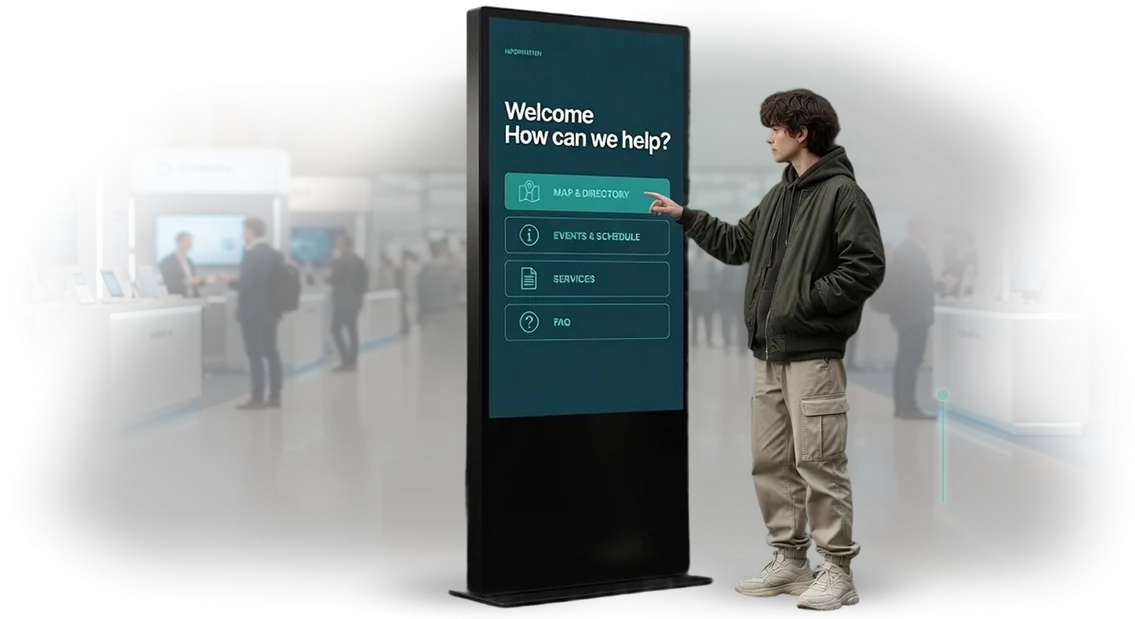
Customers Don’t Come Back Without a Product Configurator
In retail, a customer often gets lost among dozens of similar products. They can’t quickly understand how one option differs from another, waste time, and ultimately leave without buying or put off the decision.
Each such exit is not only lost revenue, but also the risk that the customer will never return to the store. When the choice becomes too complex, a person prefers to postpone it or switch to competitors.
The problem is especially noticeable where a product can be customized: color, size, configuration, additional options. Without a visual choice, the visitor relies on guesses and the advice of a sales assistant, which is slow and unreliable.
An interactive kiosk with a product configurator changes the situation: the customer selects the needed parameters themselves on screen and immediately sees the result. They don’t need to mentally assemble the product piece by piece — they see the finished solution.
This approach speeds up selection several times. The customer feels in control of the process, gets an accurate picture of the product, and hesitates less before buying. For a retail chain, this means more completed sales, fewer returns, and higher loyalty.
A person comes back because they know: it’s easy to find the right option here — and they tell their acquaintances about it.
We help address this need: we design and launch interactive kiosks with product configurators that fit into your store and solve the problem of choice for every visitor. This way your assortment stops being a problem and becomes a competitive advantage.
What an Interactive Kiosk with 3D Visualization Delivers
The customer decides to buy with their eyes, but an ordinary catalog doesn’t let them feel the product: shape, material, colors, scale.
An interactive kiosk with 3D visualization closes this gap — the customer examines the product from all sides, changes the configuration, and immediately sees the result.
This removes the main objection, “I don’t understand what it will look like,” and guides them toward a choice.
For business, this means higher sales: a customer who has “felt” the product in 3D reaches the checkout noticeably more often.
Customer engagement also grows — a session at the kiosk lasts several times longer than reading a brochure, which means the brand has more time to convey value and differences.
In addition, the interactive kiosk works like a silent showcase: it doesn’t get tired, doesn’t get distracted, and shows the product in the best light.
We build such kiosks on Unity — a professional platform for interactive 3D graphics. This allows us to quickly create realistic models, smoothly rotate the camera, and change options without delay.
The technology is proven on hundreds of projects, so the customer gets a predictable result: stable kiosk operation throughout the day and simple content updates when the assortment changes.
In the end, an interactive kiosk with 3D visualization is not an “screen with pictures” but a sales tool: it leads the customer to a choice, increases the average order value through additional options, and reduces consultant time.
If you want to increase conversion at your point of sale, this is a solution that pays off from the first weeks.
3D Interface Options for Your Kiosk, Tailored to Your Tasks
Not all 3D interfaces solve the same problem: a showcase, a product configurator, and navigation require different formats. If you choose the wrong one, visitors get lost, and an expensive kiosk turns into a lobby decoration.
The right format holds attention, reduces decision time, and guides the guest to the target action — a purchase, an application, or the right department.
Below are three typical scenarios customers come to us with. See which one matches your case: we’ll adapt the interface to your display, assortment, and guest behavior.
Three Formats for Different Business Tasks
| Format of kiosk | For which scenario | What it gives the customer |
|---|---|---|
| 3D product configurator | Selecting a product to match customer parameters | The guest builds the desired option themselves and examines it from any angle — less doubt, higher order conversion |
| 3D product catalog | Large assortment — hundreds of items on one screen | Fast search by categories and filters without staff involvement; consultants only handle complex questions |
| 3D object navigation | Shopping mall, museum, exhibition, business center | The visitor finds the needed department or exhibit in a minute, stays longer at the venue, and returns again |
Interfaces are built on Unity — a professional platform for 3D graphics — so the image remains smooth even on inexpensive kiosk hardware. The format scales from a single screen to a network of kiosks with a unified catalog. Show us your task — we’ll suggest the optimal option and give you the implementation timeline.
Stages of Developing a Product Configurator for a Kiosk
A clear process is half the success of a project. We agree in advance on the boundaries of stages, deadlines, and approval points, so you always understand what is happening with the product configurator.
This eliminates surprises and unnecessary iterations: you control every step rather than receiving the result “in one day.”
- Brief and problem definition. We dive into your assortment and customer scenarios: what they choose, which parameters matter, where questions arise. We agree on the configurator’s goals — increasing average order value, reducing staff load, or speeding up selection.
- Prototype and operating logic. We show a screen map and user behavior: category selection, parameters, color, configuration. You see the future structure before programming — edits at this stage cost nothing.
- Design and layout approval. We adapt your brand identity to the kiosk screen, develop large buttons and clear navigation. We lock the layouts after your approval — then development proceeds without guesswork.
- Application development. We build the interactive logic of the configurator: products, prices, images, options. Assortment changes are made through a convenient panel — you don’t need to rewrite code when the collection changes.
- Testing on a real scenario. We test the application on the kiosk: response speed, behavior during long operation, data updates. We also make sure the visitor can manage without a consultant.
- Launch and handover. We install the configurator, give your team brief training, and provide instructions. After launch, we stay in touch: support, refine scenarios, add functions as the business grows.
This order of work lets you get a product configurator that immediately solves the business task. You see the result at every stage and make decisions based on facts, not promises.
What’s Included in the Delivery of a 3D Application for a Kiosk
When ordering a 3D configurator for a kiosk, you receive a turnkey solution: from design mockup to employee training and support. No routine and technical worries — only a result that starts working immediately after installation.
The delivery includes:
- Design mockup of the interface — we show how the kiosk screen will look before development starts. You approve the visual part rather than getting a “pig in a poke.”
- 3D configurator application — a program where the visitor easily selects products, changes colors and materials, and sees the result on screen. The interface is intuitive — customers don’t need hints.
- Installation and setup on your kiosk — our specialists connect the application, check touch control and display. Everything works from day one.
- Automatic product loading — the catalog, prices, and characteristics sync with your database. Updates happen without a programmer — through a simple control panel.
- Staff training — a short workshop for your employees. They learn how to start the kiosk, change content, and answer visitors’ questions.
- User guide — a clear instruction manual for staff so any employee can quickly understand how the kiosk works.
- Technical support — after launch, we stay in touch: provide consultations, fix issues, help with refinements. You are never left alone with problems.
Thus, the package includes everything needed for the kiosk to work from day one. You get not just a program, but a full-fledged service that brings value to your business.
Example: How a 3D Kiosk Increased Retail Sales
For a retail chain selling large home appliances, the main pain point was long consultations: salespeople spent 20 minutes explaining the differences between models, and the customer left “to think it over.” We proposed replacing part of the consultations with a 3D kiosk featuring a product configurator — the customer assembles the needed configuration themselves and immediately sees the price and delivery times.
The project was launched in three stores of the TechnoMir chain. In two months, the average selection time dropped from 25 to 8 minutes, and conversion to purchase increased by 18%.
The number of repeat visits also grew: customers came back to check configurations — and picked up related products along the way.
Numbers That Matter for Business
- The average order value in the kiosk zone turned out to be 12% higher than with a regular consultation.
- The sales department stopped spending time on routine questions — the focus shifted to complex deals.
Today, the kiosk has become the main pre-sales preparation tool. The client expanded the project to all store locations and added an accessory selection module.
We continue to support the system: update the catalog, add new products, and make sure each release doesn’t affect stability.
This is how a 3D configurator solves the retail challenge: it speeds up selection, increases average order value, and brings customers back. If you want the same result — we’ll start with an audit of your locations and a quick prototype.
Answers to Common Questions About Kiosks
Before launching an interactive kiosk, a client usually asks the same questions: what makes up the price, how long development will take, and what you need to provide on your side.
We’ve collected answers to the most common questions — so you can see how we work before sending an inquiry.
What makes up the price of a kiosk with a product configurator?
The cost depends on three things: the complexity of the configurator logic, the need for integration with your catalog, and the design. We prepare a transparent cost estimate after a preliminary discussion — it shows exactly what you’re paying for. No hidden fees.
How long does it take to develop a kiosk?
A typical project takes two to four weeks. The timeline is affected by the number of products, access to the database, and the speed of layout approval. We set the delivery date in the contract and meet it.
What do you need from us as the client?
You just need to provide a list of products, describe the selection logic, and show examples of the desired styling. Prototyping, interface design, installation, and testing are our job. You only participate at approval points.
What about warranty and support after launch?
The application comes with a warranty. If you need to keep developing the kiosk — update products, change the design, or add screens — we provide ongoing maintenance so you don’t depend on outside contractors.
Order Your Kiosk Development and Be Ready for the Season
Seasonal sales don’t wait: if a kiosk with a configurator appears by the start of high demand, you’ll be able to catch the wave. An interactive kiosk helps visitors quickly select a product and place an order, while helping you increase the average order value and free up staff. We launch such projects in tight timeframes without sacrificing quality.
The average implementation time is 2 to 4 weeks depending on catalog complexity and functionality. We set the schedule immediately after the brief and stick to it at every stage, so you can plan the launch with confidence.
What the process includes and how long it takes:
- Request and brief — we get in touch within one business day, clarify tasks, and lock in deadlines.
- Prototype and logic approval — we show the kiosk structure and scenario before development starts.
- Configurator development — we build an interactive interface and connect your product catalog.
- Integration and testing — we check on real devices and fix any issues.
- Pre-season launch — we install the kiosk, train staff, and provide support after launch.
Such a schedule is achievable thanks to a proven process and experience with tight deadlines. If you need it faster, we’ll discuss it separately — some stages can be compressed without losing results.
Leave a request for a product configurator: we’ll send a preliminary plan and exact timelines for your task. The sooner we start, the smoother your pre-season preparation will be.
How to Choose the Right Kiosk Format for Your Task?
The format of a kiosk is not a matter of design, but a matter of how your business task will be solved at the real point of customer contact.
There is no universal option: the same application can be deployed on a floor-standing kiosk, a wall-mounted screen, or a touch table, but the result will be different depending on the location and visitor behavior.
If the main goal is to introduce the client to a wide assortment and let them assemble a product on their own, the best choice is often a vertical touchscreen kiosk with a 3D configurator.
The visitor sees the screen at eye level, isn’t distracted by the surroundings, and in a short session moves from choosing parameters to visualizing the finished product.
This format works especially well in stores, showrooms, and exhibition areas where speed and self-service matter.
When you need to involve several people at once — for example, at an exhibition or in a showroom where a family or a group of colleagues stops nearby — an interactive table or a large-format panel is more effective.
This changes the scenario: people discuss options together, and the kiosk becomes a center of attraction and a reason to linger near your display, which means more time for engagement with the brand.
The decisive factor is not technical specifications, but the answers to three simple questions: where is the kiosk located, how much time does a person have, and what action should they take after the contact — look, compare, submit an inquiry, or simply remember you.
By answering them, you narrow the choice to one or two formats, and we’ll adapt the appearance, interface, and logic of the product configurator to them.
We select the format to fit your task, rather than forcing the task to fit the device.
Come with a description of your task — together we’ll determine which kiosk and in which location will deliver maximum benefit: increase brand awareness, reduce consultation time, or boost order conversion.